GDPR and Document Sharing: What Every EU Business Must Know

GDPR and Document Sharing: What Every EU Business Must Know
GDPR applies to document sharing whenever the documents you send contain personal data — which includes names, email addresses, financial information, employment details or any information that can identify a living individual. Every EU business that shares documents externally, whether with clients, investors, partners or regulators, must ensure that sharing is lawful, secure and auditable. Failing to meet these requirements exposes organisations to fines of up to 4% of global annual turnover or €20 million, whichever is higher.
Why Document Sharing Is a GDPR Risk Area
Document sharing is one of the highest-risk activities for GDPR compliance, yet it is often overlooked in data protection programmes. Most organisations focus their compliance efforts on databases, CRMs and marketing systems — but documents flowing between people carry some of the most sensitive personal data an organisation holds:
- Client contracts — names, contact details, financial terms
- Employee records — salaries, performance reviews, personal information
- Investor materials — cap tables, shareholder names, financial projections
- Healthcare or financial reports — special category data under GDPR Article 9
- Legal correspondence — details of disputes, investigations or regulatory matters
When these documents are shared as email attachments, uploaded to consumer cloud storage or sent via unsecured links, the organisation loses all control over how they are accessed, retained or redistributed. This creates material GDPR risk.
The GDPR Principles That Apply to Document Sharing
GDPR sets out seven principles in Article 5 that apply to all personal data processing, including document sharing:
1. Lawfulness, fairness and transparency You must have a lawful basis for sharing documents containing personal data. The most common bases are:
- Legitimate interests — where sharing is necessary for a genuine business purpose
- Contractual necessity — where sharing is required to fulfil a contract
- Legal obligation — where sharing is mandated by law
2. Purpose limitation Documents shared for one purpose cannot be repurposed. If you share a client contract for the purposes of billing, the recipient cannot use it for marketing.
3. Data minimisation Share only what is necessary. If a document contains personal data that is not relevant to the recipient's purpose, redact or remove it before sharing.
4. Accuracy Ensure documents shared reflect current, accurate information. Sharing outdated personnel records or superseded financial data can constitute a GDPR breach if it causes harm.
5. Storage limitation Determine how long shared documents will remain accessible. Revoke access to shared links once the legitimate purpose has been fulfilled.
6. Integrity and confidentiality This is the security principle. Documents containing personal data must be shared using appropriate technical measures — encryption, access controls and audit logs are all relevant here.
7. Accountability You must be able to demonstrate compliance. This requires an audit trail showing who shared what, with whom, when and under what controls.
GDPR Article 32: Technical Measures for Document Security
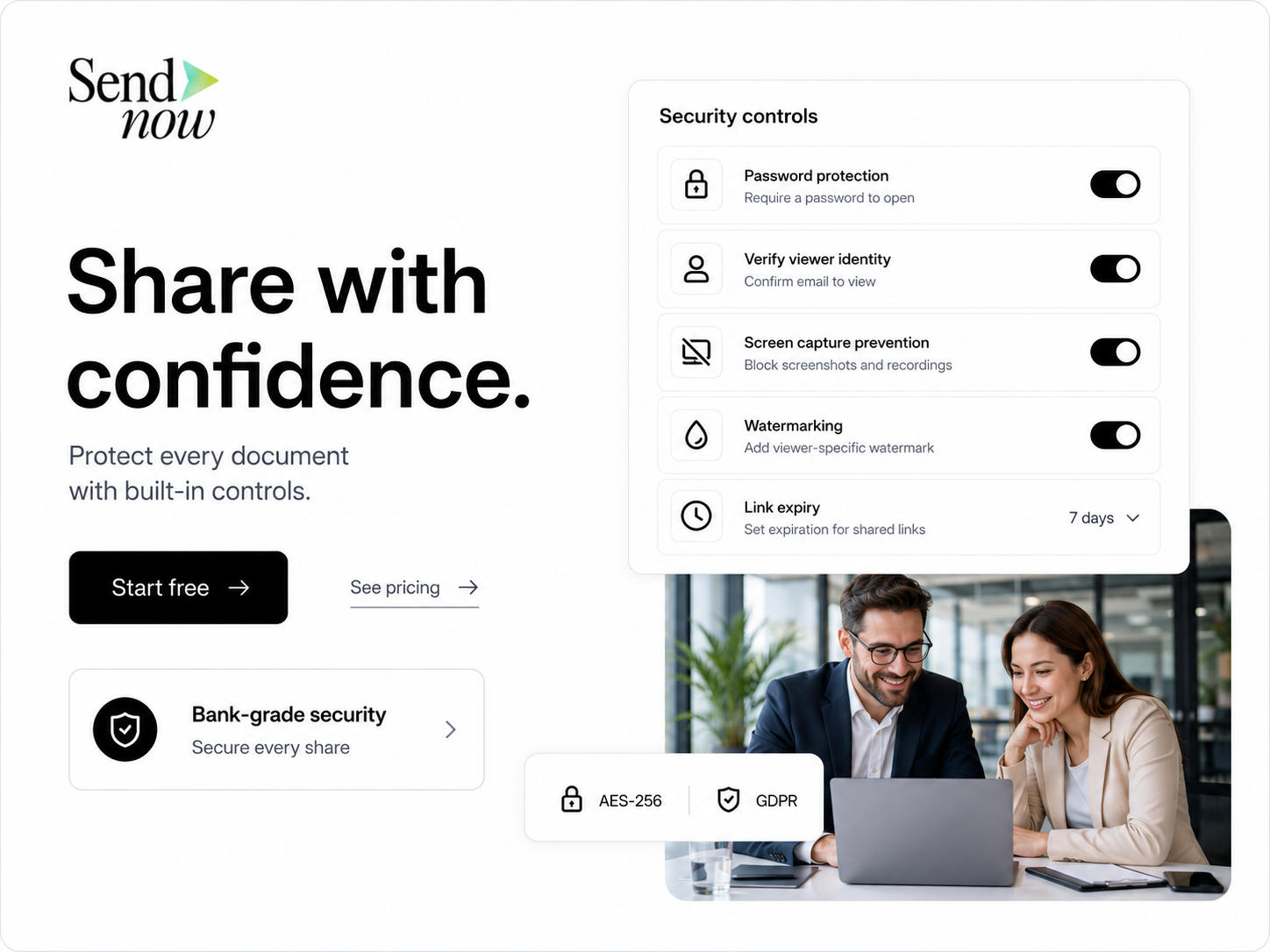
Article 32 of GDPR requires organisations to implement appropriate technical and organisational measures to ensure a level of security appropriate to the risk. For document sharing, this translates to:
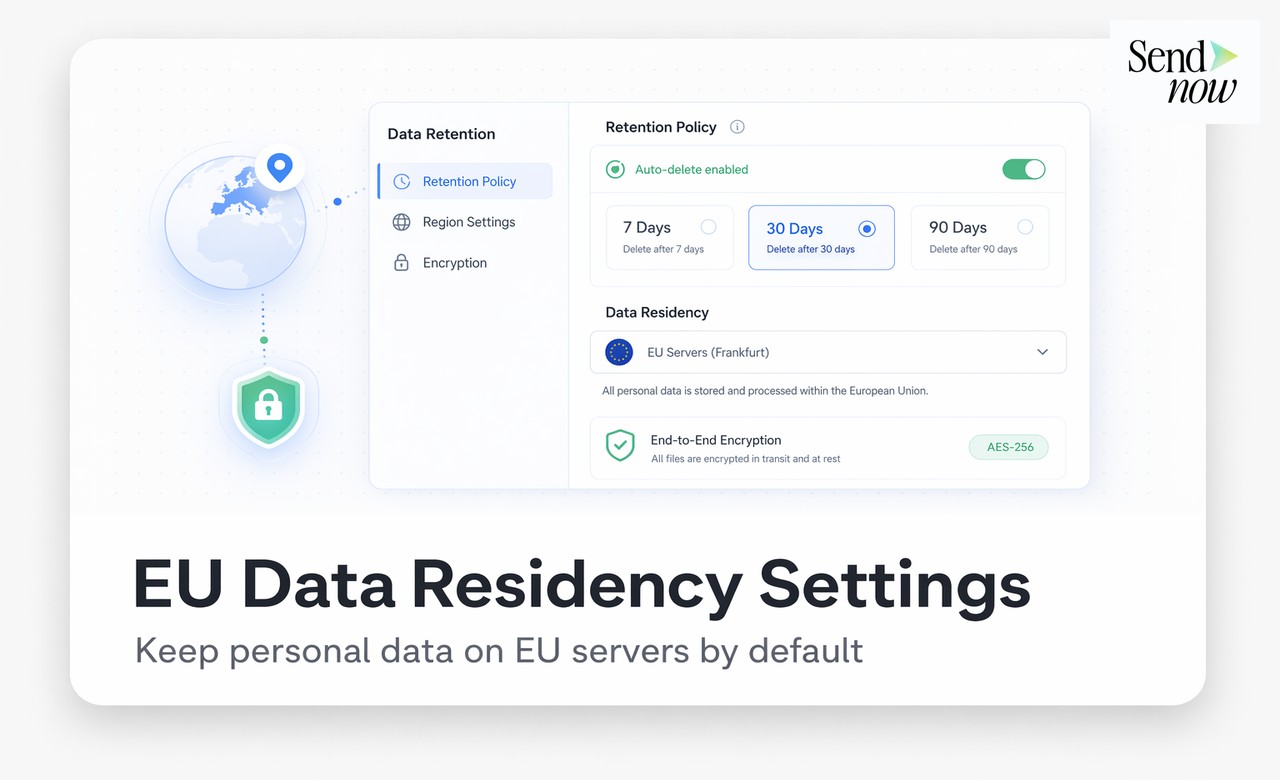
- Encryption in transit and at rest — AES-256 encryption is the accepted standard for documents containing personal data
- Access controls — only authorised individuals should be able to access shared documents
- Authentication — recipients should be verified before access is granted
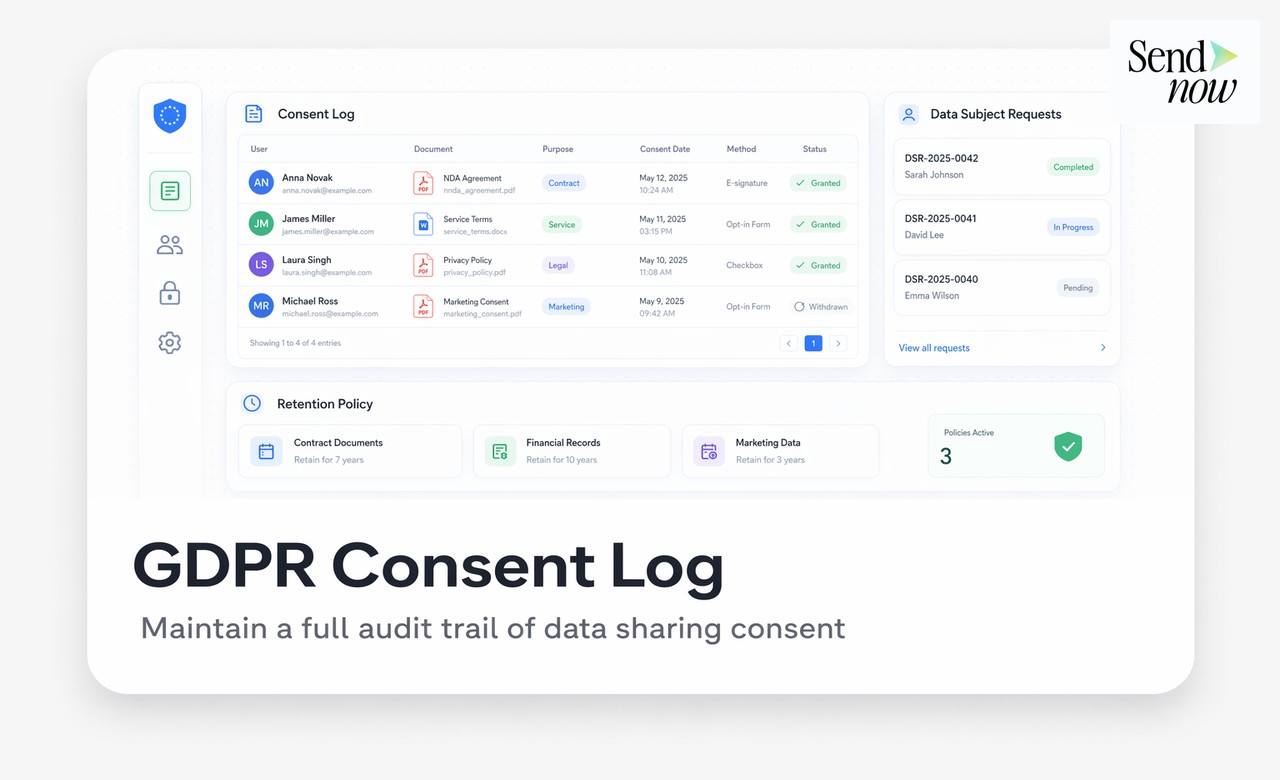
- Audit logging — a complete record of all access events must be maintained
- Breach notification capability — the ability to determine exactly which documents were accessed in the event of a security incident
Data Transfers Outside the EU
GDPR Chapter V restricts transfers of personal data outside the EU/EEA. Sharing a document with a recipient in the United States, the United Kingdom (post-Brexit) or any country without an adequacy decision requires an appropriate transfer mechanism, such as:
- Standard Contractual Clauses (SCCs) — the most commonly used mechanism
- Binding Corporate Rules — relevant for intra-group transfers within multinationals
- Adequacy decisions — for transfers to countries the European Commission has designated as providing adequate protection
If your document-sharing platform stores data on servers outside the EU, you may be in breach of Chapter V even if the documents themselves are shared only with EU recipients.
Best practice: Use a platform that stores all data exclusively on EU-based servers, eliminating Chapter V concerns entirely. SendNow operates exclusively on EU infrastructure, ensuring that no personal data crosses EU borders.
What an Audit Trail Looks Like in Practice
A GDPR-compliant audit trail for document sharing records:
- The identity of the person who created and sent the document link
- The identity of each recipient who accessed it (by email or authentication method)
- The timestamp of each access event
- The duration of each viewing session
- Any actions taken — downloads attempted, pages printed, links forwarded
- The date on which access was revoked
This audit trail must be tamper-proof and retained for a period consistent with your data retention policy. In the event of a regulatory inquiry or a data subject access request, you must be able to produce this log promptly.
Common GDPR Document Sharing Mistakes
Using email attachments for sensitive documents: Email provides no access control, no revocation capability and no audit trail. Any document sent as an attachment is outside your control the moment it is delivered.
Using consumer cloud storage for business documents: Platforms designed for consumer use typically store data in the US, have limited access controls and do not provide GDPR-grade audit trails.
Not setting expiry dates on shared links: A link that remains active indefinitely creates ongoing access risk. Set expiry dates that reflect the legitimate purpose of the sharing.
Sharing the same link with multiple recipients: A shared link cannot be selectively revoked and provides no per-recipient analytics. Always create individual links for each recipient.
Failing to document the lawful basis for sharing: If you cannot state, clearly and specifically, why you have a lawful basis for sharing a document, you should not share it.
How SendNow Addresses GDPR Document Sharing Requirements
SendNow is designed from the ground up for GDPR-compliant document sharing:
- AES-256 encryption in transit and at rest
- EU-only data centres — no personal data ever leaves the EU
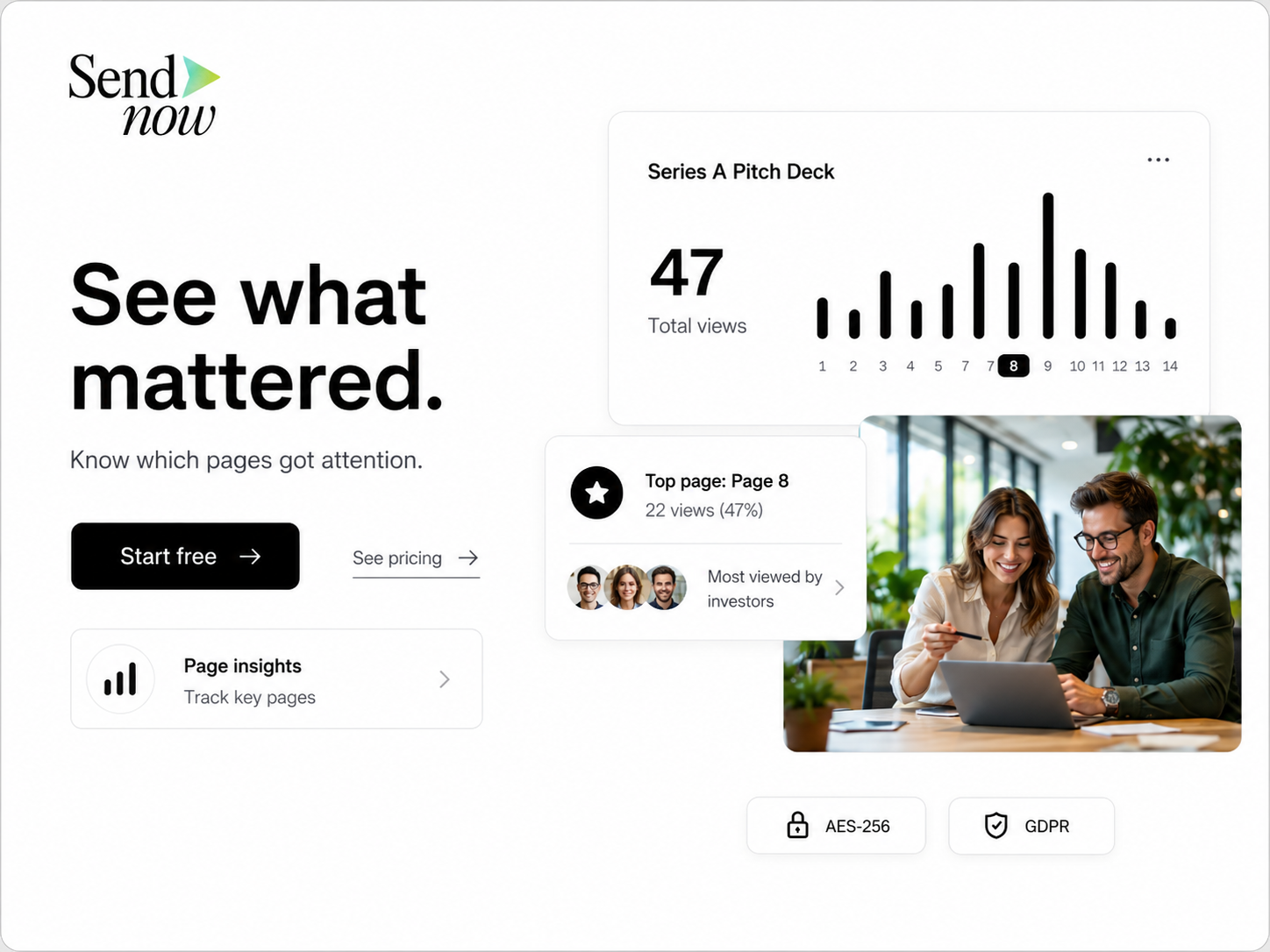
- Per-recipient access links with granular analytics
- Configurable download, print and screenshot controls
- Dynamic watermarking for leak traceability
- Full audit logs exportable for regulatory compliance
- NDA gating before sensitive documents are revealed
- Automatic link expiry based on your retention policy
- No third-party tracking — no analytics platforms outside the EU have access to your document data
GDPR Document Sharing: Compliance Summary Table
| GDPR Requirement | Email Attachment | Consumer Cloud | SendNow |
|---|---|---|---|
| Lawful basis documented | Possible | Possible | Possible |
| Encryption at rest (AES-256) | No | Partial | Yes |
| Access controls per recipient | No | Partial | Yes |
| EU data residency | No | No | Yes |
| Audit trail | No | Limited | Full |
| Revoke access | No | Yes | Yes |
| No third-party data exposure | No | No | Yes |
Frequently Asked Questions
Does GDPR apply to all documents shared by EU businesses? GDPR applies whenever the documents contain personal data — information that can identify a living individual. Documents that contain no personal data are not subject to GDPR, though they may be subject to other confidentiality obligations.
What is the lawful basis for sharing business documents with external parties? The most common basis is legitimate interests, where sharing is necessary to pursue a genuine business purpose that is proportionate to the privacy impact. Contractual necessity applies when sharing is required to fulfil a contract with the recipient.
Are email attachments GDPR compliant? Email attachments are not inherently non-compliant, but they lack the technical controls required by Article 32 for high-risk personal data. For sensitive documents, a secure link with access controls, encryption and audit logging is the appropriate method.
What counts as an adequate audit trail for GDPR purposes? An audit trail should record who accessed a document, when, for how long and from where, as well as any actions taken. It should be tamper-proof, retained for an appropriate period and producible on demand.
Do I need consent to share documents with investors? Not necessarily. Legitimate interests is typically the appropriate lawful basis for sharing business documents with investors during a fundraising process. Consent is rarely required for B2B document sharing.
What happens if a shared document is accessed by an unauthorised party? This is a personal data breach under GDPR Article 33. You must notify your supervisory authority within 72 hours if the breach is likely to result in a risk to individuals' rights and freedoms.
Can I use a US-based cloud storage platform to share documents with EU clients? Using a US-based platform for EU personal data requires appropriate safeguards under GDPR Chapter V, such as Standard Contractual Clauses. The simplest solution is to use an US-hosted platform that eliminates cross-border transfer risk entirely.
How long should I retain shared document access logs? Retention periods should be proportionate to the purpose. For contracts and legal documents, a minimum of six years is common in EU jurisdictions. For fundraising or commercial documents, align with your general data retention policy and document it.
About the Author: Rifana Hameem
Rifana is the founder of SendNow. She leads the team in building secure, compliant, and analytics-rich document sharing tools for finance and professional teams worldwide.
Connect on LinkedIn