How to Share a Pitch Deck With Investors: The Complete Guide

How to Share a Pitch Deck With Investors: The Complete Guide
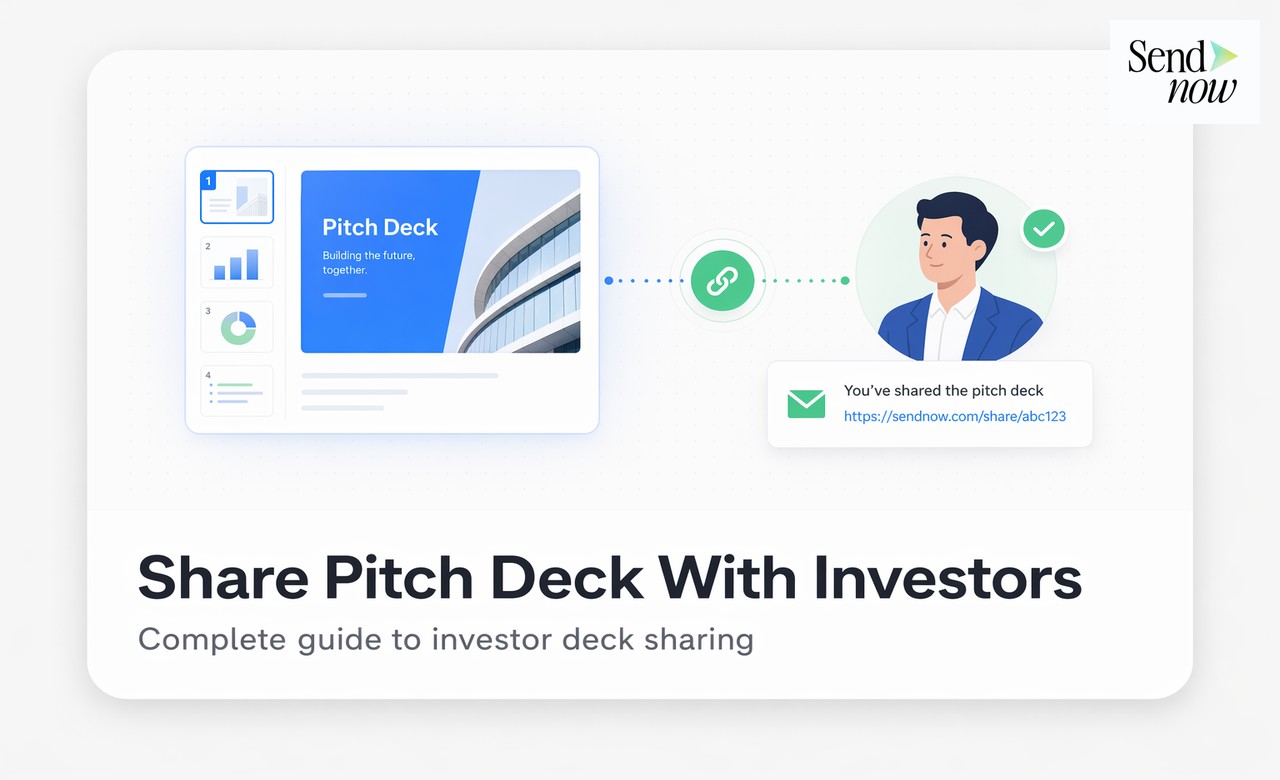
Sharing a pitch deck with investors requires more than attaching a PDF to an email. The most effective founders send their deck through a secure, trackable link that tells them exactly who opened it, which slides held attention, and when interest dropped off. This guide covers every step, from preparing your deck to acting on engagement data after it goes out.
Related Guides
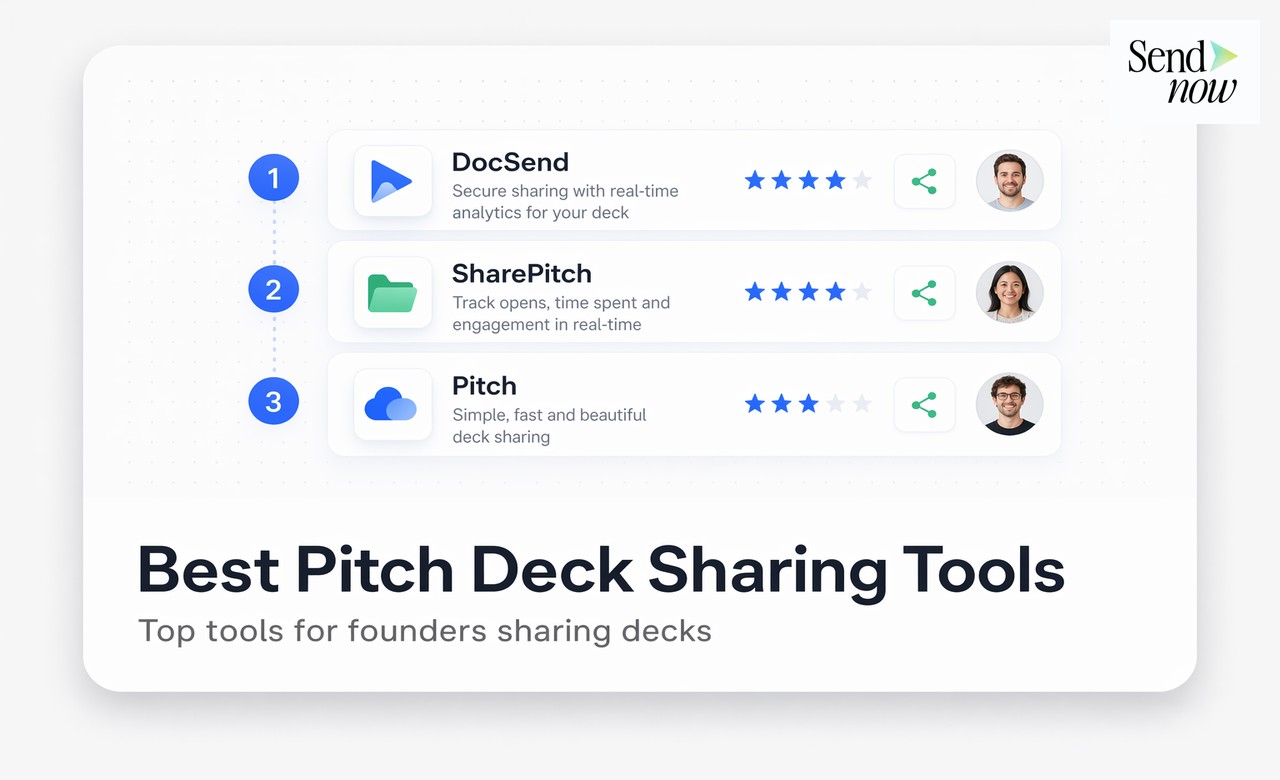
- Best Pitch Deck Sharing Tools
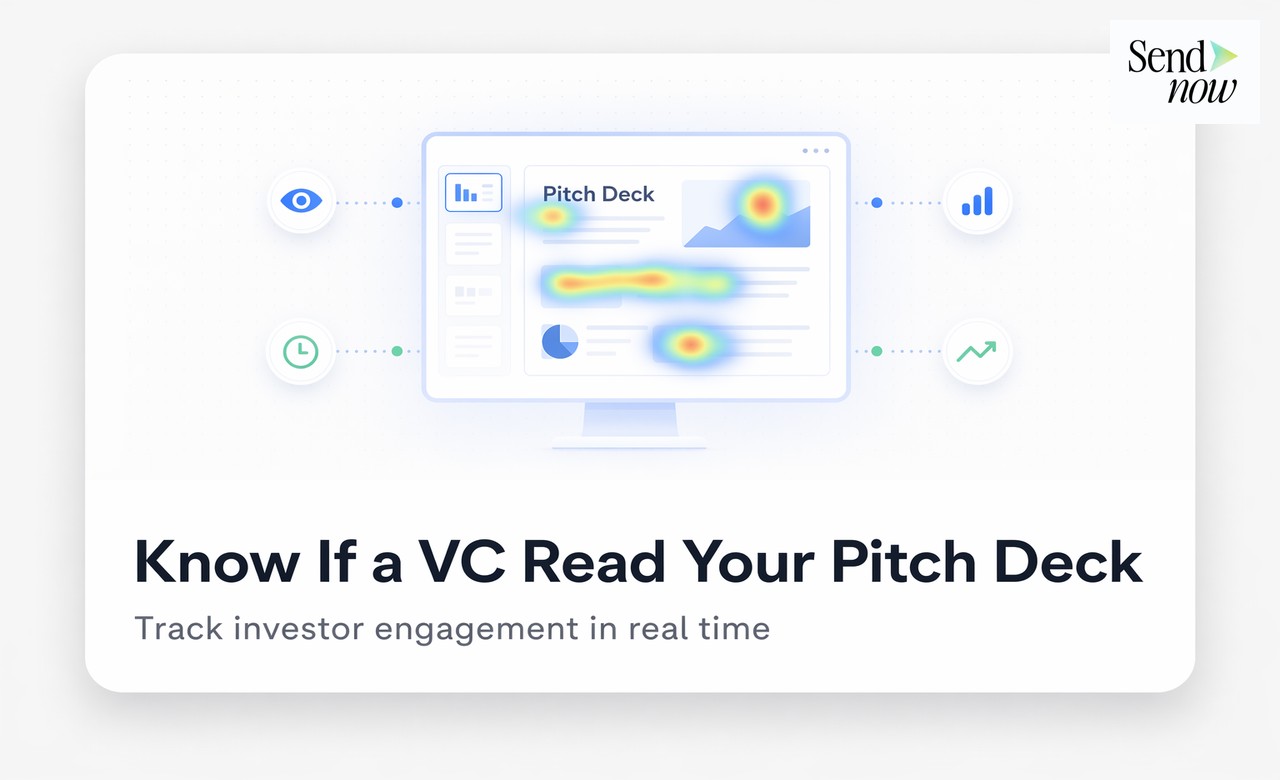
- How to Know If a VC Has Read Your Pitch Deck
- Pitch Deck Analytics & Tracking
- Share PowerPoint as a Link
Step 1: Prepare Your Pitch Deck for Investor Distribution
Format matters. PDF remains a widely used format when maximum static compatibility is your top priority. However, converting every presentation to PDF flattens the deck, stripping away embedded video, audio narration, and interactive elements. If your deck relies on rich media or product demos, you can share the original PowerPoint presentation as a link or share PPTX without converting to PDF. SendNow renders supported .pptx presentations directly in the browser with embedded media intact and per-slide engagement tracking.
File size matters. Large presentation files take time to load on mobile browsers. If sharing a PDF, compress high-resolution images to keep the file lightweight. If sharing a rich media PPTX through SendNow, decks up to 400MB can be viewed directly in the browser without requiring the investor to download the original file.
Version control matters. Label versions clearly (e.g., Deck_v3_April2026.pdf) and keep a record of which version you sent to each investor. If you update the deck mid-raise, you need to know who received the old version.
Remove sensitive data from early sends. If you are sending a cold or warm outreach deck, strip out detailed financial projections and cap table information. Save those slides for a second send after an initial meeting. This is also good practice for data minimisation under GDPR.
Step 2: Choose the Right Sharing Method
How you share the deck is as important as what is in it. The table below compares the main options.
| Method | Trackable | Secure | Access Control | Recommended For |
|---|---|---|---|---|
| Email attachment | No | No | No | Informal sends only |
| Google Drive link | Partial | No | Limited | Internal use only |
| Dropbox link | No | No | No | Not recommended |
| DocSend / Pitch.com | Yes | Partial | Yes | Common but expensive |
| SendNow secure link | Yes | Yes (AES-256) | Full | Recommended |
| Investor portal | Yes | Yes | Yes | Late-stage / formal |
Email attachments remain the most common method, but they are also the least useful. Once the file leaves your outbox, you have no visibility over whether it was opened, forwarded, or printed. That information is critical for prioritising follow-up.
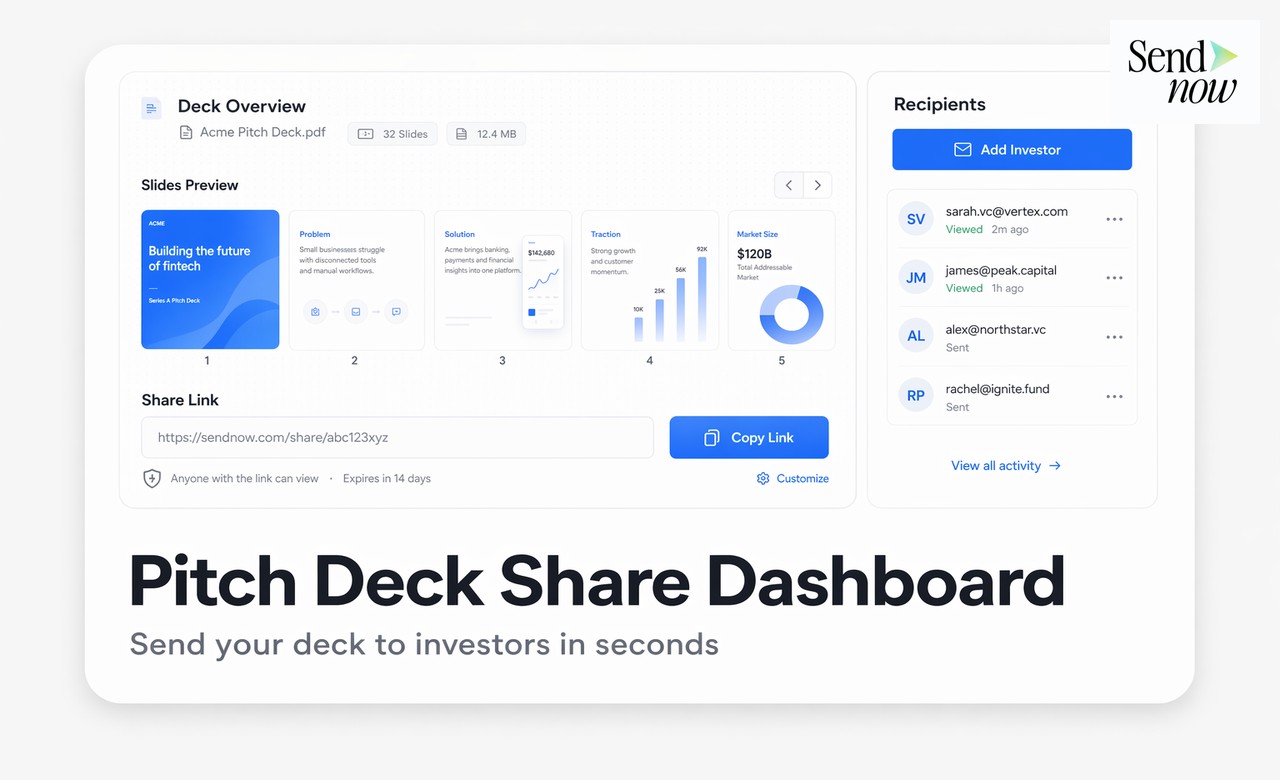
Platforms like SendNow generate a unique secure link for each investor. You see exactly when they opened it, how long they spent on each slide, and whether they forwarded it to a colleague. That data shapes every follow-up conversation.
Step 3: Protect Your Deck Before Sending
Intellectual property leaks happen during fundraising. Competitors, journalists, and industry contacts all circulate in the same investor networks. Treating your deck as confidential is not paranoia; it is standard practice.
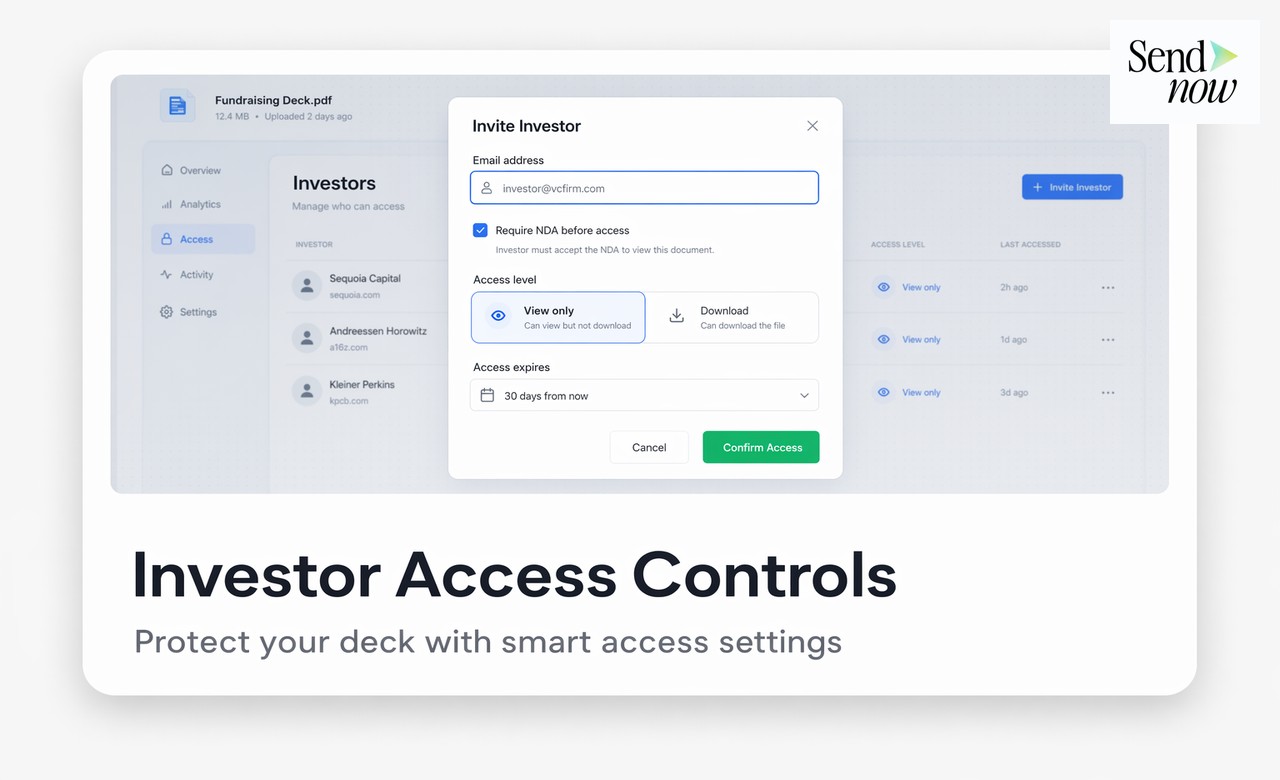
NDA gating requires each recipient to accept a non-disclosure agreement before they can view the deck. This creates a legal record of who has seen the information and on what terms. SendNow supports automatic NDA gating on any shared link.
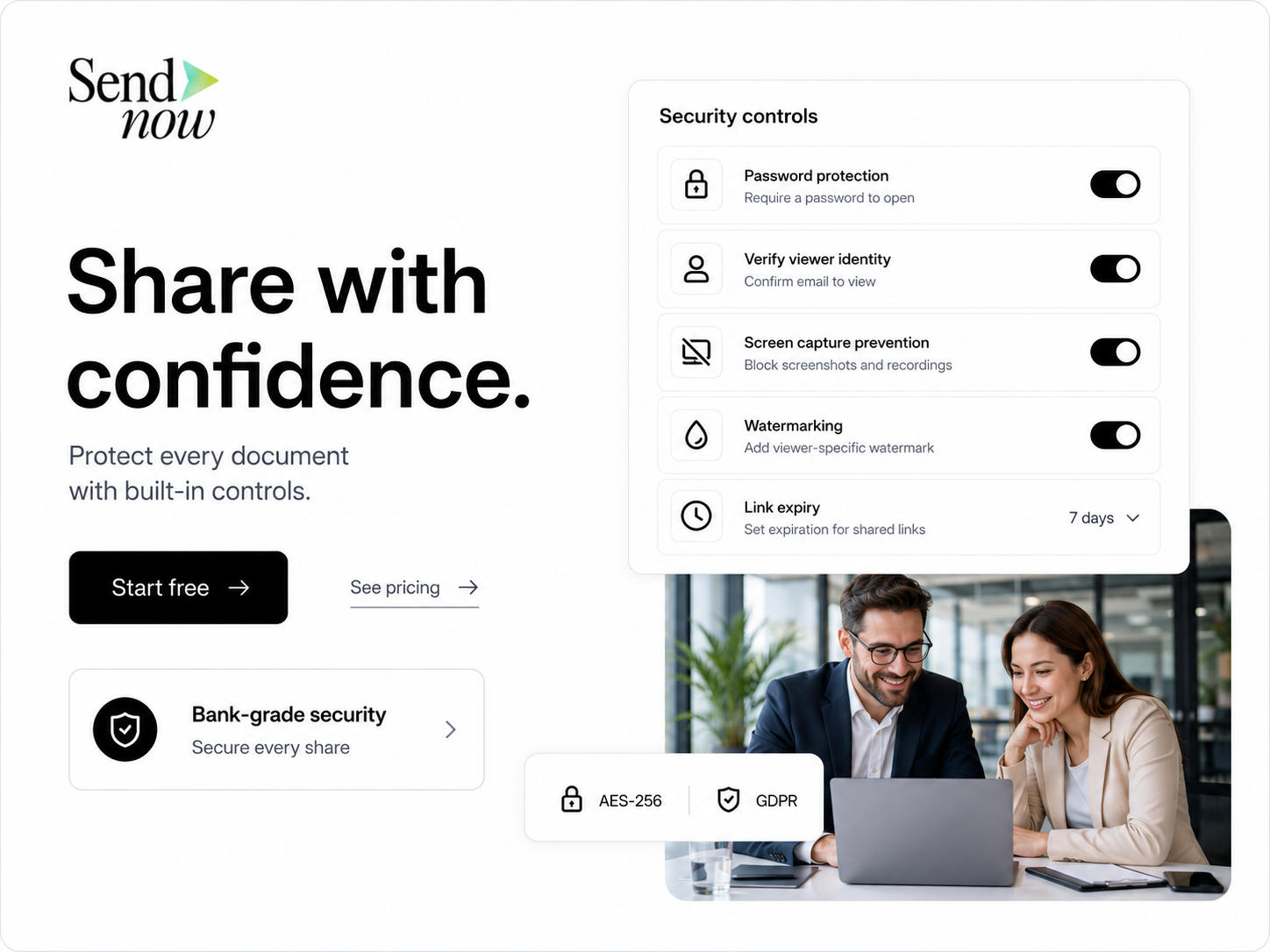
Dynamic watermarking adds the viewer's email address or name to every slide they see. If a page from your deck appears in a screenshot or a competitor's strategy document, you can trace it to the source.
Screenshot and print blocking goes one step further by disabling the ability to capture screen content when viewing through the platform. Combined with watermarking, this significantly reduces leak risk.
Access expiry lets you set a link to expire after a specific date or after a set number of views. If a round closes or you decide not to proceed with a particular investor, you can revoke access instantly.
For EU founders, all of the above must be handled through a GDPR-compliant platform with EU data residency. Sending investor data through a US-only platform without proper safeguards creates compliance exposure.
Step 4: Track Engagement Slide by Slide
This is where modern pitch deck sharing becomes genuinely powerful. Slide-level analytics tell you what your deck is actually communicating versus what you intended.
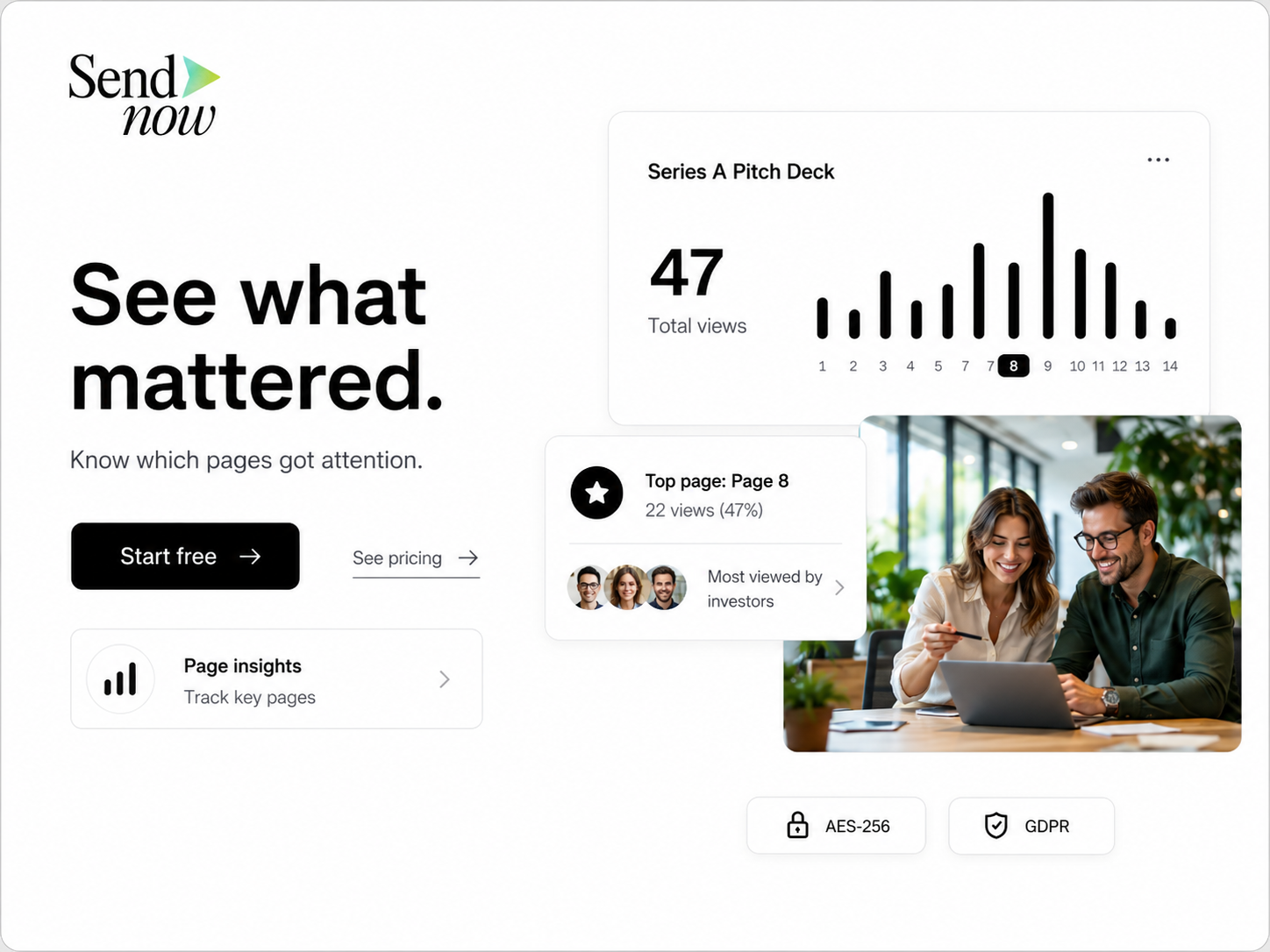
Time per slide is the single most useful metric. If investors spend 45 seconds on your market size slide and 4 seconds on your solution slide, that is a signal. Either the market slide is confusing and needs simplification, or the solution is not landing clearly.
Drop-off points show where investors stopped reading. If 80% of recipients never reach slide 8, everything after slide 7 is effectively invisible. This is useful information both for improving the deck and for prioritising what you cover in a meeting.
Return visits indicate serious interest. An investor who opens your deck three times over two days is engaged. One who opened it once for 20 seconds has moved on. This distinction should drive who you follow up with urgently.
Forwarding events tell you when your deck has been shared internally. If a partner-level investor forwards your deck to two colleagues, that is a strong signal of interest before any formal feedback has been given.
With SendNow, all of this data is available in a single dashboard, updated in real time.
Step 5: Set Up Per-Investor Access Controls
Every investor who receives your deck should get a unique link, not the same shared URL. There are several reasons for this.
First, it lets you track engagement per person rather than in aggregate. You want to know that Partner A at Fund X opened the deck, not that "someone at that IP address did."
Second, it lets you revoke access individually. If a conversation with a specific investor goes cold, you can expire their link without affecting others.
Third, it gives you a record of distribution that is useful both for your own process management and for demonstrating to later-stage investors or legal counsel that you managed confidentiality appropriately.
Most advanced sharing platforms allow you to create named links (e.g., "Link for Sarah Chen, Sequoia EU") which match engagement data to real contacts in your CRM.
Step 6: Integrate Deck Analytics With Your CRM
Engagement data is only useful if it informs action. The most disciplined founders connect their deck analytics to their investor CRM so that engagement events trigger follow-up tasks automatically.
A practical setup looks like this: when an investor opens your deck for the third time, your CRM creates a task to send a follow-up email within 24 hours. When a link expires without being opened, the investor moves to a lower-priority follow-up sequence.
SendNow integrates with HubSpot, Notion, and other CRM tools, so engagement data flows directly into your investor pipeline without manual data entry.
Step 7: Follow Up Based on Engagement Data
Most founders follow up on a fixed schedule regardless of what the data shows. Founders who use engagement data follow up at the right moment, with the right message.
High engagement (multiple opens, long time per slide): Follow up within 24 hours. Reference specific parts of the deck in your message ("I noticed you may have spent time on our unit economics section, happy to share a more detailed model if useful").
Partial engagement (opened once, read 4-5 slides): Follow up with a shorter, direct message. Ask if there is a specific concern or piece of information that would help. Do not assume rejection.
No engagement (link not opened after 72 hours): Try an alternative channel (LinkedIn, phone if appropriate). Consider whether the initial email subject line or context was compelling enough. Do not follow up more than twice on a cold deck send.
Forwarded deck: Follow up with the original contact and mention you would be happy to brief any colleagues who have seen the deck. This opens the door to meeting the wider partnership.
Common Mistakes When Sharing a Pitch Deck
- Sending the same link to everyone. You lose per-investor tracking and cannot revoke access individually.
- Using email attachments for sensitive decks. No tracking, no control, no protection.
- Sharing before the deck is ready. First impressions are difficult to undo. Send when the deck is complete and reviewed.
- Forgetting GDPR. Collecting names, emails, and behavioural data through a tracking platform requires a lawful basis and a privacy notice under GDPR Article 13. Use a compliant platform.
- Ignoring analytics. Tracking data has no value if you do not act on it. Review your dashboard before every follow-up.
- No expiry on old versions. Investors should only ever view the current version. Expire old links when you update the deck.
Start Sharing Your Pitch Deck the Right Way
SendNow is built for exactly this workflow. Create a secure, trackable link for your pitch deck in under two minutes, gate it with an NDA, add dynamic watermarks, and start seeing slide-by-slide engagement data from the moment the first investor opens it. No enterprise contract required.
Start your free trial at sendnow.live
Frequently Asked Questions
1. What is the best way to share a pitch deck with investors? The best method is a secure tracking link from a dedicated platform. This gives you per-investor analytics, access controls, and the ability to expire or revoke links. Email attachments offer none of these capabilities.
2. Should I send my pitch deck as a PDF or a link? A link is almost always preferable. It lets you track engagement, revoke access, update the underlying document without resending, and add security features like watermarking and NDA gating.
3. How do I know if an investor has read my pitch deck? Use a platform that generates unique, trackable links per recipient. You will see open events, time spent per slide, and return visits in a real-time dashboard. SendNow provides this for every shared link.
4. Should I use an NDA before sharing my pitch deck? For early-stage outreach, NDAs are typically not standard practice and many VCs refuse to sign them at first contact. However, for later-stage fundraising, detailed financial models, or proprietary technology, using an NDA gate is reasonable and professional.
5. How many slides should a pitch deck have? Most effective pitch decks contain 10-15 slides covering problem, solution, market size, product, business model, traction, team, and ask. Slide-level analytics from platforms like SendNow often reveal that investors rarely read beyond slide 12 in a cold send.
6. Is it safe to share a pitch deck via Google Drive? Google Drive offers basic sharing controls but lacks investor-grade features like NDA gating, dynamic watermarking, slide-level analytics, and screenshot blocking. It is not recommended for sensitive fundraising documents.
7. How do I protect my pitch deck from being forwarded? Dynamic watermarking, which adds the recipient's email address to each slide they view, is the most practical deterrent. Combined with screenshot blocking and access controls, it significantly reduces leak risk without preventing legitimate sharing.
8. Does sharing a pitch deck with investors affect GDPR compliance? Yes. If you are tracking investor behaviour through a link-sharing platform, you are processing personal data under GDPR. Ensure your platform provides GDPR compliance documentation and Data Processing Agreements (DPAs), provide a privacy notice, and ensure you have a lawful basis for processing. SendNow is GDPR-compliant with US-hosted infrastructure.
About the Author: Rifana Hameem
Rifana is the founder of SendNow. She leads the team in building secure, compliant, and analytics-rich document sharing tools for finance and professional teams worldwide.
Connect on LinkedIn