
AES-256 Encryption for Documents: What Financial Firms Need to Know
Published on April 24, 2026
AES-256 Encryption for Documents: What Financial Firms Need to Know
#TLDR: AES-256 is the global standard for symmetric encryption. It is used by governments, banks, and military organizations to protect classified and highly sensitive information. For financial firms sharing documents with clients and counterparties, it sets the technical floor for what "secure" means. This guide explains AES-256 in plain terms, why the 256-bit key size matters practically, what regulators require, and how to verify whether a document sharing platform actually implements it correctly.
Table of Contents
- What AES-256 Encryption Is (in Plain English)
- Why 256-Bit vs 128-Bit Matters Practically
- AES-256 in Document Sharing: In Transit and At Rest
- Financial Regulatory Requirements for Encryption (EU, UK FCA, SEC)
- What to Verify When Evaluating a Document Platform
- How SendNow Implements AES-256 Across Its Full Stack
- Comparison: Encryption Standards by Use Case
- FAQs
What AES-256 Encryption Is (in Plain English) {#what-is-aes256}
AES stands for Advanced Encryption Standard. It is a symmetric encryption algorithm, meaning the same key is used to encrypt and decrypt data. The US National Institute of Standards and Technology adopted AES in 2001 as the replacement for DES, which had become computationally vulnerable.
The "256" refers to the key length in bits. The encryption process uses this key to perform a series of mathematical transformations on blocks of data. The longer the key, the larger the number of possible combinations an attacker must try to decrypt data without authorization. With 256 bits, that number is 2 to the power of 256, approximately 1.16 times 10 to the power of 77. For reference, estimates for the total number of atoms in the observable universe range from 10 to the power of 78 to 10 to the power of 82.
In operational terms, this means that a brute-force attack on AES-256 is computationally impossible with any technology that currently exists or is theoretically foreseeable. The encryption is considered information-theoretically secure against classical computing attacks.
Why 256-Bit vs 128-Bit Matters Practically {#256-vs-128}
AES also comes in 128-bit and 192-bit key sizes. Both are considered computationally secure today. The practical case for requiring 256-bit over 128-bit is forward-looking rather than immediately operational.
The relevant consideration is quantum computing. Grover's algorithm, a theoretical quantum attack on symmetric encryption, would effectively halve the key length for brute-force purposes. Applied to AES-128, this reduces the effective security to the equivalent of 64-bit encryption under quantum conditions, which is considered inadequate for long-term sensitive data. Applied to AES-256, the effective security drops to 128-bit, which remains robust.
For financial documents that need to remain confidential for seven to ten years, the emergence of practical quantum computing represents a credible long-horizon risk. Requiring AES-256 today is a hedge against a threat that may materialize within the useful life of the data.
From a regulatory standpoint, guidance from ENISA (the EU Agency for Cybersecurity) explicitly recommends AES-256 for data requiring long-term protection. NIST's post-quantum cryptography standards similarly point toward 256-bit security levels as the appropriate baseline.
AES-256 in Document Sharing: In Transit and At Rest {#in-transit-at-rest}
When evaluating encryption claims from a document sharing platform, the key distinction is whether encryption applies to data in transit, data at rest, or both.
In transit refers to data moving between your browser and the platform's servers, and between the platform's servers and the recipient's browser. The standard protocol is TLS (Transport Layer Security), which itself typically uses AES-256 for its symmetric cipher. A platform that claims TLS encryption but without specifying the cipher suite may be using a weaker configuration.
At rest refers to data stored on the platform's servers or cloud infrastructure. AES-256 encryption at rest means that the files sitting on the server's storage layer are encrypted. If the physical storage media is accessed or stolen, the data is unreadable without the encryption key.
The weakest implementations encrypt in transit but leave data unencrypted at rest on the server. This protects against network interception but not against a data breach at the platform level. For financial documents containing MNPI, client data, or commercially sensitive information, at-rest encryption is not optional.
Financial Regulatory Requirements for Encryption (EU, UK FCA, SEC) {#regulatory-requirements}
No single EU regulation specifies AES-256 by name, but several frameworks create effective requirements:
GDPR Article 32 requires "appropriate technical measures" to ensure data security, explicitly citing encryption as an example. The EDPB guidance and national DPA guidance across EU member states consistently treat AES-256 as the current technical standard for personal data encryption.
DORA (Digital Operational Resilience Act), applicable to financial entities from January 2025, requires ICT risk management frameworks that include strong data protection measures. Encryption is identified as a core technical control.
UK FCA SYSC 13 and related operational resilience guidance requires financial firms to protect confidential and sensitive information using robust technical controls. FCA supervisory expectations treat AES-256 as the standard for data at rest.
SEC Rule 17a-4 in the US requires broker-dealers to maintain and preserve records in a manner that prevents alteration. While not prescribing AES-256 specifically, the SEC has indicated in examination guidance that encryption-at-rest is expected for digitally stored records.
The practical implication for financial firms is that using a document sharing platform without AES-256 at rest creates regulatory exposure that goes beyond operational risk.
What to Verify When Evaluating a Document Platform {#evaluating-platform}
Marketing claims about encryption are unreliable without verification. Four things to check:
Ask for the cipher specification. Request confirmation that AES-256 is used specifically, not just "AES" or "military-grade encryption." Ask whether the same standard applies both at rest and in transit.
Check the key management model. Who holds the encryption keys? A platform that manages keys on your behalf has a different risk profile than one with customer-managed keys or a split-key architecture. For the most sensitive applications, ask whether encryption keys are ever accessible to platform employees.
Review the infrastructure attestation. AES-256 on AWS is a meaningful claim because AWS publishes its encryption implementation and maintains SOC 2 and ISO 27001 certifications. "AES-256 on our own servers" requires more scrutiny.
Look for independent audits. SOC 2 Type II reports and penetration test summaries provide third-party evidence of encryption implementation. A platform that cannot produce either should be treated with caution for sensitive financial use.
How SendNow Implements AES-256 Across Its Full Stack {#sendnow-implementation}
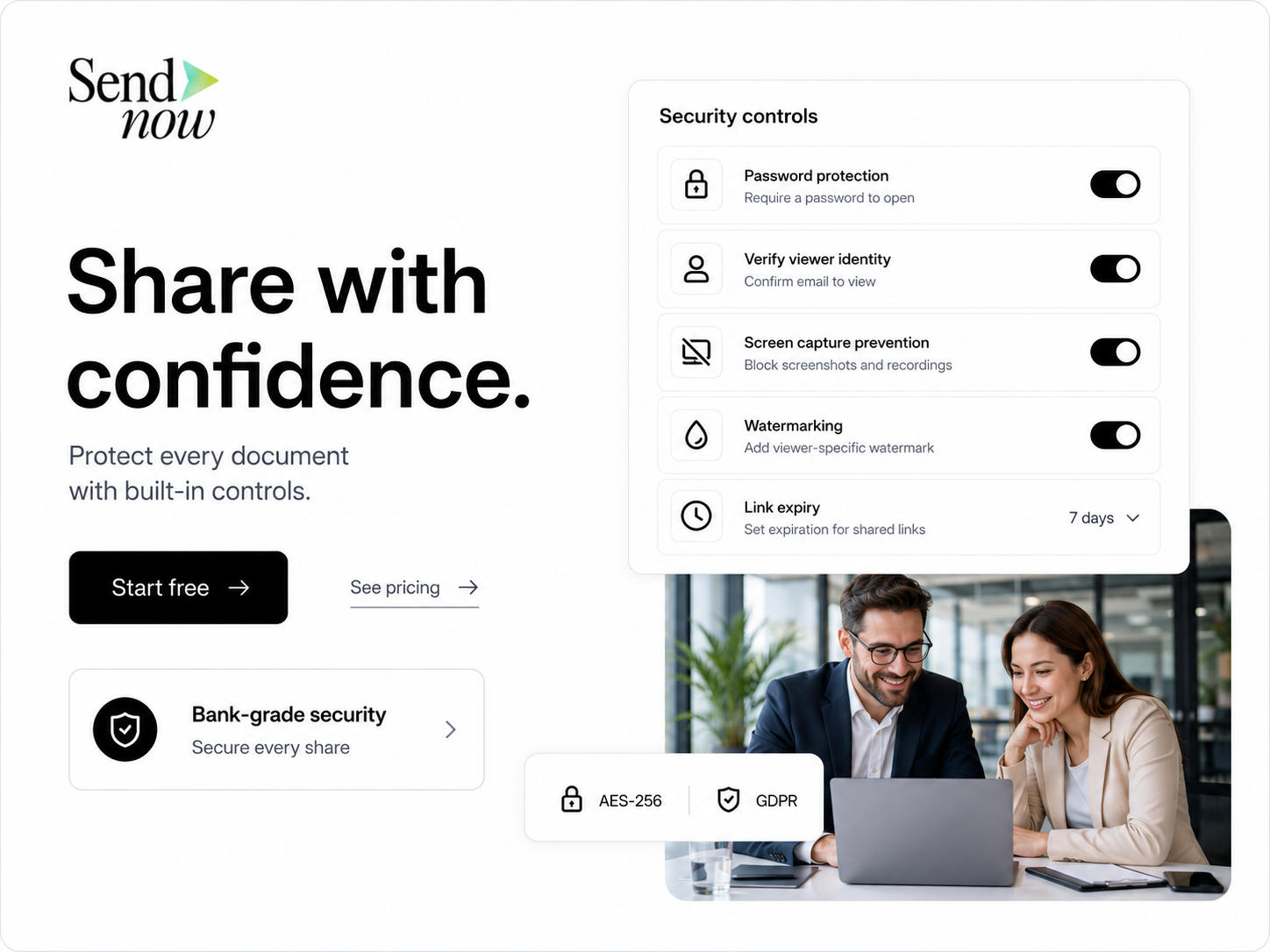
SendNow implements AES-256 encryption for all documents stored on its AWS infrastructure. Data in transit uses TLS 1.3 with AES-256 cipher suites. Data at rest is encrypted at the storage layer using AWS server-side encryption with AES-256, with keys managed through AWS Key Management Service.

This means that financial documents shared through SendNow benefit from the same encryption infrastructure used by enterprises, government agencies, and financial institutions that rely on AWS for regulated workloads. The AES-256 implementation is not a marketing label applied to a weaker underlying configuration. It is the actual cipher used at both layers.
For firms requiring audit evidence, SendNow's AWS infrastructure carries the relevant certifications including SOC 2, ISO 27001, and FIPS 140-2 for key management, which aligns with both GDPR technical requirements and DORA operational resilience expectations.
Comparison: Encryption Standards by Use Case {#comparison}
| Use Case | Minimum Recommended Standard | Notes |
|---|---|---|
| General business documents | AES-128 in transit | Adequate for low-sensitivity material |
| Personal data under GDPR | AES-256 at rest and in transit | EDPB guidance references AES-256 |
| Financial model, cap table, term sheet | AES-256 at rest and in transit | Regulatory exposure without encryption at rest |
| M&A documents, MNPI | AES-256 + access controls + audit log | Encryption is necessary but not sufficient alone |
| Long-term archival (7+ years) | AES-256 | Quantum-resilient effective security level |
FAQs {#faqs}
1. Does AES-256 encryption mean my documents are completely safe? AES-256 is the encryption standard for data at rest and in transit, but encryption is one component of a security posture. Access controls, authentication, audit logging, and platform security practices all contribute equally.
2. Can AES-256 be broken? Not by any known or theoretically foreseeable classical computing attack. Post-quantum considerations apply to longer-term data, which is why AES-256 is preferred over AES-128 for sensitive financial records.
3. What is FIPS 140-2 and why does it matter? FIPS 140-2 is a US federal standard for cryptographic modules. AWS KMS, which manages encryption keys for platforms like SendNow, is validated to FIPS 140-2 Level 3, providing third-party assurance of the key management implementation.
4. How do I verify that a platform actually uses AES-256? Ask for their SOC 2 Type II report or a third-party penetration test summary. Request written confirmation of the cipher specification for both in-transit and at-rest encryption.
5. Is AES-256 required by GDPR? GDPR does not name AES-256 specifically but requires "appropriate technical measures." EDPB guidance and national DPA guidance consistently identify AES-256 as the current appropriate standard for personal data encryption.
6. What is the difference between server-side and client-side encryption? Server-side encryption means the platform encrypts data using keys it manages on your behalf. Client-side encryption means data is encrypted on your device before it is sent to the platform. Client-side encryption offers stronger protection against platform-level breaches but requires more complex key management.
7. Does AES-256 protect against insider threats at the platform level? Encryption protects against unauthorized data access at the storage layer, but platform employees with administrative access to key management systems may have theoretical access. Review the platform's key management architecture and access control policies as part of your vendor assessment.
8. How does AES-256 interact with GDPR's right to erasure? Deleting the encryption key renders encrypted data unrecoverable, which some legal opinions treat as equivalent to erasure for GDPR purposes. Consult your DPO for guidance specific to your jurisdiction.
<script type="application/ld+json"> { "@context": "https://schema.org", "@type": "FAQPage", "mainEntity": [ { "@type": "Question", "name": "Can AES-256 be broken?", "acceptedAnswer": { "@type": "Answer", "text": "Not by any known or theoretically foreseeable classical computing attack. Post-quantum considerations apply to longer-term data, which is why AES-256 is preferred over AES-128 for sensitive financial records." } }, { "@type": "Question", "name": "What is FIPS 140-2 and why does it matter?", "acceptedAnswer": { "@type": "Answer", "text": "FIPS 140-2 is a US federal standard for cryptographic modules. AWS KMS, which manages encryption keys for platforms like SendNow, is validated to FIPS 140-2 Level 3, providing third-party assurance of the key management implementation." } }, { "@type": "Question", "name": "How do I verify that a platform actually uses AES-256?", "acceptedAnswer": { "@type": "Answer", "text": "Ask for their SOC 2 Type II report or a third-party penetration test summary. Request written confirmation of the cipher specification for both in-transit and at-rest encryption." } }, { "@type": "Question", "name": "Is AES-256 required by GDPR?", "acceptedAnswer": { "@type": "Answer", "text": "GDPR does not name AES-256 specifically but requires 'appropriate technical measures.' EDPB guidance and national DPA guidance consistently identify AES-256 as the current appropriate standard for personal data encryption." } }, { "@type": "Question", "name": "What is the difference between server-side and client-side encryption?", "acceptedAnswer": { "@type": "Answer", "text": "Server-side encryption means the platform encrypts data using keys it manages on your behalf. Client-side encryption means data is encrypted on your device before it is sent to the platform. Client-side encryption offers stronger protection against platform-level breaches but requires more complex key management." } }, { "@type": "Question", "name": "Does AES-256 protect against insider threats at the platform level?", "acceptedAnswer": { "@type": "Answer", "text": "Encryption protects against unauthorized data access at the storage layer, but platform employees with administrative access to key management systems may have theoretical access. Review the platform's key management architecture and access control policies as part of your vendor assessment." } }, { "@type": "Question", "name": "How does AES-256 interact with GDPR's right to erasure?", "acceptedAnswer": { "@type": "Answer", "text": "Deleting the encryption key renders encrypted data unrecoverable, which some legal opinions treat as equivalent to erasure for GDPR purposes. Consult your DPO for guidance specific to your jurisdiction." } } ] } </script>
Share financial documents with AES-256 encryption, full audit logs, and NDA gating built in. Get started at sendnow.live.
Written by Alex Carter. Alex covers document security, compliance, and secure sharing workflows for financial and legal professionals across the EU.