
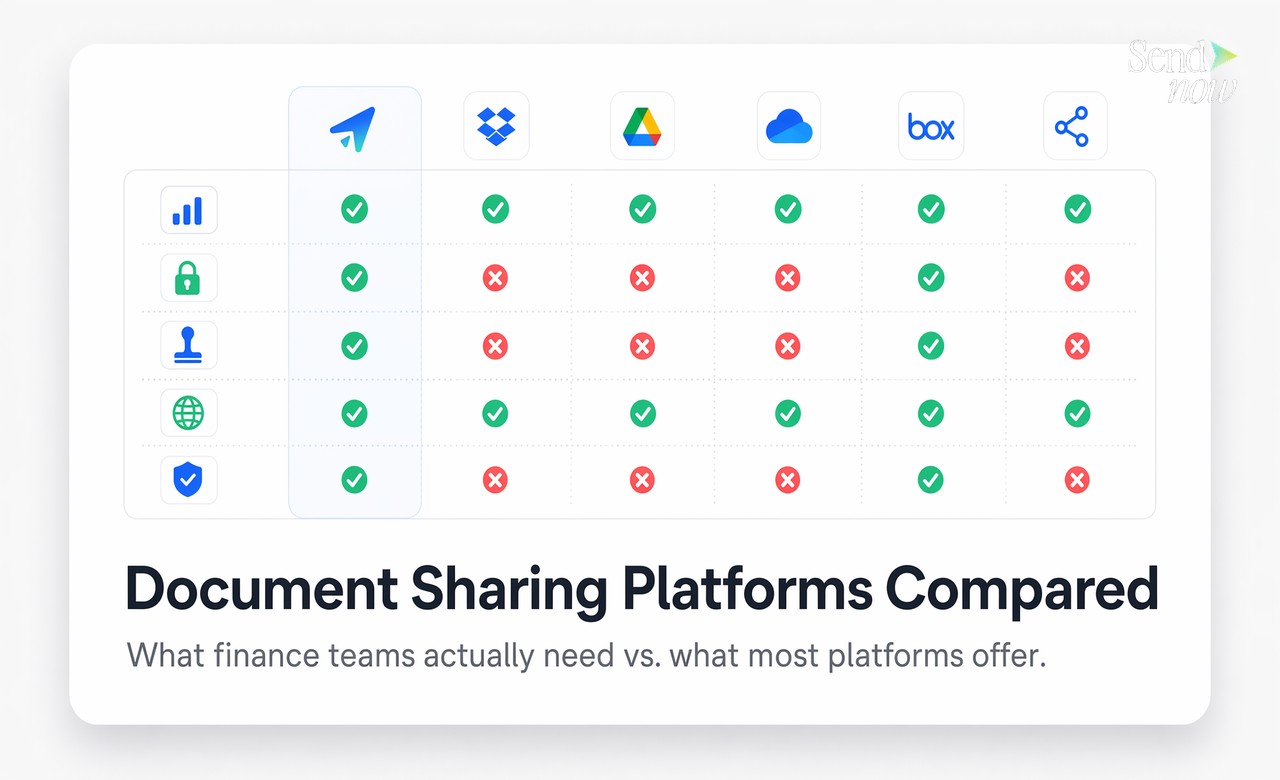
Document Sharing Platforms Compared: What Finance Teams Need to Know
Published on April 24, 2026
#TLDR Finance teams need more from a document sharing platform than a link to a PDF. This comparison breaks down the four main categories of platform, maps them against the features finance teams actually require, and explains how to make the right choice in five minutes.
Table of Contents
- What Finance Teams Specifically Need
- The Four Categories of Platforms
- Feature Comparison Table
- Pricing Comparison
- GDPR and Compliance Considerations
- How to Choose in Five Minutes
- FAQs
What Finance Teams Specifically Need {#finance-team-needs}
Finance teams share documents that carry real risk. Investor reports, financial models, board presentations, term sheets, audit packages, and client proposals all contain information that, if shared with the wrong person or at the wrong time, can create regulatory, reputational, or legal exposure.
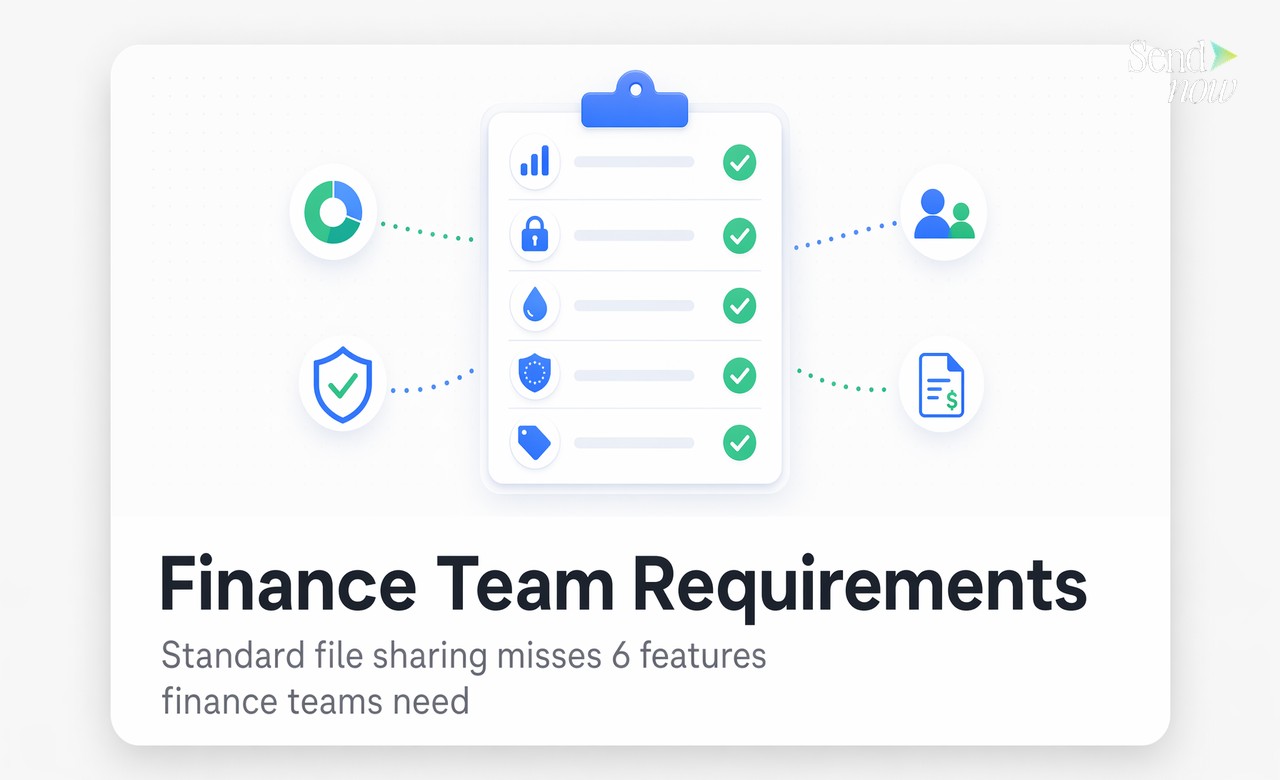
The requirements that follow from this are specific and non-negotiable for serious use cases:
- Identity verification: Knowing exactly who opened the document, not just that someone did
- Page-level analytics: Understanding which sections were read, not just whether the file was opened
- NDA gating: Requiring acceptance of a non-disclosure agreement before a document opens
- Dynamic watermarking: Embedding the viewer's email or identity into every page so leaks are traceable
- Download control: Preventing local copies of sensitive materials
- GDPR-compliant infrastructure: US-hosted, data-processing-agreement-backed storage
- White labelling: Presenting documents under your own brand, not the platform's
A consumer cloud storage service meets none of these requirements. Even purpose-built sales enablement tools typically cover only analytics and miss the security and compliance requirements that finance teams carry.
The Four Categories of Platforms {#four-categories}
1. Cloud storage (Google Drive, Dropbox, OneDrive) These platforms solve file storage and basic link sharing. They are not designed for document security. Shared links can be forwarded without restriction, there is no identity verification, analytics are minimal, and GDPR compliance depends on your organisation's broader configuration. Not suitable for sensitive financial documents.
2. Proposal tools (PandaDoc, Proposify, DocSend) Proposal tools add document analytics, open notifications, and in some cases NDA or e-signature workflows. They work well for commercial proposals and sales materials. Most lack dynamic watermarking, download-blocking that cannot be circumvented, and the granular access controls needed for M&A or compliance-grade sharing.
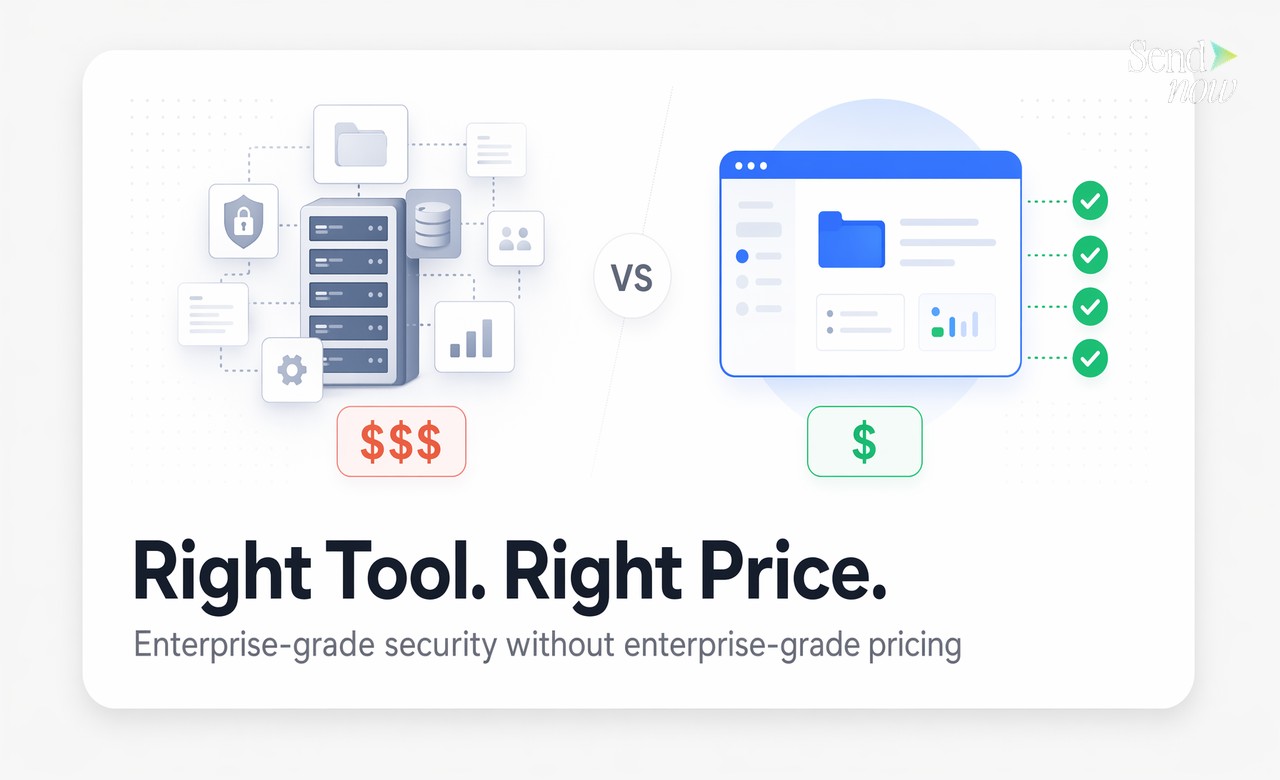
3. Enterprise virtual data rooms (Intralinks, Datasite, Ansarada) Full-featured VDRs built for large transactions. They cover every requirement finance teams have. The trade-off is cost (typically thousands of dollars per month or per transaction), contract complexity, and implementation time. For a single fundraising round, seed-stage startup, or ongoing client file sharing, this category is usually oversized and overpriced.
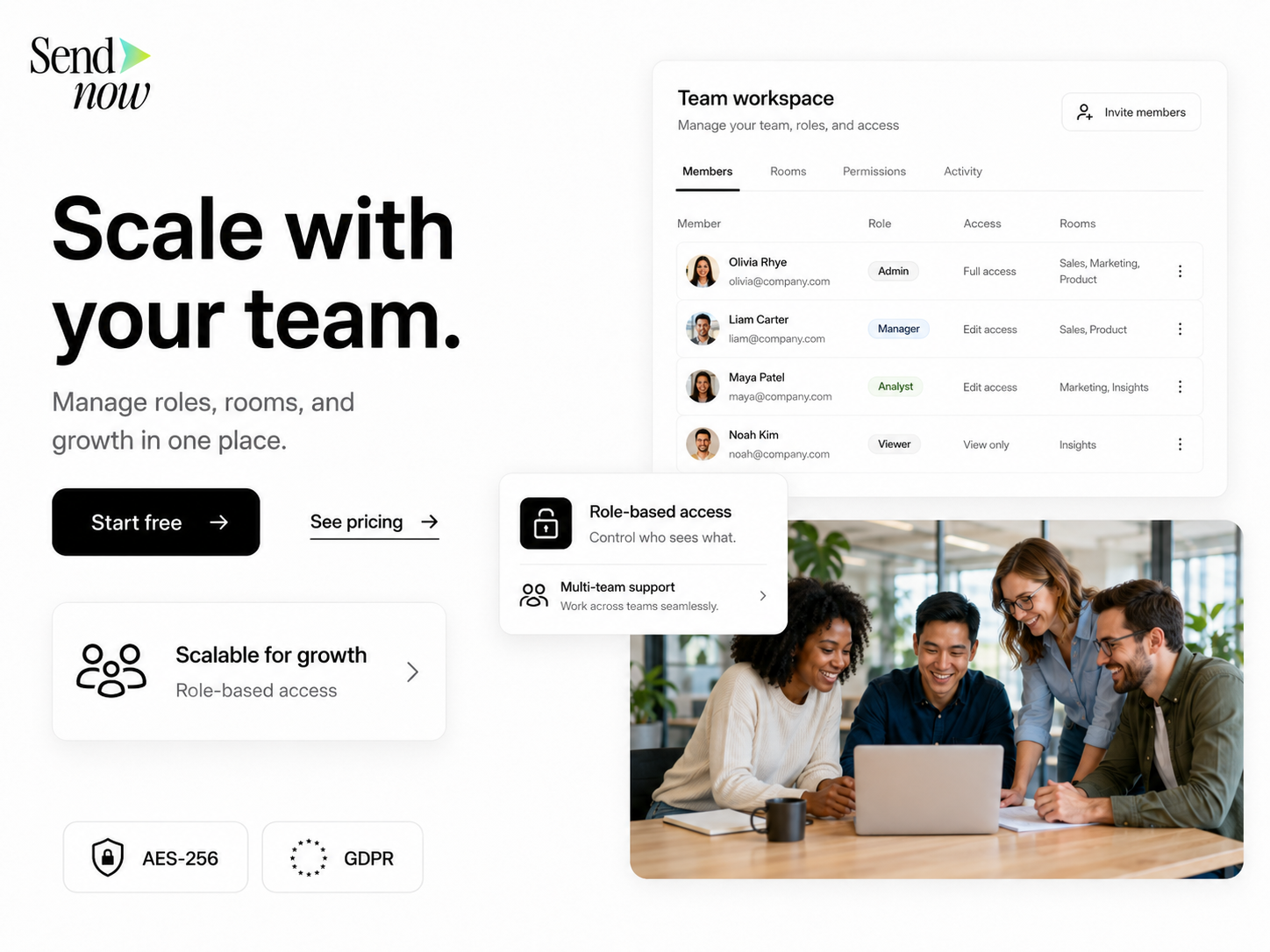
4. Purpose-built secure document sharing (SendNow) This category covers platforms designed to deliver the core security and analytics requirements of finance-grade sharing at a price and setup time that makes sense for teams that are not running a nine-figure M&A process. Full analytics, NDA gating, dynamic watermarks, email verification, download control, GDPR-compliant hosting, and white labelling, without the enterprise VDR overhead.
Feature Comparison Table {#feature-comparison}
| Feature | Cloud Storage | Proposal Tools | Enterprise VDR | Purpose-Built (SendNow) |
|---|---|---|---|---|
| Page-level analytics | No | Yes | Yes | Yes |
| Identity/email verification | No | Partial | Yes | Yes |
| NDA gating | No | Partial | Yes | Yes |
| Dynamic watermarking | No | No | Yes | Yes |
| Download blocking | No | Partial | Yes | Yes |
| Screenshot protection | No | No | Partial | Yes |
| GDPR compliance & DPA | Partial | Partial | Yes | Yes |
| White labelling / custom domain | No | Partial | Yes | Yes |
| Slack / webhook alerts | No | No | Partial | Yes |
| AI engagement scoring | No | No | No | Yes |
| Setup time | Minutes | Hours | Days-Weeks | Minutes |
| Typical monthly cost | Low | Mid | Very high | Mid |
Pricing Comparison {#pricing-comparison}
Pricing across these categories varies by an order of magnitude.
Cloud storage is typically the cheapest option per user, but the absence of security features means you are trading cost savings for risk exposure. The cost of a single document leak or compliance incident dwarfs any saving on the storage bill.
Proposal tools range from roughly $19 to $65 per user per month, depending on features. For pure analytics on commercial proposals this can be reasonable, but the gap in security functionality limits their usefulness for regulated finance content.
Enterprise VDRs are typically priced per transaction, per page, or by annual contract. All-in costs for a single M&A transaction can run from $10,000 to over $100,000 depending on deal complexity and duration. This is appropriate for nine-figure transactions with multiple-month due diligence processes. It is not appropriate for a fund sharing quarterly reports with LPs.
Purpose-built platforms like SendNow sit between proposal tools and enterprise VDRs on price while covering the feature set that finance teams actually need, without the transaction-based pricing model that makes enterprise VDRs expensive for ongoing use.
GDPR and Compliance Considerations {#gdpr-compliance}
For finance teams operating in the EU or sharing documents with EU counterparties, GDPR compliance is not optional. The relevant questions to ask any platform are:
- Where are documents stored physically? (EU region required for EU personal data)
- Is a Data Processing Agreement available and signed?
- Can access logs be exported for regulatory audits?
- Is there a personal data deletion process?
- Does the platform hold any relevant certifications (ISO 27001, SOC 2)?
Most consumer cloud storage providers offer EU region storage but require careful configuration to ensure data does not transit US infrastructure. Enterprise VDRs and purpose-built platforms generally have more robust compliance documentation available on request.
How to Choose in Five Minutes {#how-to-choose}
Answer these three questions:
1. Will you share documents containing personal data about EU individuals? If yes, you need a GDPR-compliant platform with EU hosting and a signed DPA. This rules out most consumer cloud storage and some proposal tools.
2. Do you need to know the identity of each viewer? If yes, you need email verification or a login requirement. Shareable links alone are insufficient. This rules out most cloud storage and basic proposal tools.
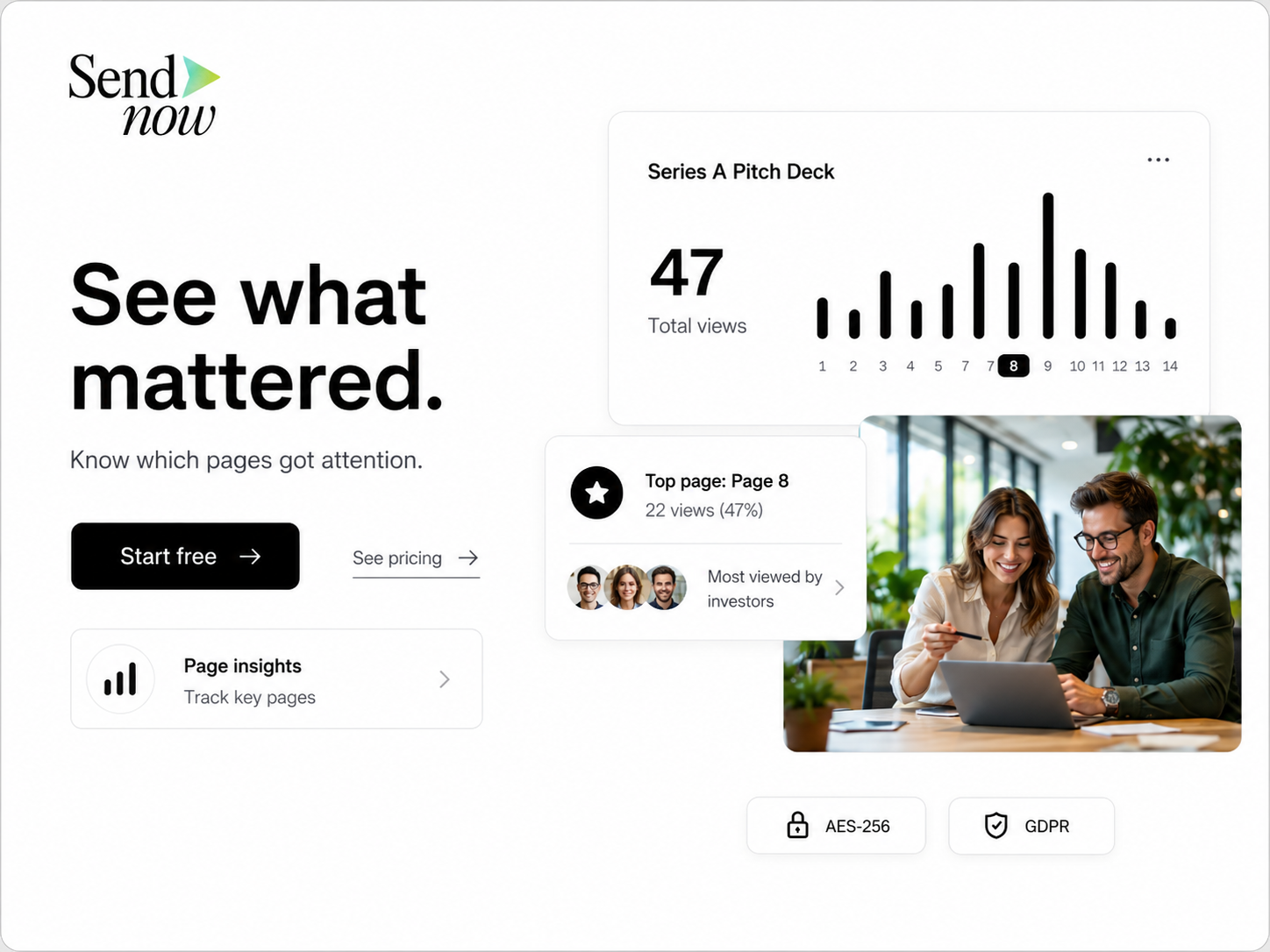
3. Will documents be shared in a deal, fundraise, or regulated context? If yes, you need dynamic watermarking, NDA gating, and a full audit trail. This rules out cloud storage and most proposal tools. The choice is then between an enterprise VDR (if the budget and complexity justify it) and a purpose-built platform like SendNow (if you need a fast setup and ongoing use).
Compare features and start a free trial at sendnow.live.
FAQs {#faqs}
Q1: What should finance teams look for in a document sharing platform? Finance teams need page-level analytics, identity verification, NDA gating, dynamic watermarking, download control, GDPR-compliant infrastructure, and white labelling. Most generic platforms cover only one or two of these.
Q2: What are the four types of document sharing platforms? Cloud storage (Google Drive, Dropbox), proposal tools (DocSend, PandaDoc), enterprise virtual data rooms (Intralinks, Datasite), and purpose-built secure sharing platforms.
Q3: How do virtual data rooms compare to cloud storage for due diligence? Virtual data rooms provide granular access control, activity logging, NDA gating, and compliance documentation. Cloud storage provides none of these. Cloud storage is not suitable for formal due diligence processes.
Q4: Do most document sharing platforms support GDPR? US-hosted data storage is available on most major platforms, but GDPR compliance requires more than storage location. It requires Data Processing Agreements, access logs, personal data deletion processes, and specific technical controls. Check each platform's DPA and compliance documentation.
Q5: What is NDA gating and which platforms support it? NDA gating requires a viewer to accept a non-disclosure agreement before accessing a document. Enterprise VDRs and purpose-built platforms like SendNow support this. Most proposal tools and cloud storage platforms do not.
Q6: Can I get analytics on document views with standard file sharing? Standard file sharing links (Google Drive, Dropbox) do not provide page-level analytics or identity-linked view tracking. You can see aggregate file access data but not individual viewer behaviour.
Q7: How much do enterprise virtual data rooms cost? Enterprise VDR pricing typically starts at several hundred dollars per month for basic access and can exceed $10,000 per transaction for M&A use cases. This makes them appropriate for large transactions but not for routine secure sharing.
Q8: What makes SendNow different from generic file sharing? SendNow combines the access controls of an enterprise VDR (identity verification, NDA gating, dynamic watermarks, GDPR compliance) with a setup time measured in minutes rather than weeks, and a pricing model suited to ongoing use rather than single transactions.
Written by Alex Carter. Alex covers document security, compliance workflows, and deal room best practices for finance and legal professionals.