
Encrypted Document Sharing: Why AES-256 Matters for Finance
Published on April 24, 2026
Encrypted Document Sharing: Why AES-256 Matters for Finance
#TLDR
AES-256 is the gold standard for encrypting financial documents, protecting data both in transit and at rest. Financial firms operating under GDPR, MiFID II, or FCA rules need platforms that implement AES-256 end-to-end. This article breaks down what that means in practice and how to verify a platform actually delivers it.
Table of Contents
- What AES-256 Encryption Is
- Why It Matters for Financial Documents
- In Transit vs. At Rest Encryption
- What to Look for in a Compliant Platform
- How SendNow Implements AES-256
- Regulatory Requirements for Financial Document Encryption
What AES-256 Encryption Is
AES stands for Advanced Encryption Standard. The 256 refers to the key length, measured in bits. A 256-bit key means there are 2^256 possible combinations — a number so large that brute-force attacks are computationally impossible with any hardware that exists today or is projected to exist in the foreseeable future.
Originally adopted by the U.S. National Institute of Standards and Technology (NIST) in 2001, AES-256 is now used by governments, militaries, and financial institutions worldwide to protect sensitive data. When a document sharing platform says it uses AES-256, it means the underlying encryption algorithm applied to your files is the same standard used to protect classified government communications.
For financial professionals sharing term sheets, investor decks, loan agreements, or client portfolios, this is the baseline you should expect, not an optional premium feature.
Why It Matters for Financial Documents
Financial documents carry information that is both commercially sensitive and personally identifiable. A leaked term sheet can move markets. An exposed client portfolio can violate GDPR. A disclosed M&A data room can destroy a deal.
The regulatory exposure alone makes strong encryption non-negotiable. Under GDPR Article 32, data controllers must implement "appropriate technical measures" to protect personal data, and encryption is the most commonly cited example. Under MiFID II and FCA guidance, firms handling client financial information must demonstrate they have controls in place to prevent unauthorised access.
Beyond compliance, there is a commercial reality: a single data breach in the financial sector can permanently damage client trust. Encrypted document sharing is one of the few controls that protects you even if a threat actor gains some level of access — because without the key, the data is unreadable.
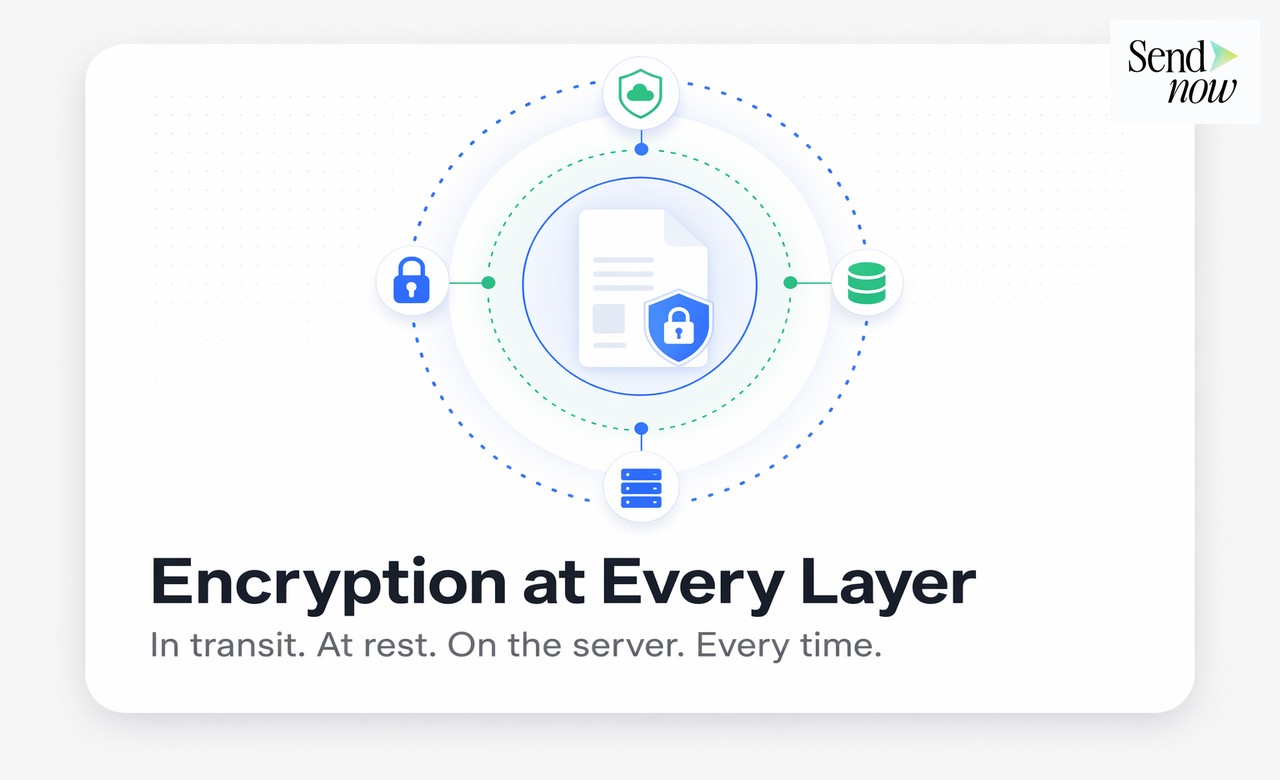
In Transit vs. At Rest Encryption
These are two distinct concepts that are both required for complete protection.
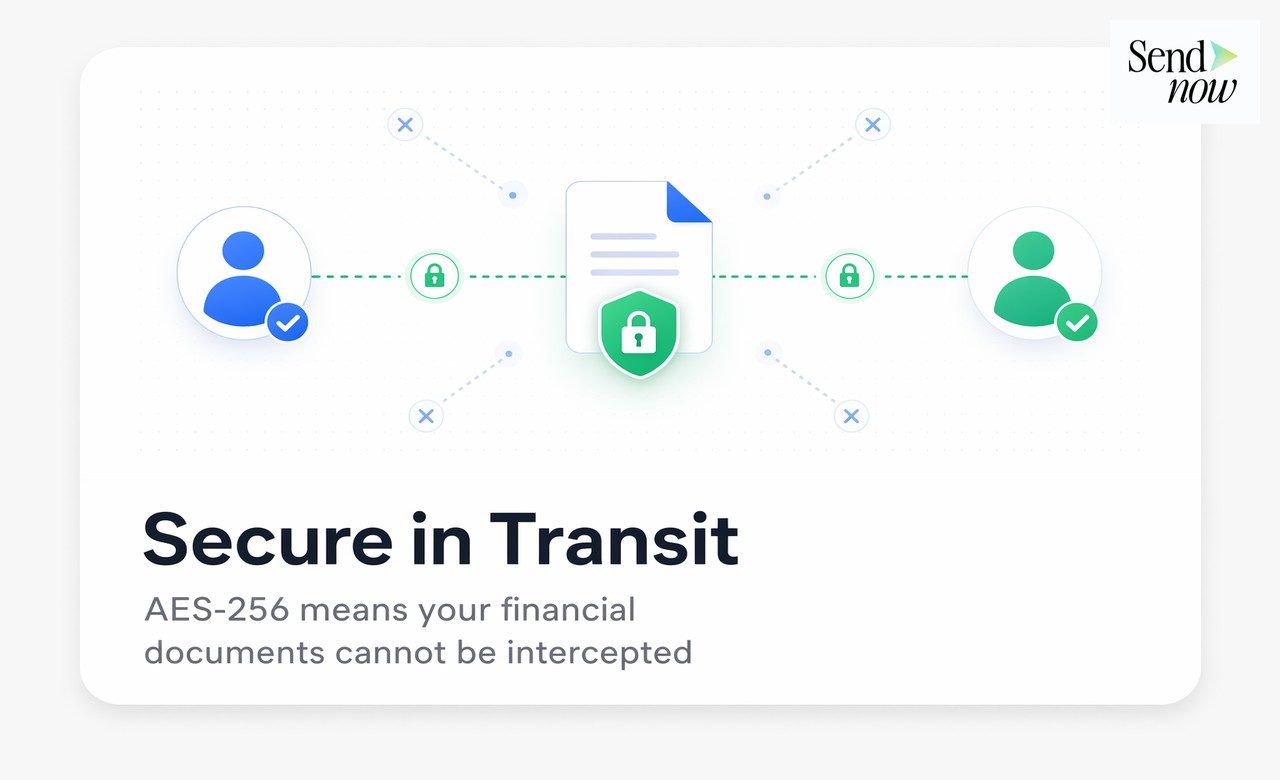
Encryption in transit protects data as it moves from one point to another. When you send a document to a client, it travels across the internet through multiple servers. Without encryption in transit (typically TLS 1.2 or 1.3), any node along that path could intercept and read the data. With it, the data is encrypted before it leaves your device and decrypted only at the destination.
Encryption at rest protects data stored on a server. Even if a threat actor gains access to the underlying storage infrastructure — through a misconfigured database, a compromised server, or a supply chain attack — AES-256 at rest means the files are unreadable without the decryption key.
A robust platform implements both. Platforms that advertise TLS but do not mention AES-256 at rest are only protecting half the journey.
What to Look for in a Compliant Platform
When evaluating a document sharing platform for financial use, ask these questions:
| Requirement | What to Check |
|---|---|
| AES-256 at rest | Explicitly stated in security documentation |
| TLS in transit | TLS 1.2 or 1.3, not older SSL versions |
| Cloud infrastructure | Hosted on SOC 2 compliant infrastructure (AWS, GCP, Azure) |
| Key management | Who holds the decryption keys, and are they separated from the data? |
| Access controls | Granular permissions, expiry, revocation |
| GDPR compliance | Data residency options, DPA available, EU data centres |
| Audit logs | Immutable logs of every access event |
Do not accept vague language like "bank-grade security" without a specific cipher suite confirmed in writing. Audit the vendor's security documentation before onboarding.
How SendNow Implements AES-256
SendNow uses AES-256 encryption for all documents stored on the platform, hosted on AWS infrastructure. Every file uploaded is encrypted at rest using AES-256 before it touches disk, and all data transfers use TLS 1.2+.
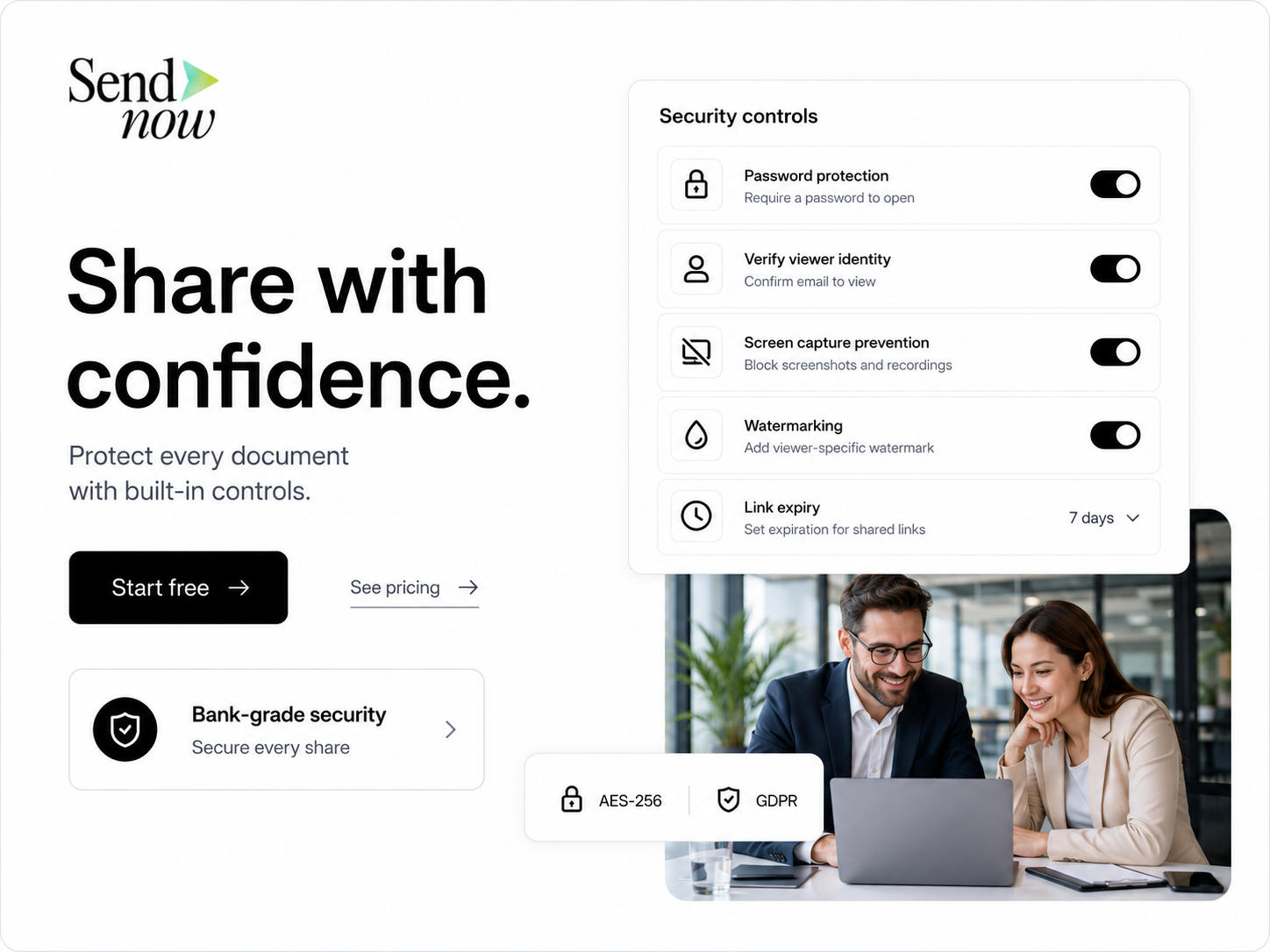
Beyond the encryption layer, SendNow adds additional document-level controls: password protection, expiry dates, email verification gates, download blocking, and revocation. These controls operate above the encryption layer, meaning even if someone obtains a valid share link, access can be revoked instantly.
The platform is GDPR-compliant by design, with data processing agreements available and EU-region hosting options. This matters for finance firms with European clients or operations covered by GDPR.
Regulatory Requirements for Financial Document Encryption
Different regulatory frameworks impose specific requirements that encryption helps satisfy:
GDPR (EU): Article 32 requires "pseudonymisation and encryption of personal data" as a technical measure. Financial firms sharing any document containing personal data — client names, account numbers, identification details — must encrypt that data.
MiFID II: Requires firms to maintain secure and confidential records of client communications and transactions. Document encryption is a core component of that obligation.
FCA (UK): The Senior Managers and Certification Regime (SMCR) and related guidance expect firms to demonstrate that data security controls are proportionate to the sensitivity of the information handled.

DORA (EU, from 2025): The Digital Operational Resilience Act explicitly requires financial entities to use strong encryption for ICT assets. Document sharing platforms are in scope.
For any finance firm operating across these frameworks, AES-256 encrypted document sharing is a compliance requirement, not a preference. The good news is that adopting the right platform addresses multiple regulatory obligations simultaneously.
Frequently Asked Questions
Q1: Is AES-256 really unbreakable? No encryption is mathematically unbreakable, but AES-256 is computationally infeasible to brute-force with any current or near-future technology. It is the standard used to protect top-secret government data.
Q2: What is the difference between AES-128 and AES-256? AES-256 uses a longer key (256 bits vs 128 bits), making it exponentially harder to brute-force. For financial and regulated industries, AES-256 is the expected standard.
Q3: Does TLS alone provide sufficient protection? No. TLS encrypts data in transit only. You also need AES-256 at rest to protect data stored on servers.
Q4: Can I use standard email for sharing financial documents? Standard email is not encrypted at rest on most servers and relies on the recipient's server also supporting TLS. It does not provide document-level access controls. A purpose-built encrypted document sharing platform is significantly more secure.
Q5: What happens if someone intercepts an AES-256 encrypted document? Without the decryption key, the document is unreadable ciphertext. The attacker gains nothing actionable.
Q6: Does GDPR require encryption? GDPR Article 32 explicitly lists encryption as an appropriate technical measure. It is not mandated as the only measure, but it is the most commonly required by regulators and DPAs.
Q7: What cloud infrastructure should a financial document platform run on? AWS, Google Cloud, or Azure with SOC 2 Type II compliance are the accepted standards. These providers maintain physical and logical security controls that complement encryption.
Q8: How does SendNow handle encryption key management? SendNow manages encryption keys separately from stored data, hosted on AWS infrastructure, using envelope encryption to ensure no single point of key compromise.
<script type="application/ld+json"> }, { "@type": "Question", "name": "What is the difference between AES-128 and AES-256?", "acceptedAnswer": { "@type": "Answer", "text": "AES-256 uses a longer key (256 bits vs 128 bits), making it exponentially harder to brute-force. For financial and regulated industries, AES-256 is the expected standard." } }, { "@type": "Question", "name": "Does TLS alone provide sufficient protection?", "acceptedAnswer": { "@type": "Answer", "text": "No. TLS encrypts data in transit only. You also need AES-256 at rest to protect data stored on servers." } }, { "@type": "Question", "name": "Can I use standard email for sharing financial documents?", "acceptedAnswer": { "@type": "Answer", "text": "Standard email is not encrypted at rest on most servers and relies on the recipient's server also supporting TLS. It does not provide document-level access controls. A purpose-built encrypted document sharing platform is significantly more secure." } }, { "@type": "Question", "name": "What happens if someone intercepts an AES-256 encrypted document?", "acceptedAnswer": { "@type": "Answer", "text": "Without the decryption key, the document is unreadable ciphertext. The attacker gains nothing actionable." } }, { "@type": "Question", "name": "Does GDPR require encryption?", "acceptedAnswer": { "@type": "Answer", "text": "GDPR Article 32 explicitly lists encryption as an appropriate technical measure. It is not mandated as the only measure, but it is the most commonly required by regulators and DPAs." } }, { "@type": "Question", "name": "What cloud infrastructure should a financial document platform run on?", "acceptedAnswer": { "@type": "Answer", "text": "AWS, Google Cloud, or Azure with SOC 2 Type II compliance are the accepted standards. These providers maintain physical and logical security controls that complement encryption." } }, { "@type": "Question", "name": "How does SendNow handle encryption key management?", "acceptedAnswer": { "@type": "Answer", "text": "SendNow manages encryption keys separately from stored data, hosted on AWS infrastructure, using envelope encryption to ensure no single point of key compromise." } } ] } </script>
Start sharing financial documents with AES-256 encryption, GDPR compliance, and full access control at sendnow.live.
Written by Alex Carter. Alex covers document security, financial compliance, and SaaS tools for finance professionals.