
GDPR-Compliant Document Sharing: What to Look For in 2026
Published on April 24, 2026
GDPR-Compliant Document Sharing: What to Look For in 2026
#TLDR: GDPR compliance for document sharing platforms means more than ticking a privacy checkbox. It requires EU data residency, documented consent, right to erasure, a signed DPA, no tracking cookies, and AES-256 encryption. This post walks you through each requirement and shows you how to audit your current tool.
Table of Contents
- What GDPR Means for Document Sharing Platforms
- The 6 Compliance Requirements You Must Verify
- How to Audit Your Current Platform
- Right to Erasure and Permanent Deletion
- No Tracking Cookies: Why It Matters More Than You Think
- How SendNow Meets All 6 GDPR Requirements
- Platform Comparison Table
- FAQs
What GDPR Means for Document Sharing Platforms {#what-gdpr-means}
The General Data Protection Regulation does not just govern how companies store customer data in a database. It governs every tool in your workflow that touches personal data, including the platforms you use to send financial proposals, investment reports, and client contracts.
When a prospect opens a document you share via a third-party platform, that platform collects data about them: their IP address, device type, time spent reading, and pages viewed. Under GDPR, that is personal data. The platform processing it is a data processor. You, the financial professional who sent the document, are the data controller. That relationship carries concrete legal obligations.
Many document sharing tools were built for speed and convenience, not compliance. They store data on US servers, drop tracking cookies without consent, and provide no mechanism for a client to request deletion of their reading history. For financial professionals serving EU clients, that exposure is real and growing.
Supervisory authorities across Europe have sharpened their focus on third-party data processors in recent years. Treating GDPR-compliant document sharing as a baseline is no longer optional for firms operating in regulated sectors.
The 6 Compliance Requirements You Must Verify {#six-requirements}
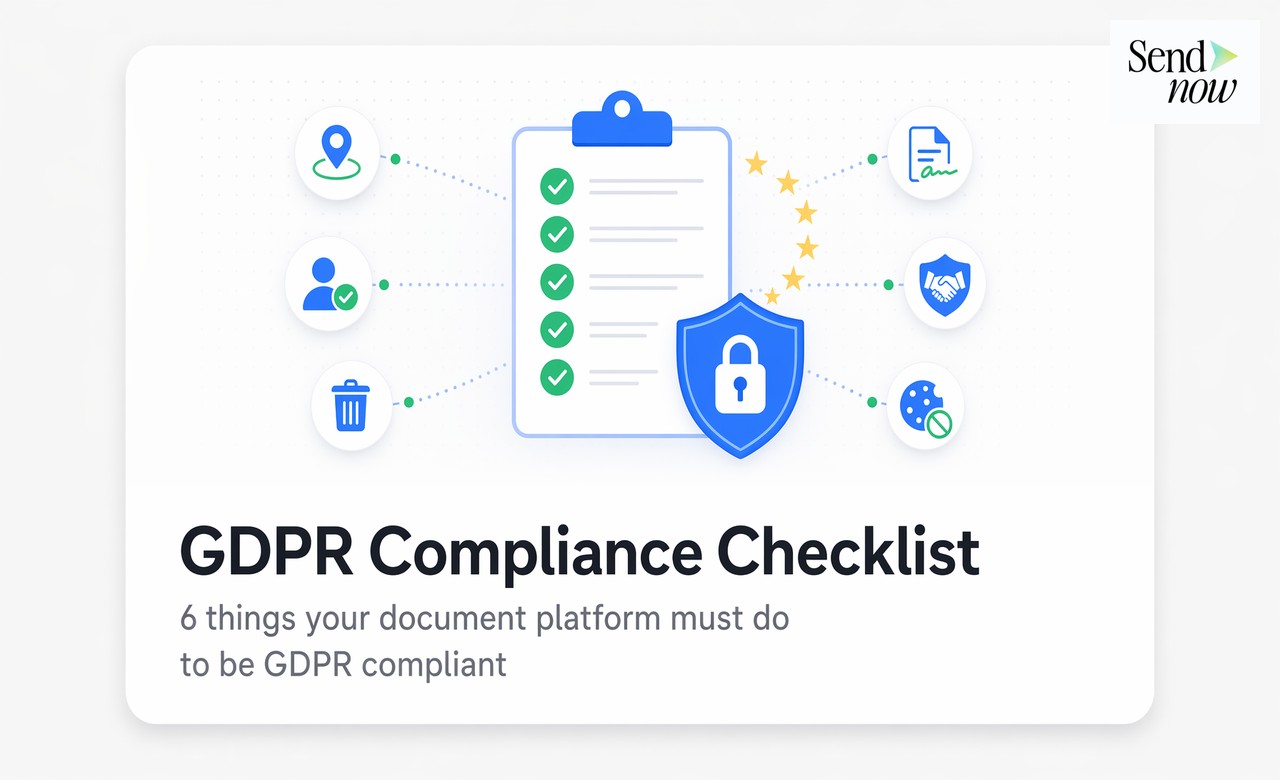
Before committing to any document sharing platform, verify all six of the following.
1. EU Data Residency All personal data, including document viewing activity, must be stored on servers physically located within the European Economic Area. A platform headquartered in the EU but running on US-based cloud infrastructure does not satisfy this requirement. Request written confirmation of where data is stored, including the specific cloud region identifiers.
2. Documented Consent Mechanism If the platform collects analytics on document recipients, it needs a compliant consent mechanism. This means presenting recipients with a clear notice before any tracking begins, with a genuine option to decline. Pre-ticked consent boxes do not comply. Implied consent does not comply.
3. Right to Deletion Support Under Article 17 of GDPR, recipients have the right to request deletion of their personal data. Your document platform must be able to permanently delete all data associated with a specific recipient's viewing activity, on request, within 30 days.
4. Signed Data Processing Agreement Any third-party vendor that processes personal data on your behalf must sign a Data Processing Agreement. This document defines the scope of processing, security obligations, and each party's responsibilities. If your current platform has never sent you a DPA, treat that as a compliance gap.
5. No Third-Party Tracking Cookies Many document platforms embed analytics pixels and third-party scripts. Under GDPR, non-essential cookies require prior informed consent. Platforms that drop these trackers on recipients without consent expose both themselves and their users to regulatory risk.
6. AES-256 Encryption Article 32 of GDPR requires appropriate technical security measures. AES-256 encryption at rest and in transit is the current industry standard for documents containing personal or financial information. Anything weaker is difficult to justify in a regulatory audit.
How to Audit Your Current Platform {#audit-platform}
Most document sharing platforms do not proactively surface their compliance status. You have to ask. Use this practical audit sequence:
- Request their signed Data Processing Agreement in writing
- Ask specifically: "In which AWS or Azure regions is recipient viewing data stored?"
- Review their privacy policy for third-party data sharing and advertising network clauses
- Send a test document and inspect what cookies are placed on the recipient's browser (browser developer tools show this)
- Ask whether individual recipient data can be deleted on request and what the process is
- Confirm whether EU data residency applies to all tiers or only enterprise-level plans
A platform that cannot answer these questions clearly, or that takes weeks to respond, is not operating with GDPR compliance as a priority.
Right to Erasure and Permanent Deletion {#right-to-erasure}
Article 17 grants individuals the right to erasure, commonly called the right to be forgotten. In document sharing, this means a client can request that all records of their viewing activity be permanently deleted.
This matters most in financial services. A prospect who reviewed a fund prospectus, decided against investing, and later requests data deletion is exercising a legal right under EU law. If your platform cannot honor that request within 30 days, you are in breach as the data controller.
Compliance requires more than a "delete account" function. It requires the ability to delete data associated with a specific recipient, even if that person never created an account, because anonymous viewing sessions with an IP address still constitute personal data under GDPR's broad definition.
No Tracking Cookies: Why It Matters More Than You Think {#no-tracking-cookies}
Many document platforms embed third-party tracking pixels to power their engagement dashboards. The viewing data these scripts collect is commercially valuable, but collecting it without recipient consent violates GDPR.
The practical implication is significant for financial teams. If your document sharing platform drops non-essential cookies on a client without consent, and that client lodges a complaint with their national data protection authority, you as the data controller bear primary responsibility for your vendor's practices.
Compliant platforms use first-party, consent-aware analytics. They do not use tracking pixels that follow recipients across the web, and they do not pass recipient data to third-party advertising networks or data brokers.
How SendNow Meets All 6 GDPR Requirements {#sendnow-gdpr}
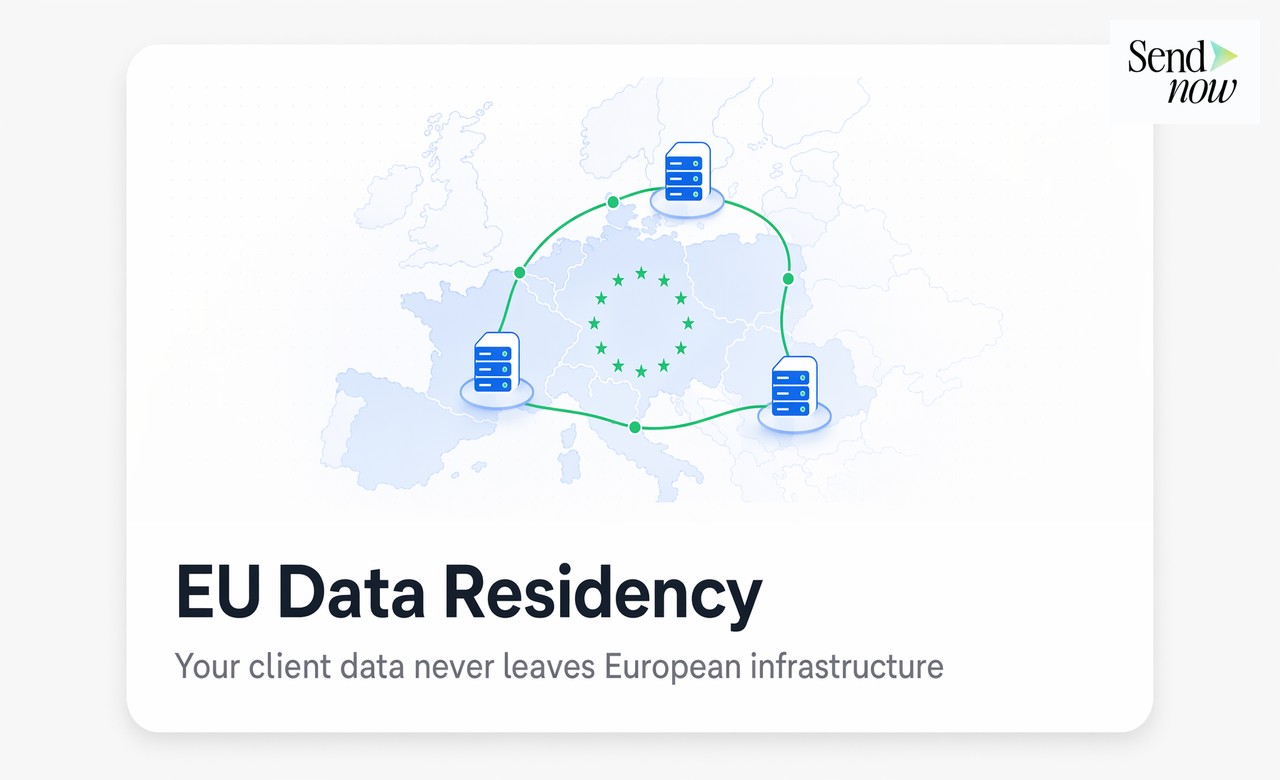

SendNow was built with European financial teams as a primary audience. Here is how the platform addresses each requirement:
- EU Data Residency: All data is stored on AWS infrastructure within EU regions. Recipient viewing data never leaves European servers.
- Consent-Aware Analytics: SendNow does not rely on non-consensual third-party tracking. Analytics are first-party and privacy-respecting.
- Right to Deletion: Senders can permanently delete any document and its associated analytics on demand. Individual recipient data is fully erasable.
- Signed DPA: SendNow provides a Data Processing Agreement to all business users.
- No Third-Party Tracking Cookies: SendNow does not embed third-party pixels or advertising trackers on document viewer pages.
- AES-256 Encryption: All documents are encrypted with AES-256 both at rest and in transit.
For financial professionals operating under GDPR, these are not marketing claims. They are verifiable requirements that SendNow is built to satisfy.
Platform Comparison {#comparison}
| Requirement | SendNow | Generic Cloud Storage | Standard PDF Tools |
|---|---|---|---|
| EU Data Residency | Yes | Varies by plan | Rarely offered |
| Signed DPA available | Yes | Varies | Usually not |
| Consent-aware analytics | Yes | No | No |
| Right to erasure support | Yes | Limited | No |
| No third-party tracking | Yes | No | N/A |
| AES-256 encryption | Yes | Varies | No |
FAQs {#faqs}
Q: Does GDPR apply to document sharing platforms? A: Yes. Any tool that processes personal data about EU data subjects, including document recipients, falls under GDPR. Document platforms that collect viewing analytics are data processors and must comply.
Q: What is a Data Processing Agreement and do I need one? A: A DPA is a contract between you (data controller) and your vendor (data processor) governing how personal data is handled. GDPR Article 28 requires one with every vendor that processes personal data on your behalf.
Q: Does storing data on EU servers automatically mean a platform is GDPR compliant? A: No. EU data residency is one requirement among several. A platform must also handle consent correctly, support deletion rights, avoid unauthorized tracking, and maintain appropriate security standards.
Q: What happens if I use a non-compliant document sharing tool with EU clients? A: You, as the data controller, bear primary responsibility. GDPR penalties can reach 4% of annual global turnover or 20 million euros, whichever is higher. Reputational and regulatory consequences are also possible.
Q: Are tracking cookies on document viewers illegal under GDPR? A: Non-essential tracking cookies require prior informed consent. If a document platform places them on recipients without consent, it violates GDPR. The sender shares responsibility as the data controller.
Q: How do I verify a platform actually stores data in the EU? A: Request specific AWS or Azure region identifiers in writing. EU regions include eu-west-1 (Ireland) and us-east-1 (N. Virginia). Vague assurances that data "may be" stored in the EU are not sufficient.
Q: What does right to erasure mean for document analytics? A: A document recipient can request deletion of all records tied to their viewing sessions: IP address, time spent, pages viewed, device type. The platform must honor this within 30 days without affecting other users' data.
Q: Can I get a DPA from SendNow? A: Yes. SendNow provides a Data Processing Agreement as part of its business offering. Visit sendnow.live to get started.
Share documents the GDPR-compliant way. SendNow gives European financial teams EU data residency, AES-256 encryption, right-to-deletion support, and a signed DPA, built in from day one. Try SendNow at sendnow.live
Written by Alex Carter. Alex covers compliance and document security for financial services teams across Europe.