
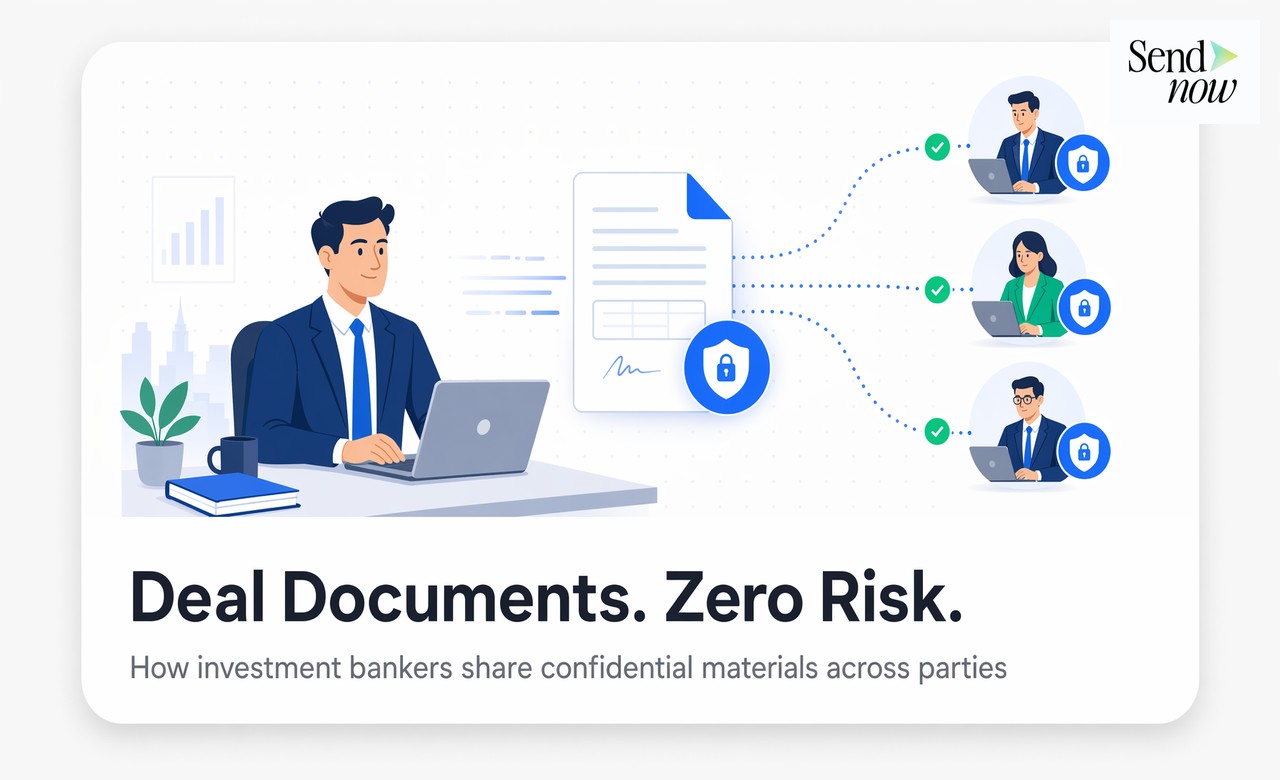
How Investment Bankers Share Deal Documents Without Losing Sleep
Published on April 24, 2026
How Investment Bankers Share Deal Documents Without Losing Sleep
#TLDR — A single leaked CIM can compromise a deal. Investment bankers now use layered document controls — NDA gating, dynamic watermarks, email verification, download blocking, and engagement analytics — all on a single shareable link.
Table of Contents
- What Deal Documents Investment Bankers Share
- The Real Risk of a Single Document Leak
- How IB Firms Control Access with SendNow
- NDA Gating for Term Sheets and CIMs
- Dynamic Watermarks on All Shared Materials
- Follow-Up Intelligence from Document Engagement Analytics
- Frequently Asked Questions
What Deal Documents Investment Bankers Share {#what-documents}
Investment banking transactions involve a specific set of sensitive documents that circulate among multiple parties under strict confidentiality obligations.
The core deal document stack:
| Document Type | Sensitivity | Typical Recipients |
|---|---|---|
| Confidential Information Memorandum (CIM) | Very high | Qualified buyers, investors |
| Teaser | Medium | Broad initial outreach |
| Financial model | Very high | Shortlisted buyers |
| Term sheet | Extremely high | Named counterparty only |
| Pitch deck | High | Target client |
| Management presentation | High | Final round participants |
| Process letter | Medium | All shortlisted parties |
Each of these documents carries a different level of sensitivity and a different set of access requirements. The CIM, for example, should only reach buyers who have signed an NDA and passed initial screening. The financial model should reach only final-round bidders.
Managing these access tiers manually is error-prone. A secure document platform applies the controls automatically, by design.
The Real Risk of a Single Document Leak {#real-risk}
In M&A and capital markets, information asymmetry is the deal itself. The moment a CIM circulates beyond its intended recipients, the deal economics can shift.
Specific risks from document leaks in investment banking:
Regulatory exposure — In public company transactions, premature disclosure of material non-public information can trigger insider trading investigations, regardless of whether the leak was intentional.
Competitive intelligence — A leaked CIM gives competitors insight into the seller's strategy, customer relationships, financial position, and deal terms. This intelligence can be used against the client in negotiations or in the market.
Deal collapse — If a leak causes a story to run in the financial press before the deal is announced, a planned transaction can be forced to abort or renegotiate on worse terms.
Reputational damage — Investment banks depend entirely on reputation. A bank known for document leaks loses mandates. The cost of a single leak dwarfs the cost of the platform that would have prevented it.
The control environment around deal documents is not a compliance exercise. It is an operational requirement that directly affects deal outcomes.
How IB Firms Control Access with SendNow {#access-controls}
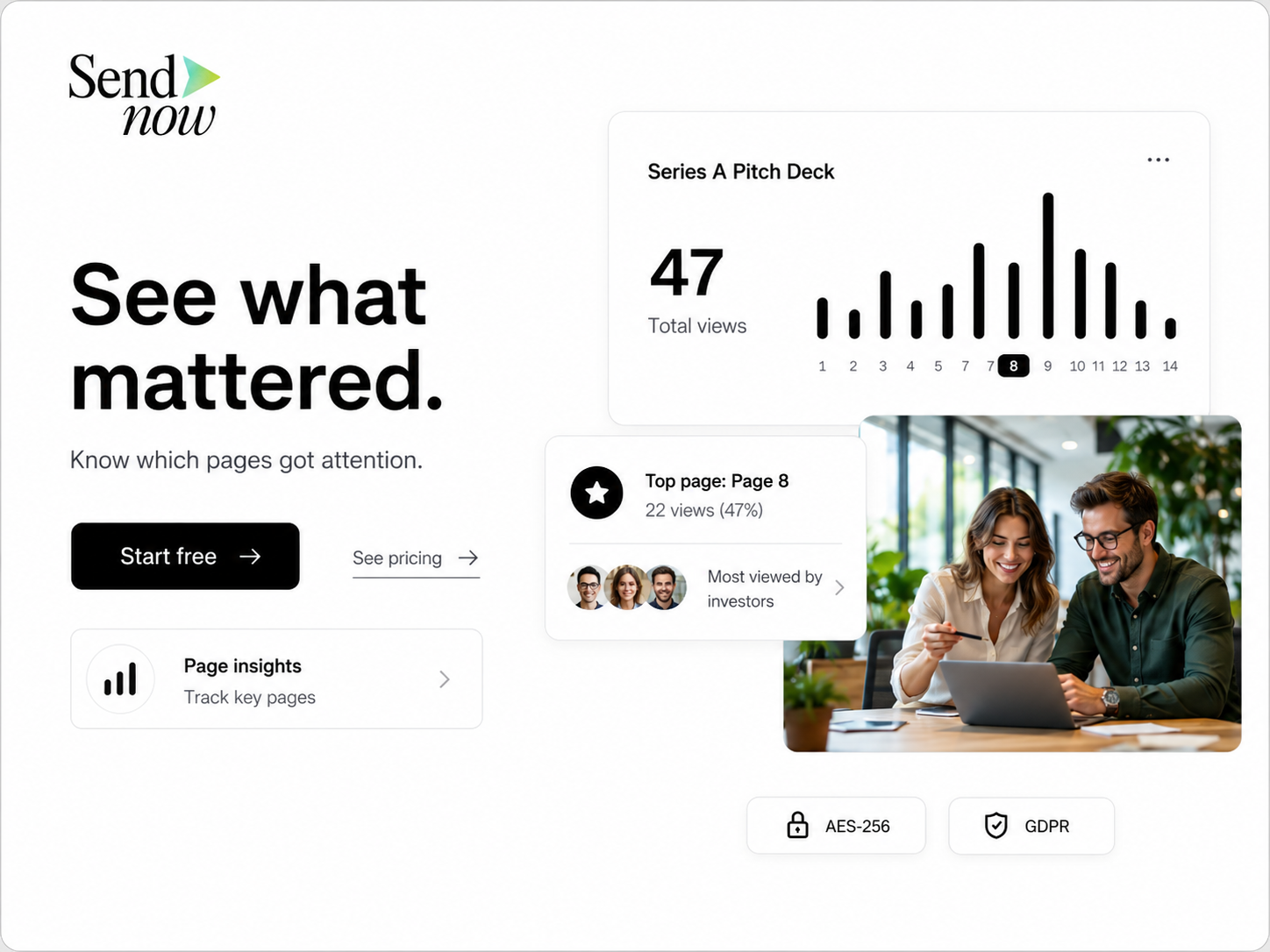
SendNow provides investment banks and independent advisors with a layered control environment for all deal materials, configurable per-document and per-recipient.
The standard control stack for a CIM distribution:
- NDA gate — The recipient must accept the NDA before the document opens. This creates a timestamped, logged acceptance record.
- Email verification — The link only opens for the specific email address it was sent to. Forwarding is blocked at the authentication layer.
- Dynamic watermark — Every page displays the recipient's email address and access timestamp as a visible watermark. This deters screenshot sharing and assists in leak tracing.
- Download block — The document is readable but not downloadable. No local copy is created.
- Screenshot protection — Active protection prevents standard screenshotting tools from capturing clean images of document pages.
- Revocation — If a party drops out of the process, their access can be revoked instantly, even if the link has already been opened.
All of these controls operate simultaneously on a single shared link. There is no additional software for the recipient to install.
NDA Gating for Term Sheets and CIMs {#nda-gating}
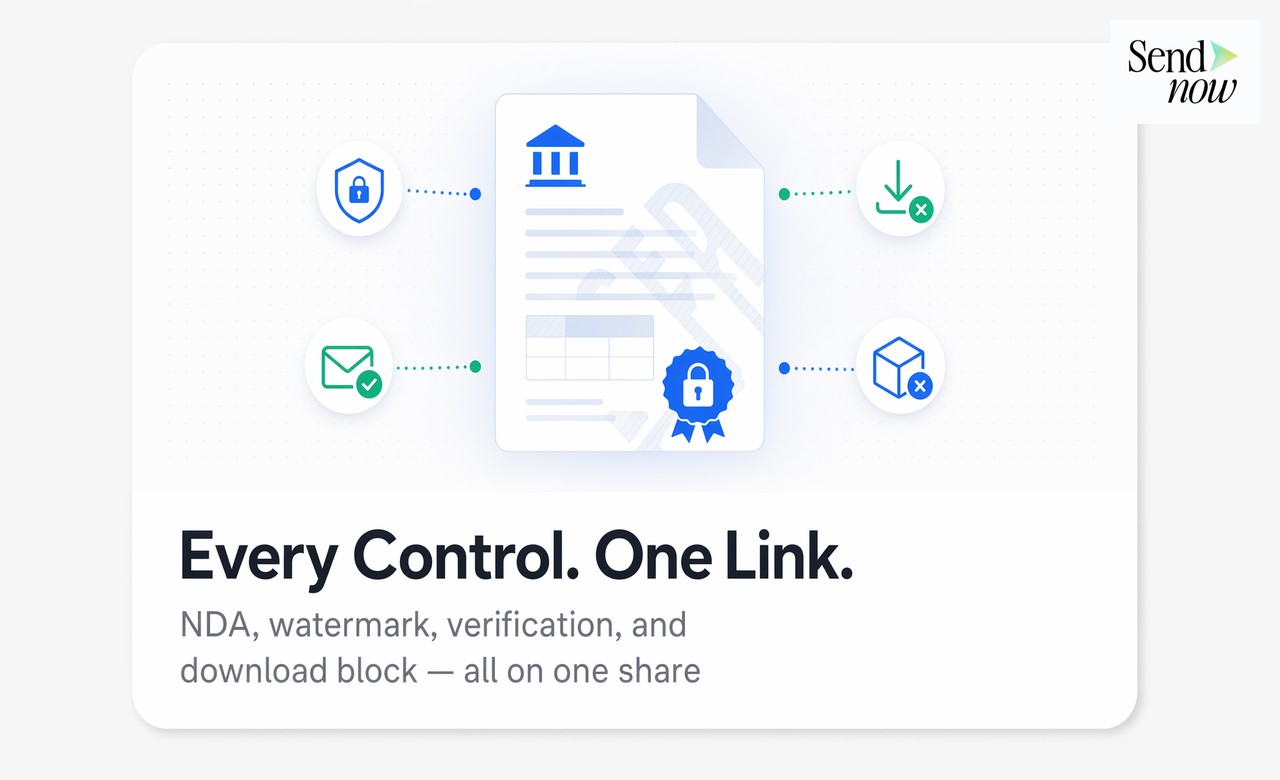
NDA gating is the practice of requiring a recipient to accept a non-disclosure agreement before a document opens. It combines the legal protection of a signed NDA with the convenience of a digital link.
For investment banking purposes, NDA gating serves three functions:
Legal protection. The NDA acceptance is timestamped and logged. If a recipient later discloses confidential information, the log provides evidence of the date and terms of the confidentiality obligation they accepted.
Qualified access control. Requiring NDA acceptance before viewing a CIM filters out recipients who are not serious enough to complete the step. It also ensures that all parties who access the document have accepted the same standard confidentiality terms.
Audit trail for the data room. In regulated transactions, being able to demonstrate that every CIM recipient accepted an NDA before access is part of the process documentation required by deal counsel.
SendNow embeds NDA acceptance directly into the document access flow. The recipient accepts, the acceptance is logged with their verified email and a timestamp, and the document opens. The entire process takes under 30 seconds for the recipient.
Dynamic Watermarks on All Shared Materials {#watermarks}
A dynamic watermark is a watermark that changes based on who is viewing the document. Rather than a static "Confidential" stamp, each page displays the recipient's email address, their name, the date of access, and any other identifiers you configure.
For investment banking, dynamic watermarks serve as a deterrent and a forensic tool.
As a deterrent: A recipient who knows their email address is visible on every page is significantly less likely to photograph, screenshot, or share the document. The watermark makes them personally identifiable as the source of any leak.
As a forensic tool: If a page from a CIM appears in a news story or a competitor's hands, the watermark on that page identifies the specific copy it came from and, by extension, the recipient who had access to it.
This capability has changed how investment banks approach information security in live transactions. The watermark cannot be removed without degrading the document quality. It does not prevent reading. It prevents leaking.
Follow-Up Intelligence from Document Engagement Analytics {#engagement}
The operational advantage of document analytics goes beyond security. It directly affects deal execution.
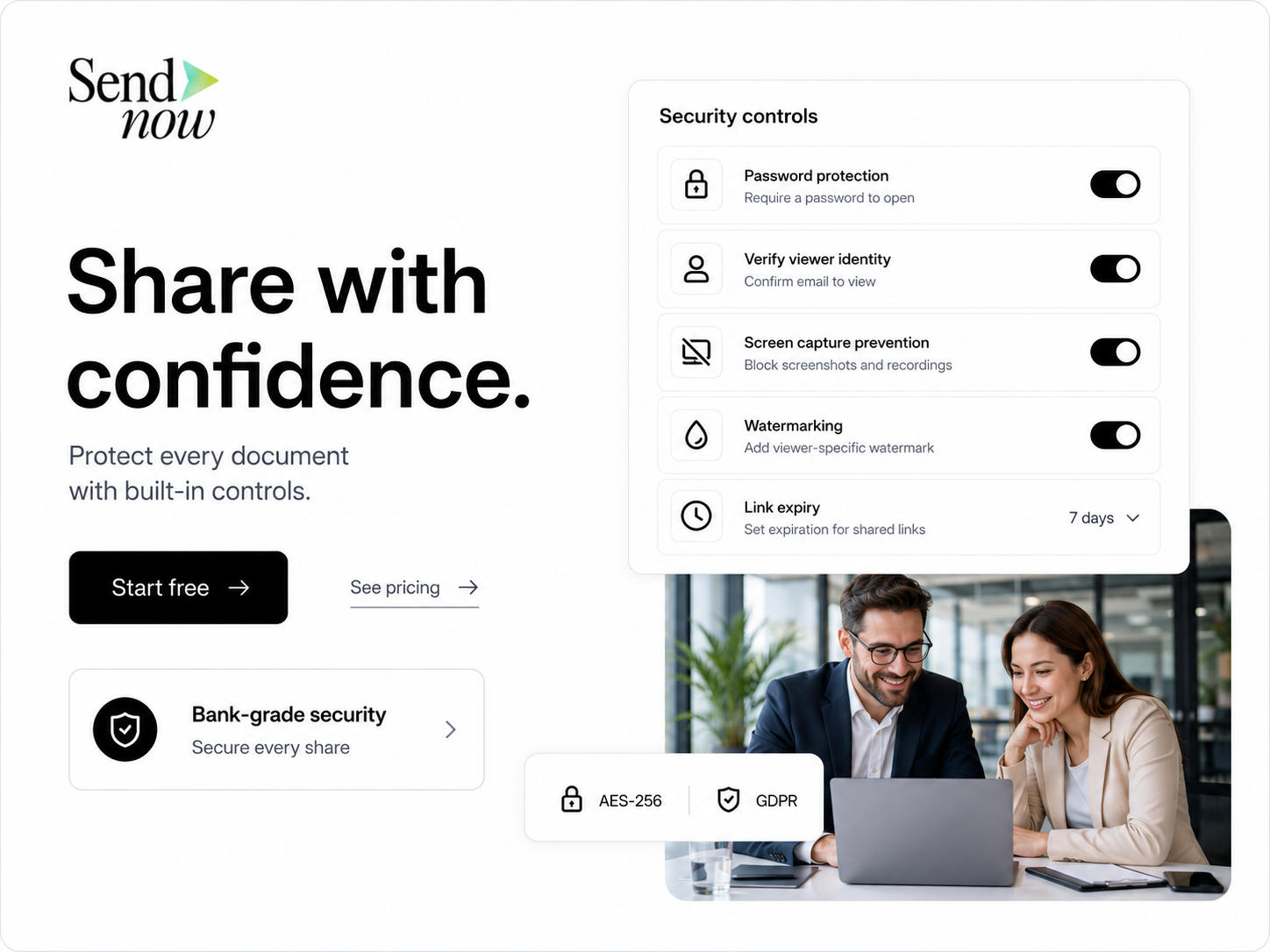
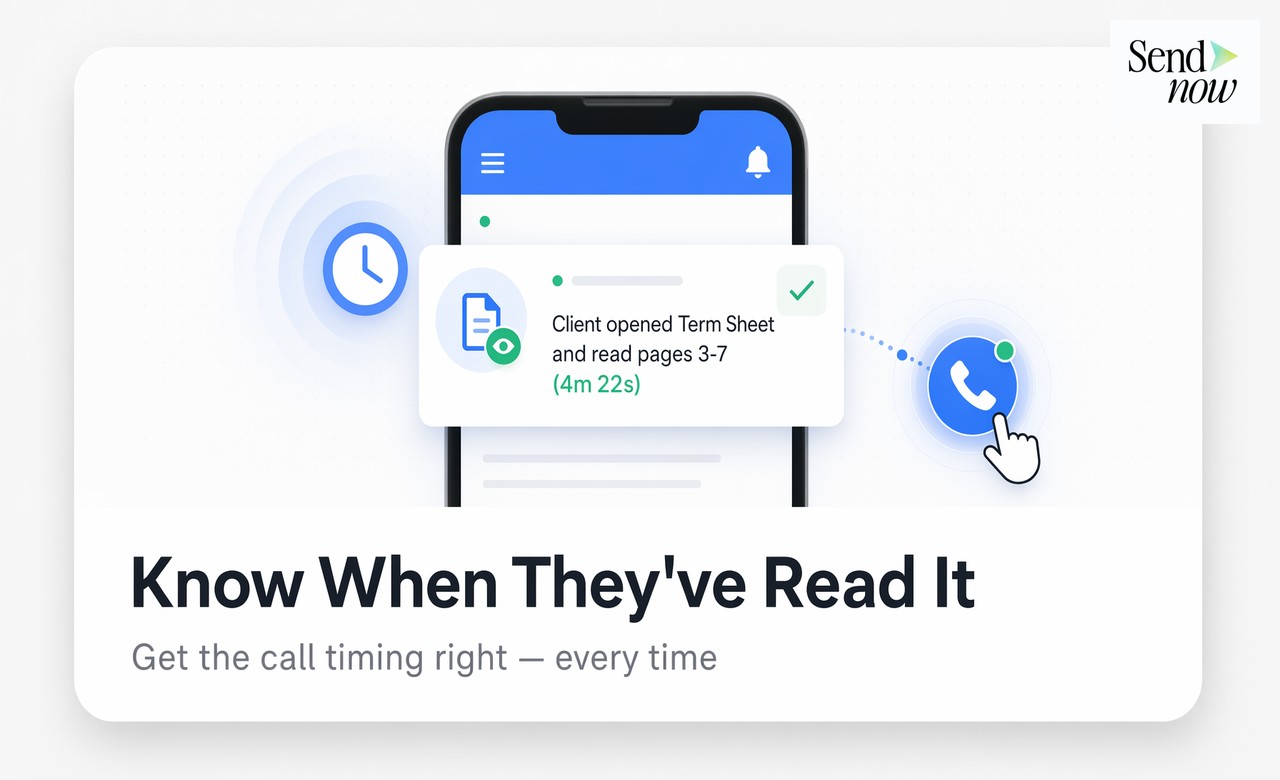
When a banker shares a term sheet via SendNow, they receive a real-time notification the moment the recipient opens it: which pages they read, how long they spent on each, and whether they returned for a second review.
This creates precise follow-up timing.
If a counterparty opens the term sheet and spends eight minutes on the pricing page, that is the moment to call. They are engaged. They have read the material. The conversation is productive.
If a counterparty opens the teaser but does not open the CIM after two days, they may need a different angle or a follow-up email that addresses a specific concern.
Document engagement data turns the black box of "did they read it?" into a real-time signal that experienced bankers use to drive process velocity.
Frequently Asked Questions {#faqs}
1. What is financial document security in investment banking? Financial document security refers to the controls used to ensure that sensitive deal materials like CIMs, term sheets, and financial models are accessed only by authorised parties and cannot be leaked or distributed without detection.
2. How does NDA gating work in practice? The recipient receives a link. Before the document opens, they are presented with the NDA terms and must click to accept. The acceptance is logged with their email, IP address, and a timestamp. The document then opens.
3. Can dynamic watermarks be removed? Dynamic watermarks can be rendered less visible by degrading document quality, but removing them cleanly from a rendered PDF without visible distortion is not feasible with standard tools. This is what makes them an effective deterrent.
4. What happens if a CIM recipient leaves their firm during the process? You can revoke their individual access link immediately. Even if they attempt to open the link after revocation, access is denied. You can then issue a new link to their replacement.
5. Does download blocking prevent all copies of the document being made? Download blocking prevents automated download of the source file. Combined with dynamic watermarking and screenshot protection, it significantly raises the effort required to create an undetected copy.
6. Can engagement analytics tell me which sections of a document generated the most interest? Yes. SendNow's page-by-page analytics show time spent per page, return visits, and total engagement time. This tells you exactly which sections attracted the most attention.
7. Is SendNow suitable for live M&A transactions? Yes. SendNow is used by financial professionals for live transactions including M&A, capital raises, and private placements. It provides the access controls, NDA gating, and audit trail required for these processes.
8. How does GDPR apply to deal document sharing in EU transactions? Deal documents in EU transactions often contain personal data about management teams, employees, or customers. The firm distributing documents is a data controller. Documents should be shared via GDPR-compliant infrastructure with appropriate access controls and a Data Processing Agreement with the platform provider.
Secure Your Next Deal
Start for free at sendnow.live and apply NDA gating, watermarking, and engagement analytics to your next CIM or term sheet distribution.
Written by Alex Carter. Alex covers document security, deal workflow, and financial information controls for investment banking professionals.
<script type="application/ld+json"> }, { "@type": "Question", "name": "How does NDA gating work in practice?", "acceptedAnswer": { "@type": "Answer", "text": "The recipient receives a link. Before the document opens, they are presented with the NDA terms and must click to accept. The acceptance is logged with their email, IP address, and a timestamp. The document then opens." } }, { "@type": "Question", "name": "Can dynamic watermarks be removed?", "acceptedAnswer": { "@type": "Answer", "text": "Dynamic watermarks can be rendered less visible by degrading document quality, but removing them cleanly from a rendered PDF without visible distortion is not feasible with standard tools." } }, { "@type": "Question", "name": "What happens if a CIM recipient leaves their firm during the process?", "acceptedAnswer": { "@type": "Answer", "text": "You can revoke their individual access link immediately. Even if they attempt to open the link after revocation, access is denied. You can then issue a new link to their replacement." } }, { "@type": "Question", "name": "Does download blocking prevent all copies of the document being made?", "acceptedAnswer": { "@type": "Answer", "text": "Download blocking prevents automated download of the source file. Combined with dynamic watermarking and screenshot protection, it significantly raises the effort required to create an undetected copy." } }, { "@type": "Question", "name": "Can engagement analytics tell me which sections of a document generated the most interest?", "acceptedAnswer": { "@type": "Answer", "text": "Yes. Page-by-page analytics show time spent per page, return visits, and total engagement time — telling you exactly which sections attracted the most attention." } }, { "@type": "Question", "name": "Is SendNow suitable for live M&A transactions?", "acceptedAnswer": { "@type": "Answer", "text": "Yes. SendNow is used by financial professionals for live transactions including M&A, capital raises, and private placements. It provides the access controls, NDA gating, and audit trail required for these processes." } }, { "@type": "Question", "name": "How does GDPR apply to deal document sharing in EU transactions?", "acceptedAnswer": { "@type": "Answer", "text": "Deal documents in EU transactions often contain personal data. The firm distributing documents is a data controller and must share via GDPR-compliant infrastructure with appropriate access controls and a Data Processing Agreement with the platform provider." } } ] } </script>