
How Law Firms Share Confidential Documents Without Violating Privilege
Published on April 24, 2026
How Law Firms Share Confidential Documents Without Violating Privilege
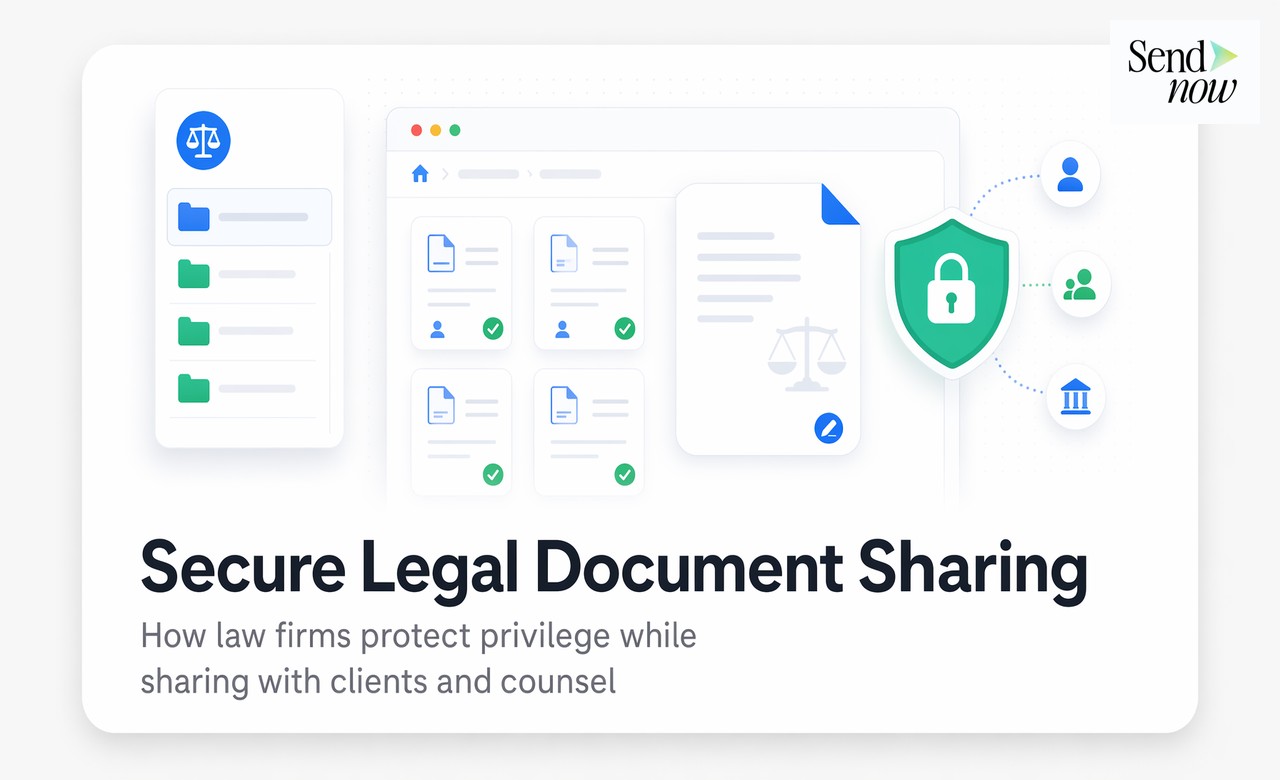
#TLDR — Attorney-client privilege requires confidentiality. Every document shared by email without access controls is a potential privilege waiver. Secure portals with matter-specific permissions and verifiable access logs are the only defensible standard for digital document sharing in legal practice.
Table of Contents
- The Challenge of Digital Document Sharing for Law Firms
- Privilege and Confidentiality Requirements
- What a Secure Legal Document Portal Needs
- Per-Matter Access Controls in SendNow
- Audit Logs for Privilege Protection in Disputes
- GDPR for Law Firms Sharing with EU Clients
- Frequently Asked Questions
The Challenge of Digital Document Sharing for Law Firms {#challenge}
Law firms generate documents that are among the most sensitive in existence: witness statements, litigation strategy memos, expert reports, draft contracts, due diligence findings, and privileged advice letters. Each of these carries specific confidentiality obligations.
The challenge is that clients, co-counsel, and counterparties all need access to subsets of these documents, and they need it quickly. Slow delivery creates friction. Insecure delivery creates liability.
The tools most firms still rely on — email attachments and consumer cloud storage — were not designed for legal confidentiality requirements. They have no per-matter access controls, no audit trail, no privilege documentation, and no mechanisms for immediate access revocation.
The gap between what legal practice requires and what email provides is where privilege disputes begin.
Privilege and Confidentiality Requirements {#privilege}
Attorney-client privilege protects confidential communications between a lawyer and their client made for the purpose of obtaining legal advice. For the privilege to hold, the communication must have been made in circumstances where confidentiality was intended and maintained.
In digital document sharing, this means the firm must be able to demonstrate:
- The document was shared only with the intended recipient
- No unauthorised third party accessed it
- Reasonable steps were taken to prevent unintended disclosure
Courts in multiple EU jurisdictions have found that privilege can be waived by careless handling of privileged documents in digital environments. Sending a privileged memo to an unverified email address, or storing it in a shared folder accessible to non-authorised parties, has been treated as evidence that confidentiality was not maintained.
A secure document portal with verified access, per-matter controls, and an immutable access log addresses each of these requirements directly.
What a Secure Legal Document Portal Needs {#portal-requirements}
Not every "secure" portal meets legal practice requirements. The following features are necessary for law firm use:
| Feature | Legal Purpose |
|---|---|
| Per-matter access isolation | Prevents cross-matter data contamination |
| Email verification | Confirms identity of the recipient |
| NDA gating | Captures confidentiality acknowledgement before access |
| Download blocking | Prevents uncontrolled document distribution |
| Immediate access revocation | Terminates access when matter closes or party changes |
| Immutable access log | Documents exactly who accessed what, and when |
| AES-256 encryption | Protects data in transit and at rest |
| GDPR-compliant hosting | Required for EU client data |
| No third-party account required | Clients should not need to create platform accounts |
The combination of email verification and an immutable access log is particularly important for privilege purposes. It creates a chain of evidence: this document was accessible only to this verified email address, and here is the log showing who accessed it and when.
Per-Matter Access Controls in SendNow {#per-matter}
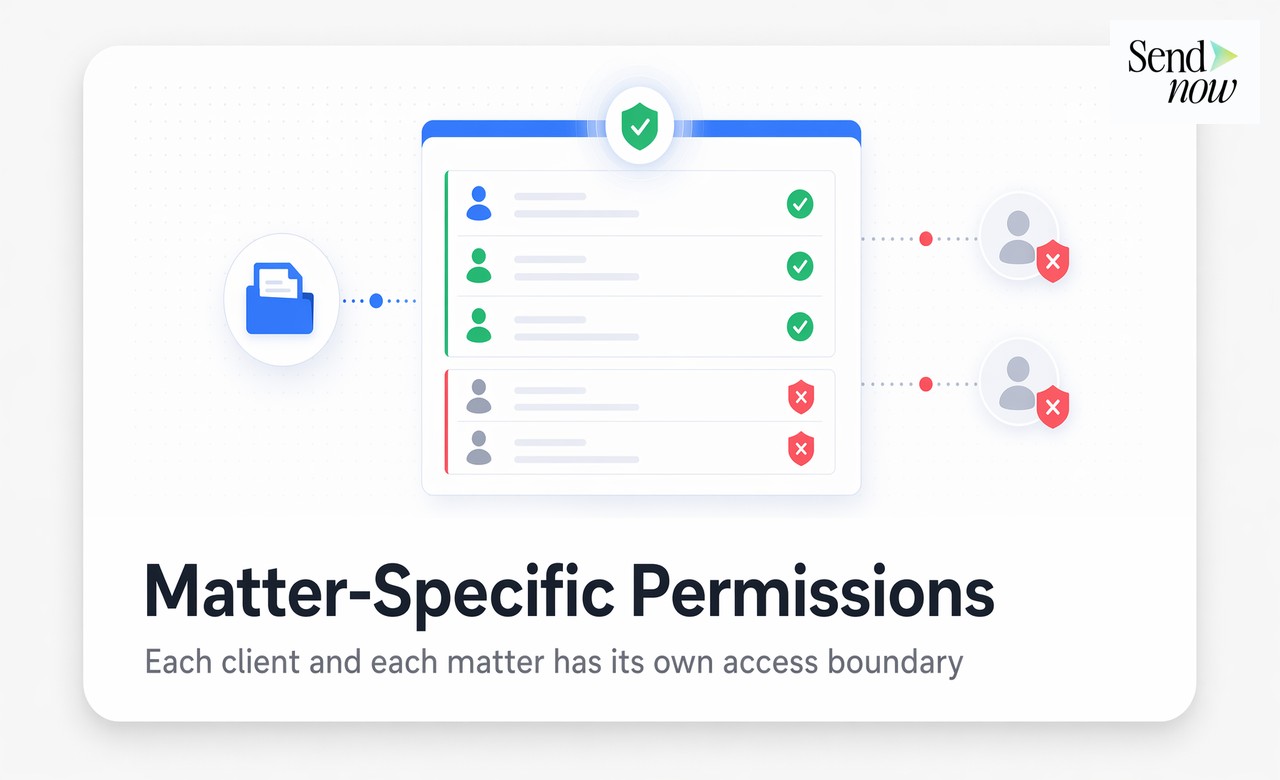
SendNow supports matter-specific access controls that map directly to the way law firms organise their work.
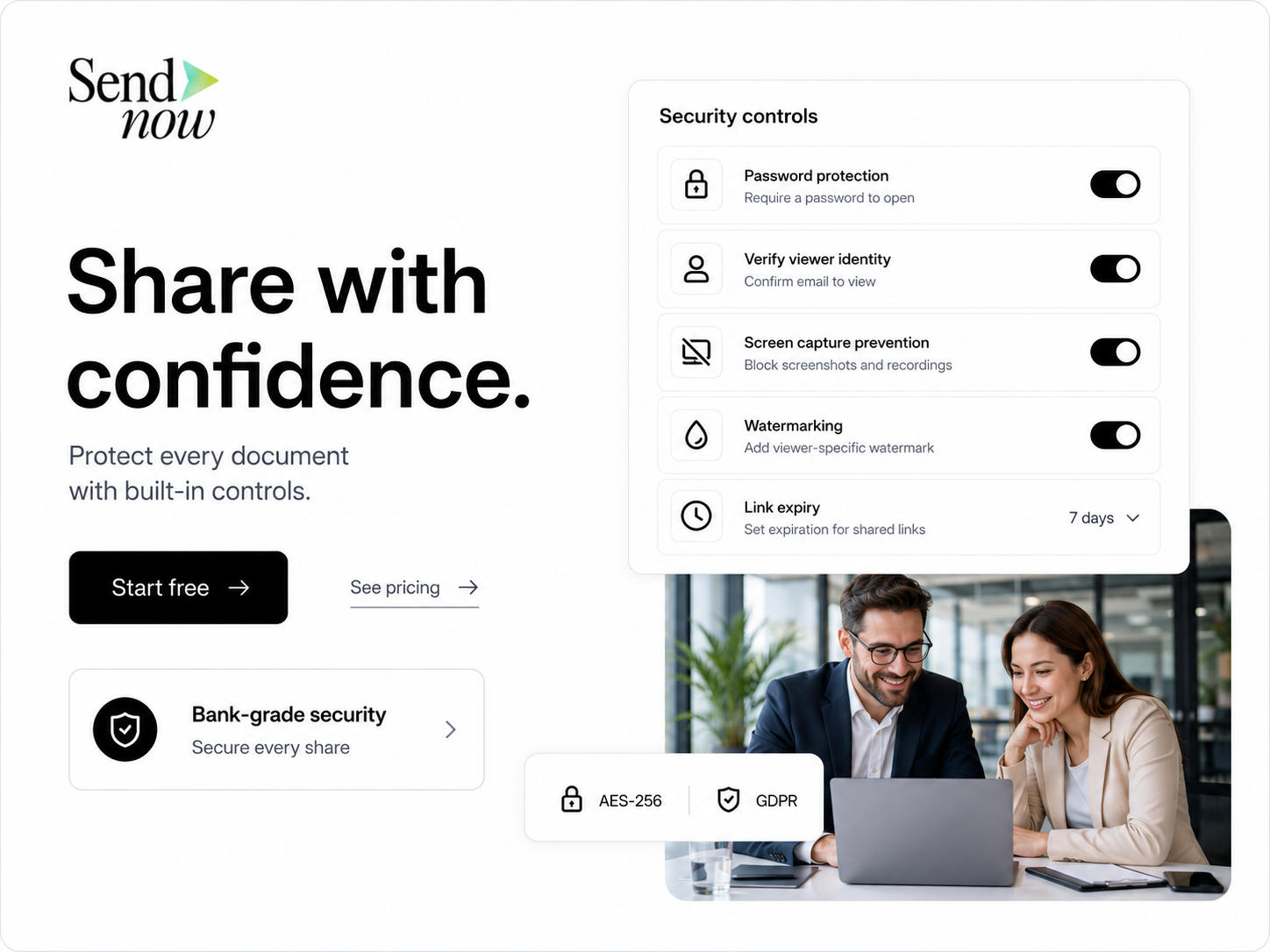
Each matter gets its own isolated document space. The supervising solicitor or partner sets the access list for that space: named clients, named co-counsel, named experts. No one outside the authorised list can see or access the documents in that space, even if they have the direct URL.
Practical setup for a litigation matter:
- Create a new SendNow space for the matter (referenced by matter number, not client name, for internal security)
- Upload the documents relevant to that stage: pleadings, witness statements, expert reports, correspondence
- Add authorised recipients by verified email address
- Enable NDA gating if the matter requires a confidentiality acknowledgement before access
- Set download blocking on privileged advice letters and strategy documents
- Set an expiry date for each document set aligned with disclosure deadlines or matter closure
When a matter closes, revoke access with a single click. The access log for the matter remains available for as long as you need it for professional indemnity or dispute purposes.
Audit Logs for Privilege Protection in Disputes {#audit-logs}
The most valuable feature of a secure legal document portal is one that only becomes apparent when something goes wrong.
If a privileged document is disputed, the question the court or regulator asks is: who had access to this document, when did they access it, and what did they see?
An email attachment cannot answer any of these questions. It left your server. After that, you have no record.
A SendNow access log answers all three:
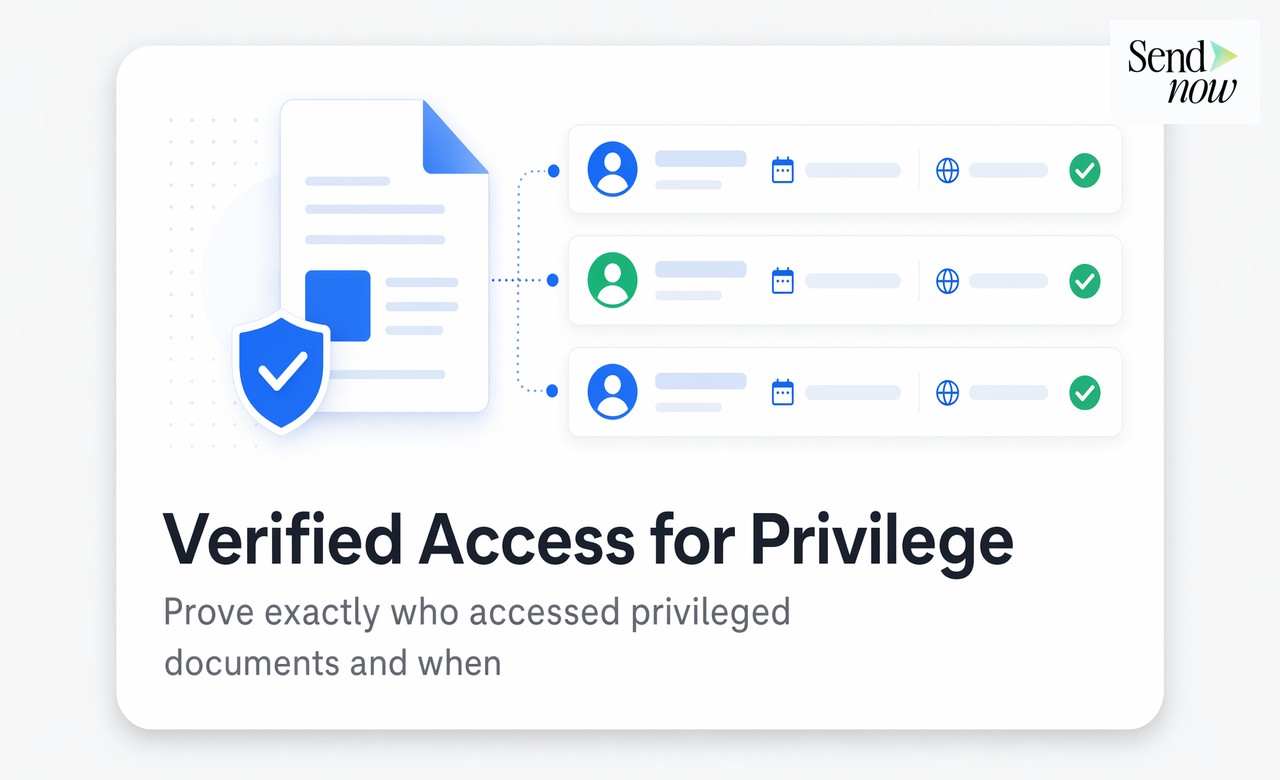
- The verified email address of every person who accessed the document
- The exact timestamp of each access
- The pages viewed during each session
- The IP address of the accessing device
- Confirmation that the download block was in effect during each session
This log is tamper-resistant and exportable. In a privilege dispute, it serves as primary evidence that access was controlled and that only named authorised parties ever viewed the document.
GDPR for Law Firms Sharing with EU Clients {#gdpr}
Law firms sharing documents with EU clients are subject to GDPR in their capacity as data controllers. Client documents routinely contain personal data: names, addresses, financial details, health information in personal injury matters, and more.
The GDPR obligations most relevant to document sharing are:
Lawful basis for processing — Sharing documents in the context of a legal engagement is covered by the performance of a contract or compliance with a legal obligation. No separate consent is required for document sharing in the context of the retainer.
Data minimisation — Share only what is necessary for the specific recipient's role in the matter. Per-matter access controls enforce this automatically.
Security of processing — Article 32 requires "appropriate technical and organisational measures" to protect personal data. Access-controlled, encrypted, audited document portals satisfy this requirement. Email attachments do not.
Right to erasure — When a client exercises their right to erasure, revoking their document access link satisfies the obligation for copies you have shared with them. The access log itself should be retained for the duration of your professional indemnity obligations before deletion.
Data processing agreements — Any system used to share client documents is a data processor. Ensure your portal provider offers a signed DPA. SendNow provides DPAs for professional and enterprise use.
Frequently Asked Questions {#faqs}
1. What is a client portal for law firms? A client portal is a secure web-based space where law firms share case documents with clients and authorised parties, with access controls, audit logging, and without relying on email attachments.
2. Can a document portal help protect attorney-client privilege? Yes. A portal with email verification, per-matter access controls, and an immutable access log creates documented evidence that privileged documents were shared only with authorised parties.
3. What happens if a document is accidentally shared with the wrong party? With a secure portal, you can revoke access immediately. The access log shows whether the document was actually opened before revocation, which is important for assessing whether a privilege waiver may have occurred.
4. Do clients need to install software or create an account? No. Email verification allows clients to access their documents via a link confirmation. No account creation, no software, and no app is required.
5. Can download blocking be set per-document rather than globally? Yes. You can set download restrictions individually on each document, so clients can download non-privileged correspondence while privileged advice letters remain view-only.
6. Is the access log admissible in court proceedings? Audit logs from secure document platforms have been used as evidence in commercial and regulatory proceedings. Admissibility depends on jurisdiction and the specific circumstances. Your firm's IT security policy should document how the platform log is generated and stored.
7. How is per-matter access isolation enforced? Each matter space is a separate access-controlled environment. A user with access to one matter cannot see documents in another matter, even if they have previously used the same platform.
8. How does GDPR apply to document sharing in legal matters? Law firms are data controllers under GDPR. Client document sharing must be conducted with appropriate technical measures, including encryption and access controls. The firm must also have a Data Processing Agreement with any platform used to share client data.
Protect Your Clients and Your Practice
Start for free at sendnow.live and set up matter-specific, privilege-protected document sharing for your law firm today.
Written by Alex Carter. Alex covers document security, legal technology, and compliance workflows for professional services firms.
<script type="application/ld+json"> }, { "@type": "Question", "name": "Can a document portal help protect attorney-client privilege?", "acceptedAnswer": { "@type": "Answer", "text": "Yes. A portal with email verification, per-matter access controls, and an immutable access log creates documented evidence that privileged documents were shared only with authorised parties." } }, { "@type": "Question", "name": "What happens if a document is accidentally shared with the wrong party?", "acceptedAnswer": { "@type": "Answer", "text": "With a secure portal, you can revoke access immediately. The access log shows whether the document was actually opened before revocation, which is important for assessing whether a privilege waiver may have occurred." } }, { "@type": "Question", "name": "Do clients need to install software or create an account?", "acceptedAnswer": { "@type": "Answer", "text": "No. Email verification allows clients to access their documents via a link confirmation. No account creation, no software, and no app is required." } }, { "@type": "Question", "name": "Can download blocking be set per-document rather than globally?", "acceptedAnswer": { "@type": "Answer", "text": "Yes. You can set download restrictions individually on each document, so clients can download non-privileged correspondence while privileged advice letters remain view-only." } }, { "@type": "Question", "name": "Is the access log admissible in court proceedings?", "acceptedAnswer": { "@type": "Answer", "text": "Audit logs from secure document platforms have been used as evidence in commercial and regulatory proceedings. Admissibility depends on jurisdiction and the specific circumstances." } }, { "@type": "Question", "name": "How is per-matter access isolation enforced?", "acceptedAnswer": { "@type": "Answer", "text": "Each matter space is a separate access-controlled environment. A user with access to one matter cannot see documents in another matter, even if they have previously used the same platform." } }, { "@type": "Question", "name": "How does GDPR apply to document sharing in legal matters?", "acceptedAnswer": { "@type": "Answer", "text": "Law firms are data controllers under GDPR. Client document sharing must be conducted with appropriate technical measures, including encryption and access controls. The firm must also have a Data Processing Agreement with any platform used to share client data." } } ] } </script>