Secure Document Sharing: The Complete Guide for Financial Professionals
Published on April 24, 2026
TLDR
Financial documents carry regulatory obligations, client trust, and deal-sensitive information that standard file sharing tools are not built to handle. Every secure share needs a minimum of six controls — from encryption and access gating to expiry and analytics — to meet professional and regulatory standards. The teams that add document analytics to their workflow also close deals faster because they know precisely when to follow up.
Table of Contents
- Why Financial Documents Need Special Handling
- 6 Controls Every Secure Share Needs
- Analytics for Follow-Up Timing
- GDPR and AES-256 Compliance
- Best Practices by Document Type
- Step-by-Step Secure Share Guide
- FAQs
Why Financial Documents Need Special Handling
A pitch deck, a term sheet, a financial model, or a board pack is not a marketing PDF. These documents contain material non-public information, personal financial data, trade secrets, and projections that carry legal weight.
Three categories of risk make standard email attachments insufficient.
Regulatory risk. Under GDPR, any document containing personal data — including named investor reports, client statements, or KYC documents — must be transferred with appropriate technical and organizational safeguards. An email attachment with no encryption, no access log, and no ability to delete remotely does not satisfy Article 32.
Commercial risk. A pitch deck shared too broadly before a funding round closes can compromise your negotiating position, attract competitor attention, or violate your NDA with the recipient. You need controls that prevent unauthorized redistribution.
Operational risk. When a recipient claims they never received a document, or disputes what version they were shown, you need a time-stamped audit trail. Without one, the dispute resolution defaults to email threads and memory — both unreliable.
6 Controls Every Secure Share Needs
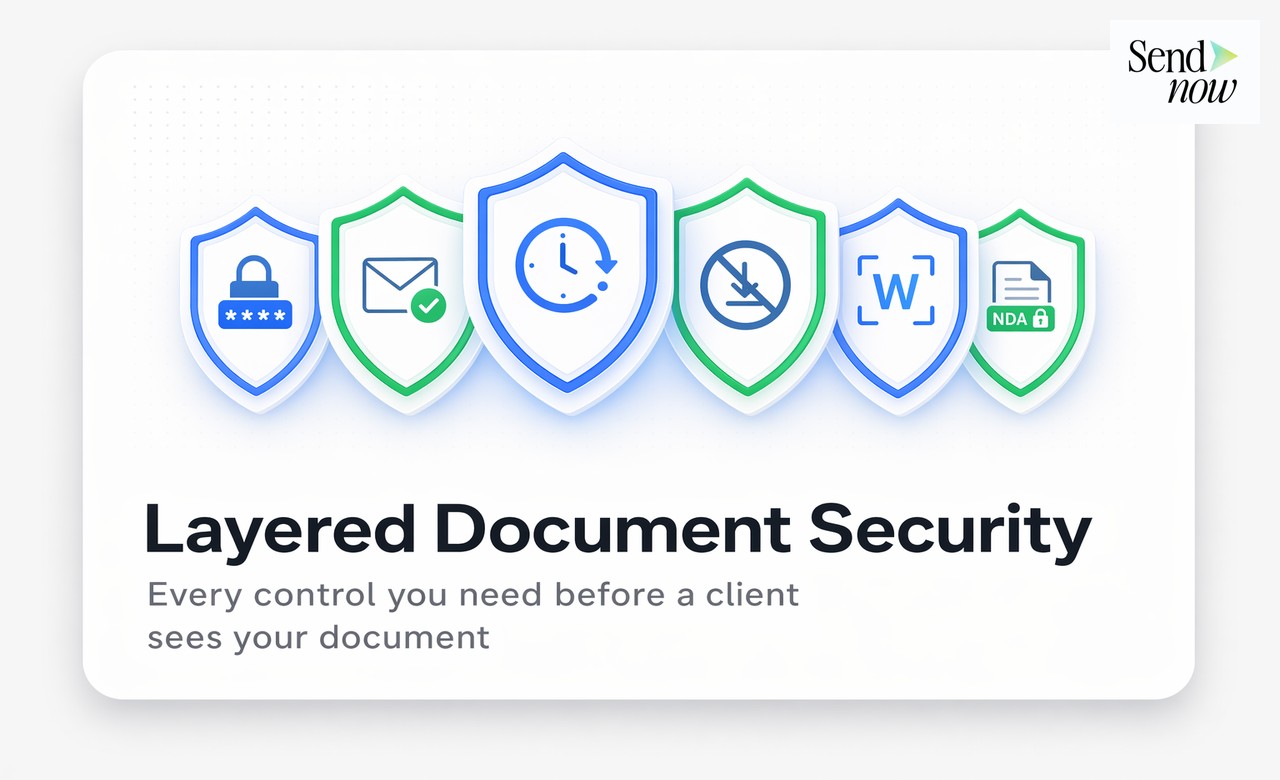
1. Encryption at rest and in transit. AES-256 encryption protects the document in storage and while it moves across networks. Any platform you use for financial documents should provide this by default and be able to confirm which encryption standard applies.
2. Email verification. Before a recipient can open the document, they verify their email address via a one-time code. This confirms identity and creates an auditable access event linked to a specific person, not just an anonymous click on a link.
3. Password protection. A secondary password layer on top of email verification adds defense in depth. The password is shared through a separate channel (phone or encrypted message), so intercepting the link alone is not enough to gain access.
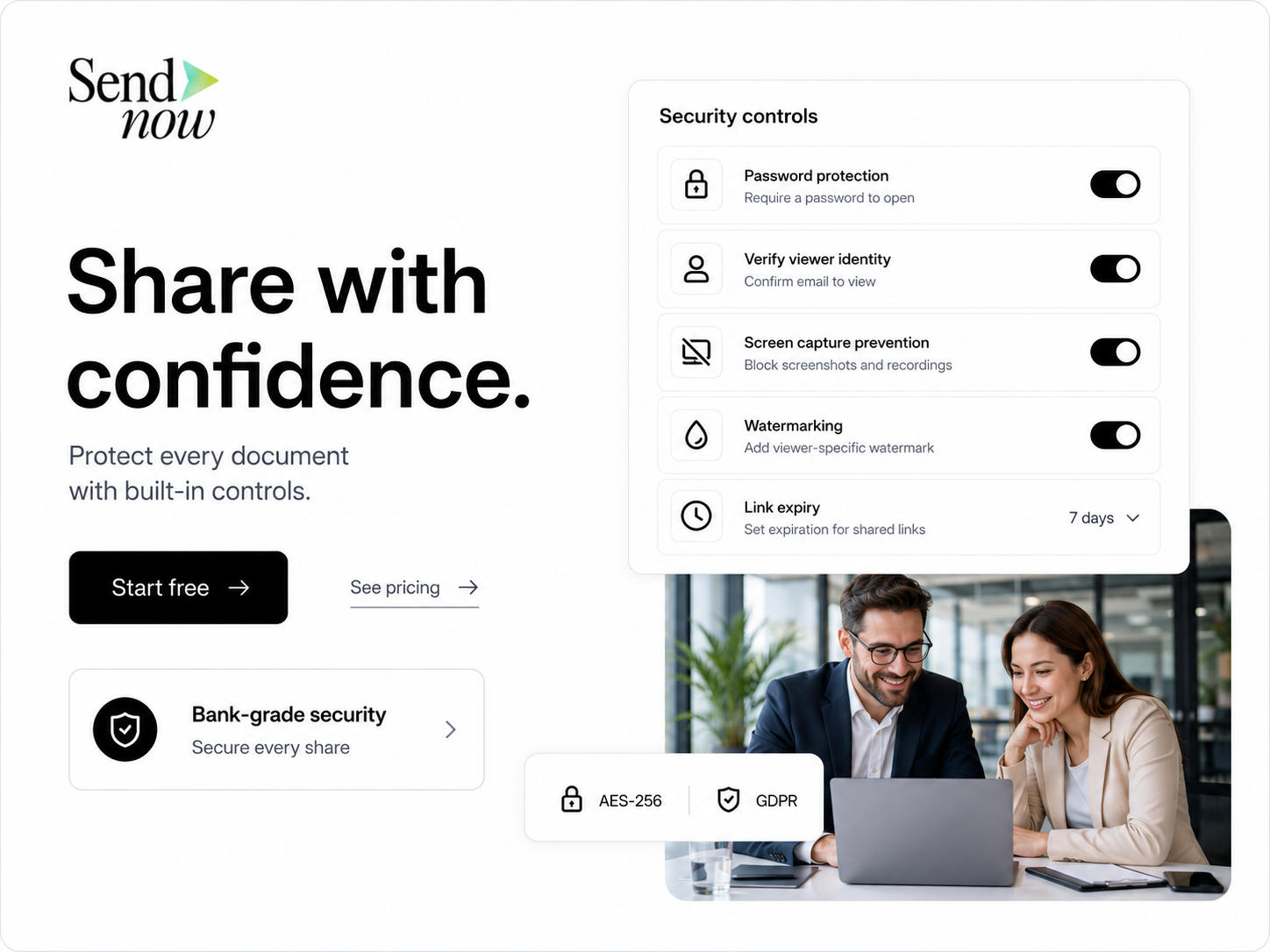
4. Expiry. Set the link to expire after a defined date, a defined number of views, or both. Documents shared during a live deal process should not remain accessible indefinitely after the deal closes or falls through.
5. Download block and screenshot deterrent. Preventing download keeps the document inside a controlled viewer. Dynamic watermarking — where the viewer's name, email, and access time appear burned into each page — deters screenshot leaks because any shared image is traceable.
6. Revocation. The ability to instantly revoke access to a shared document is the most powerful control of all. If a recipient is no longer authorized, you kill the link. Unlike an email attachment already sitting in their inbox, a revoked link renders the document inaccessible immediately.
Analytics for Follow-Up Timing
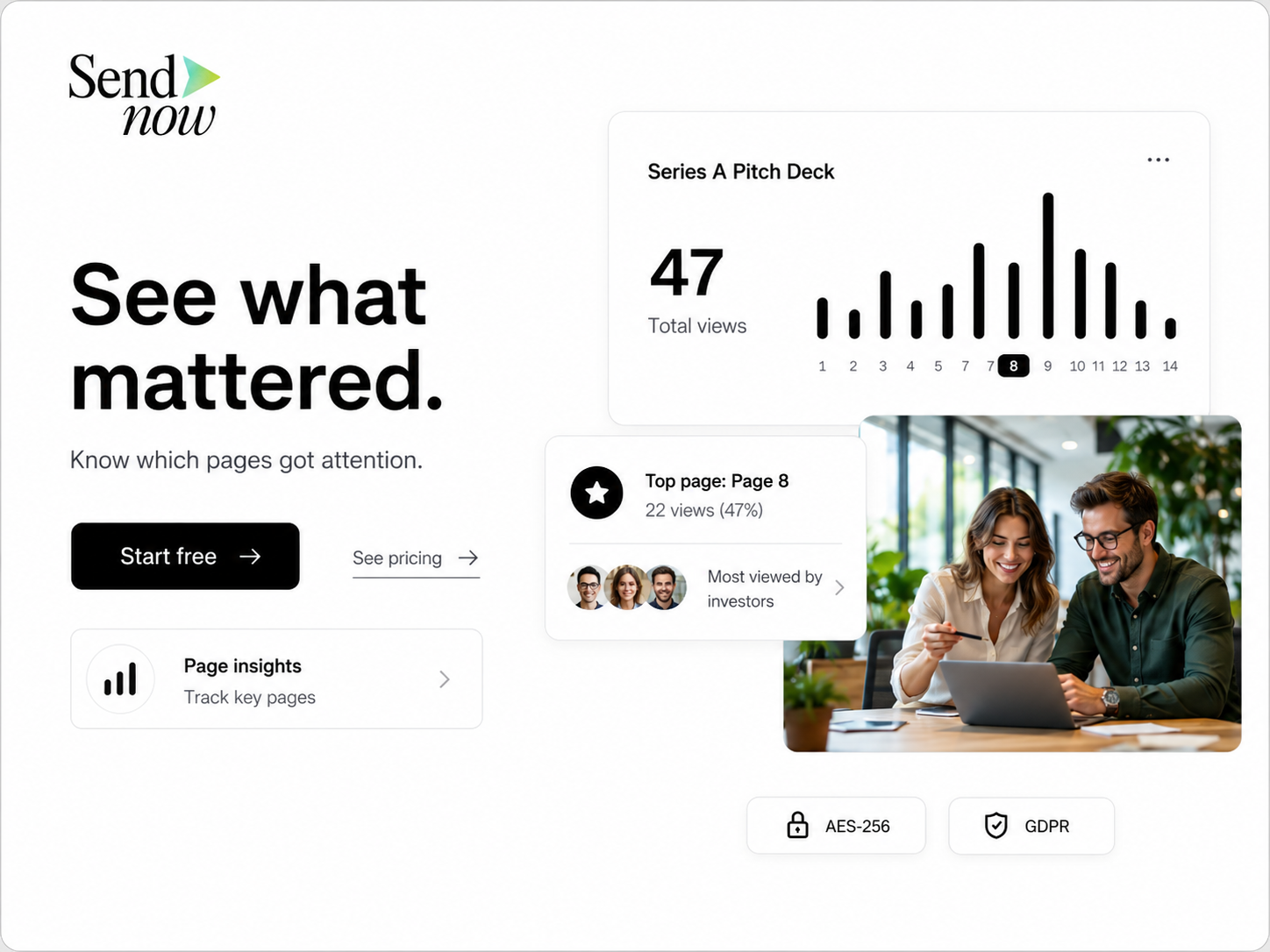
Document analytics transform passive sharing into an active intelligence feed. When you know that a prospective investor opened your pitch deck at 6 PM, read pages 8 through 12 (your financial model summary) three times, and then returned the next morning — you call them that morning, not three days later.
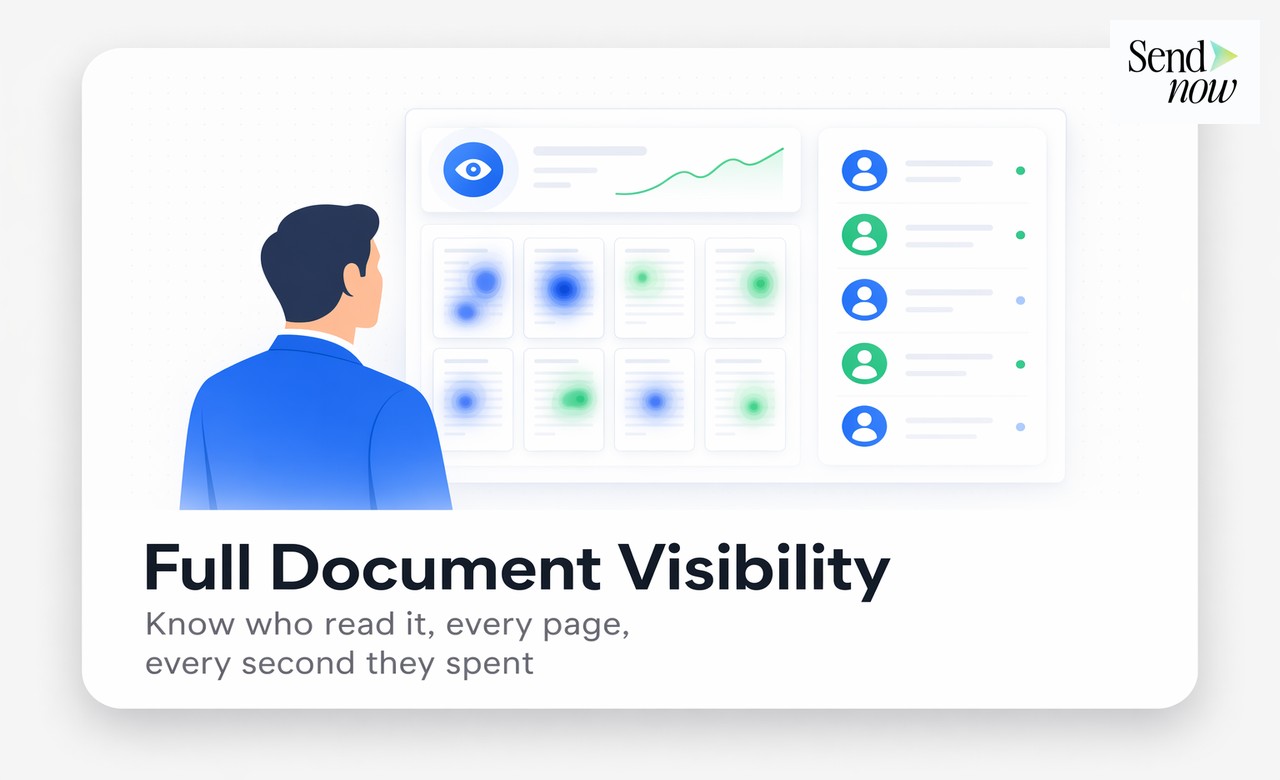
SendNow provides page-by-page analytics for every document you share. The dashboard shows total opens, time spent per page, viewer identity (post email verification), return visits, and a chronological access log. You can configure Slack alerts that fire the moment a recipient opens a document, so your team responds while the content is fresh in the prospect's mind.
This level of visibility changes follow-up from guesswork to precision. Finance teams using document analytics report materially shorter response cycles because their outreach is triggered by demonstrated engagement rather than arbitrary timers.
GDPR and AES-256 Compliance
For EU-based financial professionals, GDPR compliance is a baseline requirement, not a differentiator. Article 32 of the GDPR requires organizations to implement appropriate technical and organizational measures to protect personal data. For document sharing, this means:
- AES-256 encryption at rest and in transit. This is the industry standard adopted by AWS, Azure, and Google Cloud for sensitive data storage.
- Access logging. You must be able to demonstrate who accessed personal data and when. A full audit trail satisfies this requirement.
- Data residency. Personal data must be processed within the EU or a jurisdiction with an adequacy decision. Verify that your document sharing platform explicitly offers EU data residency.
- Right to erasure. GDPR gives data subjects the right to request deletion of their data. A platform that supports link revocation and document deletion from its servers helps you honor this right.
- Data processing agreements. Your platform provider is a data processor under GDPR. They must sign a DPA with you that specifies how they handle the data you store on their platform.
SendNow provides AES-256 encryption, EU data residency on AWS, full audit trails, and a DPA — covering the technical requirements of Article 32 for document sharing workflows.
Best Practices by Document Type
Pitch decks. Apply email verification and NDA gating before the first view. Enable page analytics so you know which slides generated the most attention. Set a 14-day expiry that resets with a fresh link for each new investor meeting.
Term sheets. Password protect with a separately communicated password. Disable downloads and enable revocation so you control the active version at all times. Never share via email attachment — a term sheet in someone's email archive is outside your control forever.
Financial models. Block all downloads (an Excel model in a prospect's hands is an uncontrolled asset). Share a read-only link with watermarking and page analytics. Restrict access to named, email-verified recipients only.
Board packs and management accounts. Apply full security: email verification, password, download block, watermark, and a defined expiry aligned to your board meeting cycle. Archive each version with its access log after the meeting.
KYC and AML documents. These carry the highest GDPR sensitivity. Confirm EU data residency, apply maximum access controls, and ensure the platform provides a DPA before uploading.
Step-by-Step Secure Share Guide
- Upload your document to SendNow. The file encrypts with AES-256 on upload and never leaves the secure environment as a raw file.
- Apply access controls. Enable email verification, set a password, and configure an expiry (recommended: 14 days for pitch decks, 7 days for term sheets).
- Enable NDA gating if the document contains material non-public information or trade secrets.
- Block downloads and enable watermarking. Every page will display the viewer's email and access timestamp.
- Copy the secure link. Share it via email or your preferred channel. The password goes through a separate channel.
- Monitor the analytics dashboard. Set a Slack alert so you know the moment the link is opened.
- Follow up while engagement is hot. If the analytics show a viewer spent 12 minutes on your financial projections, call them within the hour.
- Revoke the link when the process ends or the recipient is no longer authorized.
Start your first secure share at sendnow.live
FAQs
Q1: What makes a document sharing platform GDPR compliant? A GDPR-compliant platform provides AES-256 encryption, EU data residency, access logging, document deletion capability, and a signed data processing agreement. All five elements are necessary; a platform that offers only encryption does not satisfy Article 32 in full.
Q2: What is the most secure way to share a financial document? The most secure method combines email verification, a separately communicated password, download blocking, dynamic watermarking, a short expiry, and the ability to revoke access instantly. This is the full security stack available through platforms like SendNow.
Q3: Can I share a financial model securely without allowing the recipient to download it? Yes. Link-based document sharing platforms render the file inside a protected viewer that blocks the download button and right-click actions. Dynamic watermarks add a further deterrent against screenshot leaks.
Q4: What is an NDA gate in document sharing? An NDA gate requires the recipient to read and electronically accept a non-disclosure agreement before they can view the document. The acceptance is logged with a timestamp, providing a contractually significant record.
Q5: How do document analytics help close deals? Analytics show which pages a prospect focused on and when they returned. This data lets you follow up with precision — calling a prospect minutes after they spend 15 minutes on your financial projections, rather than guessing when to reach out.
Q6: Is AES-256 encryption sufficient for financial documents? AES-256 is the current industry standard for financial data encryption, used by banks, regulators, and cloud providers. It is sufficient for document storage and transit when combined with strong access controls.
Q7: What should I do if a document is shared without authorization? Revoke the link immediately. If the document platform supports it, check the audit trail to identify which access event resulted in the unauthorized share. Dynamic watermarks on the shared document can identify the original authorized viewer.
Q8: Do I need a different tool for each document type? No. A single platform like SendNow handles all financial document types — pitch decks, models, term sheets, board packs, and KYC files — with the same security stack applied consistently across all shares.