
Why Email Attachments Are Killing Your Deal Flow
Published on April 24, 2026
TLDR
Every email attachment you send is a blind send — you have no idea whether the document was opened, read, or forwarded. Top deal teams use tracked, secure document links to know exactly when a prospect engages, which pages they focus on, and the precise moment to follow up. Switching from attachments to link-based sharing is the single highest-leverage change most finance and sales teams can make to their document workflow.
Table of Contents
- 3 Problems With Email Attachments
- The Hidden Deal Cost of Blind Sends
- What Top Deal Teams Do Differently
- How Analytics Change Follow-Up Timing
- Visibility vs No Visibility
- How to Stop Sending Blind Today
- FAQs
3 Problems With Email Attachments
Problem 1: Zero visibility after you hit send.
The moment you attach a PDF to an email and press send, you lose all contact with that document. You do not know if it landed in a spam folder, if the recipient opened it the moment it arrived, or if it has been sitting unread for two weeks. You are operating in the dark, and you are making follow-up decisions based on guesses.
Problem 2: No control over distribution.
An email attachment is a free-floating copy of your document. The recipient can forward it to five colleagues, share it with a competitor, upload it to their own cloud storage, and print twenty copies. You have no technical means to prevent any of this. For financial documents containing material non-public information, this is not just a nuisance — it is a liability.
Problem 3: No version control.
When you update your pitch deck and send a revised version, the recipient now has two copies in their inbox. They may be referencing the old version in tomorrow's partner meeting. You have no way to force the current version or retire the old one. Version confusion is one of the most common sources of friction in late-stage deal negotiations.
The Hidden Deal Cost of Blind Sends
The direct cost of a blind send is easy to overlook because it is invisible. You follow up too early and annoy the prospect. You follow up too late and the conversation has gone cold. You spend the week between sends unable to prioritize which prospect to call because you have no signal about who is actually engaging.
Research from sales engagement platforms consistently shows that the optimal follow-up window after sharing a proposal is within 4 hours of the prospect reviewing it. With email attachments, you have no way to identify that window. With tracked document sharing, the system tells you.
The opportunity cost compounds across a full deal pipeline. If your team manages 20 active opportunities and each one has 3-5 document shares per month, that is 60-100 blind sends per month producing no actionable data. A tracked sharing platform converts each of those sends into an engagement event with follow-up intelligence attached.
What Top Deal Teams Do Differently
The highest-performing deal teams share documents through tracked, secure links rather than email attachments. The mechanics are simple but the operational shift is significant.
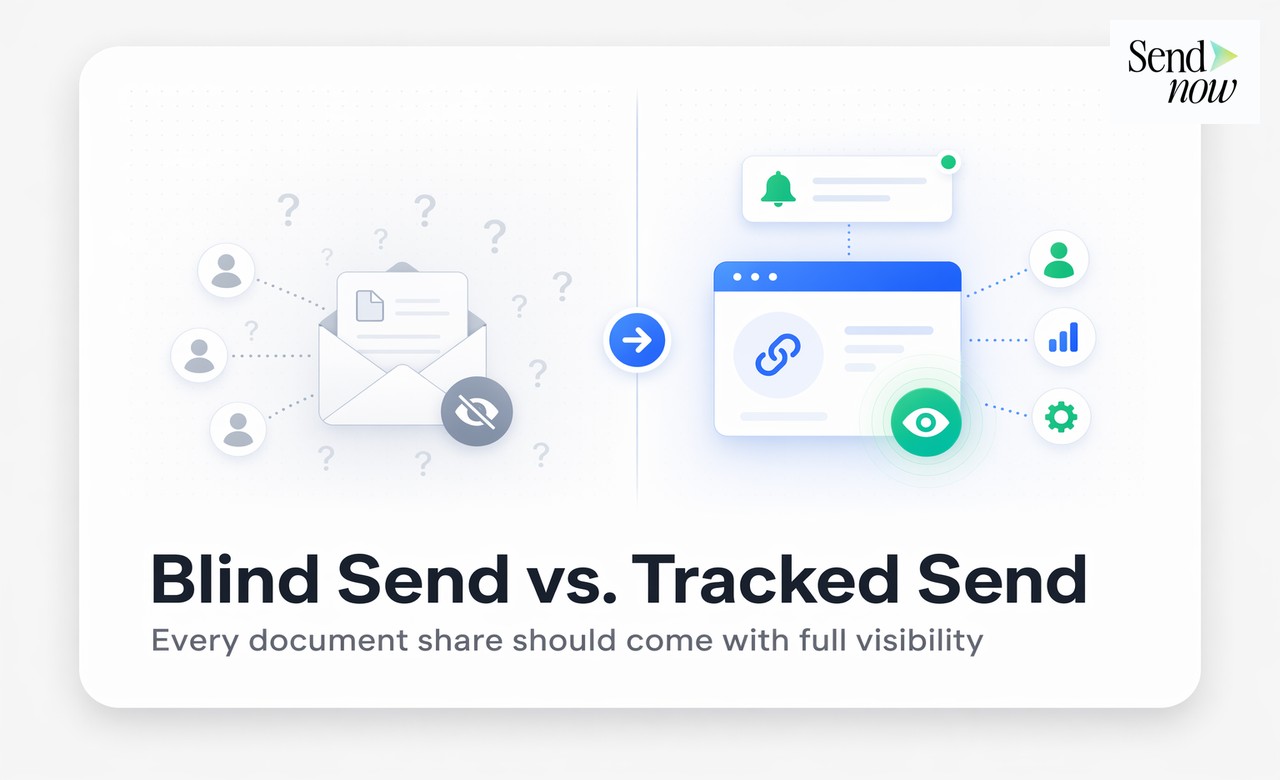
Instead of attaching a PDF, they upload the document to a platform like SendNow, apply security controls (email verification, password, download block, expiry), and share a link. The platform logs every access event — who opened it, which pages they read, for how long, and whether they returned.
Three changes follow from this shift:
Outreach becomes precise. The team calls when the prospect is actively engaged, not on an arbitrary schedule. A document opened at 9 AM Tuesday means a call at 9:30 AM Tuesday, not Friday afternoon.
Version control becomes effortless. Update the document on the platform and the link automatically serves the new version. Recipients who click the link the next day see the updated document without you sending anything new.
Forwarding becomes visible. When a prospect shares the link internally, analytics show a new access event from a different person or device. The deal team learns that the document has reached a new stakeholder — intelligence that shapes the next conversation.
How Analytics Change Follow-Up Timing
Consider two scenarios for the same pitch deck share.
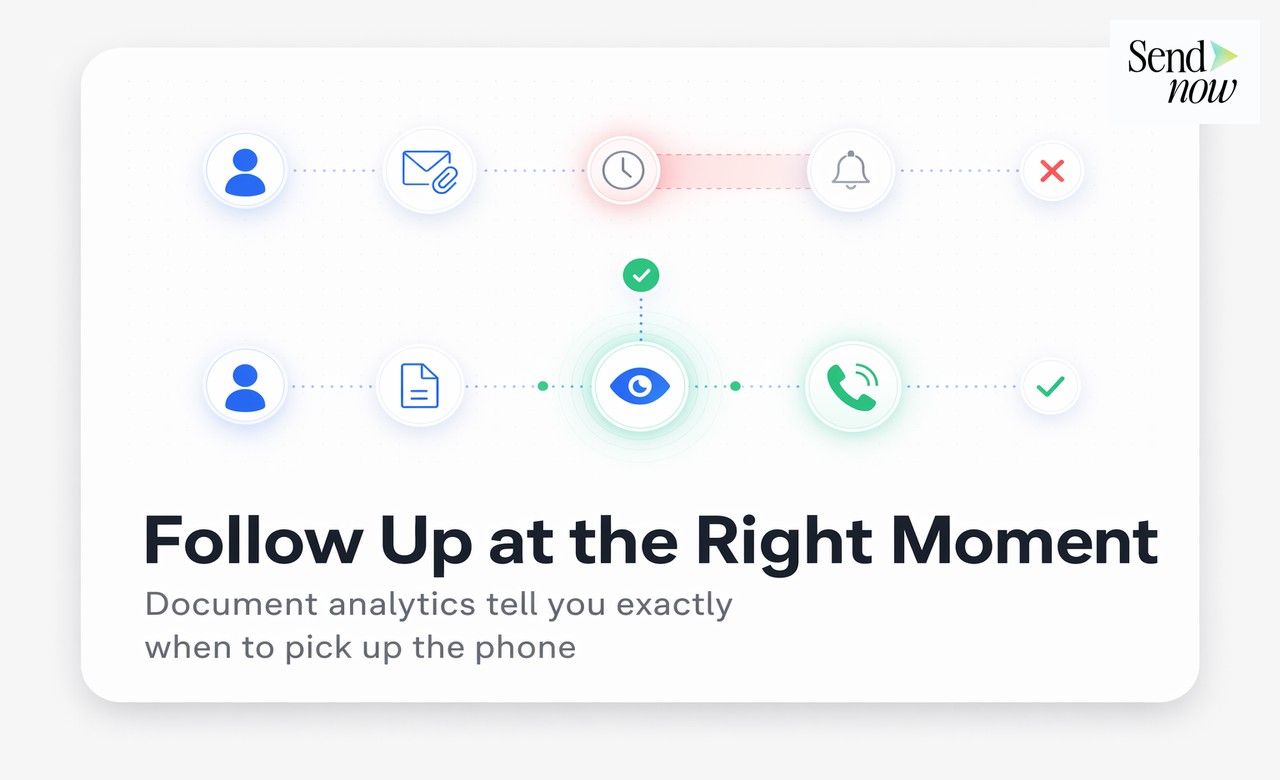
Scenario A (email attachment): You send the pitch deck on Monday. You wait until Thursday to follow up, following a three-day rule that feels professional. The investor actually read the deck Tuesday morning, got excited, discussed it with their partners Tuesday afternoon, and had largely moved on to other opportunities by Thursday. Your follow-up arrives too late to capture the peak interest moment.
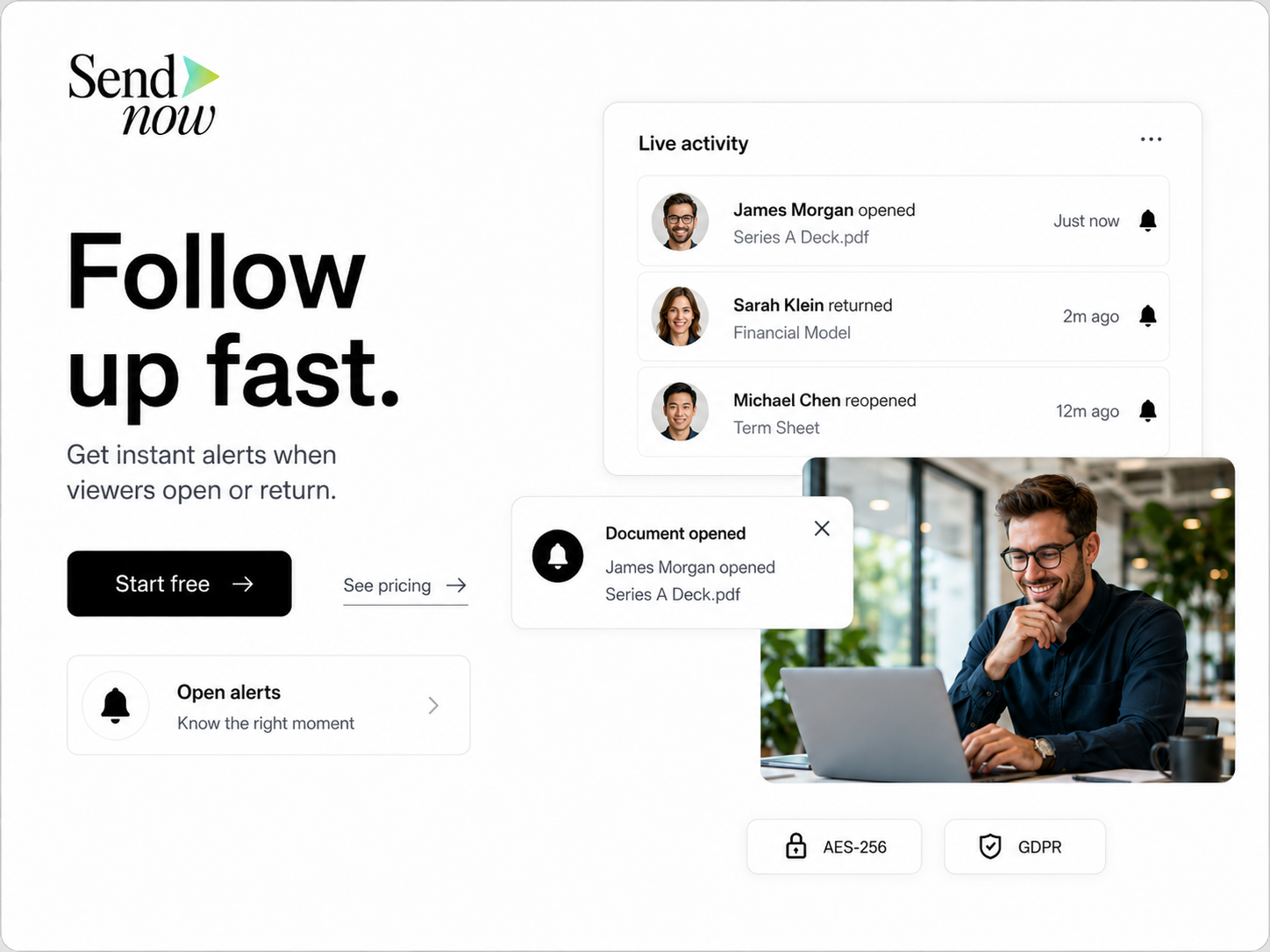
Scenario B (tracked link): You send the SendNow link on Monday. At 9:47 AM Tuesday, you receive a Slack notification: your investor opened the deck, spent 4 minutes on the financial projections slide, and returned an hour later. By 11 AM you have a message in their inbox offering a call. You reach them at peak interest.
Analytics do not manufacture urgency — they reveal it. The prospect's behavior tells you what a cold outreach schedule never can.
Visibility vs No Visibility
| Metric | Email Attachment | Tracked Document Link |
|---|---|---|
| Confirmed delivery | Read receipt (optional, often blocked) | Yes, with timestamp |
| Open confirmation | No | Yes, with identity |
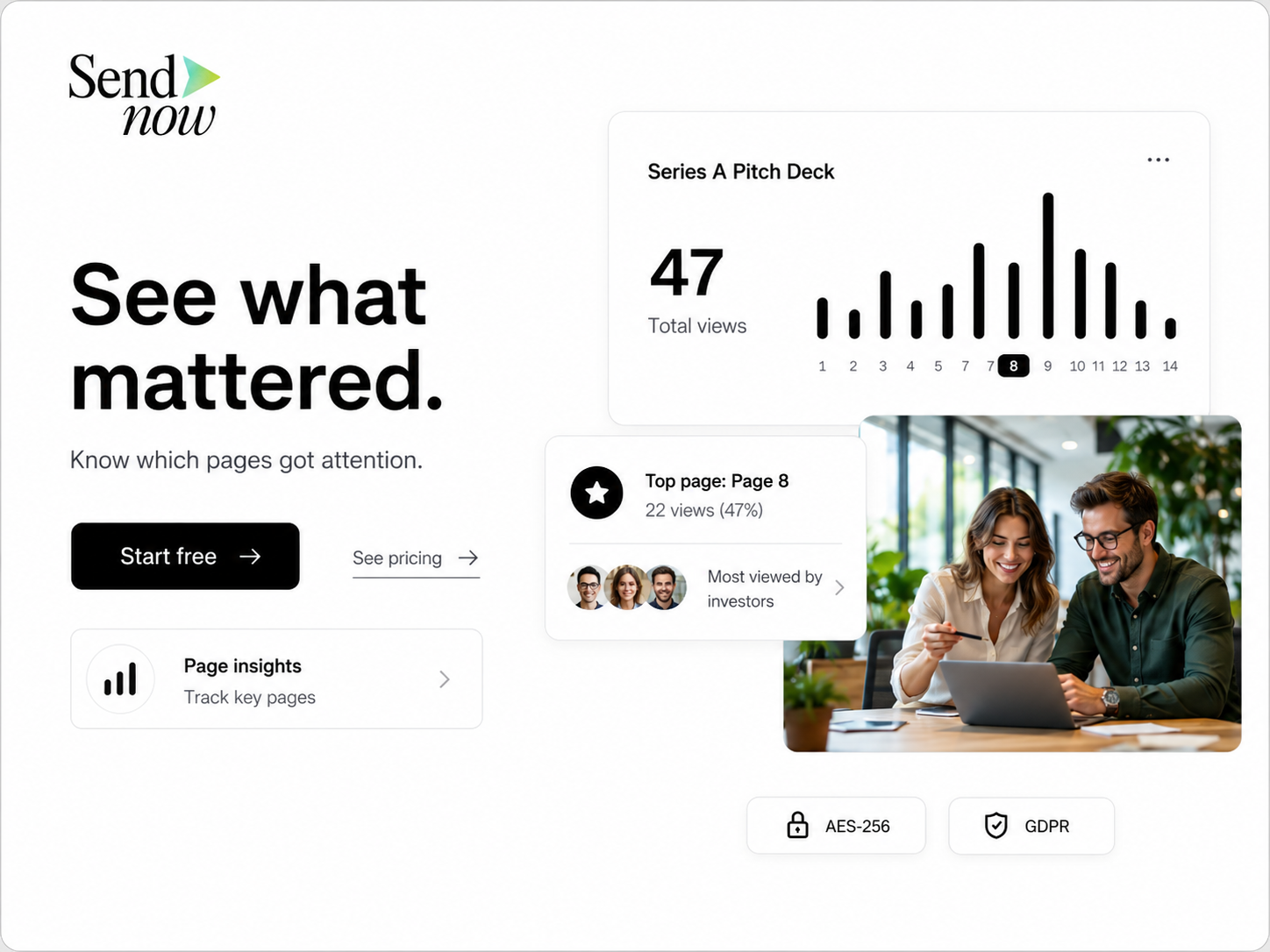
| Pages read | No | Yes, per-page heatmap |
| Time spent per page | No | Yes, in seconds |
| Return visits | No | Yes, with timestamps |
| Forwarding detection | No | Yes, new access event |
| Follow-up trigger | Arbitrary schedule | Engagement-based alert |
| Version control | Manual resend | Automatic via link |
| Download control | None | Blockable |
| Revocation | None | Instant |
| GDPR compliance | Varies | Provided by platform |
How to Stop Sending Blind Today
The switch from email attachments to tracked document sharing takes less than an hour to implement and nothing to change on the recipient's end. They still click a link and read a document. The difference is entirely on your side.
- Sign up for SendNow at sendnow.live. Upload your first document.
- Apply security settings. Enable email verification so every open is tied to a verified identity. Add a download block. Set a 14-day expiry.
- Copy the secure link and paste it into your email exactly where you would have attached the file.
- Set up Slack or email alerts so you are notified the moment the link is opened.
- Open the analytics dashboard after each document share. Build the habit of checking engagement before scheduling your follow-up call.
- Revoke old links for deals that have closed or gone cold. Remove outdated documents from active circulation.
The first time you call a prospect 20 minutes after they finished reading your deck — and open the conversation with specific reference to the sections they spent the most time on — you will never send a blind attachment again.
FAQs
Q1: Why are email attachments bad for deal flow? Email attachments give you zero visibility after you send. You do not know whether the document was opened, which sections the recipient engaged with, or when they returned. This makes follow-up guesswork and causes teams to miss the optimal engagement window.
Q2: What is a tracked document link? A tracked document link is a URL that opens a document inside a secure, analytics-enabled viewer. Every access event — open, page view, time spent, return visit — is logged and reported back to the sender in real time.
Q3: Can recipients tell when a document is being tracked? Dynamic watermarks make it visible that the document is being monitored for security purposes. The specific analytics data (time spent, page views) is not disclosed to the recipient, though they can reasonably assume that a professional sharing platform logs access events.
Q4: How much faster is follow-up with document analytics? Research consistently shows that following up within 4 hours of a prospect reviewing a proposal dramatically increases response rates compared to following up 24-72 hours later. Document analytics make it possible to identify and act on that 4-hour window.
Q5: Does tracked document sharing work for any file type? Most platforms support PDF, PowerPoint, Word, and Excel formats. The document is converted to a secure, viewer-optimized format that renders inside the platform's protected viewer.
Q6: What happens when I update a document? With tracked link sharing, you update the document on the platform and the link automatically serves the new version. Recipients who click the link the next day see the updated content without any action on your part.
Q7: Is tracked document sharing legal under GDPR? Yes, when the platform processes data under a valid DPA, stores data in an EU data residency, and provides appropriate access controls. Logging access events for your own documents is a legitimate interest under GDPR.
Q8: How is SendNow different from DocSend? Both platforms offer tracked document sharing with analytics. SendNow adds NDA gating, microsites for multi-document deal rooms, AI engagement scores, GDPR-specific compliance features including EU data residency, and Slack webhook integrations — at a price point designed for growing finance teams.