
Granting Granular Document Access in VC/PE Deal Rooms

Granting Granular Document Access in VC/PE Deal Rooms
In a high-stakes transaction, a secure m&a document portal must enforce granular document access to protect highly confidential corporate data. By establishing role-based permissions, restricting downloads, and setting time-based access limits, deal teams can ensure that financial models, customer contracts, and IP are shared only with authorized users. This granular approach prevents data leaks and maintains transactional integrity during due diligence.
The Complex Web of Multi-Party Due Diligence
Corporate transactions, whether they are early-stage venture capital rounds, private equity buyouts, or strategic mergers and acquisitions, are characterized by their complexity. A typical deal does not occur in a vacuum between two people. Instead, it involves a large, multi-disciplinary group of participants, each requiring access to a specific subset of company information.
Consider the participants in a standard private equity transaction:
- The Target Company Management: Needs to present their financial performance and operations in the best light while protecting proprietary data.
- The Lead PE Investors: Require deep access to corporate financials, tax records, customer contracts, and HR details.
- Legal Counsel (both Buy-Side and Sell-Side): Need to review corporate bylaws, litigation history, intellectual property filings, and material contracts.
- Accountants & Auditors: Focus almost exclusively on audited financial statements, general ledgers, tax histories, and accounting policies.
- Technical & Industry Consultants: Must audit source code, product architecture, manufacturing facilities, or proprietary technologies.
If you share all of your diligence materials with every participant, you create a significant security risk. A technical consultant does not need to see your employee salary spreadsheets or cap table. An accountant does not need to review your patented source code. A secure m&a document portal resolves this by allowing deal administrators to define exactly who can see what, when, and under what conditions.
What is Granular Document Access?
Granular document access is the practice of restricting information access within a shared repository to the most precise level possible. Rather than using an "all-or-nothing" approach—where anyone invited to a folder can view and download every file within it—granular permissions allow you to define rules for individual files, users, and actions.
For example, in a coarse permission model, you might share a folder called "Due Diligence" with a potential investor. That investor can open and download everything. In a granular permission model, you can configure the system so that:
- The investor can view the "Financial Model" in a web-based browser but cannot download it.
- The accountant can download the "Tax Audits" folder.
- The legal counsel can view and download the "Corporate Governance" files.
- The technical auditor can only view the "Software Patents" folder, and their access will automatically expire in 48 hours.
This level of control ensures that sensitive data is only exposed to the individuals who require it for their specific diligence tasks, minimizing the surface area for potential data leaks.
The Core Levels of Granular Control in VC/PE Deal Rooms
To build a secure and functional deal room, administrators must understand the different dimensions of granular control available in modern VDR platforms.
1. Document-Level vs. Folder-Level Access
While folder-level permissions are standard (e.g., granting a user access to the "02_Financials" folder), there are times when you need to restrict a specific file within a folder. For instance, you may want to share all financial reports except the executive compensation model. Granular VDRs allow you to override folder permissions for specific files, ensuring you do not have to create separate folders for single, highly sensitive files.
2. View-Only vs. Download Enforcements
The ability to separate viewing rights from downloading rights is critical. When you allow a user to download a document, it leaves your secure environment. The user can forward it, print it, or upload it to their personal cloud. For files containing trade secrets, proprietary algorithms, or customer lists, administrators should enforce view-only permissions. The document is rendered in a secure web viewer, and the options to download, print, or copy text are disabled.
3. Dynamic Watermarking Constraints
Watermarks should be dynamic and personalized. Instead of a generic "Confidential" stamp, a granular VDR overlays the viewer's email address, IP address, and the exact date and time of access on the document. This can be applied selectively—for example, you might turn on watermarks for external bidders but turn them off for your internal legal advisors.
4. Time-Limited Access and Expiring Links
Due diligence needs change as a transaction progresses. You can set time-based constraints on document access:
- Expirations: Set a link to expire automatically after a specific date (e.g., at the end of the diligence period).
- Scheduled Access: Allow users to access files only during specific hours (useful for managing external consultants working on specific shifts).
- Access Duration: Grant a user access for a set number of hours after their first login (e.g., 24 hours to review a proprietary code audit).
5. IP Address Whitelisting and Geofencing
For high-security corporate deals, you can restrict access to specific IP ranges or geographical locations. This prevents a user from logging into the deal room from an unverified public Wi-Fi network or an unauthorized country, protecting the transaction from remote hacking or unauthorized sharing.
Setting Up a Secure Permission Matrix
Before configuring your deal room, map out your permission structure. Below is a best-practice permission matrix template for a typical mid-market M&A transaction:
| Document Category | Lead Investor | Buyer's Legal | Technical Auditor | Buyer's Accountant | Target Executive |
|---|---|---|---|---|---|
| 01_Corporate_Governance | View & Download | View & Download | View Only | View Only | Full Admin |
| 02_Financials & Models | View Only (Watermarked) | No Access | No Access | View & Download | Full Admin |
| 03_IP & Source Code | View Only | View & Download | View Only (Watermarked) | No Access | Full Admin |
| 04_Customer Agreements | View Only | View & Download | No Access | No Access | Full Admin |
| 05_HR & Compensation | View Only (No Salary Details) | View Only | No Access | View & Download | Full Admin |
| 06_Litigation Records | View Only | View & Download | No Access | No Access | Full Admin |
Note: "No Access" means the folder or file is completely invisible to that user role, preventing them from even knowing the files exist.
Implementing Granular Access: A Step-by-Step Guide
By using a modern VDR platform like SendNow, implementing this permission matrix is simple and fast.
Step 1: Define Your User Groups
Rather than managing permissions for dozens of individuals, organize your participants into distinct user groups (e.g., "Legal Team," "Financial Auditors," "Lead Investors").
Log into your VDR dashboard at https://share.sendnow.live/dashboard and create these groups. When a new analyst joins the buy-side legal team, you can add them to the "Legal Team" group, and they will automatically inherit the correct permissions.
Step 2: Upload and Structure Your Folders
Upload your folders following a clear index. Make sure file names are descriptive, as this helps users navigate the portal without needing guidance.
Step 3: Apply Group Permissions to Folders
Navigate to your folder permissions settings. For each folder, assign the appropriate access level to each user group. For example:
- Select folder
02_Financials. - Set
Financial Auditorsto "View & Download." - Set
Legal Teamto "No Access." - Set
Lead Investorsto "View-Only" and enable "Dynamic Watermark."
Step 4: Configure Individual File Exceptions
If there is a highly sensitive document within an otherwise open folder—such as a key customer contract containing a change-of-control clause—select that specific file and restrict access. You can block downloads for this file even if the rest of the folder is downloadable.
Step 5: Activate Security Gating
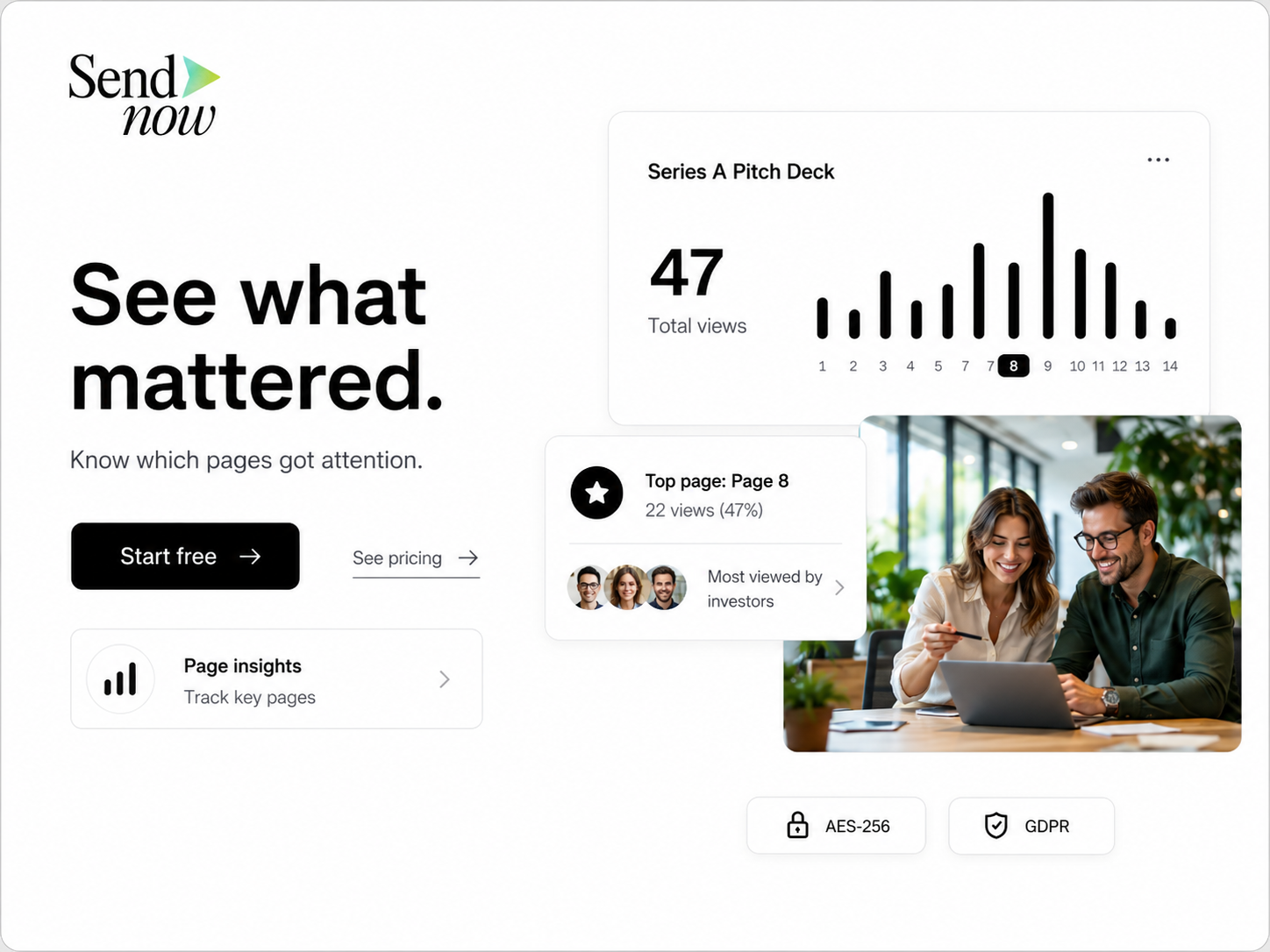
Ensure your access gates are active. Enable NDA Gating so that all external users must sign a digital confidentiality agreement before they can access the folders. Enable Email Verification Gates to ensure that users must verify their identity via a one-time passcode (OTP) sent to their corporate email, preventing link-forwarding leaks.
Step 6: Monitor and Revoke Access
Once the deal room is active, monitor visitor activity. If a bidder exits the transaction, navigate to the user management tab and revoke their access with a single click. Their links will immediately deactivate, and any active sessions will be terminated.
Real-World Use Cases
Let us examine how granular access controls protect transactions in two different scenarios.
Scenario A: Protecting IP During Early-Stage VC Fundraising
A deep-tech startup, QuantumTech, is raising a Series A round. They are sharing their pitch deck, financial model, and proprietary software architecture with several venture capital firms.
To protect their technology, the founders set up a deal room on SendNow. They configure the following rules:
- Pitch Deck: Accessible to all verified users; downloads enabled.
- Financial Model: View-only for all VC associates; downloads disabled.
- Software Architecture PDF: View-only, protected by screenshot blocking, and restricted to whitelisted IP addresses belonging to the VC firm's office.
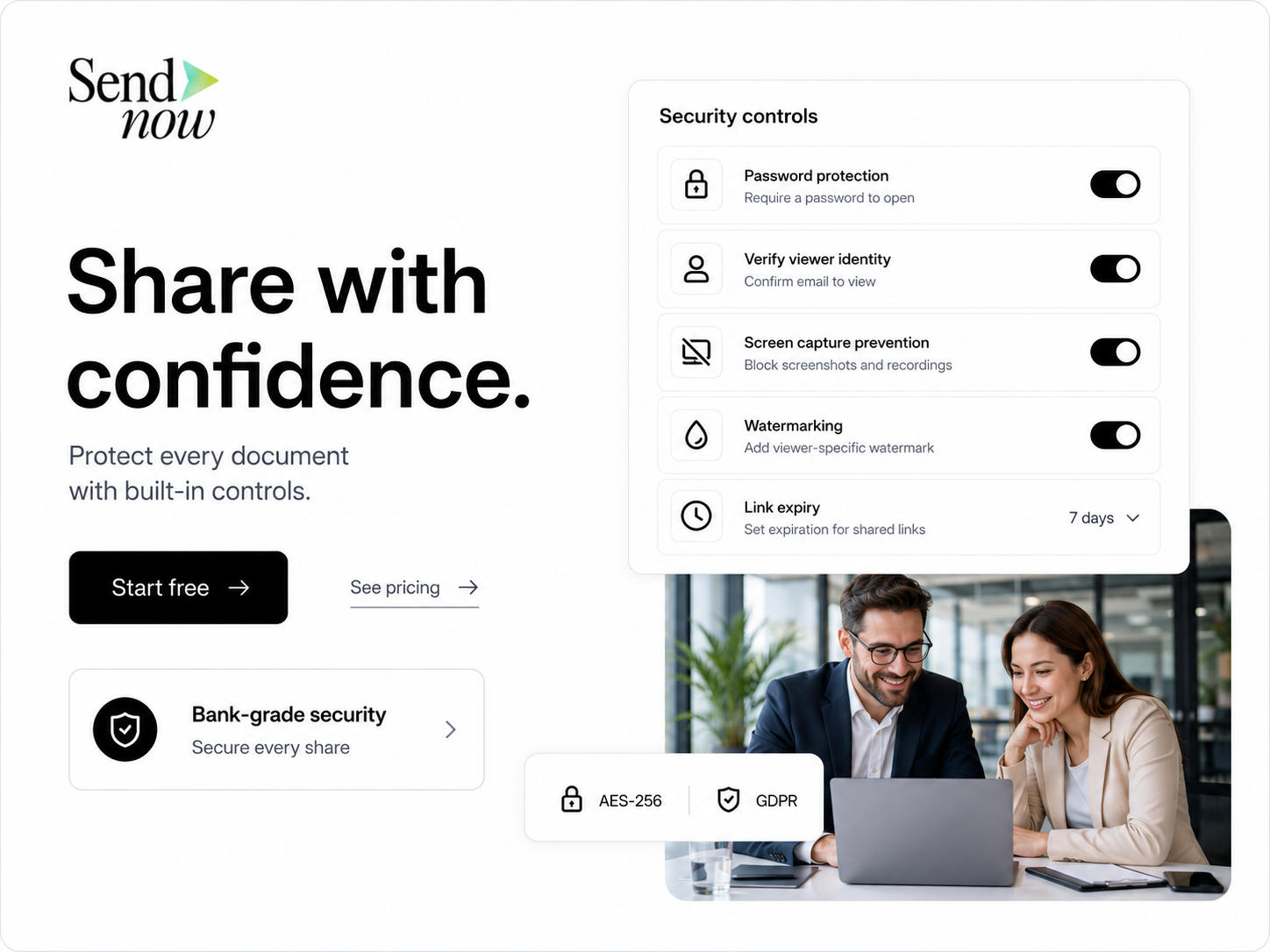
During diligence, one of the VC associates tries to capture a screenshot of the architecture diagram. The SendNow screenshot shield blocks the capture, and the founder is notified of the attempt. The startup's intellectual property remains protected.
Scenario B: Managing a Competitive M&A Process
A private equity firm, CapitalPartners, is auctioning one of their portfolio companies. They have invited five strategic bidders to the process.
Using SendNow, the deal team sets up a single data room but generates five distinct, isolated secure links—one for each bidder.
- Bidder A is in the final bidding phase. They are granted access to the detailed customer contracts folder (view-only) and the tax audits folder (downloadable).
- Bidder E has just entered the process. They can only see the corporate structure and basic financial summaries folders.
- The deal team tracks the page-level viewing times for each bidder. They notice that Bidder A has spent 12 hours reviewing the customer contracts, indicating high interest, while Bidder E has spent only 10 minutes.
When negotiating, CapitalPartners uses this intelligence to push Bidder A for a higher valuation, knowing they have conducted deep diligence.
Compliance and Regulatory Security Standards
Granular access controls are not just a best practice; they are often required to comply with international data security and privacy regulations.
General Data Protection Regulation (GDPR)
Under the GDPR, companies must practice "data minimization"—ensuring that personal data is only accessible to those who need to process it. An m&a document portal that implements granular permissions allows you to restrict access to employee records, customer lists, and payroll data, ensuring compliance with European privacy standards. For details on data protection regulations, you can review the GDPR portal.
SOC 2 Type II Auditing
A VDR provider must maintain SOC 2 Type II compliance to prove that its system controls are secure. Granular permissions, multi-factor authentication, and detailed access logging are core components of a SOC 2 security framework.
Legal Defensibility: eIDAS and ESIGN Act
When a user signs an NDA gate to enter your deal room, the VDR logs their identity, IP, and timestamp. Under the U.S. ESIGN Act and the European eIDAS regulation, these logs form a legally binding signature record, ensuring that your confidentiality agreements are enforceable in a court of law. Learn more about electronic signature frameworks at the ESIGN Act resources.
Frequently Asked Questions
What is a granular document access system?
A granular document access system is a security framework within a virtual data room that allows administrators to set specific viewing, printing, and downloading permissions for individual files and users, rather than applying a single rule to an entire folder or system.
How do I set up permissions in an M&A document portal?
To set up permissions, first define your participant groups (e.g., Legal, Financial, Investor). Upload your documents in a structured index, and then assign specific permission levels (such as View-Only, Downloadable, or No Access) to each group for each folder or file.
Can I restrict downloads for specific files in a deal room?
Yes. Modern virtual data rooms allow you to disable download rights for specific sensitive files (like financial models or IP blueprints), forcing users to view them inside a secure, web-based viewer where copy-pasting and printing are also disabled.
What happens when a user's deal room access link expires?
Once an access link or permission window expires, the user is immediately logged out of the session, and the link becomes inactive. If they attempt to click the link again, they will see an access-denied message. The administrator can extend or renew the link at any time.
Is it possible to track who viewed a specific page in the deal room?
Yes. Modern VDRs provide page-level tracking that records which users opened a document, which pages they viewed, and exactly how many seconds or minutes they spent on each page, providing valuable intelligence for the deal team.
Secure Your Diligence Materials with SendNow
Managing a confidential transaction requires tools that give you complete control over your data. A secure, granular permission structure is the best way to protect your company's value during due diligence.
SendNow provides a finance-first virtual data room that makes it easy to set up granular permissions, enforce NDA gating, apply dynamic watermarks, and block screenshots. Our flat-rate pricing starting at $12/month ensures you can manage your deal without worrying about per-user or per-page fees.
Protect your intellectual property and streamline your transactions.
Start your free trial of SendNow at the Dashboard, or explore our solutions and pricing to find the perfect plan for your transaction. Follow us on LinkedIn for the latest insights on secure document sharing.
About the Author: Rifana Hameem
Rifana is the founder of SendNow. She leads the team in building secure, compliant, and analytics-rich document sharing tools for finance and professional teams worldwide.
Connect on LinkedIn