
AI Engagement Scores for Documents: What They Are and How to Use Them
Published on April 24, 2026
AI Engagement Scores for Documents: What They Are and How to Use Them
#TLDR: An AI document engagement score aggregates everything a prospect did with your document — pages read, time spent, return visits, sections re-read — into a single number that tells you how engaged they are. This post explains how the score is built, why it outperforms gut-feel follow-up, and how to use it to prioritize your pipeline every day.
Table of Contents
- What an AI Document Engagement Score Is
- How the Score Is Calculated: The 4 Factors
- Why Gut-Instinct Follow-Up Fails in Finance
- How to Use Scores to Prioritize Your Pipeline Daily
- Combining AI Scores with Slack Alerts for Immediate Action
- Integrating AI Scores with CRM via Webhooks
- Platform Comparison
- FAQs
What an AI Document Engagement Score Is {#what-is-score}
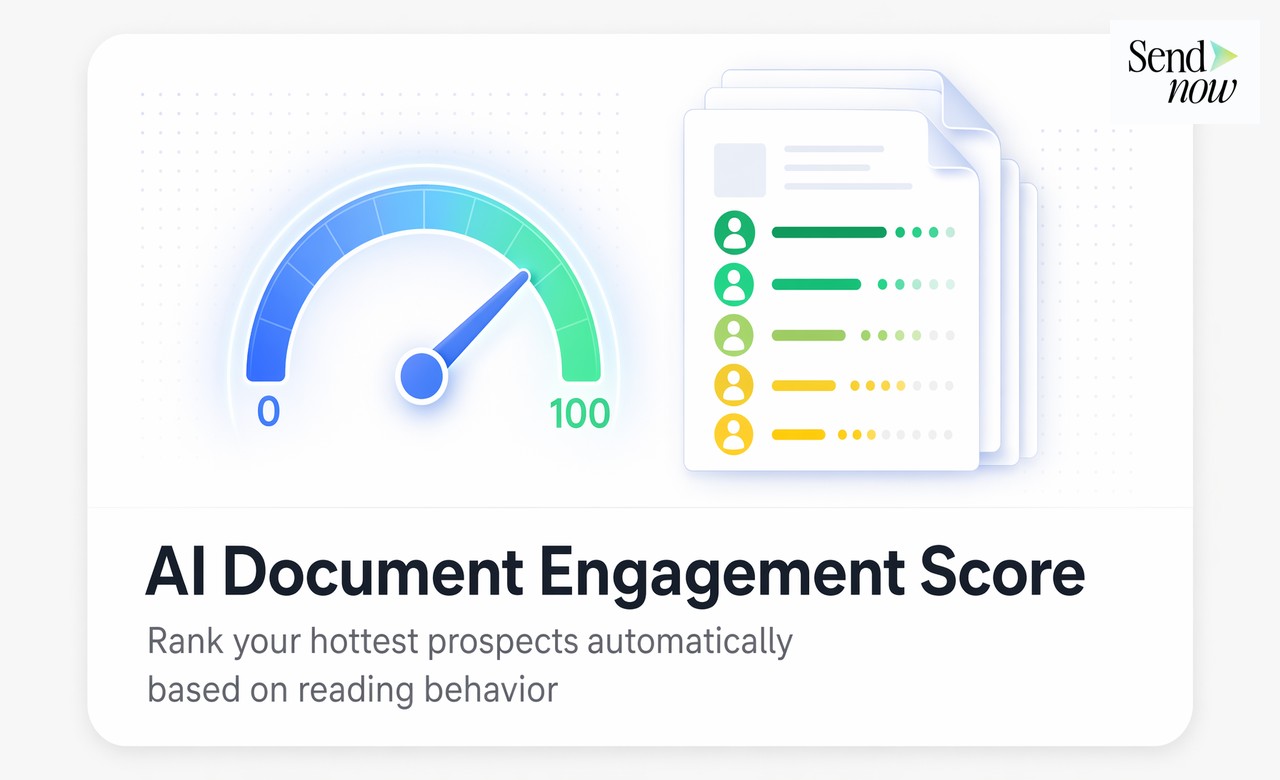
An AI document engagement score is a single numeric value that summarizes how deeply a specific prospect has engaged with a document you shared. Rather than asking you to interpret raw analytics data yourself, the scoring system weighs each behavioral signal and combines them into a clear ranking.
A score near 100 means a prospect has spent significant time with your document, revisited it multiple times, re-read key sections, and displayed reading patterns consistent with serious evaluation. A score near 10 means the document was opened briefly and not meaningfully engaged with.
The value of the score is not the number itself. The value is what it enables: a ranked list of every prospect who has received one of your documents, ordered by engagement, that you can use to make better decisions about who to contact, when, and with what message.
In financial services, where salespeople manage dozens of active proposals and relationships simultaneously, this ranking function is what transforms document analytics from an interesting dashboard into an operational tool.
How the Score Is Calculated: The 4 Factors {#how-calculated}
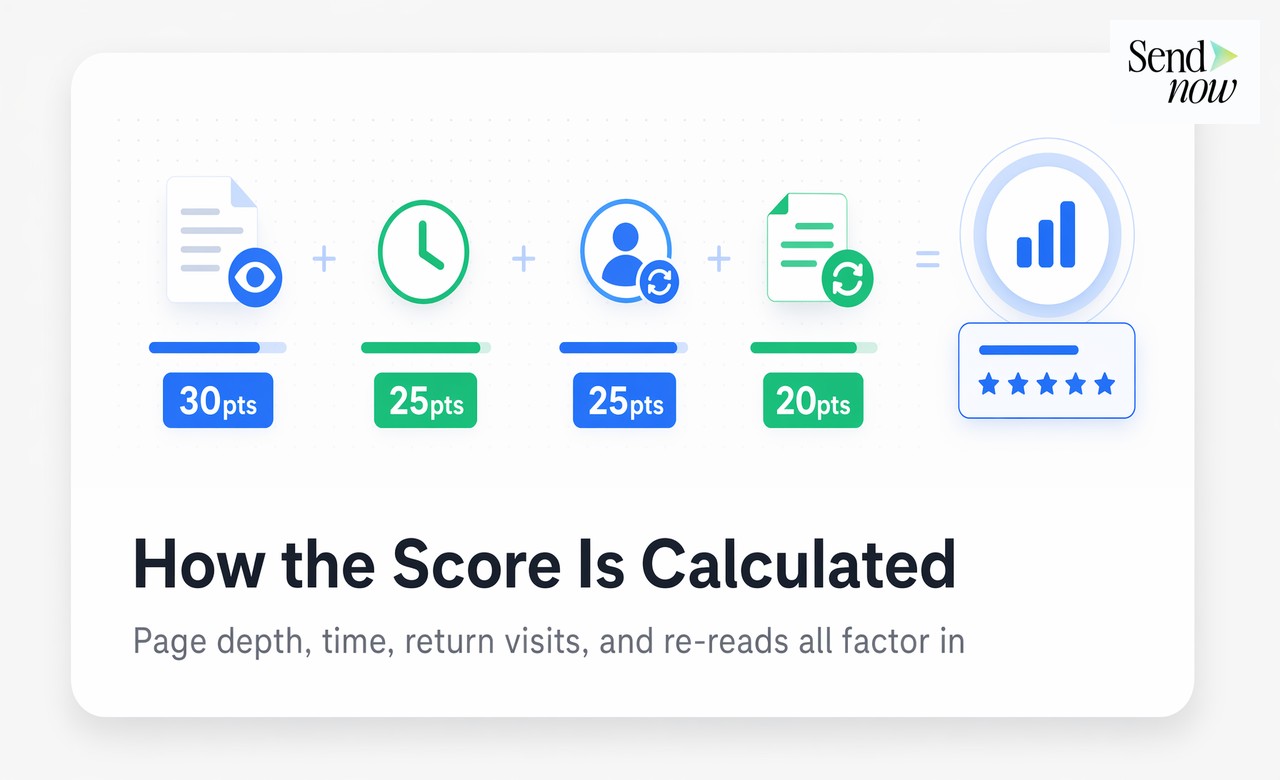
SendNow's AI engagement scoring uses four behavioral factors, each weighted to reflect its significance as a buying signal:
Pages Read (30 points) The proportion of the document's pages that were viewed. A prospect who read every page scores higher here than one who viewed only the first two. Page breadth indicates whether the prospect engaged with the complete document or abandoned early.
Time Spent (25 points) Total time across all sessions. This factor rewards depth of reading. A prospect who spent 12 minutes across two sessions scores significantly higher than one who spent 45 seconds in a single visit.
Return Visits (25 points) The number of times the prospect returned to the document after the initial open. As covered in our analysis of return visit signals, a second or third open indicates active re-evaluation. This factor weights that signal heavily.
Pages Re-Read (20 points) The number of pages the prospect viewed in multiple sessions. A prospect who revisited the pricing section across three sessions is signaling specific interest in that topic. This factor captures that granular re-engagement behavior.
The four factors combine into a score from 0 to 100. Scores above 70 indicate prospects worth immediate direct outreach. Scores between 40 and 70 indicate active engagement worth a follow-up within 24 hours. Scores below 40 suggest early-stage interest that may benefit from a nurture approach.
Why Gut-Instinct Follow-Up Fails in Finance {#gut-instinct-fails}
The traditional follow-up approach in financial services relies on a combination of calendar scheduling and intuition. Call three days after sending. Follow up weekly. Check in if you have not heard back in two weeks.
This approach has two fundamental problems. First, it is unresponsive to actual prospect behavior. A prospect who re-opened your document four times over 48 hours is actively evaluating you, but your calendar-based follow-up does not know that. A prospect who opened the document for 20 seconds is clearly not ready, but you might still call them on your standard schedule.
Second, it is inefficient. A financial professional managing 30 active prospects with identical follow-up schedules is spending the same amount of attention on the prospect who has read their proposal three times as on the one who has never looked at it. AI engagement scoring corrects that imbalance.
The science of follow-up timing supports behavioral triggers over calendar intervals. Prospects are most receptive to contact when they are actively thinking about your proposal. An AI score that rises when a prospect re-engages gives you that trigger.
How to Use Scores to Prioritize Your Pipeline Daily {#prioritize-pipeline}
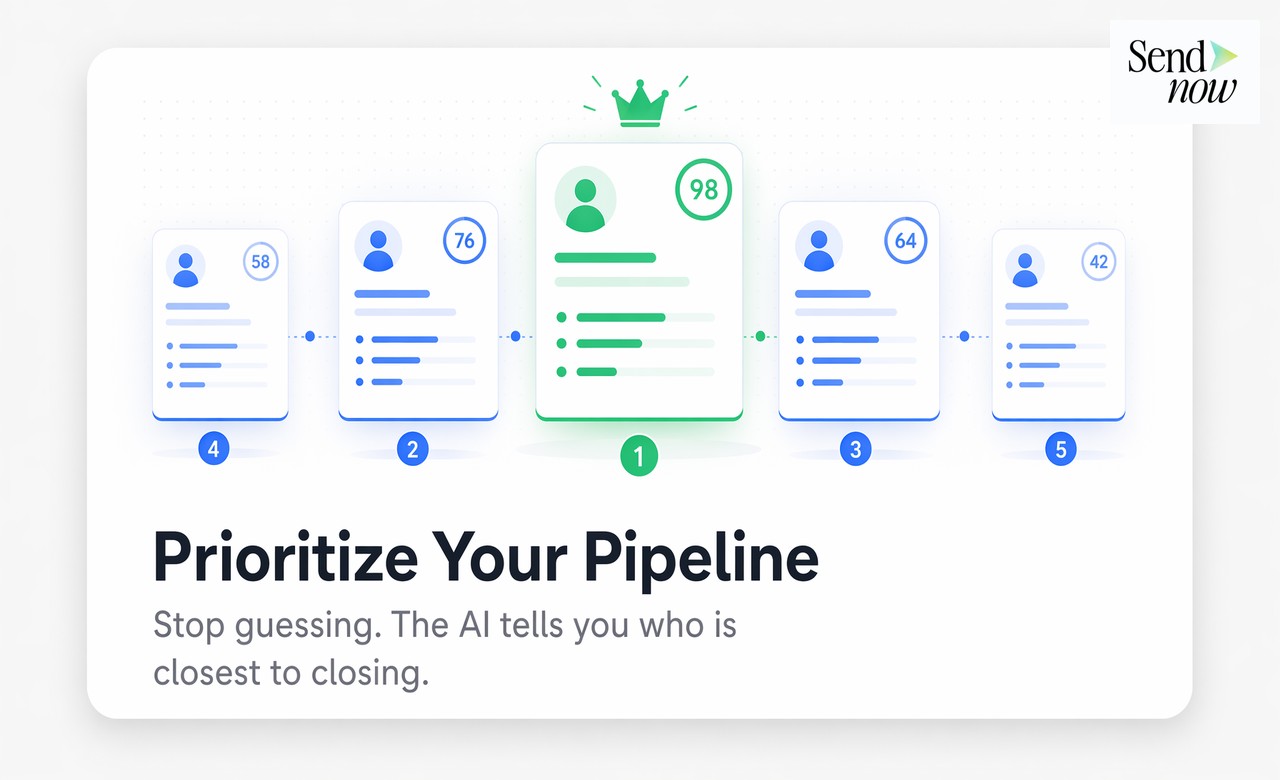
The most effective way to use AI engagement scores is to make them the first thing you review each morning. Here is a practical daily routine:
Morning review (5 minutes): Open your SendNow dashboard and sort active document shares by AI engagement score. Look for two things: scores that have risen overnight (indicating evening engagement activity) and any score above 70 that did not trigger a Slack alert you already acted on.
Top-score outreach (immediate): Any prospect with a score above 70 who you have not contacted in the past 24 hours gets a call or personalized email before anything else. Reference what you know about their engagement: "I know you have been reviewing the proposal, happy to walk through any questions you have on the structure."
Mid-range follow-up (same day): Prospects scoring 40-70 receive a follow-up within the same business day. These are engaged but not yet at peak interest. A brief check-in keeps the conversation moving without being premature.
Low-score nurture (scheduled): Prospects scoring below 40 stay on a standard nurture cadence. You are not ignoring them, but you are allocating your high-attention time to the prospects the data shows are closest to a decision.
Combining AI Scores with Slack Alerts for Immediate Action {#slack-alerts}
AI engagement scores are most actionable when paired with real-time notifications. A score that rises while you are available to act on it is far more valuable than one you discover hours later.
SendNow integrates with Slack, allowing you to configure alerts triggered by specific score thresholds or document open events. A typical configuration might look like:
- Alert when any document is opened more than twice
- Alert when a prospect's engagement score crosses 60
- Alert when a document that was dormant for five or more days is reopened
These alerts land in a designated Slack channel, giving your team a live feed of prospect engagement activity. The follow-up happens within minutes of the prospect's re-engagement, not hours or days later.
The combination of AI scoring for prioritization and Slack alerts for timing removes the two biggest sources of missed follow-up opportunity in financial services.
Integrating AI Scores with CRM via Webhooks {#crm-integration}
For teams that manage their pipeline in a CRM, SendNow's webhook integration allows AI engagement scores to flow directly into your existing systems. Each time a score updates, a webhook fires with the current score, the prospect's email, and the document details. Your CRM receives this data and can use it to update contact records, trigger automations, or surface high-score prospects in your daily task list.
A practical CRM integration might:
- Update a custom field on the contact record with the current document engagement score
- Trigger a task creation for the assigned sales rep when a score crosses 65
- Add a contact to a hot-leads pipeline stage when a score reaches 80
- Log the score update as a CRM activity for timeline visibility
This integration means AI scoring is not a separate tool you have to remember to check. It becomes part of your existing workflow, surfacing the right prospects in the right place at the right time.
Platform Comparison {#comparison}
| Feature | SendNow | Basic Analytics Platforms | CRM Native Tools |
|---|---|---|---|
| AI engagement scoring | Yes | No | Rarely |
| Score based on 4 behavioral factors | Yes | No | No |
| Real-time score updates | Yes | No | Varies |
| Slack alert integration | Yes | No | Varies |
| Webhook CRM sync | Yes | No | Varies |
| Per-document prospect ranking | Yes | No | No |
FAQs {#faqs}
Q: How is an AI engagement score different from a simple page view count? A: A page view count tells you how many pages were viewed. An AI engagement score weighs page breadth, time spent, return visits, and re-read behavior together to give a composite measure of how deeply and repeatedly a prospect engaged. It is designed to rank buying intent, not just activity volume.
Q: Can two prospects with the same score have had very different behaviors? A: Yes. A score of 65 could come from high pages-read and time-spent with no return visits, or from fewer pages read but multiple return visits. The score summarizes overall engagement but the full session breakdown is always available for detailed review.
Q: How quickly does the score update after new engagement activity? A: Scores update in real time. Each time a prospect opens the document, the score is recalculated immediately and any configured alerts fire within seconds.
Q: Do scores reset when I update the document? A: Existing scores and session history are tied to the original document share. If you create a new share link for an updated version, that link starts with a fresh score history.
Q: Can I use AI scores to compare engagement across multiple documents? A: Yes. Scores are calculated per-document-share, so you can compare how different prospects engaged with the same document, or how the same prospect engaged with different documents you sent them over time.
Q: Does the AI scoring work for microsites? A: Yes. Each document within a microsite has its own engagement analytics. A composite engagement picture for a microsite visitor can be built from the individual file scores.
Q: Is the scoring methodology transparent? A: Yes. The four factors and their weightings are documented and visible in the SendNow platform so you can understand exactly how each score is derived.
Q: Can I adjust the scoring weights to match my sales process? A: The default weights reflect general best practices for buying intent signals. Contact the SendNow team at sendnow.live to discuss custom configurations for specific use cases.
Know who to call before you pick up the phone. SendNow's AI engagement scoring ranks every prospect by reading behavior so your pipeline reflects real intent, not guesswork. Try SendNow at sendnow.live
Written by Alex Carter. Alex covers AI-driven sales tools and document intelligence for financial professionals.