
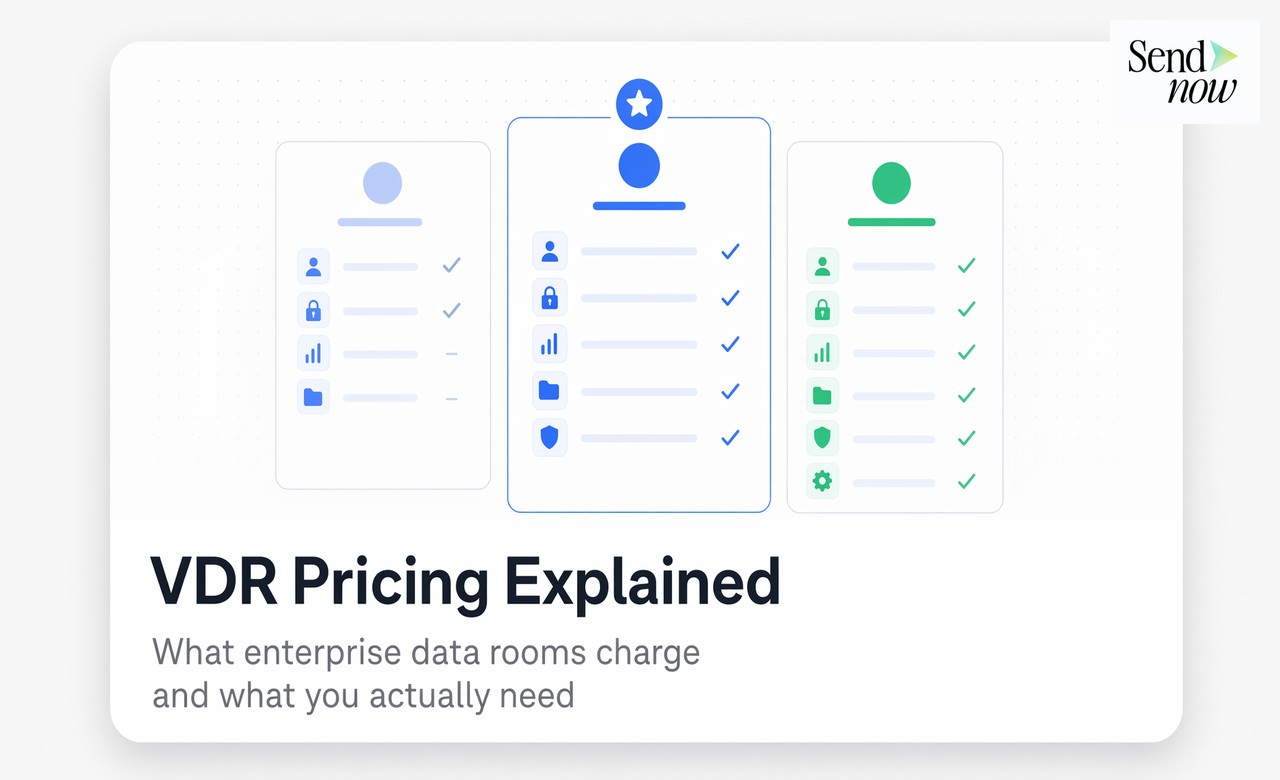
Virtual Data Room Pricing Explained: What You Pay For
Published on April 24, 2026
Virtual Data Room Pricing Explained: What You Pay For
#TLDR: VDR pricing ranges from flat-fee plans under EUR 200/month to enterprise contracts exceeding EUR 5,000/month. Understanding the per-page, per-user, and per-GB models before signing is the only way to avoid surprise invoices. This guide breaks down every pricing variable and shows how to calculate real total cost of ownership.
Table of Contents
- How VDR Pricing Works
- Enterprise VDR Cost Ranges in 2026
- Hidden Fees to Watch For
- What You Actually Need vs What You Pay For
- Lightweight VDRs vs Enterprise Platforms
- Total Cost of Ownership: The Real Comparison
How VDR Pricing Works
Virtual data room vendors use four main pricing models. Knowing which one applies to a contract changes everything about the final invoice.
Per-page pricing charges a flat fee for every page uploaded to the room. This model originated when VDRs were used for physical document scanning and made sense when digitization was the primary cost driver. It makes little sense for digital-native workflows but remains common at legacy enterprise vendors. At EUR 0.40 to EUR 1.50 per page, a single 500-page financial model can cost EUR 200 to EUR 750 in upload fees alone.
Per-user pricing charges monthly for each person given access. This works directly against deal teams that need to add multiple buyer-side advisors, legal counsel, and management contacts without budget impact. Some vendors distinguish between admin users and guest users, charging different rates for each.
Flat-fee pricing provides a set monthly cost for unlimited users and a defined storage cap. This is the most predictable model and rewards teams with large document sets or multiple simultaneous deal processes. Newer platforms and lightweight alternatives use this approach.
Per-GB pricing charges based on total storage consumed. Combined with overage fees that activate above a storage threshold, this model produces unpredictable billing during active due diligence when large financial files are uploaded in bulk.
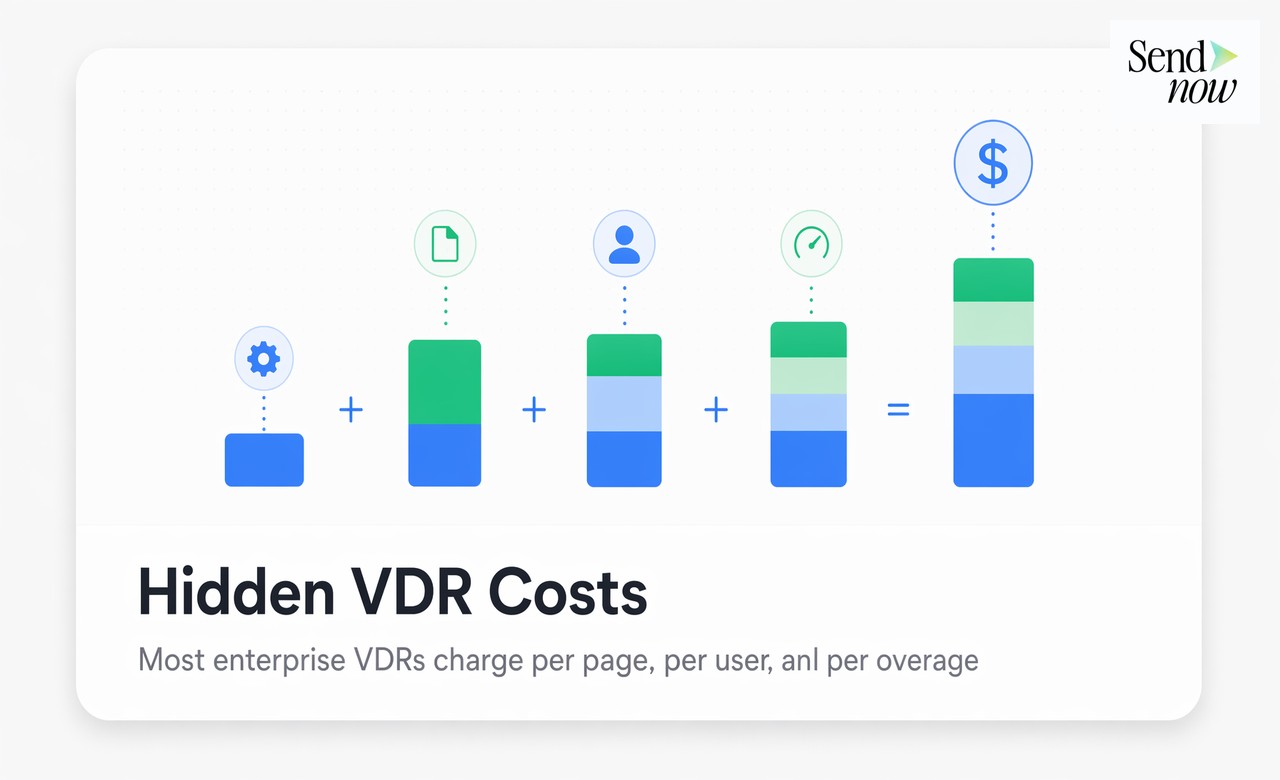
Most enterprise vendors stack these models together: a monthly base fee, a per-user charge beyond a small included seat count, and per-GB overage fees above the storage limit. This layering is what causes budget overruns.
Enterprise VDR Cost Ranges in 2026
Enterprise VDR contracts in Europe typically fall into these bands for a 12-month subscription:
- Entry-level enterprise: EUR 400 to EUR 800/month - 10 users included, 10 GB storage, per-page fees apply to uploads above a threshold
- Mid-market: EUR 1,000 to EUR 2,500/month - 25 users, 50 GB storage, dedicated support line included
- Full enterprise: EUR 3,000 to EUR 10,000+/month - unlimited users, custom storage, compliance add-ons, dedicated customer success manager

Annual contracts frequently require 12-month minimum commitments with early termination penalties. Onboarding and training fees ranging from EUR 1,000 to EUR 5,000 are commonly invoiced separately from the subscription.
Hidden Fees to Watch For
Even experienced deal teams miss these line items until the invoice arrives:
- Setup fees: One-time charges for workspace configuration, sometimes labeled "professional services" or "onboarding"
- Overage charges: Per-page or per-GB fees that activate when usage exceeds the base plan limits
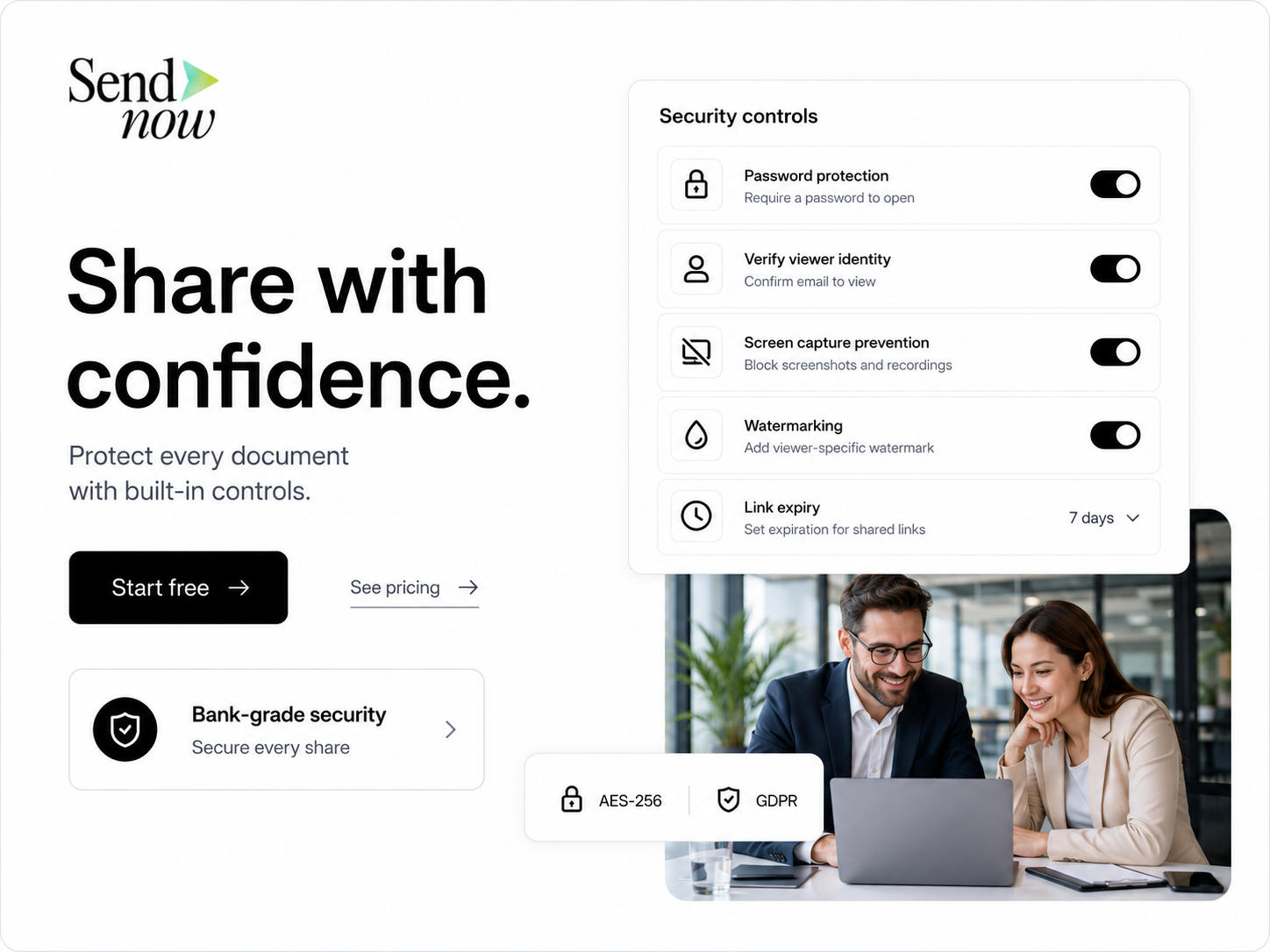
- Watermarking fees: Dynamic watermarks on confidential documents positioned as a premium security feature requiring an add-on
- Audit log exports: Exporting activity reports for regulatory or compliance purposes can trigger per-report charges at some vendors
- Support tier fees: 24/7 support, dedicated phone support, or SLA-backed response times often require a paid upgrade from the base tier
- White-label and branding fees: Custom domain setup and logo removal from the interface charged as a separate add-on
What You Actually Need vs What You Pay For
Most deal teams use fewer than 20 percent of an enterprise VDR's feature set. The core requirement for M&A, fundraising, and legal processes is:
- Secure document upload with organized folder structure
- Granular access control per user or group
- Activity tracking: who opened what, which pages, and for how long
- NDA acceptance before first access
- Link expiry and revocation
- Exportable audit trail for compliance
Enterprise VDRs bundle AI-assisted redaction, physical data center redundancy SLAs, FINRA-compliant archiving, and white-glove support on top of these basics. These features matter for high-volume public company transactions. They are largely irrelevant for a Series A fundraise, a mid-market acquisition, or a real estate transaction.
Lightweight VDRs vs Enterprise Platforms
| Feature | Enterprise VDR | Lightweight VDR (e.g. SendNow) |
|---|---|---|
| Monthly cost | EUR 800 to EUR 5,000+ | EUR 30 to EUR 200 |
| Setup time | Days to weeks | Under 30 minutes |
| Per-page fees | Common | None |
| User limits | Seat-based with charges | Unlimited viewers |
| Page-by-page analytics | Rarely included | Included |
| GDPR compliance | Yes | Yes |
| NDA gating | Often an add-on | Included |
| White labeling | Enterprise tier only | Available |
| Minimum contract | 12 months typical | Monthly |
| Screenshot protection | Enterprise tier | Included |
Total Cost of Ownership: The Real Comparison
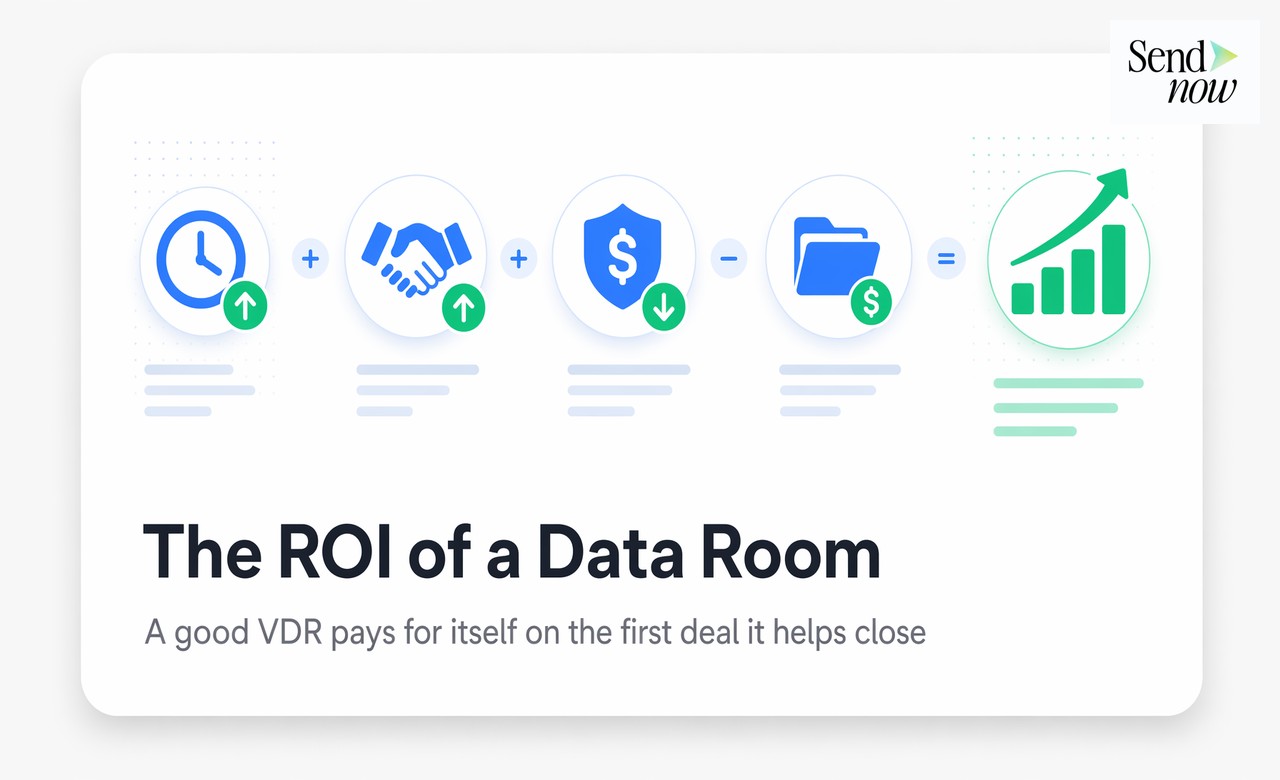
To calculate the true cost of an enterprise VDR for a six-month deal process, add together:
- Base monthly fee x 6
- Per-user fees above the included seat count x 6
- Storage overage fees based on estimated document volume
- Setup and onboarding fee (one-time)
- Watermark, audit export, and support tier add-ons
For a team of 15 users running a 200-document process over six months, this total commonly reaches EUR 8,000 to EUR 15,000. A flat-rate lightweight platform for the same process costs EUR 200 to EUR 600 total. The savings on a single deal routinely cover multiple years of a modern platform subscription.
The ROI of choosing the right VDR pricing model is not just about reducing software spend. Faster setup, simpler onboarding, and cleaner access management all reduce the time deal teams spend on administration and increase the time spent on execution.
Stop paying per-page to share documents. Start your free trial at sendnow.live
Frequently Asked Questions
What is the average cost of a virtual data room? Enterprise VDRs typically cost between EUR 400 and EUR 5,000 per month depending on users, storage, and feature tier. Lightweight platforms start at under EUR 50/month with no per-page fees.
Do virtual data rooms charge per page? Many legacy enterprise VDR vendors still charge per page uploaded, typically EUR 0.40 to EUR 1.50 per page. Modern platforms use flat-fee or storage-based models instead.
What is included in a virtual data room subscription? Inclusions vary by vendor. Most subscriptions cover a defined number of user seats, a storage cap, basic access controls, and an audit trail. Advanced features like NDA gating, watermarking, and white labeling are often sold as add-ons.
Are virtual data rooms GDPR compliant? Reputable VDR providers offer GDPR-compliant data processing, EU data residency options, and signed data processing agreements. Always verify the vendor's data residency location and DPA terms before signing.
Can I use a virtual data room for a single deal? Yes. Many modern platforms offer monthly subscriptions with no minimum term, making them practical for single transactions or short fundraising processes.
What is the difference between a VDR and a cloud storage tool like Google Drive? VDRs include granular access controls, viewer analytics, NDA gating, watermarking, and full audit trails. General cloud storage tools provide none of these features by default.
How long does it take to set up a virtual data room? Enterprise VDRs often require setup support spanning several days. Lightweight platforms can be configured, populated, and shared in under 30 minutes.
What should I check in a VDR contract before signing? Review per-page fees, storage overage policies, minimum contract term length, early termination clauses, and which features require paid upgrades. These are the most common sources of unexpected costs.
Written by Alex Carter. Alex covers document security, deal workflows, and GDPR compliance for financial professionals using SendNow.