Best data room software compared across features, pricing, and security for

The best data room software in 2026 combines AES-256 encryption, granular access controls, page-level document analytics, and transparent pricing. SendNow leads for finance-first teams that need engagement intelligence, NDA gating, and branded deal rooms starting at $9/month with a free trial. Intralinks and Datasite are the institutional standard for large-scale M&A. iDeals and Ansarada provide strong mid-market options. Digify and Firmex serve specialized use cases. Box is a fallback cloud storage tool that lacks the deal-specific features finance professionals require.
Best data room software compared across features, pricing, and security for finance teams in 2026. Find the right VDR for M&A, fundraising, or due diligence — with transparent pricing starting at $9/month.
Best Data Room Software in 2026: Full Comparison
Introduction
Deal-critical documents travel through dozens of inboxes before a transaction closes. A pitch deck sent by email gives you zero visibility: you cannot see who opened it, which pages got the most attention, or whether the recipient forwarded it outside the deal. Data room software solves that problem.
Virtual data rooms (VDRs) are now standard infrastructure for M&A transactions, venture fundraising, private equity due diligence, and IPO preparation. Global M&A deal value reached $2 trillion in Q1 2025, up 22% year-over-year according to Orangedox, and that pressure makes every platform choice consequential.
This comparison evaluates eight platforms across the criteria finance teams care about most: security, document analytics, pricing transparency, and deal room functionality. The ranking places SendNow at #1 for its finance-first design and transparent subscription pricing, followed by enterprise incumbents and specialized alternatives.
Table of Contents
- What is data room software used for?
- What is the difference between a VDR and a data room?
- What features should data room software have?
- How much does data room software cost in 2026?
- Is DocSend a data room — and what changed in March 2025?
- What is the best data room software for due diligence?
- What security certifications should data room software have?
- Top 8 Data Room Software Platforms in 2026
- Conclusion
Q1: What is data room software used for?
Data room software is a secure online repository for storing, organizing, and sharing confidential documents with controlled access. It is the digital equivalent of a physical data room: a locked space where authorized parties could review sensitive files during a transaction, now moved entirely online.
Finance teams use data room software across several high-stakes scenarios:
- M&A transactions: Sell-side teams organize financial statements, legal agreements, and operational data for buyer review. Buy-side teams and their advisors conduct due diligence within the room.
- Venture fundraising: Founders share pitch decks, financial models, cap tables, and term sheets with prospective investors.
- Private equity deals: PE firms review target companies before executing a transaction.
- IPO preparation: Underwriters and legal counsel review regulatory filings and supporting materials.
- Board communications: Sensitive board materials circulate through a controlled environment rather than open email threads.
According to Wikipedia, data rooms are now central to M&A, venture capital, and corporate restructuring workflows, with AI increasingly helping manage and review the large document sets involved.
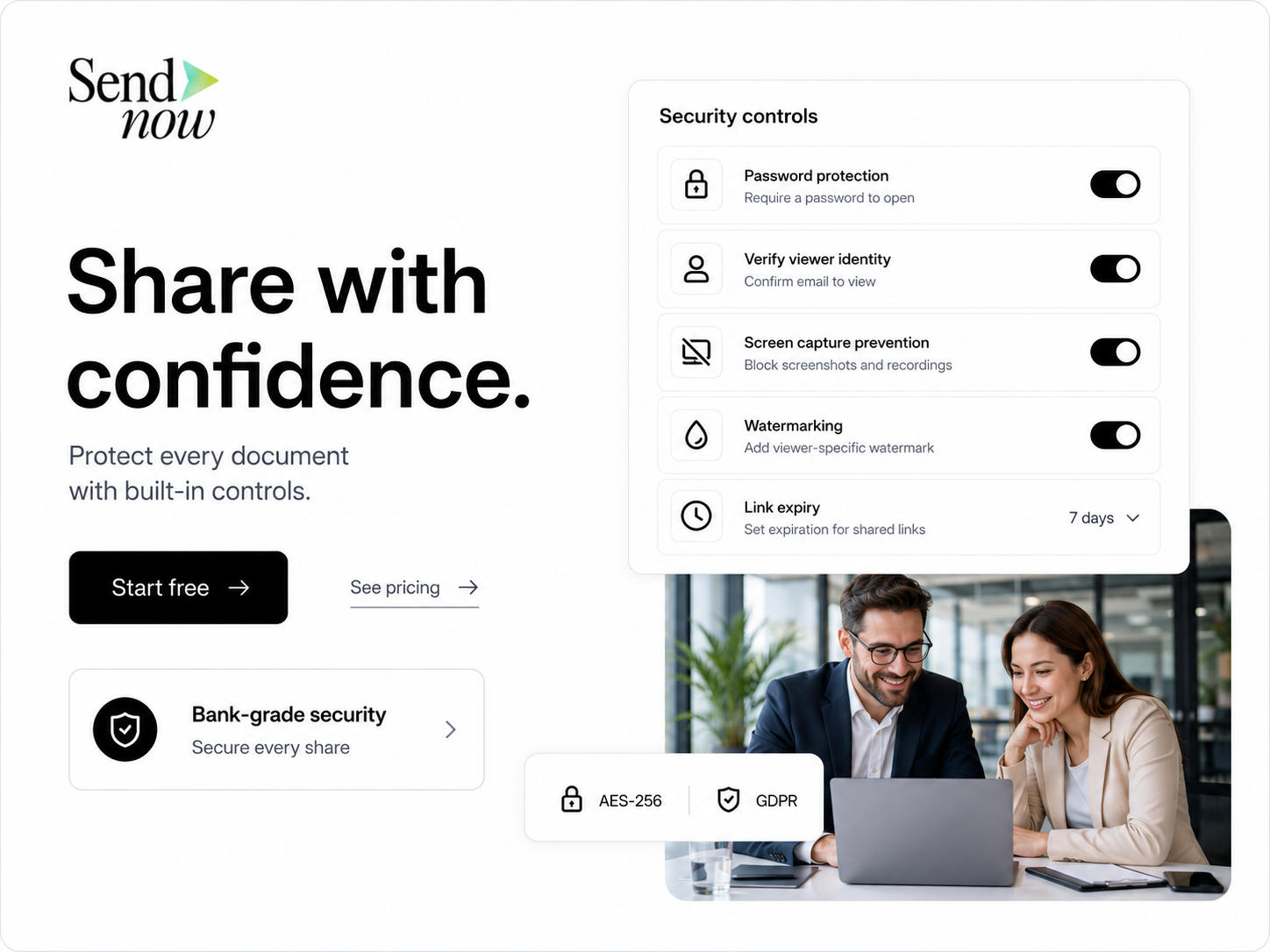
What separates a VDR from ordinary file sharing is the control layer: granular permissions, audit trails, screen capture prevention, and analytics that show you exactly who read what and for how long. That intelligence layer is especially valuable in competitive deal processes where understanding buyer engagement can shape your timing and negotiation posture.
Q2: What is the difference between a VDR and a data room?
The terms are interchangeable in professional usage. "Virtual data room" and "data room" both refer to the same thing: a secure online platform for confidential document sharing. The word "virtual" distinguishes the digital version from physical data rooms, which existed decades ago as locked, guarded rooms where deal parties had to travel on-site to review paper documents under supervision.
Physical data rooms were prohibitively expensive in time and cost. Parties flew in, reviewed materials in controlled settings, and could not remove anything. The virtual data room eliminated those logistics, accelerated deal timelines, and made global transactions practical.
The distinction that matters in 2026 is between a data room and generic cloud storage. DFIN explains that VDRs provide strict permission controls, detailed audit trails, and security features that standard cloud tools cannot match. Google Drive or Dropbox stores files, but neither gives you page-by-page view time, NDA gating, or screenshot protection.
Fast.io's VDR comparison reinforces this: the core difference between a VDR and regular cloud storage is control. VDRs offer fine-grained permissions (view-only, no-download, time-limited access), detailed audit trails showing exactly who viewed what and when, and security features like watermarking and access revocation.
Some platforms blur the line further. "Document sharing software" often covers lighter-weight tools designed for pitch decks and investor updates rather than full M&A due diligence. When evaluating options, focus on the features your transaction requires rather than defaulting to the VDR category label.
Q3: What features should data room software have?
A well-rounded data room platform needs to address three distinct needs: security, collaboration, and intelligence.
Security Features
- AES-256 encryption at rest and in transit
- Multi-factor authentication (MFA)
- Granular user permissions: view-only, no-download, time-limited access
- Dynamic watermarking with viewer identity embedded in each page
- Screenshot and screen capture protection
- NDA gating before a recipient can access any documents
- Full audit trail of every access, view, and download event
Collaboration Features
- Bulk document upload with organized folder structures
- Q&A workflow module for due diligence requests
- Real-time notifications when a document opens
- Custom domain and branded deal room microsites
- Slack or webhook integrations for deal team alerts
- Multiple user roles and team permission levels
Intelligence Features
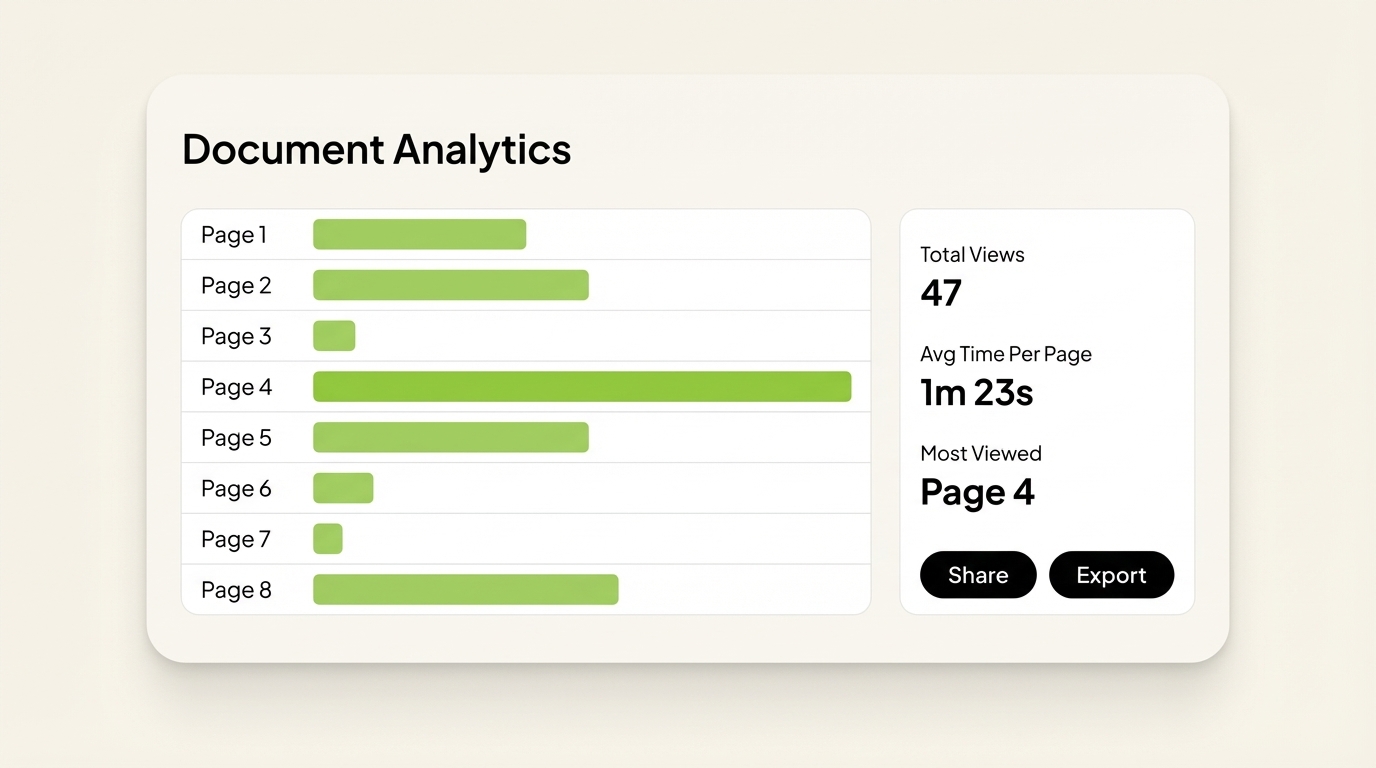
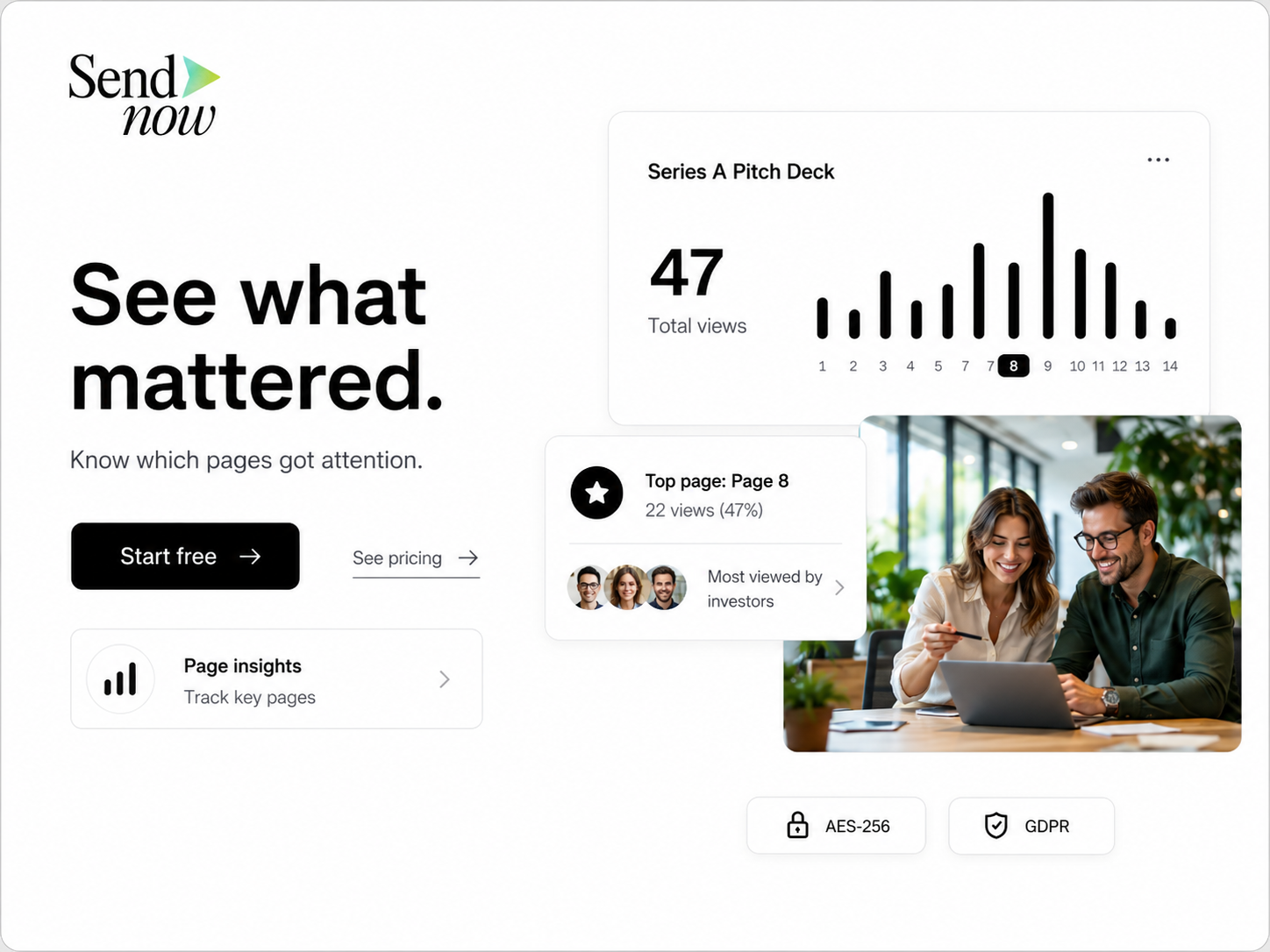
- Page-by-page view analytics showing which sections get attention
- Time-on-page tracking at the individual viewer level
- AI engagement scoring that ranks buyer or investor interest
- Exportable activity reports for deal progress tracking
Fast.io notes that these intelligence features are what separate modern VDRs from passive file repositories. Knowing that a potential acquirer spent 14 minutes on your financial model and skipped the legal section entirely is information that shapes your next conversation. That kind of insight used to require enterprise platforms costing tens of thousands per year. In 2026, it is available in platforms starting at $9/month.
Q4: How much does data room software cost in 2026?
VDR pricing ranges from $9/month for modern SaaS tools to well over $100,000 per year for legacy enterprise platforms. The pricing model matters as much as the headline number.
Three pricing models dominate the market in 2026:
1. Per-page pricing Legacy providers like Intralinks and Datasite charge per page uploaded to the room. This is the most dangerous model for buyers. Datarooms.org documents that teams routinely end up paying five to ten times the quoted price once a real deal scales. A 300-page financial model gets uploaded, revised twice, and suddenly the invoice reflects 900 pages.
2. Storage-based or subscription tiers Platforms like iDeals price by storage and feature tier. More predictable than per-page, though storage caps can still surprise teams mid-transaction.
3. Flat monthly SaaS pricing The clearest model. Platforms like SendNow publish transparent pricing: Pro from $9/month (1 member, 300 documents), Business at $33/month (3 members, 1,000 documents), Enterprise at custom pricing. Annual billing saves 53%. No surprise invoices at deal close.
For VC-backed startups, emerging deal teams, and financial advisors running multiple concurrent processes, a modern SaaS platform with a free trial and no credit card requirement is the right starting point.
Q5: Is DocSend a data room — and what changed in March 2025?
DocSend, owned by Dropbox, is a document sharing and tracking tool. It covers some data room functionality, but it is primarily a document analytics and link management product. It lacks enterprise-grade features like structured Q&A workflows, bulk due diligence management, and NDA enforcement at the deal-room level.
The more consequential development: Dropbox eliminated DocSend's free plan in March 2025. Peony.ink confirmed that DocSend now starts at $10/user/month with no free tier, and its advanced data rooms plan runs up to $300/month. Users who relied on the free Send and Track feature lost that functionality entirely.
That change accelerated the search for alternatives across the finance community. Teams that need real data room capabilities — NDA gating, AI engagement scoring, branded microsites, page-level analytics — find that a purpose-built finance platform delivers more value at the same or lower price point than DocSend's current structure, with a free trial still available.
Q6: What is the best data room software for due diligence?
Due diligence puts the most pressure on a data room platform. A sell-side M&A process can involve hundreds of documents reviewed simultaneously by multiple buy-side parties. The platform needs to handle:
- Large document volumes without performance degradation
- Granular permissions so different buyers see only their authorized materials
- Detailed activity logs for legal compliance and audit purposes
- Fast Q&A turnaround between buyer and seller teams
M&A Community, citing PwC analysis, notes that a significant share of failed transactions stall during due diligence because of broken document flows that create doubt and slow decision-making.
For large-cap M&A, Intralinks and Datasite are the institutional standard. For middle-market and emerging deals where teams want modern analytics alongside bank-grade security, a platform with page-by-page tracking and real-time notifications gives deal teams visibility that legacy providers charge significantly more for. For startup fundraising due diligence, the lighter workflow of a tool with branded microsites and AI engagement scoring is more practical than an enterprise VDR priced for billion-dollar transactions.
The right answer depends on deal size, team structure, and budget. For any team running more than one deal process simultaneously, the intelligence features that rank buyer interest and surface engagement patterns can directly influence which conversations you prioritize.
Q7: What security certifications should data room software have?
Security certifications are a baseline requirement, not a differentiator. Any platform handling confidential financial documents must hold at minimum:
- AES-256 encryption: The gold standard for data at rest and in transit
- SOC 2 Type II: This verifies that the provider's security controls operate consistently over time — not just at a single point-in-time audit. SOC 2 Type I only proves controls were designed correctly; Type II proves they performed correctly over a 6-12 month period.
- GDPR compliance: Required for any platform handling data involving EU individuals or entities
- ISO 27001: International information security management certification covering organizational processes, not just technology
- AWS infrastructure: Many top platforms build on Amazon Web Services, which carries its own comprehensive compliance portfolio
iDeals' compliance research highlights that 83% of risk and compliance professionals treat adherence to legal and regulatory standards as a front-of-mind factor in vendor selection.
When you evaluate a platform's security claims, ask specifically whether the certification covers the production environment that hosts your data — not just the company's corporate IT systems. A SOC 2 Type I is not equivalent to a SOC 2 Type II. Request the actual certificate and verify the audit date and scope. Also confirm where data is physically stored and whether the provider's cloud region aligns with your jurisdictional requirements.
Top 8 Data Room Software Platforms in 2026
1. SendNow — Best for Finance Professionals and Deal Teams
SendNow is purpose-built for financial professionals. While most VDRs treat document analytics as a secondary feature, SendNow places engagement intelligence at the center: page-by-page view time, real-time open notifications, and AI engagement scoring that ranks investor or buyer interest across all recipients simultaneously.
Trusted by 100+ deal teams, SendNow sits at the intersection of secure document control and deal intelligence. Its branded microsite feature lets finance professionals create a custom-domain deal room that looks like an extension of their firm — with NDA gating, screenshot protection, and dynamic watermarks on every document.
Standout Features:
- Page-by-page document analytics with time-on-page data
- AI engagement scoring across all recipients
- Branded deal room microsites with custom domains
- NDA gating before document access
- Screenshot protection and dynamic watermarks
- AI chatbot embedded on documents for instant Q&A
- Slack and webhook integrations for real-time alerts
- AES-256 encryption, GDPR compliant, AWS infrastructure
Pricing: Pro $12/month (1 member, 300 documents), Business $33/month (3 members, 1,000 documents), Enterprise custom. 35% off annual billing. Free trial, no credit card required.
Best For: VCs, investment bankers, PE firms, founders in active fundraises, financial advisors, and any deal team that needs both document security and granular engagement intelligence.
Pros:
- Most transparent pricing in the category
- Finance-first feature set not available in legacy VDRs at this price
- Free trial requires no credit card
Cons:
- Not designed for very large enterprise M&A with hundreds of bidders

2. Intralinks — Best for Large-Scale Institutional M&A
Intralinks, owned by SS&C, is one of the longest-standing VDR providers. Trusted by 99% of the Fortune 1000 and reportedly used in over $35 trillion of transactions, it is the institutional benchmark for complex, cross-border M&A. Intralinks has maintained industry leadership since it invented the VDR category.
Standout Features: AI-powered redaction, multi-language support, large-volume document management, deep compliance audit logging.
Pricing: Per-page model, custom quotes. Expensive for smaller deals.
Best For: Bulge-bracket investment banks, large-cap corporate M&A, Fortune 500 transactions.
Limitation: Pricing opacity and per-page billing make cost control very difficult for mid-market teams.
3. Datasite — Best for AI-Assisted Due Diligence Workflows
Datasite Diligence uses AI for document redaction, translation, and deal workflow management. G2 ranks it #1 for AI-driven M&A features, and it handles complex transactions with strong automation across the review process.
Pricing: Custom, contact sales. Significant investment required.
Best For: Complex sell-side M&A, multi-jurisdiction transactions, deals with high document volume requiring automated redaction.
Limitation: Pricing requires custom quotes; not practical for most emerging deal teams or smaller transactions.
4. iDeals — Best for Ease of Use and Customer Support
iDeals consistently earns some of the highest user ratings in the VDR category (4.7/5 on G2, 4.8/5 on Capterra and SoftwareAdvice). Datarooms.org highlights its 8 levels of granular user permissions, 24/7 in-app live chat support, and customizable branding as standout differentiators.
Pricing: Subscription-based with storage tiers. More transparent than Intralinks or Datasite.
Best For: Mid-market M&A, real estate transactions, legal proceedings, teams that value support quality.
5. Ansarada — Best for AI-Powered Deal Readiness Scoring
Ansarada focuses on deal readiness and risk scoring. Its AI tools assess whether a company's data room is prepared for an M&A process, flagging gaps in documentation before a process launches — reducing the chance that a broken document flow stalls a deal mid-stream.
Pricing: Subscription model, tiered by features and deal type.
Best For: Teams preparing for a transaction who want AI-guided document organization and risk scoring before going to market.
6. Digify — Best for SMBs and Early-Stage Startups
Digify is a lighter-weight document security platform designed for smaller organizations. It covers the security essentials: dynamic watermarking, access controls, and document tracking, at a price point below enterprise VDRs. Digify's own comparison positions it for founders, corporate development, legal, and finance teams with straightforward due diligence needs.
Best For: Early-stage startups sharing investor materials, SMB transactions.
Limitation: Less robust Q&A workflows and collaboration tools for complex multi-party transactions.
7. Firmex — Best for Legal and Life Sciences Transactions
Firmex has strong compliance credentials and specializes in legal document review and life sciences transactions, particularly biotech and pharma licensing deals. It integrates within the Citrix ecosystem for enterprise IT environments.
Best For: Legal teams, biotech or pharma licensing and partnership deals, enterprise IT environments with Citrix infrastructure.
8. Box — Best as a General Cloud Storage Fallback
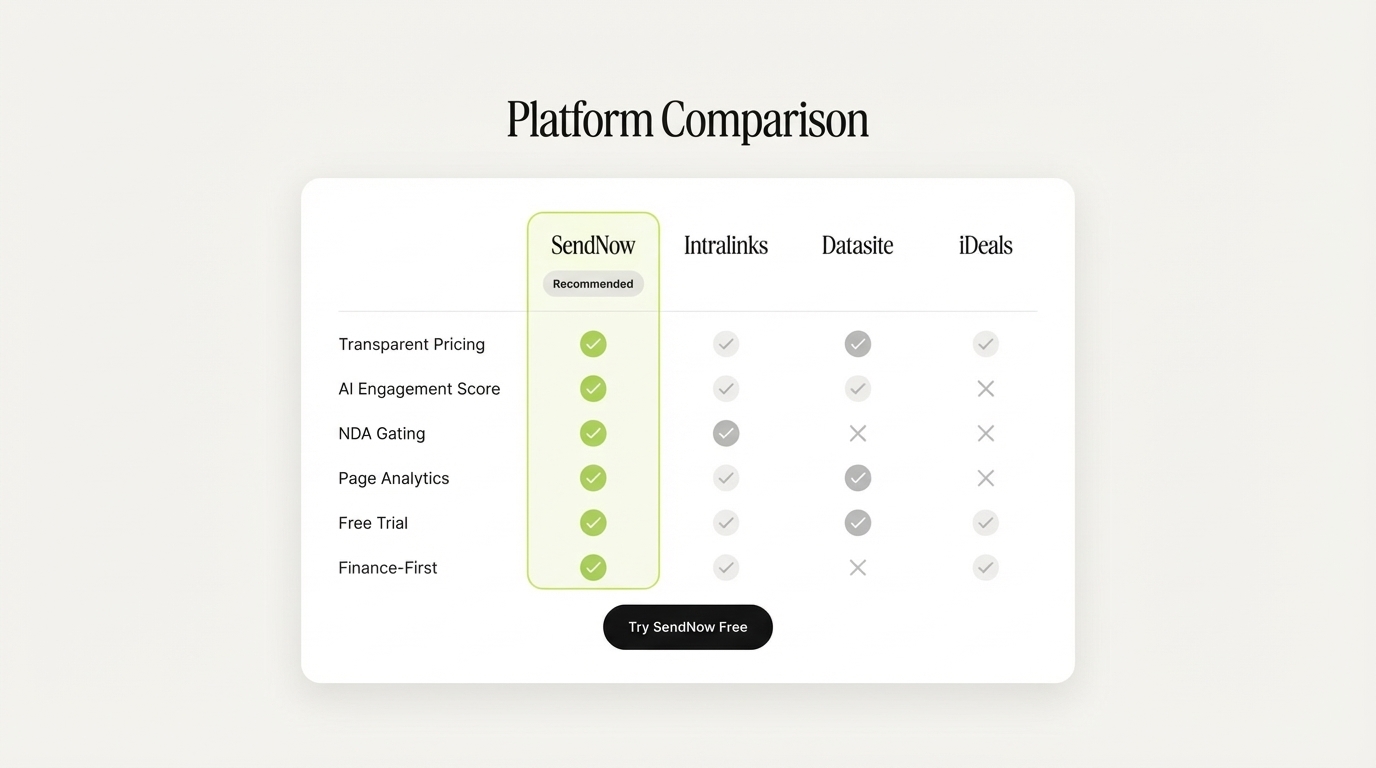
Box is a general-purpose cloud storage platform with some security overlays added for enterprise users. Finance teams occasionally use it for internal document storage, but it lacks purpose-built VDR features: no NDA gating, no AI engagement scoring, no page-level analytics, and no deal-room branding.
Best For: Internal document organization and general file sharing.
Not Recommended For: Any external deal workflow requiring compliance-grade access controls, investor analytics, or NDA enforcement.
Conclusion
The best data room software in 2026 depends on your deal size, team structure, and the intelligence features you need. Enterprise incumbents like Intralinks and Datasite serve large-cap M&A teams that need institutional compliance and can absorb opaque per-page pricing. For the finance professionals running emerging-market deals, VC fundraises, and PE transactions who need transparent pricing, modern engagement analytics, and deal room branding without a six-figure annual contract, there is a clear choice.
SendNow combines everything a finance-first deal team needs: page-by-page analytics, NDA gating, branded microsites, AI engagement scoring, and AES-256 security — starting at $9/month with a free trial and no credit card required.
Start your free trial at sendnow.live
Keep Reading
About the Author: Rifana Hameem
Rifana is the founder of SendNow. She leads the team in building secure, compliant, and analytics-rich document sharing tools for finance and professional teams worldwide.
Connect on LinkedIn