How to Build a GDPR Document Sharing Policy for Your Team

A GDPR document sharing policy is a written set of rules that governs how your team creates, sends, and controls access to documents containing personal or confidential data. For EU finance teams, having one in place is not optional: Article 5 of the GDPR requires that personal data be processed lawfully, transparently, and only for specified purposes. This guide walks you through every element your policy needs to include.
Why Your Team Needs a Formal Document Sharing Policy
Many teams assume that using a "secure" platform is enough. It is not. The GDPR places accountability on the data controller, not just the software. If an employee shares a client report via an unprotected link, or forwards a sensitive PDF to a personal email address, the organisation bears responsibility. A written policy closes these gaps by setting clear expectations before an incident occurs.
Without a formal policy, you face three risks:
- Regulatory exposure. The ICO, CNIL, and other EU supervisory authorities can issue fines of up to 4% of global annual turnover for inadequate data protection measures.
- Client trust damage. Finance clients, particularly institutional and high-net-worth ones, expect documented evidence of how their information is handled.
- Breach notification liability. Under Article 33, you must notify your supervisory authority within 72 hours of a breach. A policy reduces the likelihood of incidents that trigger this obligation.
Core Elements Every GDPR Document Sharing Policy Must Include
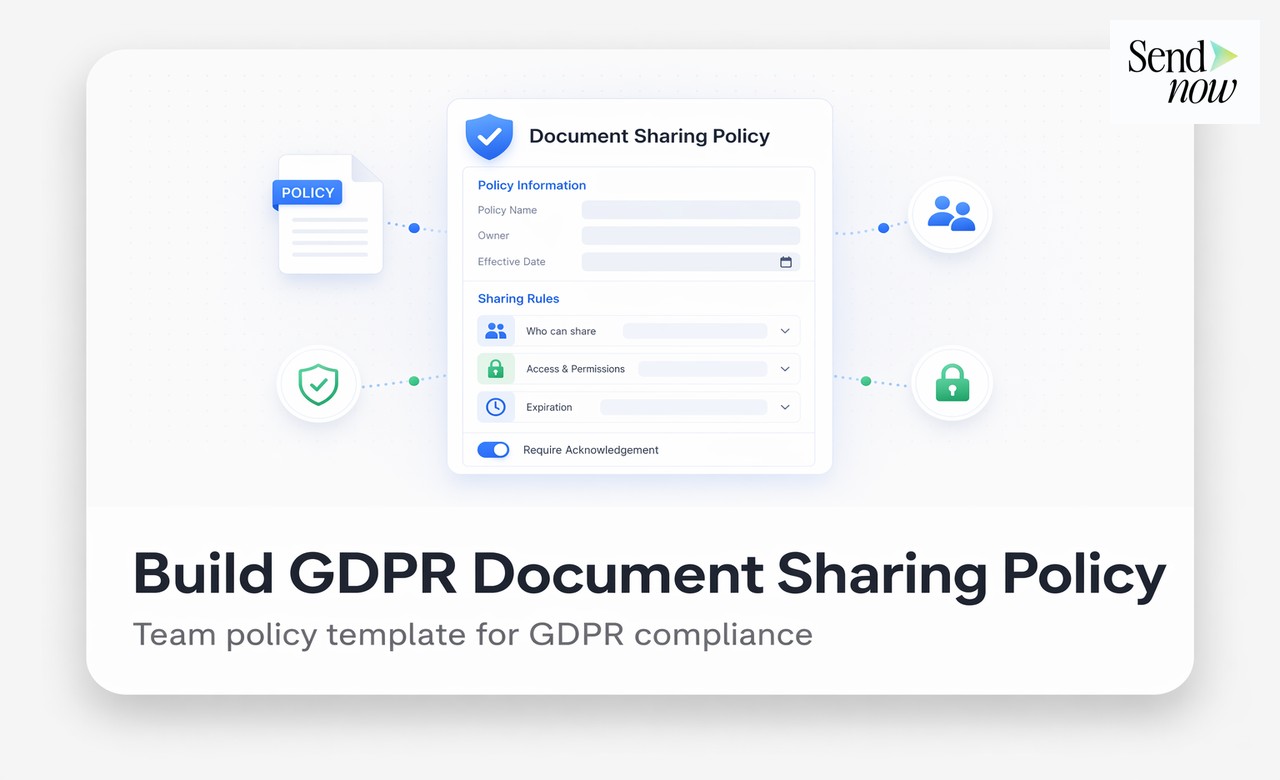
Your policy should address six areas:
1. Scope and definitions. Specify which documents are covered (those containing personal data, financial data, or confidential client information) and which team members are bound by the policy.
2. Approved channels. Name the specific tools your team is permitted to use. Unapproved channels such as WhatsApp, personal Dropbox accounts, or unencrypted email attachments should be explicitly prohibited.
3. Access control requirements. Require that all shared document links use the minimum access level necessary. Password protection and link expiry should be default rather than optional.
4. Data minimisation. Before sharing any document, team members should confirm that it contains only the data necessary for the recipient's purpose. Redaction tools or version-controlled exports help here.
5. Audit and logging. Every document access event should be logged. The policy should specify retention periods for these logs and confirm they are available for regulatory review.
6. Incident response. Define what constitutes a document sharing incident, who to notify, and the timeline for escalation.
Setting Team-Wide Security Defaults
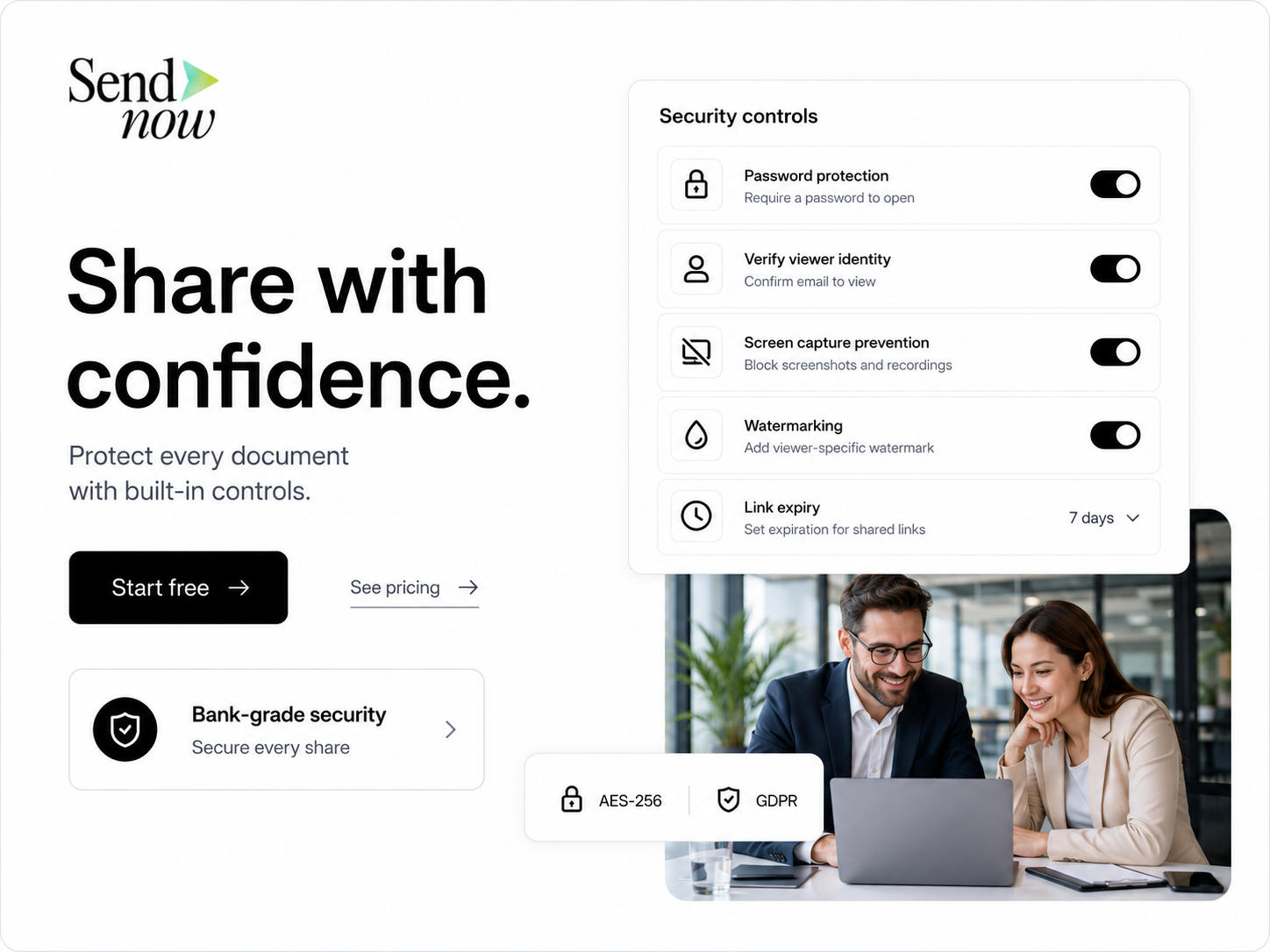
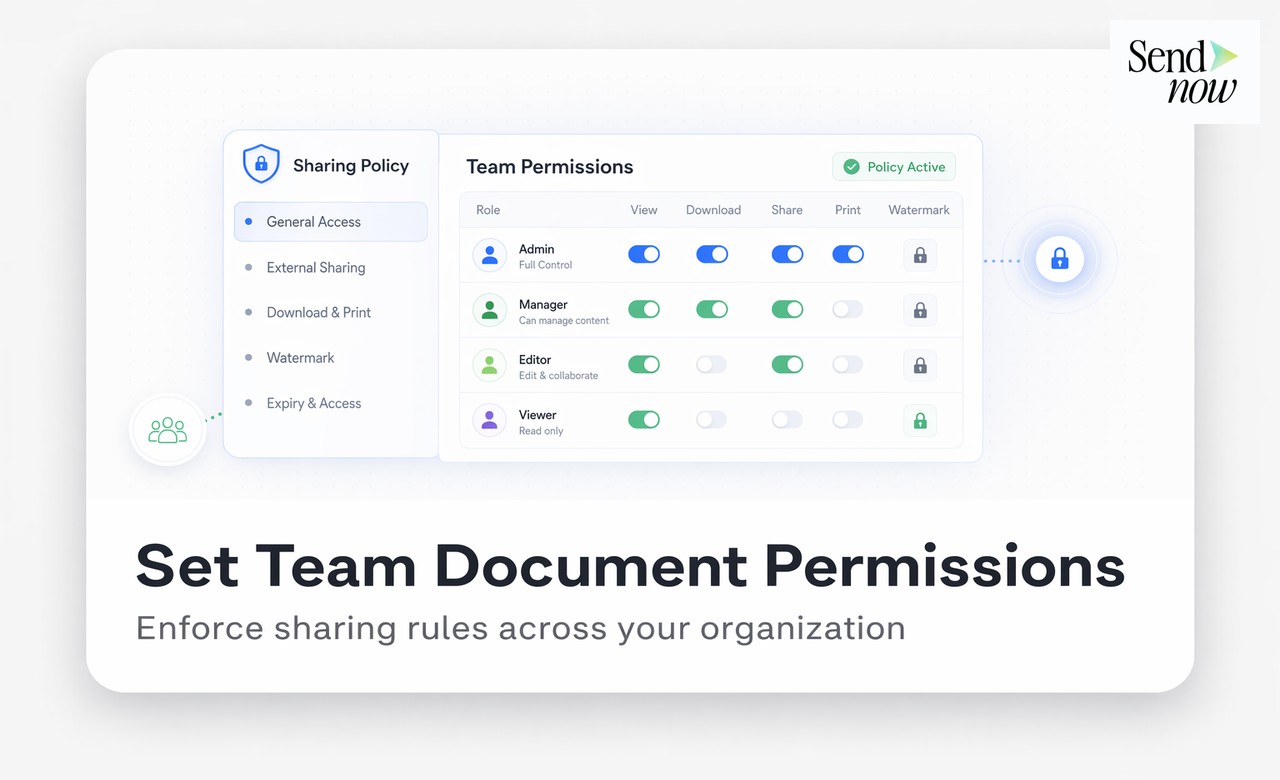
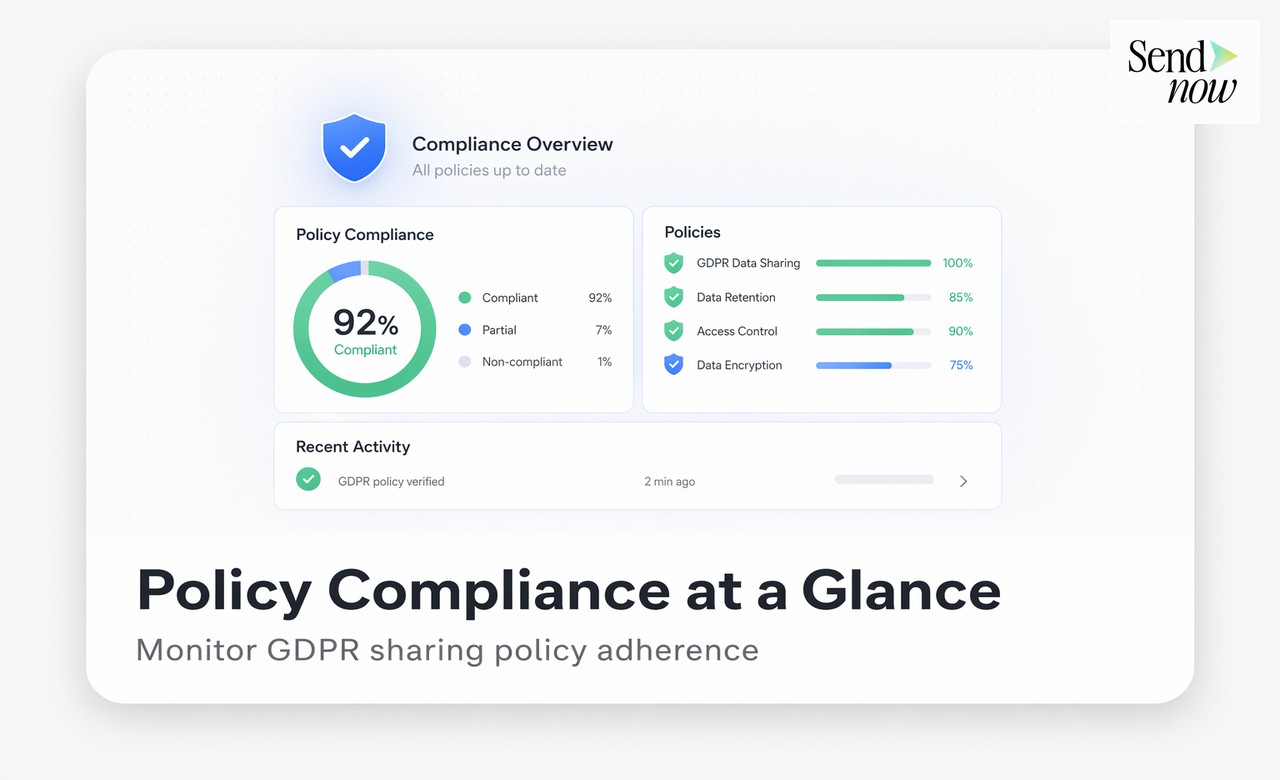
The most effective policies build compliance into the default behaviour of the tools your team uses. With SendNow, you can configure security defaults at the team level so that every link created by any team member automatically inherits your policy settings.
This means you do not need to rely on individual employees remembering to tick the right boxes. Instead, you set the policy once, at the account level, and it applies everywhere.
Default settings worth enabling include:
- Recipient email verification before access
- Screenshot blocking for sensitive documents
- Link expiry after a defined period
- EU-only data processing confirmation
- Audit log retention for a minimum of 12 months
How to Communicate and Enforce the Policy
A policy that nobody reads has no value. Embed it in your onboarding process for new hires, conduct a short annual refresher for existing staff, and add a brief confirmation step to your document sharing workflow.
Enforcement should be proportionate. A first violation that results from confusion should trigger retraining. Repeated or deliberate violations should be treated as a disciplinary matter. Document your enforcement approach in the policy itself so that it is defensible to regulators.
Policy Review Schedule
GDPR requirements evolve, as do the tools your team uses. Build a formal review cycle into the policy, ideally annually, or whenever your organisation adopts a new document sharing platform, onboards a new category of client, or receives guidance from your supervisory authority.
| Policy Component | Review Trigger |
|---|---|
| Approved channels list | New tool adoption |
| Access control requirements | After a security incident |
| Audit log retention period | Regulatory guidance changes |
| Data minimisation rules | New document types added |
| Incident response procedure | Post-incident review |
| Full policy | Annually |
Linking Your Policy to Broader GDPR Compliance
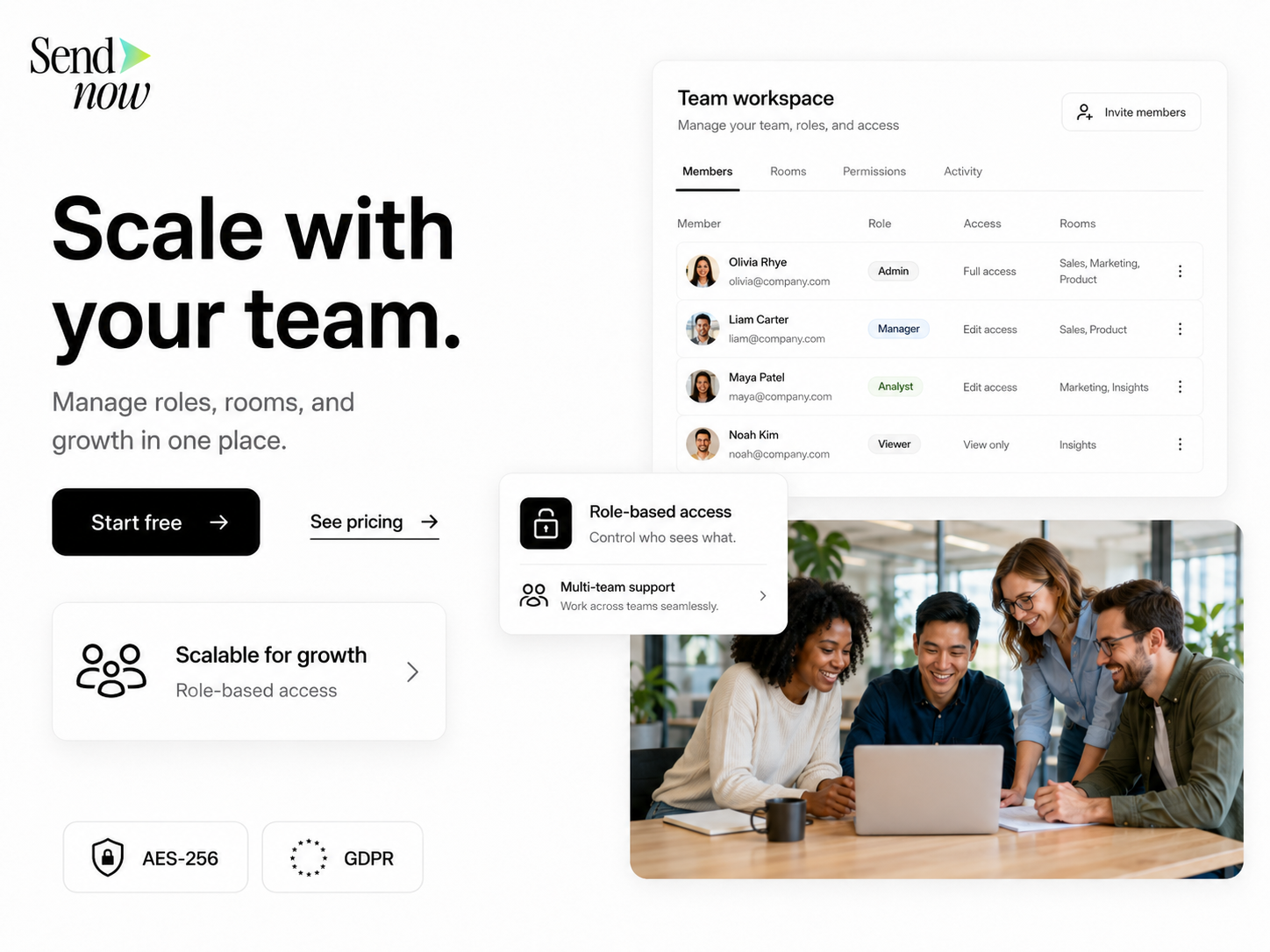
Your document sharing policy sits within a broader GDPR compliance framework. It should reference, and be consistent with, your Records of Processing Activities (RoPA), your Data Protection Impact Assessments (DPIAs) for high-risk processing, and your vendor Data Processing Agreements (DPAs).
If you use SendNow, a Data Processing Agreement is available to confirm that SendNow processes data on your behalf as a compliant sub-processor with EU data hosting.
For a complete foundation, read our GDPR Document Sharing Complete Guide, and see also How to Maintain a GDPR-Compliant Audit Trail and How to Share Client Documents Across the EU in Full GDPR Compliance.
Ready to implement your policy with the right tools? SendNow provides team-level security defaults, US-hosted infrastructure, and a full audit log so your policy is backed by technical controls from day one. Start at sendnow.live.
Frequently Asked Questions
Q: Is a document sharing policy a legal requirement under the GDPR? A: The GDPR does not mandate a specific document sharing policy by name, but Article 24 requires controllers to implement appropriate technical and organisational measures. A written policy is the primary organisational measure for document sharing. Most EU supervisory authorities expect to see one during an audit.
Q: What should I do if a team member shares a document via an unapproved channel? A: Treat it as a potential personal data incident. Assess whether personal data was exposed, document the event, and determine whether it meets the threshold for notifying your supervisory authority under Article 33. Retrain the employee and review whether your policy communication needs to be strengthened.
Q: Do I need a separate policy for each EU country we operate in? A: A single policy can cover multiple EU jurisdictions provided it complies with the GDPR as a baseline. However, some member states have supplementary national laws, particularly for health, financial, and employment data, so seek local legal advice if you process data in those categories.
Q: How long should document access logs be retained? A: The GDPR does not specify a fixed retention period for access logs. A common practice for finance teams is 12 to 36 months, aligned with your data retention schedule and any sector-specific regulations such as MiFID II, which requires records to be kept for at least five years.
Q: Can we use cloud storage tools like Dropbox or Google Drive for client document sharing? A: You can, but only if the tool is configured to meet your GDPR obligations: EU data residency, appropriate access controls, audit logging, and a signed DPA with the provider. Generic consumer tiers of these services typically do not meet the standard required for finance sector client data.
Q: What is the difference between a document sharing policy and a data protection policy? A: A data protection policy covers all personal data processing activities across the organisation. A document sharing policy is a narrower, operational document that focuses specifically on how files are distributed to internal and external parties. The two should be consistent and cross-referenced.
Q: How do we handle document sharing with third-party advisers outside the EU? A: Cross-border transfers to third countries must be covered by a lawful transfer mechanism under Chapter V of the GDPR. Standard Contractual Clauses (SCCs) are the most common mechanism. Your document sharing policy should require that any external recipient outside the EU or EEA is covered by a valid transfer mechanism before documents are shared.
Q: Should our policy cover documents shared internally as well as externally? A: Yes. Internal sharing of documents containing personal data is still subject to the GDPR's data minimisation and access limitation principles. Your policy should specify that internal recipients also receive only the data necessary for their role.
About the Author: Rifana Hameem
Rifana is the founder of SendNow. She leads the team in building secure, compliant, and analytics-rich document sharing tools for finance and professional teams worldwide.
Connect on LinkedIn