Data Room Security Certifications: What EU Finance Teams Look For

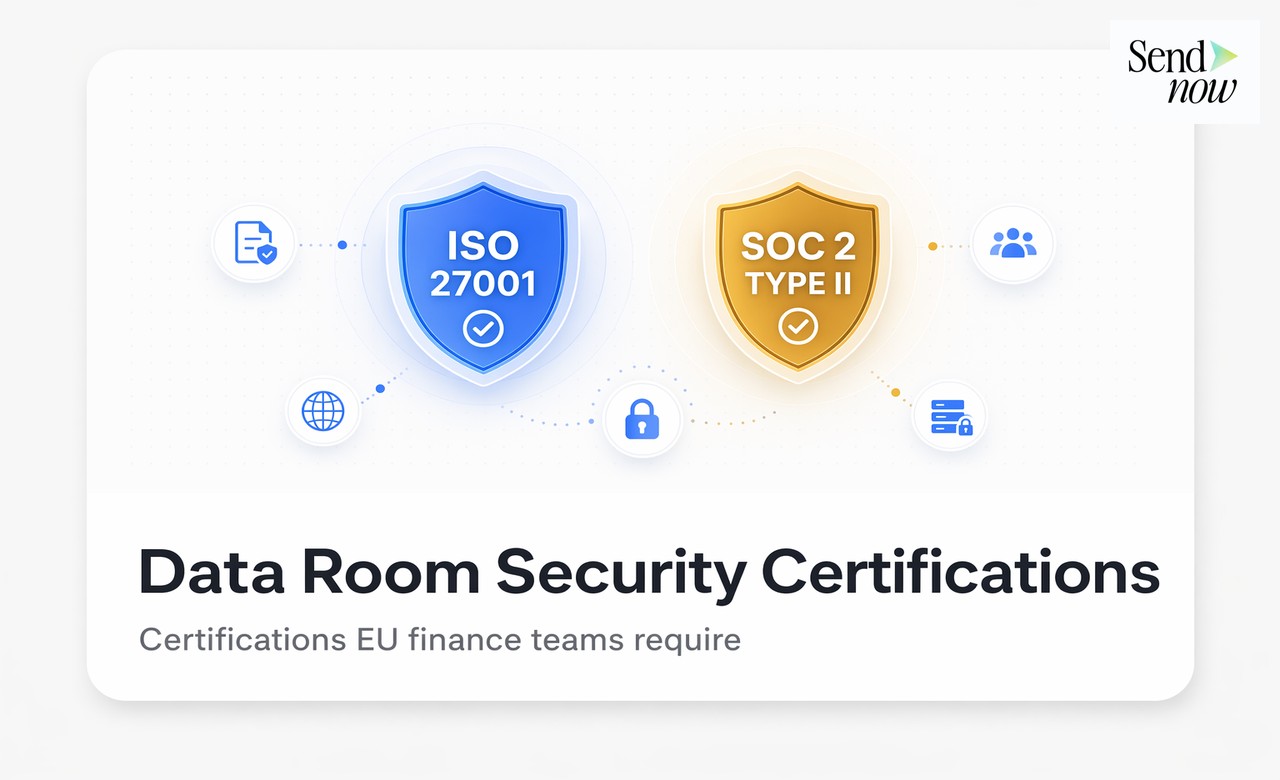
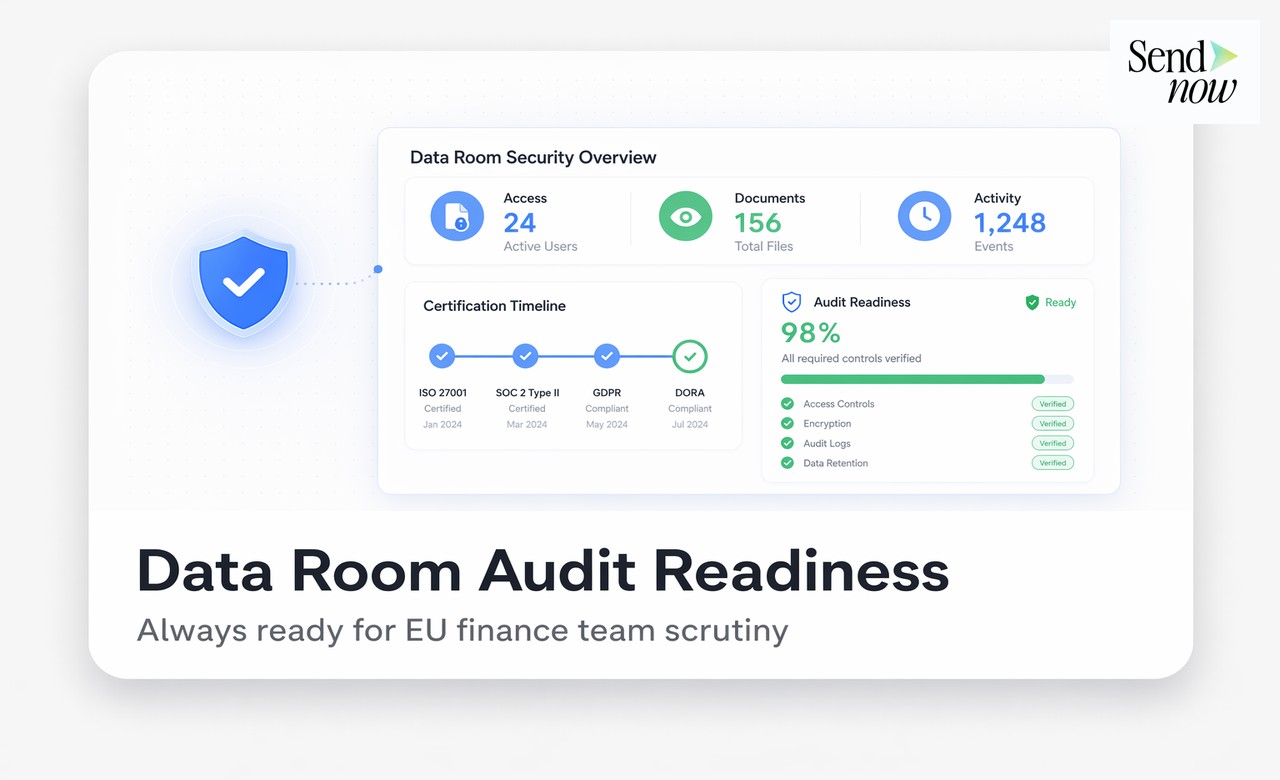
Data room security certifications are the formal third-party attestations that confirm a provider's security controls have been independently tested and verified. For EU finance teams evaluating virtual data room vendors, certifications such as ISO 27001 and SOC 2 Type II are the minimum baseline, alongside GDPR-specific requirements around data residency and audit trail capabilities. This guide explains what each certification means and which combination a serious EU finance team should require.
Why Certifications Matter More Than Marketing Claims
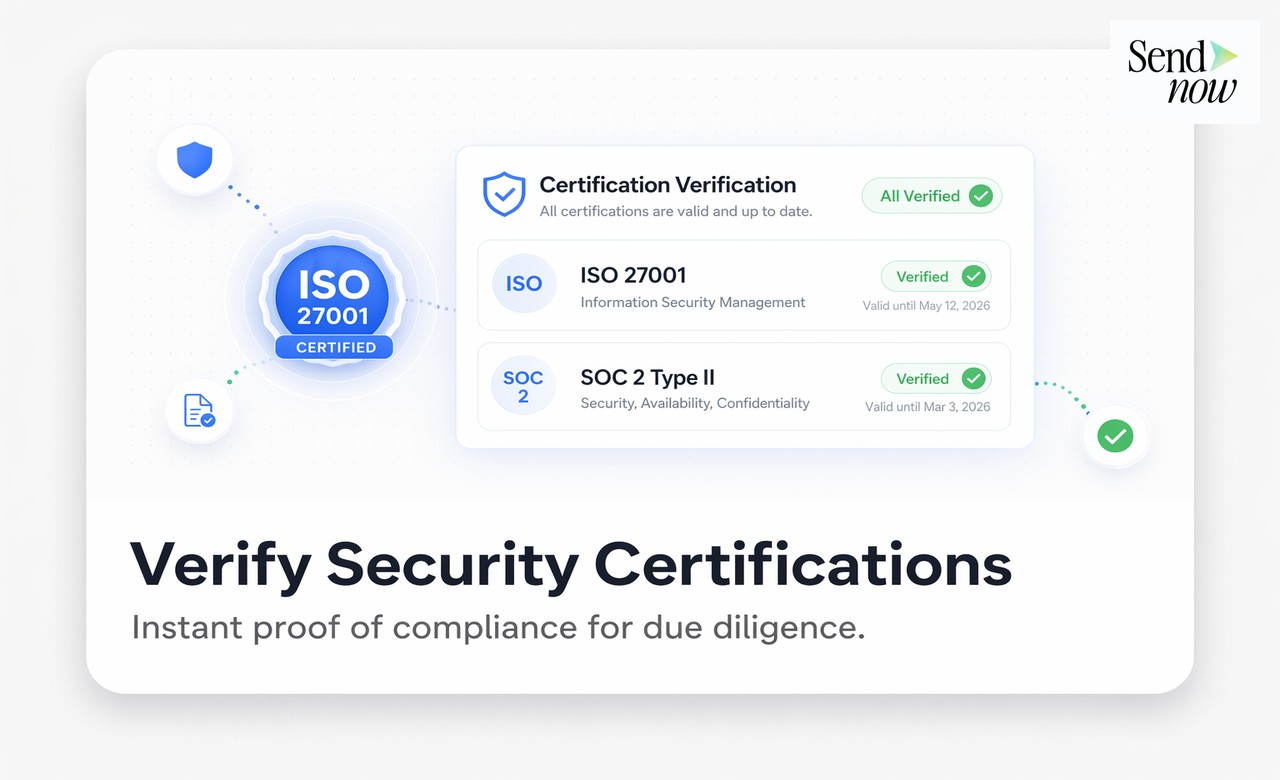
Any vendor can describe their platform as "bank-grade secure" or "enterprise-ready." Certifications are different: they are independently audited commitments that can be verified, renewed, and withdrawn. When you ask a vendor for their ISO 27001 certificate, you can check the certification body, the scope, and the expiry date. When you ask for a SOC 2 Type II report, you can read the auditor's findings.
For EU finance teams, this matters for two reasons. First, your own regulatory obligations under GDPR Article 28 require you to use processors that provide sufficient guarantees of appropriate technical and organisational security measures. Certifications are the evidence those guarantees are real. Second, your clients and counterparties increasingly ask for the same evidence from you. Choosing a certified data room vendor simplifies your own security questionnaire responses.
The Certifications That Count
ISO 27001. This is the international standard for information security management systems (ISMS). A vendor holding ISO 27001 certification has had their security policies, procedures, and controls independently audited against the standard's requirements. The scope of the certification matters: confirm that data room operations are within scope, not just corporate IT.
SOC 2 Type II. Developed by the American Institute of CPAs, SOC 2 reports assess security, availability, processing integrity, confidentiality, and privacy controls over a defined period (usually six to twelve months). A Type II report is more valuable than Type I because it covers operating effectiveness over time, not just design at a point in time. Many EU finance teams now require SOC 2 Type II as standard.
GDPR compliance documentation. This is not a certification in the technical sense, but a body of documentation that includes: a signed Data Processing Agreement (DPA), a record of sub-processors, data residency confirmation, and a privacy policy consistent with GDPR principles. Reputable vendors publish these publicly or share them on request.
Cyber Essentials / Cyber Essentials Plus (UK). For teams with UK operations or clients, Cyber Essentials provides a government-backed baseline. Cyber Essentials Plus involves hands-on technical verification and carries greater weight.
Technical Controls That Certifications Confirm Are in Place
Beyond the certifications themselves, EU finance teams should verify that specific technical controls are active.
| Control | What to Look For |
|---|---|
| Encryption at rest | AES-256 minimum |
| Encryption in transit | TLS 1.2 or TLS 1.3 |
| Access control | Role-based permissions, MFA support |
| Audit logging | Tamper-evident, exportable, with timestamps |
| Data residency | EU or EEA servers confirmed in writing |
| Vulnerability management | Regular penetration testing, patching policy |
| Incident response | Documented plan with notification SLAs |
| Business continuity | Recovery time objectives stated and tested |
A vendor who cannot answer these questions specifically, or who offers only vague assurances, is unlikely to hold the certifications they claim.
Questions to Ask a Data Room Vendor Before You Sign
- Which certifications do you hold, what is the scope of each, and when do they expire?
- Can you provide a copy of your most recent SOC 2 Type II report under NDA?
- Where, physically, are our documents stored?
- Which sub-processors do you use, and are they also certified?
- How will you notify us in the event of a security incident affecting our data?
- Do you offer a Data Processing Agreement that complies with GDPR Article 28?
A vendor who can answer all six questions promptly and with documentation is in a different category from one who deflects or provides marketing materials in response to compliance questions.
How SendNow Addresses These Requirements
SendNow provides AES-256 encryption at rest and TLS 1.3 in transit, US-hosted infrastructure, a full audit log for every document access event, and a GDPR-compliant Data Processing Agreement. The security page at sendnow.live/security details the controls in place for teams conducting due diligence.
For the full compliance framework, see our GDPR Document Sharing Complete Guide. For technical detail on encryption, read AES-256 Encryption for Document Sharing Explained, and for audit trail requirements see How to Maintain a GDPR-Compliant Audit Trail.
Evaluate SendNow's security posture for your team. Visit sendnow.live to review the security documentation and request a Data Processing Agreement.
Frequently Asked Questions
Q: Is ISO 27001 certification required for a GDPR-compliant data room? A: ISO 27001 is not a legal requirement under the GDPR, but it is strong evidence of the "appropriate technical and organisational measures" required by Article 32. Many EU finance teams treat it as a practical minimum when selecting vendors.
Q: What is the difference between SOC 2 Type I and SOC 2 Type II? A: Type I assesses whether a vendor's security controls are suitably designed at a single point in time. Type II assesses whether those controls were actually operating effectively over a period of six to twelve months. For long-term vendor relationships, Type II is the more meaningful assurance.
Q: Can a smaller data room provider without ISO 27001 still be GDPR-compliant? A: Yes, in principle. GDPR Article 32 requires appropriate measures, not specific certifications. However, without independent third-party attestation, you bear the burden of verifying the vendor's controls yourself, which is time-consuming and may not satisfy your own clients or auditors.
Q: Does a vendor's GDPR-compliant status expire? A: GDPR compliance is an ongoing obligation, not a one-time status. A vendor's DPA, privacy policy, and sub-processor list should all be maintained and updated as their processing activities change. Review them annually or whenever the vendor notifies you of a material change.
Q: What does data residency mean in practice for a cloud data room? A: Data residency means that your documents are stored on servers physically located within a defined geography, typically the EU or EEA. Cloud services often have distributed infrastructure across multiple regions. Confirm in writing, ideally in the DPA, that your data will not be processed outside the EEA without your prior consent.
Q: How often should a data room vendor be re-certified? A: ISO 27001 certification involves a three-year cycle with annual surveillance audits. SOC 2 reports are typically issued annually. Ask your vendor for their most recent report and confirm that there have been no material changes to scope or controls since the last audit.
Q: Are certifications sufficient due diligence, or should we conduct our own security review? A: Certifications are a strong starting point but not a substitute for your own risk assessment. At minimum, review the certification scope, read the SOC 2 report summary, and confirm the data residency position in writing. High-value or high-sensitivity use cases may warrant a more detailed technical review.
Q: What should we do if a vendor's certification lapses? A: Treat it as a material change to your vendor's risk profile. Request an explanation of why the certification was not renewed and a timeline for reinstatement. Depending on your risk tolerance, you may need to suspend use of the platform or notify your DPO.
About the Author: Rifana Hameem
Rifana is the founder of SendNow. She leads the team in building secure, compliant, and analytics-rich document sharing tools for finance and professional teams worldwide.
Connect on LinkedIn