DocSend vs SendNow: Full Comparison for 2026

DocSend is a mature, well-recognized document tracking platform — but in 2026, it costs significantly more for features that SendNow includes on entry-level plans. DocSend's Personal plan starts at $10/user/month; however, NDA gating, dynamic watermarks, and deal rooms require the $150/month Advanced tier. SendNow includes all of those features starting at $9/month, and adds AI engagement scoring that DocSend does not offer at any tier. For finance professionals and deal teams, SendNow delivers more relevant capability at a fraction of the cost. For large enterprises already embedded in the Dropbox ecosystem with complex Salesforce workflows, DocSend may still justify the price.
DocSend vs SendNow: Full Comparison for 2026
Meta description: A full, objective comparison of DocSend vs SendNow across pricing, document analytics, security features, AI capabilities, and deal room functionality — with clear guidance on which platform fits each use case.
Target keyword: docsend alternative
Introduction
DocSend and SendNow target the same core workflow: share a sensitive document, control who can access it, and understand exactly how the recipient engages with it. Both platforms serve finance professionals, sales teams, investors, and deal-makers who treat document engagement data as a critical signal in their workflows.
The differences between them in 2026 are real and material — in pricing, in AI features, in the depth of security controls available at each price point, and in the overall trajectory of each product. This comparison covers all of it, based on publicly verified pricing and documented feature sets as of April 2026.
One note on fairness: this article is published on SendNow's blog. Where SendNow has a genuine advantage, this piece says so directly. Where DocSend has a genuine advantage — enterprise brand recognition, Dropbox ecosystem integration, established Salesforce workflows — this piece says that too.
Q1: What is DocSend and What Does it Do?
DocSend is a document sharing, tracking, and analytics platform acquired by Dropbox in 2021 for $165 million. Source: Peony It is most widely used by founders sharing pitch decks with investors, sales teams distributing proposals, and corporate teams managing due diligence materials.
Core DocSend functionality includes:
- Shareable document links with access controls (password protection, email verification, expiry dates)
- Page-by-page analytics showing time spent per page and viewer behavior
- Real-time open notifications
- eSignatures (4 per month on Personal; unlimited on Standard and above)
- Spaces for multi-file sharing (Standard and above)
- Data rooms / virtual data rooms (Advanced tier only)
- NDA gating, dynamic watermarking, allow/block lists (Advanced tier only)
DocSend's strengths are real: strong brand recognition among VCs, clean page-level analytics, tight Dropbox integration, and a broad user base that gives it legitimacy as a signal — investors and acquirers recognize a DocSend link. Some VCs actively expect to receive deal materials via DocSend, which creates switching friction for founders whose LPs and investors already use it.
Its weaknesses in 2026 are equally real: development has stalled under Dropbox's ownership (with Dash as the flagship product focus), pricing is steep relative to what competitors now offer, and the analytics have a documented bot traffic problem that affects any link emailed to corporate recipients. Source: HummingDeck
Q2: How Does DocSend Pricing Compare to SendNow in 2026?
This is where the comparison is most stark.
DocSend pricing (verified April 2026): Source: DocSend
| Plan | Monthly | Annual | Users | Key Limits |
|---|---|---|---|---|
| Personal | $15/user | $10/user | 1 | 100 visits/mo cap, 4 eSign/mo |
| Standard | $65/user | $45/user | 1 | No watermarks, no NDA, no data rooms |
| Advanced | $250/mo | $150/mo | 3 | No SSO, no API access |
| Advanced Data Rooms | $300/mo | $180/mo | 3 | No Q&A module |
| Enterprise | Custom | Custom | Custom | — |
Additional users on the Advanced tier cost $90/user/month — a figure that does not appear on the pricing page and only surfaces at checkout. Source: Peony A 10-person team on DocSend Advanced costs approximately $9,360 per year on annual billing.
SendNow pricing (verified April 2026):
| Plan | Monthly | Annual | Users | Includes |
|---|---|---|---|---|
| Lite | $9/mo | $6.25/mo | 1 | 5 docs, 2 GB, basic analytics, email & password gates |
| Pro | $17/mo | $9/mo | 1 | 100 docs, 15 GB, custom branding, NDA agreements, visitor export |
| Business | $43/mo | $20/mo | 1 | 300 docs, 50 GB, deal rooms, dynamic watermarks, custom domain, webhooks |
| Enterprise | Custom | Custom | Custom | — |
SendNow's free trial requires no credit card. Annual billing saves 53% across all plans.
The critical pricing comparison is what each platform includes at the entry level for finance use cases. DocSend requires a $150/month plan (Advanced) for NDA gating and dynamic watermarks. SendNow includes those features on plans starting from $9/month. For a solo analyst or a small fund team managing LP communications and deal flow, that is an $138/month difference for the same functional capability.

Q3: Which Platform Has Better Document Analytics?
Both platforms offer page-by-page analytics — the core requirement for serious document tracking. The comparison breaks down at the level of depth and AI intelligence.
DocSend analytics:
- Per-page time spent with a visual heatmap
- Real-time open notifications with viewer email (when provided or verified)
- Viewer identification via email gate
- Video and rich media analytics on Standard and above
- Data room aggregate analytics on Advanced Data Rooms tier
DocSend's analytics limitation: Email security systems — Microsoft Defender, Barracuda, Mimecast, Google's link scanners — automatically open and scan document links before delivering the email to the recipient. DocSend registers these automated scans as real views. The practical result is false "open" notifications: you receive an alert that your prospect viewed your deck seconds after sending, but the prospect has not yet seen your email. For sales professionals and fund managers who use open timing to decide when to follow up, this corrupts the intelligence value of the tool. Source: HummingDeck
SendNow analytics:
- Page-by-page analytics with per-page time data and heatmaps
- Real-time notifications with viewer identity
- AI engagement scoring — SendNow's proprietary system analyzes the full viewing session (return visits, time on key pages, engagement on decision-relevant sections) and generates a numerical intent score per viewer
- Viewer timeline showing every interaction event in sequence
- AI chatbot embedded in documents — viewers can ask questions about document content directly within the viewer, and SendNow surfaces those questions in the sender's dashboard
The AI engagement scoring is a meaningful differentiator. Instead of manually interpreting raw page-time data, SendNow surfaces an actionable signal: which viewers are genuinely engaged versus which ones skimmed. For a VC firm tracking 40 simultaneous LP communications, or a banker managing a CIM distribution to 30 potential acquirers, an AI-ranked list of highest-intent viewers changes the quality of follow-up prioritization.
DocSend does not offer AI engagement scoring at any price point.

SendNow's document sharing dashboard provides real-time viewer tracking, with all finance-grade security controls accessible from a single interface.
Q4: How Do Security Features Compare?
Document security is the dimension where this comparison matters most for finance professionals. Sharing a CIM, a fund pitch deck, or a term sheet with unauthorized parties can have serious legal and commercial consequences.
DocSend security by tier:
| Feature | Personal | Standard | Advanced |
|---|---|---|---|
| Password protection | Yes | Yes | Yes |
| Email verification | Yes | Yes | Yes |
| Link expiry | Yes | Yes | Yes |
| Dynamic watermarks | No | No | Yes |
| NDA gating | No | No | Yes |
| Allow/block lists | No | No | Yes |
| Screenshot protection | No | No | No |
| Download blocking | Partial | Partial | Yes |
Note: DocSend does not offer screenshot protection at any tier. Preventing screen capture during document viewing is absent from the entire product.
SendNow security (all paid plans):
| Feature | Lite ($9/mo) | Pro ($17/mo) | Business ($43/mo) | |---|---|---| | AES-256 encryption | Yes | Yes | | Password protection | Yes | Yes | | Email verification | Yes | Yes | | Link expiry | Yes | Yes | | Dynamic watermarks | Yes | Yes | | NDA gating | Yes | Yes | | Allow/block lists | Yes | Yes | | Screenshot protection | Yes | Yes | | Download blocking | Yes | Yes | | Access revocation | Yes | Yes | | GDPR compliance | Yes | Yes | | AWS infrastructure | Yes | Yes |
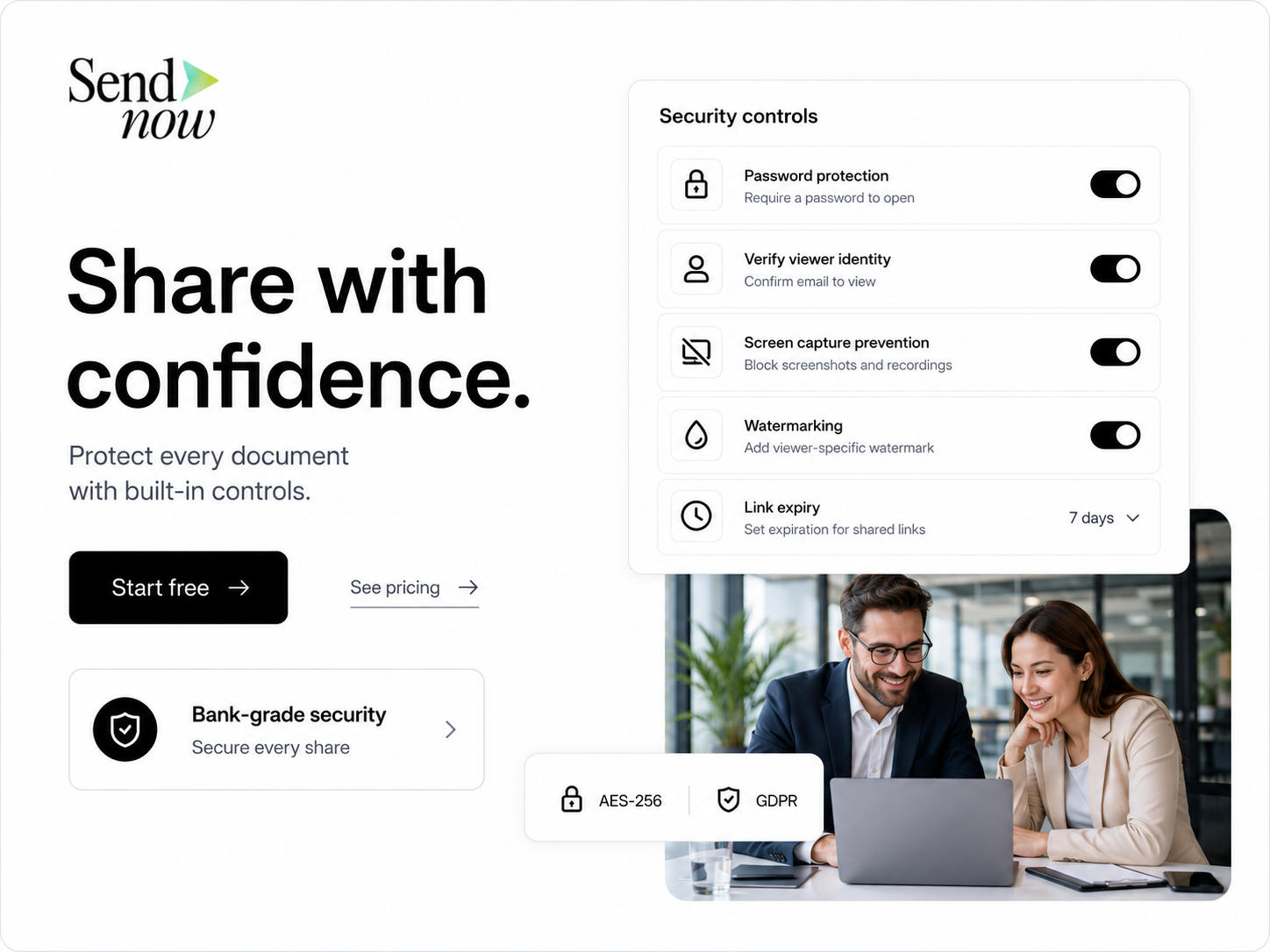
SendNow includes screenshot protection on all plans — a feature absent from DocSend entirely. For finance professionals sharing materials that contain proprietary financial models, deal structures, or confidential market analyses, this distinction is significant. A viewer cannot photograph or screen-record a SendNow document without the control being actively enforced at the viewer level.
The full security parity comparison is clear: SendNow delivers DocSend's Advanced-tier security starting from Lite at $9/month (or Pro at $17/month vs $150/month).
Q5: Does DocSend Offer AI Features?
No. As of April 2026, DocSend does not offer AI-powered engagement analysis, AI document chatbots, or any AI-driven features at any pricing tier.
SendNow offers two distinct AI features:
AI Engagement Scoring: After a recipient views a document, SendNow's AI analyzes the complete behavioral session — total time, time per page, return visits, engagement with specific page types (financial data, team sections, market analysis) — and generates a composite intent score from 0 to 100. Senders see a ranked list of viewers by engagement intensity, with specific behavioral signals highlighted. The system identifies behaviors like re-reading the financials multiple times, returning to the document hours after the first viewing, and engaging heavily with the deal terms page.
AI Document Chatbot: Viewers can ask natural language questions about document content directly within the SendNow viewer (e.g., "What is the revenue run rate for Q3?" or "What are the terms of the preferred equity?"). The chatbot answers from the document content. The sender's dashboard surfaces all questions asked, which creates a qualitative signal about which points of confusion or interest the document generates — intelligence that no amount of page-time data can provide.
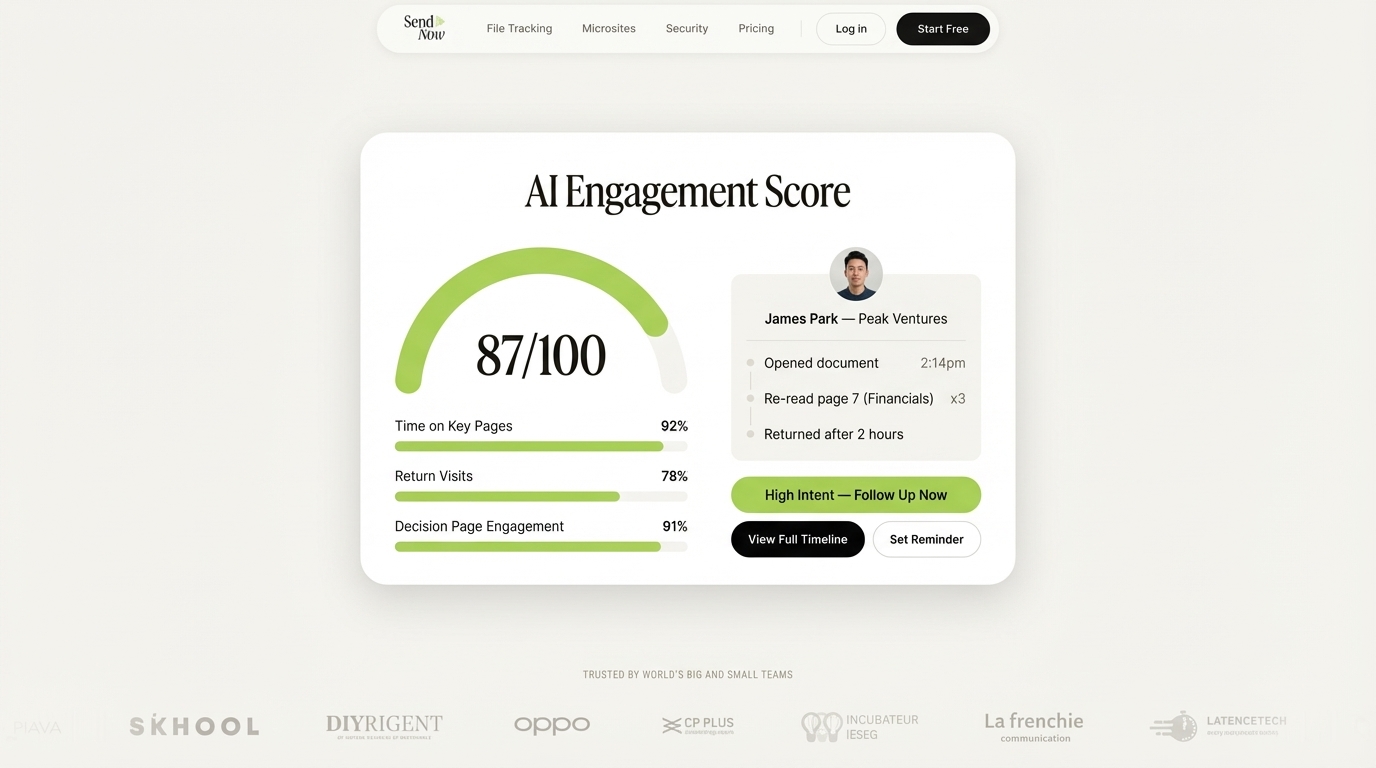
SendNow's AI engagement scoring surfaces viewer intent signals from behavioral data — re-reads of financial pages, return visits, and time on decision-relevant sections — into a single actionable score.
Q6: Which Platform Works Better for Deal Rooms and Investor Sharing?
Deal rooms — shared spaces where multiple documents live under a single branded link — are central to how finance professionals structure investor outreach, M&A processes, and due diligence workflows.
DocSend deal rooms: DocSend calls its deal room product "Spaces" (Standard tier) and "Virtual Data Rooms" (Advanced and Advanced Data Rooms tiers). Access to functional data rooms with NDA gating, watermarks, and granular permissions requires the Advanced tier at $150/month. The Advanced Data Rooms tier at $180/month (annual) supports up to 2,000 assets and includes audit logs and file indexing. However, DocSend's data rooms lack a Q&A module — a standard feature in dedicated VDR platforms. No document-level permissions exist (only folder-level). Version control history is absent. Source: Peony
SendNow deal rooms: SendNow's branded microsites function as full deal rooms: multiple documents organized under a custom-branded URL, with NDA gating at the room level, per-document analytics, screenshot protection across all files, and AI engagement scoring aggregated across the entire room. Deal rooms are available on the Business plan at $33/month for 3 users.
For a private equity firm running a sell-side process, the workflow difference is significant. SendNow allows the deal team to set up a branded deal room for a prospective acquirer, require NDA signing at the door, monitor exactly which sections of the CIM each party spent time on, and receive an AI-ranked view of buyer engagement — all at $33/month for the team. DocSend requires $150–$180/month for equivalent (and in some respects less complete) functionality.
The one genuine advantage DocSend retains in the deal room comparison is brand familiarity. Some institutional investors specifically request or expect DocSend links. For teams raising from VCs who express a preference, the path of least resistance may still favor DocSend — at least until SendNow's brand recognition catches up.
Q7: When Should You Choose DocSend vs SendNow?
This comparison does not argue that DocSend is wrong for every team. There are legitimate reasons to stick with it.
Choose DocSend if:
- Your investors or counterparties specifically request DocSend and the switching friction outweighs the cost savings
- Your organization has 200+ users deeply integrated into Dropbox and Salesforce workflows where the migration cost is genuinely high
- You share documents infrequently and the 100-visit cap on the Personal plan is not a constraint
- You are raising a later-stage round where LP familiarity with the DocSend interface provides meaningful comfort
Choose SendNow if:
- You are a finance professional — VC, PE, banker, advisor — who needs NDA gating, screenshot protection, and dynamic watermarks without paying $150/month
- You want AI-powered engagement scoring to prioritize follow-ups by investor or buyer intent
- You manage multiple deal rooms simultaneously and need each branded and analytics-tracked
- You run a sales team that shares proposals and needs page-level engagement data with real-time alerts
- You are evaluating document tracking for the first time and want a free trial without a credit card commitment
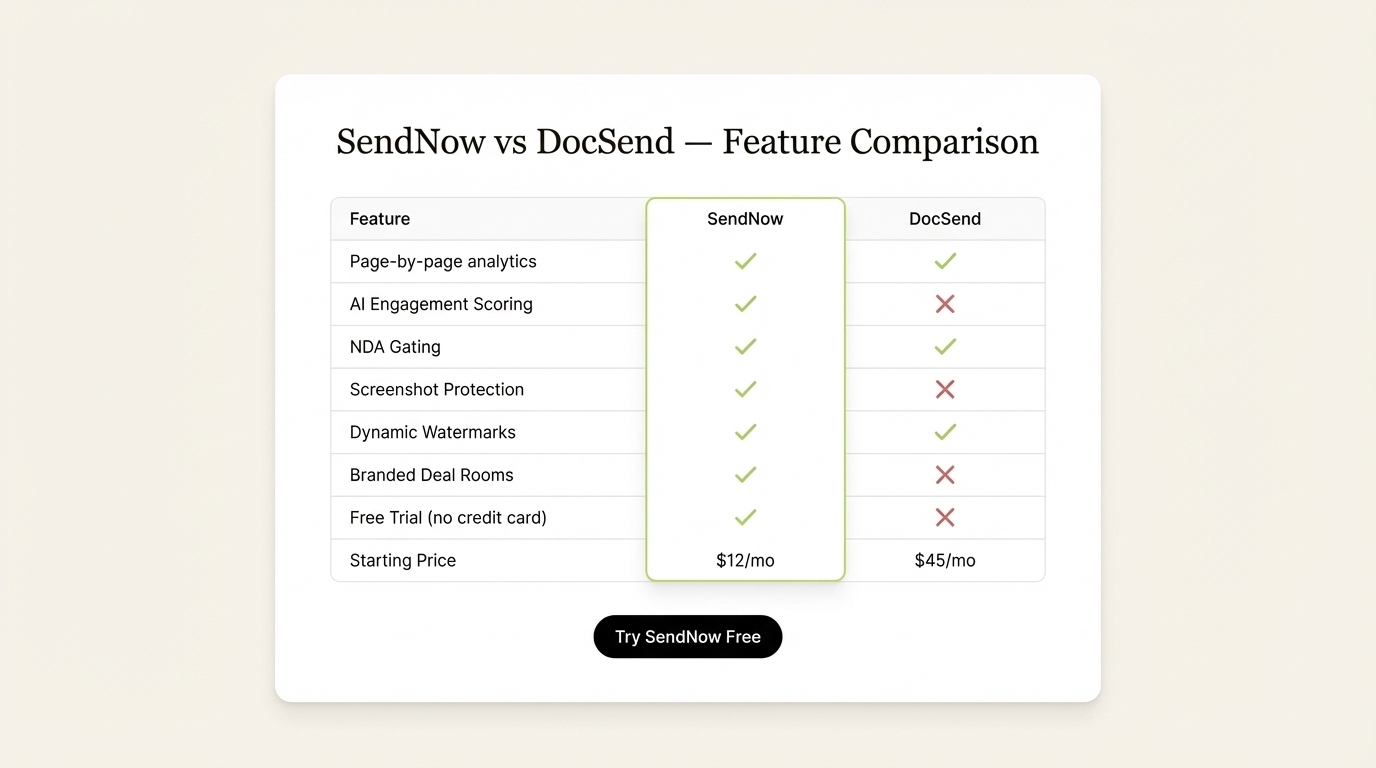
The feature-for-feature comparison shows SendNow delivering DocSend's Advanced-tier security suite at the entry-level Pro plan — with AI capabilities DocSend does not offer at any price.
Conclusion: A Fair Verdict
DocSend defined the document tracking category. That history is real, and the product works for the use cases it was built for. But pricing has not kept pace with what the market now delivers, development has visibly slowed, and AI-powered engagement features have arrived in the category without DocSend participating.
For finance professionals — the people who built DocSend's reputation by sharing pitch decks, CIMs, and fund materials through it — SendNow offers every security feature DocSend locks behind $150/month, adds AI capabilities DocSend does not have, and delivers all of it from $9/month for a single user or $33/month for a 3-person team.
The comparison is not close on price or feature parity for finance use cases. Where DocSend maintains an edge — brand familiarity and Dropbox ecosystem depth — it is a real edge, but a narrowing one.
If you are evaluating both platforms today, the most direct test is a side-by-side trial. SendNow's free trial requires no credit card and gives you access to the full feature set — screenshot protection, NDA gating, AI scoring, branded deal rooms — from day one.
Pricing and feature information verified as of April 2026. Verify current details on each vendor's pricing page before purchasing. DocSend pricing sourced from docsend.com/pricing.
Keep Reading
About the Author: Rifana Hameem
Rifana is the founder of SendNow. She leads the team in building secure, compliant, and analytics-rich document sharing tools for finance and professional teams worldwide.
Connect on LinkedIn