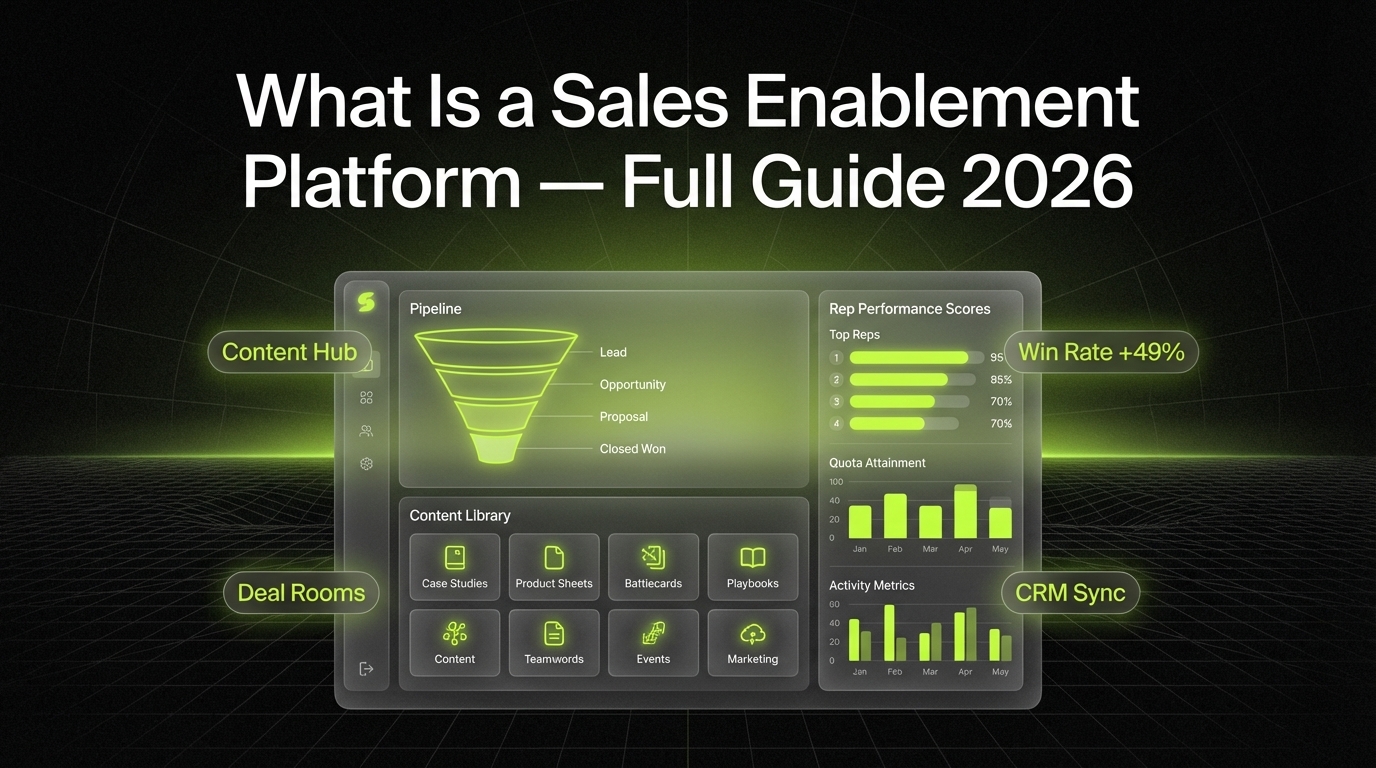
What Is a Sales Enablement Platform? Full Guide for 2026

- A sales enablement platform is software that equips sales, marketing, and revenue teams with content, tools, and analytics to improve buyer engagement and win rates.
- Companies with formal sales enablement programs achieve 49% higher win rates and a 4:1 ROI on their investment.
- In 2026, the category includes document analytics, digital deal rooms, AI engagement scoring, content management, rep coaching, and revenue intelligence.
- Sales enablement is different from sales engagement: enablement prepares reps to sell, while engagement manages the buyer interaction itself.
- The right platform depends on team size, deal complexity, and whether your biggest gap is content delivery, rep skills, or prospect intelligence.
What Is a Sales Enablement Platform? Full Guide for 2026
A sales enablement platform gives revenue teams the tools, content, and analytics to engage buyers more effectively and close more deals — and in 2026 the category has expanded well beyond training libraries and slide decks. This complete guide covers what these platforms do, who uses them, how to measure their ROI, and how to pick the right one for your team.
What Is a Sales Enablement Platform?
A sales enablement platform is software that provides sales and marketing teams with the resources, tools, and data they need to engage buyers at the right moment in the buying journey. Microsoft Dynamics defines it as "the process of providing sellers the tools, content, and materials they need to target the right buyers and increase engagement — helping close more deals, faster."
The distinction between a "tool" and a "platform" matters. A single sales enablement tool might do one thing well — document tracking, proposal creation, or call coaching. A platform connects multiple functions — content library, buyer engagement analytics, rep training, and CRM integration — so the entire revenue team operates from a single source of truth.
Gartner now categorizes the space under "Revenue Enablement Platforms" (REPs), which it defines as systems that "unite sales and customer-facing enablement and revenue functions" across sales, customer success, marketing, and presales. This reflects a shift away from siloed, rep-only tools toward platforms that support the full go-to-market team.
According to Coursera's 2026 guide, teams using a unified sales enablement platform are 42% more likely to improve win rates than those without one. And SiftHub's research finds that 76% of organizations now maintain a dedicated enablement function — up significantly from just a few years ago.
What Is the Difference Between Sales Enablement and Sales Engagement?
These two terms describe different layers of the revenue process, and they are frequently confused.
Sales enablement focuses on preparing reps to sell. It covers the content, training, playbooks, analytics, and tools that make reps more effective before and during buyer interactions. According to Highspot, companies with successful enablement programs see a 23% higher lead conversion rate.
Sales engagement focuses on managing the buyer interaction itself. Platforms like Outreach and Salesloft orchestrate email sequences, call cadences, and LinkedIn touchpoints — automating the mechanics of reaching buyers at scale.
Clari's analysis describes the difference concisely: enablement is about making reps better, engagement is about making outreach faster. SiriusDecisions research cited by Highspot shows that sales engagement tools can increase rep tenure by 40-65% when combined with a strong enablement foundation.
High-performing revenue teams use both. Enablement ensures the right content is ready; engagement ensures that content reaches the right buyer at the right moment in a cadence that converts.
What Does a Sales Enablement Platform Include?
The feature set varies by vendor, but most platforms cover a combination of the following:
Apollo.io (All-in-One Sales Intelligence & Engagement)

For growing SMBs and high-velocity sales teams, deploying separate tools for prospecting data, email sequencing, meeting scheduling, and deal intelligence quickly becomes cost-prohibitive. Apollo.io solves this fragmentation by offering an all-in-one B2B sales platform that combines a database of 275M+ verified contacts with advanced engagement automation and AI-powered deal workflows.
Apollo enables reps to discover in-market buyers, enrich existing CRM records, launch multi-channel outbound sequences (email, phone, LinkedIn), and analyze deal pipeline health—all within a single intuitive interface. Its built-in AI writing assistant helps SMB reps personalize outreach at scale without sacrificing quality or message relevancy.
Key platform advantages for SMBs include:
- Massive B2B Lead Database: Search through 275+ million contacts and 60+ million companies with 65+ granular filters covering revenue, tech stack, funding, and intent signals.
- Unified Multi-Channel Sequencing: Build automated workflows that blend email steps, cold calling via native dialer, LinkedIn tasks, and meeting scheduling.
- AI-Driven Personalization & Insights: Automatically generates personalized email icebreakers and analyzes prospect engagement to recommend the optimal follow-up timing.
Get started with apollo.io.
Who Should Use a Sales Enablement Platform?
Sales enablement platforms serve different roles across a revenue organization:
Sales Representatives (AEs, SDRs, BDRs) Reps use enablement tools to find the right content for each deal stage, share documents with full tracking, and receive real-time alerts when buyers engage. A well-configured platform removes the guesswork from follow-up: instead of "should I check in today?", the rep gets a Slack notification when the CFO opens the proposal and reads the pricing section twice.
Sales Managers and Revenue Leaders Managers use analytics to see which content performs best at each deal stage, identify reps who need coaching, and forecast pipeline with higher confidence. According to Highspot, teams with enablement analytics achieve 31% higher pipeline conversion. Careertrainer.ai's research shows firms with integrated CRM and enablement tools see 41% better forecast accuracy.
Marketing Teams Marketing uses enablement platforms to understand which content actually influences deal outcomes, not just which blog posts drive traffic. When a particular case study gets attached to 40 proposals and those deals close at 60%, that data changes where marketing invests next.
Customer Success and Account Management Modern platforms extend beyond the initial sale. CS teams use digital deal rooms for onboarding, renewal conversations, and expansion plays — applying the same engagement analytics to understand which resources customers actually use.
Revenue Operations RevOps teams configure integrations, maintain data hygiene, and build dashboards that connect enablement activity to revenue outcomes. They also govern content so that reps always present current, compliant materials.
How Do You Build a Sales Enablement Strategy?
A sales enablement strategy is a systematic plan for equipping your revenue team with the right content, skills, and data at the right point in the sales cycle. Fluint's 2026 guide argues that the most effective strategies in 2026 connect directly to live pipeline activity — content that does not touch a live deal has limited impact.
Here are the core steps:
1. Audit existing content Map which assets exist for each stage of the funnel — awareness, consideration, decision. Identify gaps: what do reps currently create themselves because marketing has not provided it? What do buyers ask for repeatedly that you do not have a polished answer for?
2. Define buyer personas and deal stages Enablement only works when content matches the buyer's context. A CFO evaluation meeting needs different materials than an SDR cold outreach, and a renewal conversation needs different assets than an initial demo.
3. Organize a searchable content library Structure by stage, persona, and product line. Make assets searchable and version-controlled. Content Camel's 2026 guide notes that unstructured Google Drive folders are the most common content management failure in SMB sales teams.
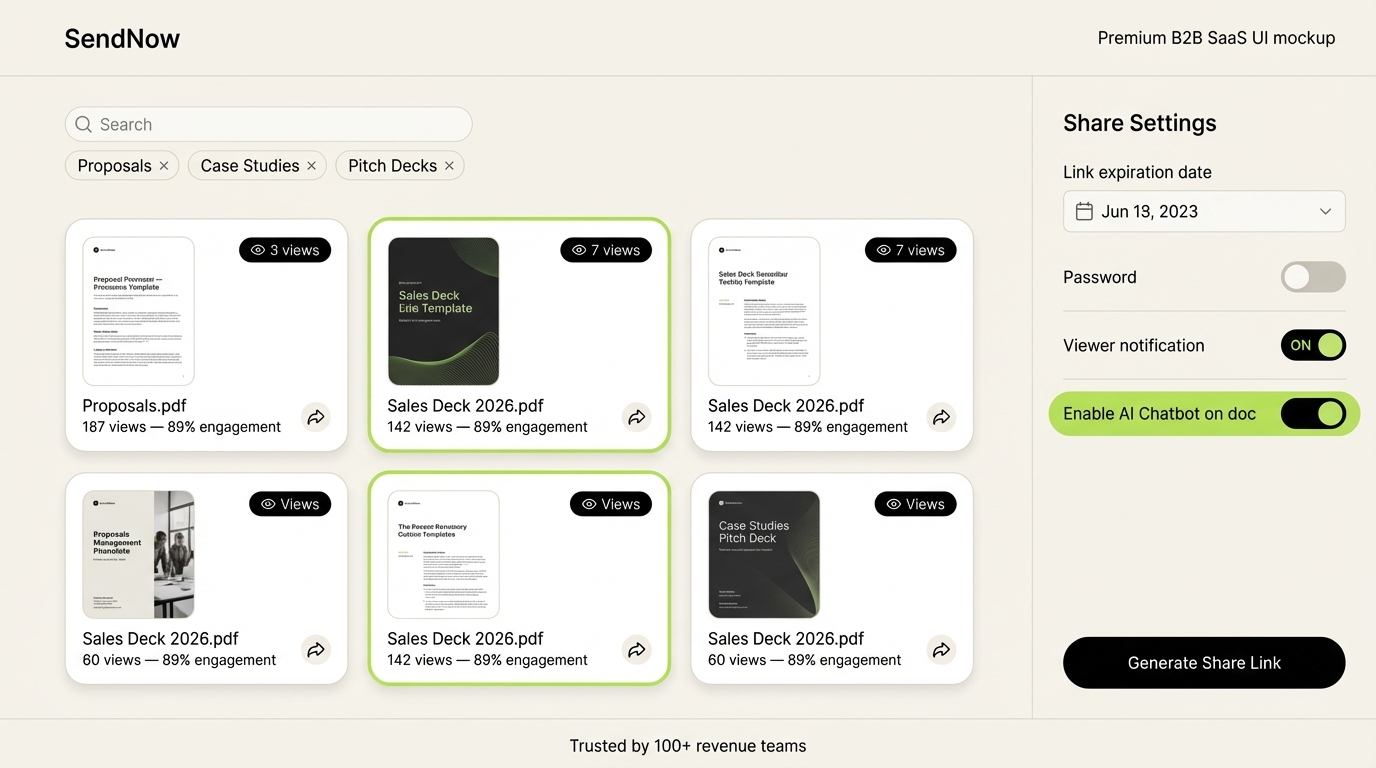
4. Implement document tracking and analytics Know which assets prospects open, which pages generate questions, and which content appears most in closed-won deals. This data improves both rep behavior and content quality over time. Tools like SendNow make this setup fast — no developer required, trackable links in minutes.
5. Build a feedback loop between sales and marketing DemandZen's analysis shows that shared data is the fastest path to sales-marketing alignment. When marketing sees which content closes deals, they produce more of it. When sales sees which objections recur, marketing builds better battle cards.
6. Measure, iterate, and improve Enablement is not a one-time project. Outreach's guide emphasizes continuous iteration based on win/loss data, rep feedback, and content engagement metrics.
How Do You Measure the ROI of a Sales Enablement Platform?
ROI measurement is where many enablement programs fall short. According to Exec.com's research, 90% of organizations now have enablement programs, but only 25% can demonstrate whether those programs work. The problem is usually metric selection — teams measure content uploads and training completions rather than deal outcomes.
SiftHub provides concrete benchmarks from across the industry:
- Companies with formal enablement programs achieve a 4:1 ROI on investment
- Teams report 49% higher win rates on forecasted deals
- Organizations with enablement analytics see 31% higher pipeline conversion
- Mature programs deliver 19% better customer lifetime value
- Enablement reduces time spent searching for content by 56%
- Firms with integrated CRM and enablement report 41% better forecast accuracy
To measure ROI at your organization, track these KPIs:
- Win rate — do reps with enablement close a higher percentage of deals?
- Sales cycle length — does time-to-close decrease?
- Content engagement rate — which assets get opened, read, and shared vs. ignored?
- Ramp time — how quickly do new reps reach quota after onboarding?
- Average deal size — does enablement support upsell and expansion conversations?
- Quota attainment rate — the most direct measure of overall program effectiveness
Highspot recommends building a dashboard that connects content activity — which assets appear in closed-won deals — directly to revenue outcomes rather than tracking content views in isolation. Seismic frames the core question simply: "Is my enablement technology making us more money than it costs?"
How Do You Choose the Right Sales Enablement Platform?
The right platform comes down to three diagnostic questions:
Sendoso (Direct Mail & Personalized Gifting)
In an era saturated with automated cold emails and generic LinkedIn messages, breaking through the noise requires an omnichannel approach. Sendoso is the premier direct mail and corporate gifting platform that helps B2B revenue teams integrate tangible experiences into their sales enablement workflows.
Sendoso enables sales reps and account executives to send curated physical gifts, handwritten notes, personalized merchandise, and digital e-gifts directly from their CRM or sales engagement platform. Whether used to secure a first meeting with a target enterprise CIO or re-engage a stalled opportunity after sending a proposal, Sendoso provides measurable attribution and automated delivery tracking.
Core platform highlights include:
- Global Fulfillment & Sourcing: Access a worldwide warehouse network with curated gift catalogs, custom packaging, branded swag storage, and eco-friendly options.
- Trigger-Based Workflow Automation: Automatically dispatch gifting campaigns when specific CRM milestones are met (e.g., proposal viewed for over 5 minutes or contract stage reached).
- Comprehensive ROI Attribution: Track deliverability status, recipient engagement, cost-per-touch, and influence on pipeline acceleration directly inside Salesforce and HubSpot.
Get started with sendoso.com.
Conclusion
A sales enablement platform does more than organize content. At its best, it transforms guesswork into data — telling reps which deals to prioritize, which content resonates at each stage, and precisely when to follow up. In 2026, the category spans document analytics, AI engagement scoring, digital deal rooms, rep coaching, conversation intelligence, and revenue operations tooling.
For sales and marketing teams that want to start with the layer that most directly impacts deal outcomes — understanding exactly what your prospects do with your documents — SendNow is purpose-built for that use case. Page-by-page analytics, AI engagement scoring, branded deal rooms, NDA gating, and screenshot protection starting at $9/month give revenue teams the prospect intelligence they need without an enterprise contract or a long implementation.
Start your free trial at sendnow.live — no credit card required.
SendNow is trusted by 100+ revenue teams for secure document sharing, page-by-page analytics, and branded deal rooms. Plans start at $12/mo with a free trial.
Keep Reading
- Best Sales Enablement Tools in 2026 (Ranked)
- Best Sales Enablement Software for SMBs in 2026
- Best Sales Enablement Platforms for Financial Services
- Sales Enablement KPIs Every Revenue Team Should Track
- DocSend vs SendNow: Full Comparison for 2026
Related SendNow Resources
- 8 Best DocSend Alternatives for Startups in 2026 (Tested)
- Related SendNow resource
- Related SendNow resource
- Related SendNow resource
- Related SendNow resource
- Related SendNow resource
External References
About the Author: Rifana Hameem
Rifana is the founder of SendNow. She leads the team in building secure, compliant, and analytics-rich document sharing tools for finance and professional teams worldwide.
Connect on LinkedIn