
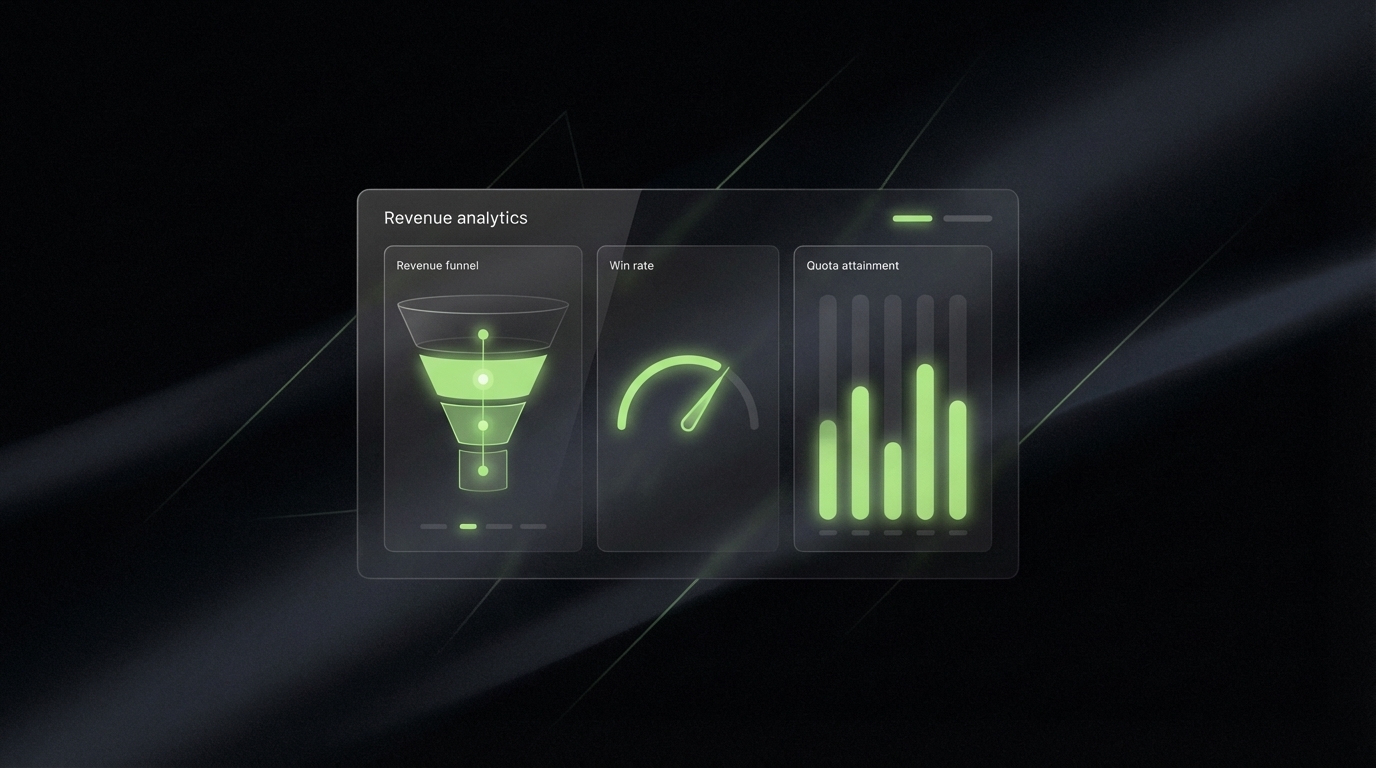
Sales Enablement KPIs Every Revenue Team Should Track

- Sales enablement KPIs measure whether your investment in tools, training, and content actually drives revenue outcomes.
- The most critical KPIs are win rate, quota attainment, sales cycle length, ramp time, content engagement, document open-to-close rate, and pipeline velocity.
- The median B2B SaaS sales cycle is now 84 days and has lengthened 22% since 2022.
- Companies with formal sales enablement programs achieve 49% higher win rates and a 4:1 ROI.
- Document analytics, including page-by-page engagement data from tools like SendNow, bridge the gap between content performance and revenue outcomes.
- KPIs should be reviewed weekly at the rep level and monthly at the program level.
Sales Enablement KPIs Every Revenue Team Should Track
Meta description: Sales enablement KPIs tell revenue teams whether their tools, content, and coaching actually produce closed deals. This guide covers the seven most important metrics every AE, sales manager, and marketing leader needs to measure in 2026, with benchmarks and actionable guidance.
Introduction
Most revenue teams know they should measure sales enablement. Few measure it well.
The typical mistake is tracking activity metrics: training completion rates, content downloads, tool logins. These numbers look productive in a report but reveal almost nothing about whether enablement actually helps reps close deals. A rep can complete every training module and still miss quota. A piece of collateral can get downloaded 500 times and never influence a single deal.
The right sales enablement KPIs connect directly to revenue outcomes. They answer one question: is this investment making the team win more deals, faster?
The stakes are high. According to SiftHub, companies with formal sales enablement programs achieve 49% higher win rates and a 4:1 ROI on enablement investment. Yet only 30% of rep time is spent actually selling. Reps waste 440 hours per year searching for the right content. These are not abstract statistics. They are the direct cost of enablement programs that are not measured or optimized.
This guide covers the seven sales enablement KPIs that actually predict revenue performance, with benchmarks, interpretation guidance, and the tools that make each one measurable.
1. What Are Sales Enablement KPIs and Why Do They Matter?
Sales enablement KPIs are quantitative measures that assess whether your enablement program improves sales performance. The word "enablement" covers a wide range of investments: onboarding programs, sales playbooks, CRM configuration, content libraries, proposal tools, and coaching frameworks. KPIs tell you which of those investments are working.
They matter for three reasons.
First, they protect budget. Sales enablement functions face constant scrutiny, especially during budget cycles. KPIs give you the evidence to justify continued investment or redirect resources toward what actually moves deals.
Second, they identify performance gaps before they become revenue problems. If you see a drop in proposal-to-close conversion rates in February, you can diagnose and fix the issue before it wrecks Q1.
Third, they align sales and marketing. When both teams look at the same document engagement data, win rate trends, and sales cycle benchmarks, conversations shift from "marketing isn't sending us good leads" to "here is exactly where buyers disengage and why."
Highspot puts it directly: the best sales enablement metrics link to business goals and give you the power to refine, realign, and rally your go-to-market teams around impact. Without them, you are making decisions based on opinion rather than evidence.
2. What Is the Difference Between a Sales Enablement Metric and a KPI?
The terms are often used interchangeably, but the distinction is worth understanding.
A metric is any quantitative data point you can measure: number of proposals sent, number of training sessions attended, average email open rate. Metrics are the raw material of measurement.
A KPI (Key Performance Indicator) is a metric that directly indicates progress toward a specific business goal. Not every metric is a KPI. A KPI is a metric you have decided to actively manage because moving it produces a meaningful business outcome.
For example:
- "Number of proposals sent" is a metric. It tells you activity volume.
- "Proposal-to-close rate" is a KPI. It tells you whether your proposals convert, which directly connects to revenue.
CloudShare makes the distinction clear: every KPI is a metric, but not every metric is a KPI. Revenue teams that track too many metrics often lose sight of what matters. The goal is to identify the 5-7 metrics that have a direct, documented relationship to revenue outcomes, and treat those as your KPIs.
The practical test: if improving this number by 10% would materially affect revenue, it is a KPI. If improving it would not change what leadership cares about, it is a metric to monitor but not to manage.
3. How Do You Measure the ROI of Sales Enablement?
The standard ROI formula applies: (Revenue Attributed to Enablement - Enablement Investment) / Enablement Investment x 100.
The challenge is attribution. How much of a closed deal is attributable to enablement versus the rep's skill, the product's competitiveness, or favorable market timing?
Sales Assembly recommends measuring across three tiers:
- Activity metrics (leading indicators): content usage rates, training completion, tool adoption. These tell you if reps are using what you have built.
- Capability metrics (skill development): rep competency scores, role-play assessment outcomes, certification completion. These tell you if reps are getting better.
- Business impact metrics (revenue outcomes): win rate, quota attainment, sales cycle length, average contract value. These tell you if the improvement in skills and activity is producing deals.
Attribution becomes clearest when you compare cohorts. Reps who completed a specific training program versus those who did not. Deals where a branded proposal tool was used versus deals that went through email attachment. Deals where content engagement data informed the follow-up strategy versus deals where the rep followed a fixed cadence.
Highspot notes that dashboards alone never tell the complete performance story without context and judgment. The best enablement leaders combine quantitative KPIs with qualitative rep feedback to build a full picture.
4. What Is a Good Win Rate for B2B Sales Teams?
Win rate is the percentage of deals in your pipeline that close as won, typically calculated as won deals divided by total closed deals (won + lost) in a period.
The ABM Agency (Strategic Account-Based Marketing)

Closing large enterprise contracts requires a coordinated, multi-touch strategy that engages entire buying committees across target accounts. The ABM Agency is a full-service B2B account-based marketing agency that develops bespoke, data-driven ABM campaigns designed to penetrate Tier-1 target accounts and accelerate deal cycles.
The ABM Agency combines precision IP-targeted digital advertising, customized content experiences, direct mail orchestration, and sales team alignment to surround key decision-makers with tailored messaging. By coordinating marketing touchpoints with sales rep outreach, they ensure consistent engagement across all executive stakeholders involved in enterprise purchasing decisions.
Key services include:
- Account Identification & Tiering: Building granular target account lists (TALs) based on Ideal Customer Profile (ICP) criteria, intent signals, and historical win rates.
- Multi-Touch Orchestration: Synchronizing programmatic display ads, LinkedIn sponsored content, personalized landing pages, and direct mail gifting.
- Pipeline Acceleration & ABM Analytics: Measuring account penetration, buying committee engagement depth, and velocity improvements across target accounts.
Get started with abmagency.com.
5. How Does Quota Attainment Connect to Sales Enablement Effectiveness?
Quota attainment is the percentage of sales reps who hit their assigned revenue target in a given period. It is the most direct measure of whether your enablement program produces actual sellers rather than trained attendees.
The current state of the market is challenging. Hyperbound's 2025 B2B Sales Performance Benchmark Report found that up to 70% of reps miss quota, with average attainment at just 43%. Trykondo reports that 84% of reps currently miss quota, a figure that reflects both longer sales cycles and larger buying committees.
For enablement leaders, quota attainment breaks into two sub-metrics:
Individual quota attainment rate: What percentage of reps hit their number? If 40% of your reps consistently hit quota, the question is: what do those 40% do differently? That answer becomes the playbook for the other 60%.
Team quota attainment rate: What percentage of the team's total quota was achieved? A team of 10 reps with a $5M target that closed $3M achieved 60% team attainment.
The gap between top performers and average performers is widening, according to Hyperbound. High-performing teams close that gap by identifying the specific behaviors and tools used by top closers, then building them into the standard playbook. Proposal analytics play a key role here: if your top AE follows up within 10 minutes of an open notification and your average AE follows up the next day, that is an observable, trainable difference.
Seismic's enterprise sales enablement guide frames quota attainment as a function of three interconnected factors: shortening the sales cycle, reducing customer acquisition cost, and increasing customer lifetime value. Quota attainment is the output; those three levers are the inputs your enablement program controls.
6. What Role Does Content and Document Engagement Play in Sales Enablement KPIs?
Content engagement is the most undertracked category in most sales enablement programs. Most teams know how many documents they have created. Very few know which ones actually influence deals.
The core content KPIs that revenue teams should track:
Content utilization rate: What percentage of your library gets used by reps? SiftHub reports that reps waste 440 hours per year searching for content. A high utilization rate means the library is organized and reps can find what they need. A low rate means content sits unused while reps build their own decks, inconsistently.
Document open rate: What percentage of shared proposals and collateral get opened? Industry benchmarks suggest 70-80% of sales documents sent via tracked links get opened within 48 hours. Below 50% points to a delivery or relevance problem.
Proposal-to-close conversion rate: Of all opened proposals, how many result in a won deal? This is the sales version of a landing page conversion rate. It reflects proposal quality, competitive positioning, pricing fit, and follow-up effectiveness together.
Time-per-page and engagement depth: Where do buyers spend time inside your proposals? Which pages do they skip? This page-level data turns your proposal into a feedback loop. High time on the pricing page with no follow-up conversion suggests pricing is a sticking point. High time on the case study section suggests the buyer is evaluating credibility, not cost.
AI engagement score: Platforms like SendNow compute a composite engagement score across all these dimensions, giving each active prospect a ranked score so reps can prioritize their time on the highest-intent buyers.
Highspot describes sales content analytics as the tie between buyer engagement with enablement assets and actual conversions. Without it, content investment is unmeasurable. With it, marketing and sales can see exactly which pieces of collateral contribute to revenue and which do not.
The practical implication: tracking document engagement at the page level is now a core sales enablement KPI, not a bonus feature. Every proposal your team sends should produce analytics that inform the next one.
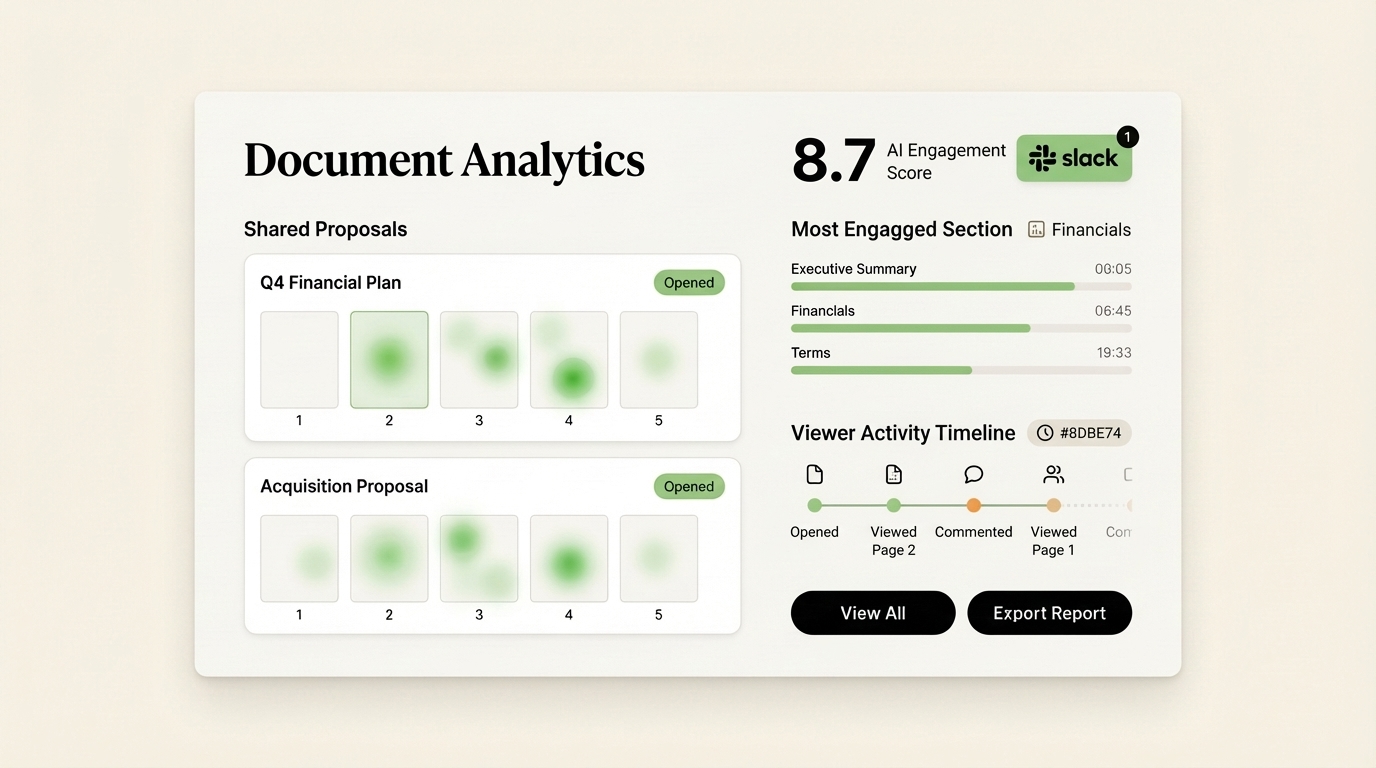
SendNow's AI engagement scoring and page heatmaps give revenue teams a ranked view of buyer intent across every active deal.
7. How Often Should Revenue Teams Review Sales Enablement KPIs?
Review cadence should match the decision cycle of the metric. Not all KPIs need the same frequency of review.
Weekly (rep-level):
- Individual quota attainment pace
- Proposal open rate and document engagement for active deals
- Follow-up response rate
- Pipeline velocity for deals in late stages
Weekly reviews at the rep level give managers the data to coach in real time, not after a lost deal. If a rep's proposal open rate drops to 40% in a given week, the manager can review the email outreach and subject lines immediately.
Monthly (program-level):
- Win rate trends
- Sales cycle length vs. benchmark
- Content utilization and proposal-to-close conversion
- Ramp time for new hires
- AI engagement score trends by segment
Monthly program reviews answer whether the enablement investments made last quarter are producing measurable change.
Quarterly (strategic):
- Quota attainment rate (team)
- Enablement ROI calculation
- Competitive win/loss analysis
- Content library audit (retire underperforming assets, invest in high-usage formats)
Klipfolio emphasizes that the goal is not just to measure metrics but to ensure your enablement approaches align with business goals and consistently yield positive outcomes. Quarterly reviews are where that alignment gets tested: is the number moving, and is it moving because of enablement or despite it?
The teams that get this right use a single dashboard that consolidates all three layers: activity (document opens, training completions), capability (engagement scores, follow-up rates), and revenue impact (win rate, cycle length, attainment). Real-time data at the activity layer feeds into the monthly and quarterly views without requiring manual aggregation.

SendNow provides real-time proposal analytics that feed directly into the document engagement KPIs your revenue team tracks.
Conclusion: Measure What Moves Deals
Sales enablement is only as effective as your ability to measure it. Activity metrics look good in a slide deck. Revenue KPIs tell the truth.
The seven metrics in this guide, win rate, quota attainment, sales cycle length, ramp time, content utilization, document engagement, and proposal-to-close rate, are the ones that directly connect your enablement investment to your revenue line.
Start with the two that are easiest to influence with tools you already have access to: document engagement and proposal-to-close conversion. These are the KPIs where better data produces faster, measurable results.
If your team currently sends proposals without any visibility into what happens after, that is both your biggest measurement gap and your biggest opportunity.
SendNow gives revenue teams page-by-page document analytics, AI engagement scoring, real-time notifications, branded deal rooms, and NDA gating, starting at $9/month. Free trial, no credit card required. Start measuring the KPIs that actually predict which deals you will close.
Sources: SiftHub | Highspot | Hyperbound | Trykondo | Sales Assembly | Seismic | CloudShare | Klipfolio | Optifai
Keep Reading
- What Is a Sales Enablement Platform? Full Guide for 2026
- Document Engagement Analytics: The Metrics That Actually Matter
- AI Document Analytics: The Future of Sales Follow-Up
- Best Sales Enablement Platforms for Financial Services
Related SendNow Resources
- 8 Best DocSend Alternatives for Startups in 2026 (Tested)
- Related SendNow resource
- Related SendNow resource
- Related SendNow resource
- Related SendNow resource
- Related SendNow resource
External References
About the Author: Rifana Hameem
Rifana is the founder of SendNow. She leads the team in building secure, compliant, and analytics-rich document sharing tools for finance and professional teams worldwide.
Connect on LinkedIn