
Document Engagement Analytics: The Metrics That Actually Matter

Document analytics tracks how recipients interact with the files you share: which pages they read, how long they spend on each section, whether they forward it, and how often they return. The metrics that actually matter are page-level time data, completion rate, return visit frequency, forwarding activity, and AI engagement scores. Vanity metrics like total views or open rate alone tell you very little. Tools like SendNow give finance and sales teams page-by-page intelligence, real-time alerts, and AI-driven engagement scores that turn shared documents into a live signal of buyer intent.
Document Engagement Analytics: The Metrics That Actually Matter
Most document analytics platforms surface a wall of numbers. This guide cuts through the noise to show finance and sales professionals exactly which engagement metrics drive better decisions, faster deals, and more closed revenue.
Introduction
You send a 22-page pitch deck. Three days pass. Silence.
Did your prospect open it? Did they get to the financial model on page 18 or bail after the cover slide? Did they forward it to their managing partner without telling you?
Without document analytics, you have no idea. You are following up blind, personalizing nothing, and trying to read intent from the absence of a reply.
Document analytics solves this. It turns every shared file into a source of behavioral data, letting you see not just that someone opened a document, but exactly how they engaged with it. For investment bankers, VCs, private equity deal teams, and enterprise sales professionals, that data changes the game. It tells you when to follow up, what to address in your next conversation, and which stakeholders are actually engaged.
This article answers the seven most common questions about document engagement analytics and identifies the specific metrics that move the needle, not just the ones that look impressive in a dashboard.
Q1: What Is Document Analytics?
Document analytics is the practice of tracking and measuring how recipients interact with documents you share, typically through a secure tracking link. Unlike a standard file attachment, a tracked document sends back engagement data in real time: who opened it, when they opened it, which pages they viewed, how long they spent on each section, whether they returned, and whether they forwarded the link to someone else.
The term covers a spectrum of sophistication. At the basic end, you get open notifications, similar to email read receipts but for files. At the advanced end, platforms provide page-by-page heatmaps, AI engagement scoring, viewer identification, device and location data, and lead capture forms. Finance-focused platforms take this further with NDA gating and screenshot protection to control who sees sensitive deal materials.
According to Qwilr, document analytics closes the "sales black box" between sending a proposal and knowing what happens next. It replaces guesswork with behavioral evidence, helping teams prioritize the right prospects at the right time.
Q2: What Is the Most Important Document Engagement Metric?
If you can only track one metric, track time per page.
Marpipe (Catalog Ad Optimization and Creative Measurement)

The discipline of judging an asset by measured engagement rather than opinion applies just as hard upstream, in paid media. Marpipe applies it at catalog scale, turning raw product feeds into branded, designed dynamic product ads across Meta, Google, Pinterest and other channels for ecommerce brands.
Left alone, a product feed renders as plain, undifferentiated creative identical to every competitor selling comparable items. Marpipe treats each SKU as a creative unit instead, generating product-level video automatically, applying generative AI to images and copy, and layering in dynamic elements such as price displays, scarcity messaging and social proof. The platform reports an average lift of roughly 20% on catalog ads across more than 650 connected ad accounts, with enriched ads reaching 2.4% CTR and 8.18 ROAS against 2.26% and 6.86 for plain catalog ads.
- Catalog creative design: Product data becomes on-brand designed creative rather than default feed output.
- Product-level video: Individual video generated per SKU automatically, not one generic clip per category.
- SKU optimization: Underperforming products filtered out of campaigns so spend concentrates where it converts.
Commerce teams applying the same measurement discipline to paid creative can see the catalog side of it at marpipe.com.
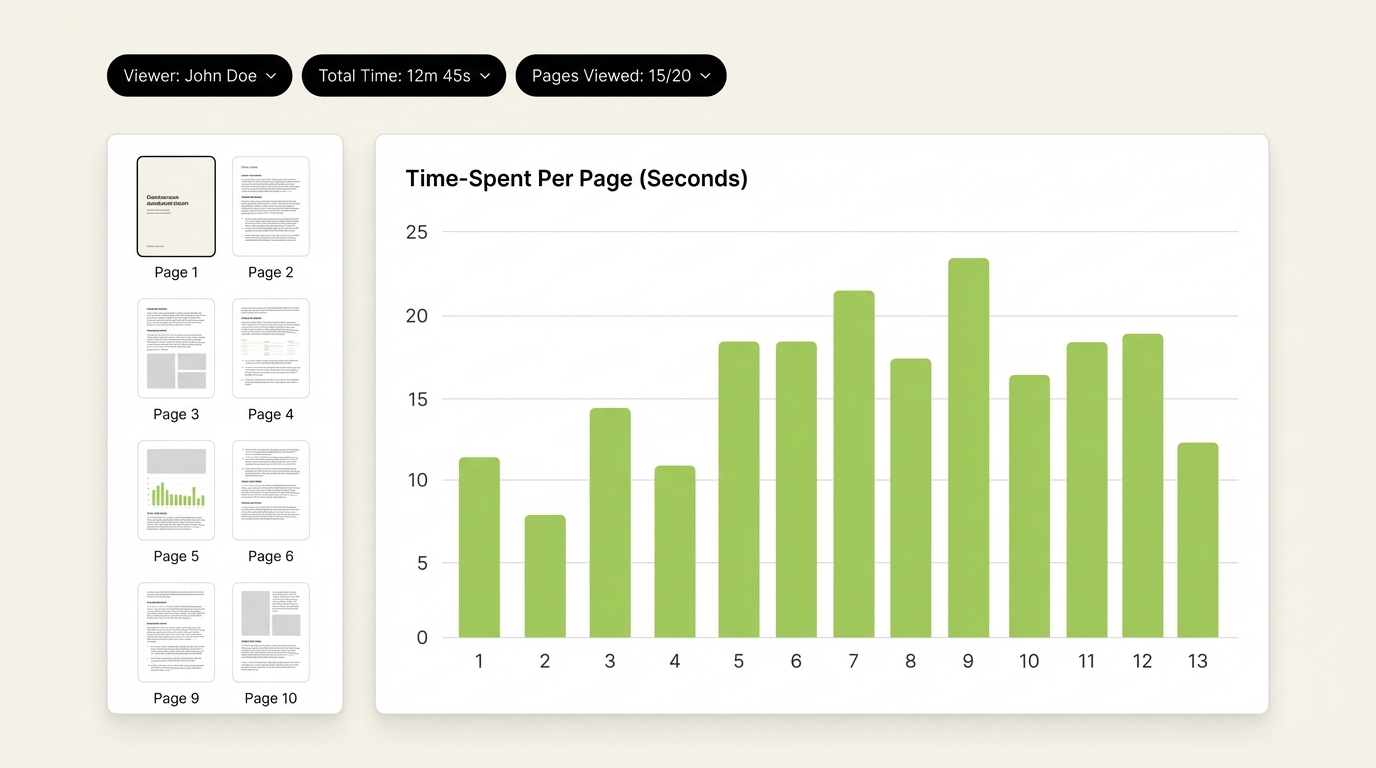
Total views or open rate is a blunt instrument. A document can be "opened" by someone who glances at the cover for two seconds and closes it. That tells you nothing useful. Time per page reveals genuine attention. If a prospect spent 4 minutes on your pricing page, that is a buying signal. If they spent 30 seconds on the executive summary and moved on, you may need to rework your hook.
The most important metrics for a complete picture are:
- Time per page - seconds or minutes spent on each individual slide or page
- Completion rate - percentage of pages the viewer actually reached
- Return visit frequency - how many times the viewer reopened the document
- Forwarding activity - whether the link was shared with additional stakeholders
- Drop-off point - the specific page where most viewers stop engaging
Together, these five metrics give you a behavioral fingerprint for every recipient.
Q3: How Does Page-by-Page Analytics Work?
Page-by-page analytics captures engagement data at the individual slide or page level, not just for the document as a whole.
When you share a document through a platform that supports this feature, the file is rendered in a secure viewer hosted by the platform. As the recipient scrolls or advances through pages, the system records the time they spend on each one, which pages they navigate forward and back through, and where they pause. This data flows into a live dashboard where the sender sees a timeline of the viewing session.
Ellty describes page-by-page analytics as capturing "seconds spent per page, live viewer activity, navigation patterns, and completion rates by section." This is far more granular than what a standard PDF attachment or file-sharing link provides.
For a VC sending a term sheet, this means knowing whether the fund manager focused on valuation terms or governance clauses. For a sales rep sending a proposal, it means knowing whether the prospect lingered on the ROI section or skipped straight to the pricing page. That behavioral context transforms what would otherwise be a generic follow-up into a precisely targeted conversation.
Q4: What Does Time-on-Page Tell You About Buyer Intent?
Time-on-page is one of the clearest proxies for genuine interest available in a sales workflow.
A buyer who spends eight minutes on a specific section of a document is signaling that the content there is relevant to their evaluation process. A buyer who breezes through twelve pages in ninety seconds is either highly familiar with the content or not engaged with it at all. The pattern of time allocation across pages tells a story that no email reply or verbal feedback can replicate.
Research from DocSend shows that investor attention on pitch decks is highly concentrated. Busy VCs spend less time on decks than most founders assume, making it critical to know exactly which sections attract or lose attention. When you know a prospect spent four minutes on your competitive differentiation slide and two minutes on your financial projections, you have a roadmap for your next call.
The practical implication: do not follow up asking "did you get a chance to look at the deck?" when you can already see that they read it twice and spent significant time on the pricing page. Instead, open the conversation there. That shift in follow-up specificity, grounded in real behavioral data, is what separates top performers from everyone else.
Q5: How Do You Know If a Prospect Has Actually Read Your Document?
Knowing whether a prospect has genuinely read a document requires more than an open confirmation. A notification that someone clicked your link proves access, not engagement.
True read confirmation comes from a combination of signals:
- Completion rate above 80% - the viewer reached most or all pages
- Time-on-page above threshold - each page received at least several seconds of attention
- Return visits - the viewer came back more than once, suggesting they shared it internally or are re-evaluating specific sections
- Forwarding activity - the link was shared with someone else, indicating internal circulation
Ellty notes that forwarding activity is a particularly strong signal because it means the document is being advocated by your primary contact to other decision-makers. "Focus on investors who spent 10 minutes reading. Stop chasing those who never opened it," is their practical guidance. The same principle applies to enterprise sales.
SendNow provides real-time open notifications, so you know the moment someone accesses your document. Combined with page-level time data and AI engagement scoring, you get a complete view of whether a recipient truly engaged with the content or just glanced at the cover.
Q6: What Is AI Engagement Scoring for Documents?
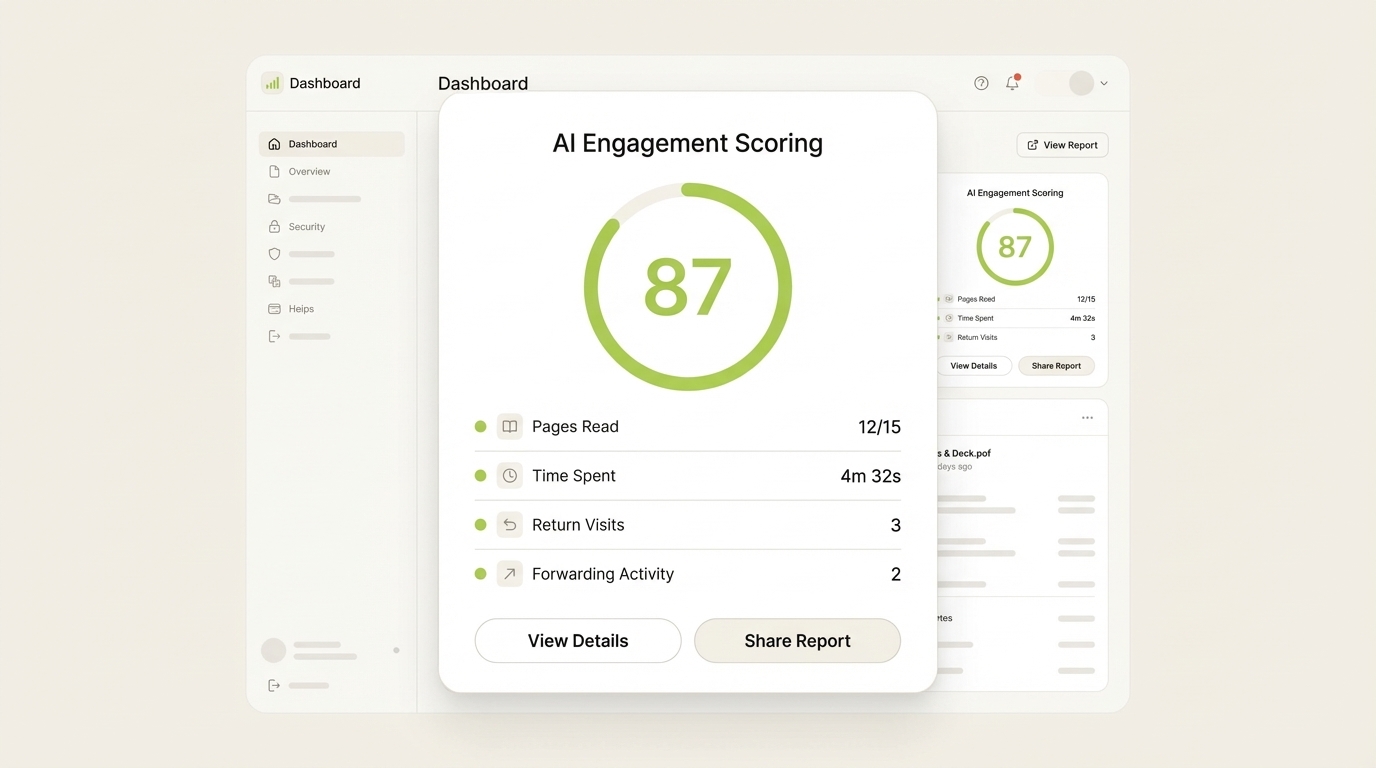
AI engagement scoring takes the raw behavioral signals from document analytics and synthesizes them into a single predictive number or grade that indicates how likely a viewer is to take the next step.
Rather than manually interpreting whether 3 minutes on a pricing page and 2 return visits adds up to strong intent, an AI model processes all the signals, including time per page, pages viewed, return frequency, forwarding activity, and drop-off patterns, and produces a score that ranks prospects by engagement strength.
EverWorker describes this class of tooling as "analyzing firmographic fit, engagement, and behavioral signals to predict conversion probability and trigger next-best actions." Applied specifically to documents, the AI is not relying on third-party intent data but on first-party behavioral evidence from the document itself.
For finance professionals who send multiple pitch decks, proposals, or financial models simultaneously, AI engagement scoring makes prioritization instant. Instead of reviewing analytics for each link individually, you see a ranked list of recipients by engagement score and know exactly who to call first.
Q7: How Do You Protect Sensitive Documents Without Losing Analytics?
Security and analytics are not mutually exclusive. Modern document sharing platforms let you enforce strict access controls while still capturing full engagement data.
The key protection features for sensitive financial and legal documents are:
- NDA gating - recipients must accept a non-disclosure agreement before accessing the document. According to DataRoom Deals, NDA acceptance can be one-click and is logged with a timestamp.
- Dynamic watermarks - the viewer's name and email are embedded visibly or invisibly across every page, deterring unauthorized redistribution.
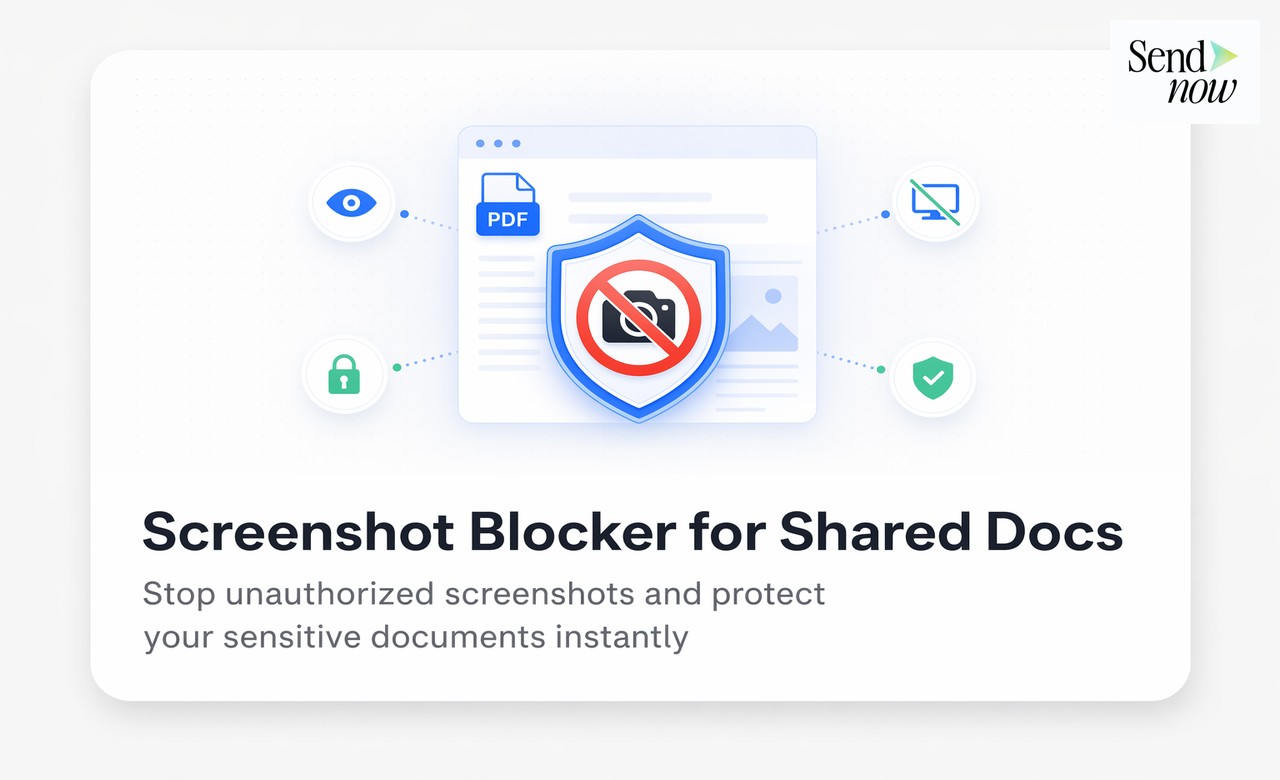
- Screenshot protection - screen capture attempts are blocked or produce blank images.
- Link expiration and password protection - access ends at a defined time or requires authentication.
- Custom domains - documents open under your brand's domain rather than a third-party URL, reducing friction and maintaining trust.
The Virtual Data Room market is growing at a 18.1% CAGR through 2029, reaching an estimated $5.6 billion, driven precisely by the need to share sensitive documents securely without losing the ability to track engagement. SendNow combines all these security layers with full analytics, so finance teams never have to choose between protection and intelligence.
The Real Screenshot — SendNow in Action

Conclusion
Document analytics is not a reporting tool. It is a signal layer that sits between your outbox and your prospect's desk, translating invisible reading behavior into actionable intelligence.
The metrics that actually matter are time per page, completion rate, return visit frequency, and forwarding activity. Together they tell you not just that a document was opened but whether the content landed, where attention concentrated, and how many people inside the account are now evaluating it. AI engagement scoring takes all those signals and surfaces a clear priority order for follow-up.
For finance professionals, the stakes are high enough that guessing at buyer intent is a real cost. A $50M deal that stalls because you followed up at the wrong time, with the wrong talking point, is a recoverable loss only if you have better data next time.
SendNow gives finance teams, deal rooms, and B2B sales professionals page-by-page analytics, AI engagement scoring, NDA gating, screenshot protection, and real-time notifications, starting at $9/month for the Pro plan with a free trial and no credit card required. Every document you send becomes a live source of buyer intelligence.
Keep Reading
About the Author: Rifana Hameem
Rifana is the founder of SendNow. She leads the team in building secure, compliant, and analytics-rich document sharing tools for finance and professional teams worldwide.
Connect on LinkedIn