
Best Sales Enablement Software for SMBs in 2026

Sales enablement software gives small business revenue teams the training, content, and real-time buyer analytics they need to close more deals. The 8 best options for SMBs in 2026 are: SendNow, HubSpot Sales Hub, Apollo.io, Outreach, Gong, Highspot, Loom, and Showpad. Each tool solves a different part of the enablement problem. The fastest ROI for most small teams comes from document analytics — knowing precisely when and how prospects engage with your pitch decks and proposals.
Best Sales Enablement Software for SMBs in 2026
A curated comparison of the 8 best sales enablement software tools built for small and mid-sized businesses in 2026. Compare pricing, features, and use cases to find the right platform for your revenue team.
Introduction
The average B2B sales rep spends only 30% of their time actually selling. The rest goes to hunting for the right content, wondering whether a prospect ever opened that pitch deck sent on Thursday, and sending follow-up emails into a complete void.
Sales enablement software closes that gap. It gives reps the right content, coaching, and real-time buyer engagement signals at the right moment in the deal cycle, so every conversation is more informed and every follow-up hits at peak prospect interest.
According to a 2025 survey cited by Coursera, teams using a unified sales enablement platform are 42% more likely to improve win rates than those without one. The use of sales enablement tools jumped 48% in 2024 alone, and three in four reps say it prepares them to meet quota, according to the Salesforce State of Sales report.
For SMBs, the right tools matter even more. You don't have a dedicated enablement manager, a content ops team, or a six-month implementation budget. You need tools that work out of the box, integrate with your CRM, and give every rep a competitive edge from day one.
This guide covers the 7 questions buyers ask most before purchasing sales enablement software, plus an honest comparison of the 8 best platforms for small and mid-sized teams in 2026.
What is sales enablement software?
Sales enablement software is a category of tools that equip sales teams with the content, training, coaching, and data they need to engage buyers effectively and close deals. It covers everything from content libraries and document tracking to sales coaching, call intelligence, and prospecting automation.
As Microsoft Dynamics 365 defines it: "Sales enablement is the process of providing sellers with the tools, content, and materials they need to target the right buyers and increase engagement, helping close more deals, faster."
The category spans several sub-types. Document analytics tools let reps see exactly how prospects interact with pitch decks and proposals. Content management platforms organize assets so reps always send the current version. Conversation intelligence tools analyze sales calls. CRM-native enablement layers coaching and playbooks directly into HubSpot or Salesforce.
For SMBs, the most practical entry point is often a document sharing and analytics tool — something that tells you immediately when a prospect opens your deck and how long they spent on the pricing page. That single signal changes how your reps follow up, and it requires zero process overhaul to implement.
What is the difference between sales enablement software and a CRM?
A CRM is the system of record. It stores contacts, deal stages, activity logs, and revenue forecasts. Sales enablement software is the system of action. It answers "what should the rep do next, with which content, to move this deal forward?"
As The Pedowitz Group explains: "The CRM answers 'What is happening in the pipeline?' Enablement answers 'What should the rep do next, and with what assets?'"
In practice, a CRM tells you a deal sits in the "proposal sent" stage. A sales enablement tool tells you the prospect opened the proposal three times, spent four minutes on the pricing table, and skipped the case studies section entirely — so the rep knows exactly when to call and what to address.
Most SMBs need both. The CRM tracks the relationship; enablement tools improve execution. If budget forces a choice, start with the CRM and add a document tracking tool as the first enablement layer — it integrates with almost any system and adds immediate visibility to your existing workflow.

Does sales enablement software actually improve win rates?
Yes, and the data is consistent across multiple research sources.
SiftHub's 2025 research found that companies with formal sales enablement programs achieve 49% higher win rates and a 4:1 ROI. 76% of organizations now maintain dedicated enablement functions, up from less than half a decade ago.
Docebo reports that 65% of organizations using sales enablement tools see sales process automation improvements, and 75% of those companies saw revenue increase over the prior 12 months.
The ROI comes from a few specific levers:
- Faster, more precise follow-up. Real-time open notifications let reps call prospects the moment they engage with content. Response rates are significantly higher when outreach happens in the first minute of engagement versus 24 hours later.
- More relevant conversations. Knowing which pages a prospect viewed lets reps tailor their next call to what that buyer actually cared about, rather than replaying the full pitch.
- Less time on content admin. Reps spend roughly 440 hours per year searching for content, per SiftHub research. A centralized content library or document platform cuts that materially.
The caveat: tools don't create results on their own. Adoption is everything. The simplest, fastest-to-adopt tool in your stack will consistently outperform a more powerful platform that reps only use intermittently.
How much does sales enablement software cost for SMBs?
Pricing varies significantly across the category:
- Document tracking and deal room tools (e.g., SendNow): $12-$49/month for small teams. SendNow starts at $9/month for the Pro plan (1 member, 300 documents), $33/month for Business (3 members, 1,000 documents), and custom Enterprise pricing. 35% savings apply on annual billing. Free trial available, no credit card required.
- CRM-native enablement (HubSpot Sales Hub Starter): From $20/user/month. Professional tier from $100/user/month.
- Prospecting and engagement platforms (Apollo.io): Free plan available. Paid plans from $49/user/month.
- Conversation intelligence platforms (Gong, Chorus/ZoomInfo): Typically $100-$200+/user/month, generally sold as annual contracts.
- Enterprise content enablement platforms (Highspot, Seismic): Enterprise pricing, often starting at $30,000+/year.
The most common mistake SMBs make is purchasing enterprise-grade platforms they lack the headcount to fully use. For teams under 20 reps, combining a CRM with a document analytics tool covers the majority of practical enablement value at a fraction of the enterprise cost.
What features should SMBs look for in sales enablement software?
For a small or mid-sized revenue team, these features deliver the most practical return:
Real-time engagement notifications. Know the exact moment a prospect opens your proposal, pitch deck, or case study. This single capability changes how your reps prioritize their day.
Page-by-page document analytics. Simple open-rate tracking is insufficient. You want to know which page held a prospect's attention for three minutes and which section they never reached.
Content version control. When marketing updates pricing, the new version should reach every rep's outbound links automatically. Version confusion is invisible but common.
CRM integration. Engagement data from your enablement tools should log back to HubSpot, Salesforce, or Pipedrive without requiring manual input.
Security and compliance features. If your team shares sensitive financial models, term sheets, or NDAs, screenshot protection, NDA gating, and dynamic watermarks are non-negotiable. Tools like SendNow include all three natively.
Ease of onboarding. A tool that takes a rep 30 minutes to learn will be used daily. A tool that takes two weeks to configure may never be fully adopted.
What is the difference between sales enablement and sales engagement?
These two terms are frequently used interchangeably, but they solve different problems.
Sales enablement prepares reps. It covers content management, training, coaching, and analytics — the "what to say and show" layer that makes reps more effective in every deal.
Sales engagement executes outreach. It covers email sequences, call cadences, multi-touch automation, and outreach timing — the "how and when to reach out" layer.
Tools like Outreach and Salesloft are sales engagement platforms. Tools like Highspot, Showpad, and SendNow are sales enablement tools. Gong sits at the intersection, analyzing calls to improve both coaching (enablement) and deal strategy (engagement).
Most growing SMB sales stacks eventually include both: an engagement platform to run outreach, and an enablement tool to ensure reps have the right content and buyer intelligence to make those conversations count. The sequencing matters: solve the pipeline generation problem first, then layer in content analytics and coaching as deal volume grows.
How do you build a sales enablement strategy for a small team?
Building an enablement strategy for an SMB does not require dedicated headcount or a complex rollout. Start with these four steps:
Step 1: Audit your current content. List every asset your reps actually use — decks, one-pagers, case studies, proposals, pricing sheets. Identify what's outdated and what's missing.
Step 2: Add visibility to what you send. Deploy a document tracking tool so you can see exactly how prospects engage with every asset you share. This is the fastest way to identify what content is working and what isn't.
Step 3: Build rep-level playbooks. Document your best objection responses, discovery questions, and competitive positioning. Even a simple shared Google Doc is more effective than leaving reps to improvise.
Step 4: Track leading indicators. Measure time-on-page for sent documents, content engagement rates, follow-up response rates after real-time notifications, and the correlation between deal activity and close rate.
GTM 80/20 notes that companies with structured enablement programs see faster rep onboarding, stronger quota attainment, and measurable revenue growth compared to teams with ad-hoc processes.
The 8 Best Sales Enablement Software Tools for SMBs in 2026
Apollo.io (All-in-One Sales Intelligence & Engagement)

For growing SMBs and high-velocity sales teams, deploying separate tools for prospecting data, email sequencing, meeting scheduling, and deal intelligence quickly becomes cost-prohibitive. Apollo.io solves this fragmentation by offering an all-in-one B2B sales platform that combines a database of 275M+ verified contacts with advanced engagement automation and AI-powered deal workflows.
Apollo enables reps to discover in-market buyers, enrich existing CRM records, launch multi-channel outbound sequences (email, phone, LinkedIn), and analyze deal pipeline health—all within a single intuitive interface. Its built-in AI writing assistant helps SMB reps personalize outreach at scale without sacrificing quality or message relevancy.
Key platform advantages for SMBs include:
- Massive B2B Lead Database: Search through 275+ million contacts and 60+ million companies with 65+ granular filters covering revenue, tech stack, funding, and intent signals.
- Unified Multi-Channel Sequencing: Build automated workflows that blend email steps, cold calling via native dialer, LinkedIn tasks, and meeting scheduling.
- AI-Driven Personalization & Insights: Automatically generates personalized email icebreakers and analyzes prospect engagement to recommend the optimal follow-up timing.
Get started with apollo.io.
1. SendNow — Best for Document Analytics and Deal Room Intelligence
Best for: Sales reps and AEs who share proposals, pitch decks, and financial models and need precise visibility into prospect engagement.
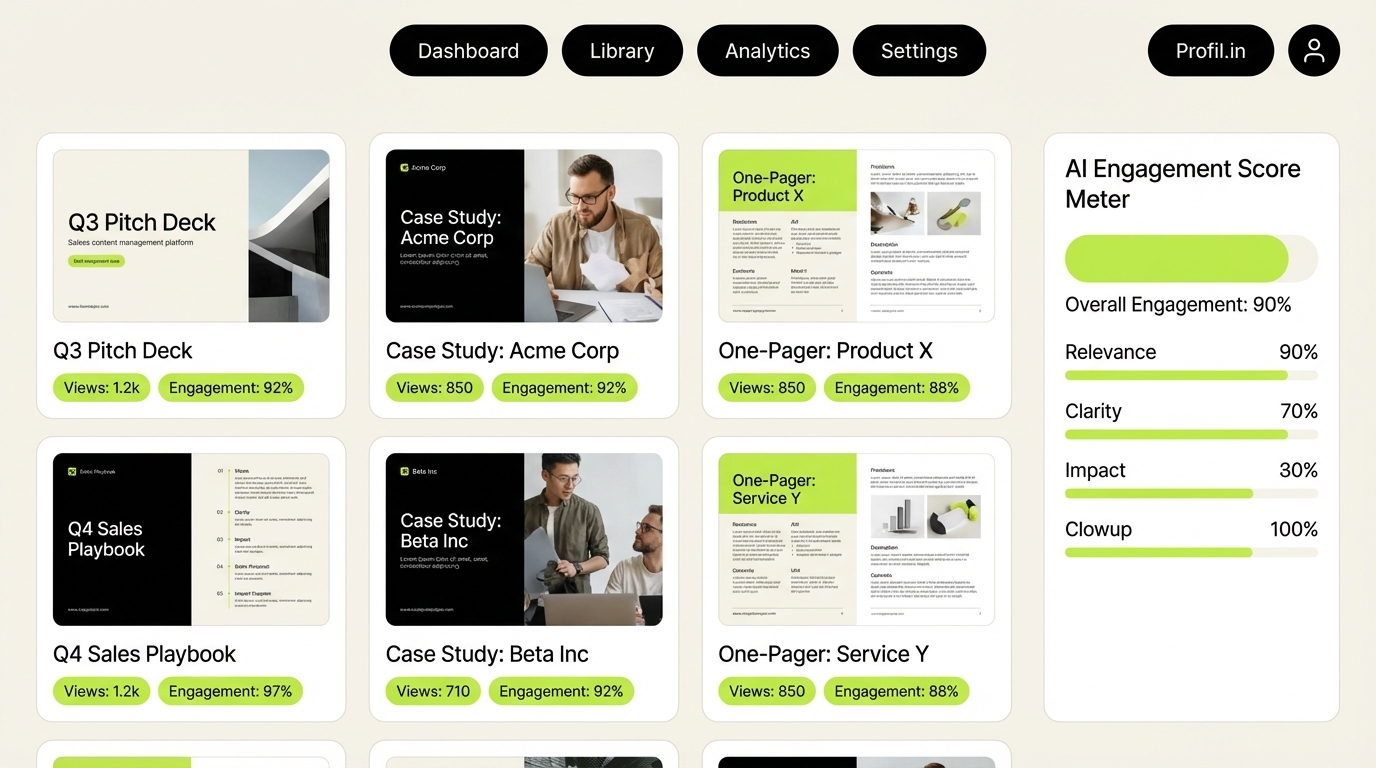
SendNow is a secure document sharing and analytics platform built for revenue teams. It gives reps page-by-page engagement data, real-time open notifications, and AI engagement scoring — so every follow-up is timed perfectly and grounded in actual buyer behavior.
Beyond standard analytics, SendNow includes branded microsites and deal rooms, NDA gating, screenshot protection, dynamic watermarks, an AI chatbot that answers prospect questions directly inside documents, Slack and webhook integrations, and custom domain support. It is trusted by 100+ teams across sales, finance, and consulting.
What sets it apart: Most document tools report when someone opened a file. SendNow generates a full AI engagement score per viewer, tells you which pages they spent the most time on, and alerts your Slack channel the instant a deal gets active.
Pricing: Pro $12/month (1 member, 300 documents), Business $33/month (3 members, 1,000 documents), Enterprise custom. 35% off with annual billing. Free trial, no credit card required.
2. HubSpot Sales Hub — Best for CRM-Native Enablement
Best for: SMBs already running HubSpot CRM who want enablement features without a separate platform.
HubSpot Sales Hub layers email sequences, document tracking, deal analytics, call recording, and a Playbooks feature directly into HubSpot CRM. For teams that want a single platform managing both their CRM data and enablement workflows, it removes integration overhead entirely.
Pricing: Starter from $20/user/month. Professional from $100/user/month.
3. Apollo.io — Best for Prospecting and Outbound Pipeline Generation
Best for: Teams that need to generate pipeline before they can enable it.
Apollo combines a 270M+ contact database with email sequences, call dialing, and LinkedIn integration. While technically a sales engagement and prospecting tool, it earns a place on this list because for many SMBs, pipeline generation is the first enablement gap to address.
Pricing: Free plan available. Paid plans from $49/user/month.
4. Outreach — Best for Sales Engagement at Scale
Best for: Growing SMBs and mid-market teams running complex, multi-channel outreach sequences with clear pipeline visibility needs.
Outreach is a leading sales engagement platform with advanced sequencing, AI-powered deal health scores, pipeline forecasting, and deep CRM integrations. Apollo.io's 2026 Buyer Guide ranks it among the top tools for teams optimizing outbound execution.
Pricing: Contact for pricing. Generally $100+/user/month.
5. Gong — Best for Conversation Intelligence and Sales Coaching
Best for: Teams that want to coach reps based on what actually happens in calls and demos, rather than anecdote.
Gong records, transcribes, and analyzes every call and video meeting. It surfaces deal risks, tracks competitor mentions, and identifies which talk tracks correlate with closed deals. The coaching dashboards help managers pinpoint exactly where individual reps lose conversations.
Pricing: Contact for pricing. Typically $100-$200+/user/month with annual contracts required.
6. Highspot — Best for Sales Content Management
Best for: Teams with large, frequently updated content libraries where marketing-sales content alignment is a core priority.
Highspot is a full-featured sales content management platform with AI-powered content recommendations, guided selling playbooks, training modules, and analytics on asset performance. It is the tool most often chosen by teams where the quality and consistency of sales content directly affects close rates.
Pricing: Enterprise pricing. Contact for a custom quote.
7. Loom — Best for Async Video Selling
Best for: SDRs and AEs who want to personalize outreach and follow-ups with short, recorded video messages.
Loom lets reps record quick video walkthroughs — a custom proposal review, a personalized feature demo, or a post-meeting follow-up summary. Video prospecting consistently outperforms plain text email in open and reply rates, and Loom's lightweight interface makes it easy to adopt without a formal training program.
Pricing: Free plan available. Business from $12.50/user/month.
8. Showpad — Best for Product-Heavy and Technical Sales Teams
Best for: Companies selling complex products where rep training, product knowledge, and interactive demos must be unified in a single place.
ZoomInfo (Enterprise B2B Intelligence & Intent Signals)

When sales teams need enterprise-grade data depth, organizational hierarchy mapping, and real-time intent monitoring, ZoomInfo remains the gold standard for B2B go-to-market intelligence.
ZoomInfo provides sales, marketing, and operations teams with verified direct-dial phone numbers, validated email addresses, corporate tech stack profiles, and active purchase-intent signals. Its comprehensive company dossiers allow enterprise account executives to map buying committees across multi-thousand-employee organizations, identify key department heads, and spot active buying cycles before competitors enter the deal.
Key capabilities for sales enablement include:
- Streaming Buyer Intent Data: Pinpoints accounts actively researching specific solutions across the web, allowing sales teams to reach prospects at the onset of their evaluation cycle.
- Comprehensive Org Charts & Committee Mapping: Visualizes reporting structures, departmental hierarchies, and budget holders across enterprise accounts.
- Automated GTM Workflows: Automatically routes intent-driven accounts into customized sales sequences, enriches inbound leads instantly, and alerts reps when key accounts visit your website.
Get started with zoominfo.com.
Conclusion: Start With Visibility, Then Build From There
The best sales enablement software for an SMB is the tool your reps actually open every day. The most reliable path to adoption is starting with the friction point that costs you deals right now.
If you don't know how prospects engage with your proposals and pitch decks — which page they read, how long they spent on pricing, whether they ever forwarded your document to a decision-maker — that is the first problem to solve.
SendNow adds page-by-page analytics, AI engagement scoring, NDA gating, branded deal rooms, and real-time Slack alerts to every document you share. Plans start from $9/month. Start a free trial today without a credit card, and know exactly what your next best follow-up looks like before you make the call.
Keep Reading
- What Is a Sales Enablement Platform? Full Guide for 2026
- Best Sales Enablement Tools in 2026 (Ranked)
- Sales Enablement KPIs Every Revenue Team Should Track
- Best DocSend Alternatives in 2026 (Honest Review)
Related SendNow Resources
- Related SendNow resource
- Related SendNow resource
- Related SendNow resource
- Related SendNow resource
- Related SendNow resource
External References
About the Author: Rifana Hameem
Rifana is the founder of SendNow. She leads the team in building secure, compliant, and analytics-rich document sharing tools for finance and professional teams worldwide.
Connect on LinkedIn