Email Attachments vs Secure Links: Why Finance Teams Are Switching

- Email attachments lose all access control the moment you hit Send.
- Secure links let you revoke access, track page-by-page engagement, block downloads, and require NDA completion before a document opens.
- Finance teams that switch to secure document sharing close deals faster, stay compliant with GDPR and FTC Safeguards rules, and eliminate the risk of confidential materials reaching unintended recipients.
- DocSend removed its free plan in March 2025, making platforms like SendNow a practical, affordable alternative for deal teams of every size.
Email Attachments vs Secure Links: Why Finance Teams Are Switching
Finance professionals — VCs, investment bankers, and PE firms — still rely on email attachments to share deal documents, but each sent file becomes an untracked copy with no access controls. This guide breaks down the security gaps in email attachments and explains why secure document sharing links have become the professional standard for deal teams.
Introduction
The pitch deck is ready. The term sheet is finalized. The financial model has three tabs that nobody outside your firm should ever see. You attach the PDF, add a brief note, and click Send.
Two hours later, it lands in the inbox of an analyst you did not know about, forwarded without a second thought. A week later, you have no idea who else has the file, whether anyone read it, or how long they spent on the cap table page.
This is the quiet security failure at the center of how many finance professionals still share documents today.
Email attachments feel fast and familiar. For investment bankers, VC firms, private equity deal teams, and financial advisors handling sensitive information, the convenience of an attachment hides real exposure: no tracking, no access controls, no ability to revoke, and no audit trail.
Secure document sharing links solve all of that. This article answers the seven questions finance teams ask most often before they make the switch.
1. Why Are Email Attachments Not Secure for Financial Documents?
Email was not designed for the confidentiality demands of modern finance. When you send a PDF as an email attachment, you lose every form of control the moment that email leaves your outbox.
The core problems are well-documented. Standard email lacks end-to-end encryption for attachments in transit. According to the University of Maryland's IT security guidance, most users "forget to encrypt a file" and email clients often strip even basic transport-layer protections in practice. (Source: University of Maryland IT Security)
Beyond encryption, attachments are persistent copies. Anyone who receives the file can save it, print it, forward it, or screenshot it. You have no mechanism to stop any of those actions after the fact.
Misdirected emails are also far more common in finance than most teams admit. A Stack Exchange discussion on financial document safety put it plainly: email "has no audit protections" — if a forwarded email reaches the wrong party, there is no log of what was accessed and no chain of custody. (Source: Money Stack Exchange)
For deals involving term sheets, cap tables, or LP financials, a single misdirected attachment can trigger an NDA dispute, regulatory scrutiny, or a competitor getting your deal structure before closing.
2. What Is a Secure Document Sharing Link?
A secure document sharing link is a controlled URL that opens a protected viewer for your document, rather than creating a downloadable copy on the recipient's device.
Instead of attaching a PDF, you upload it to a secure platform, configure your access controls, then share a single link. The document never leaves the platform's servers. The recipient views it through a browser-based or app-based viewer, and you retain full control at all times.
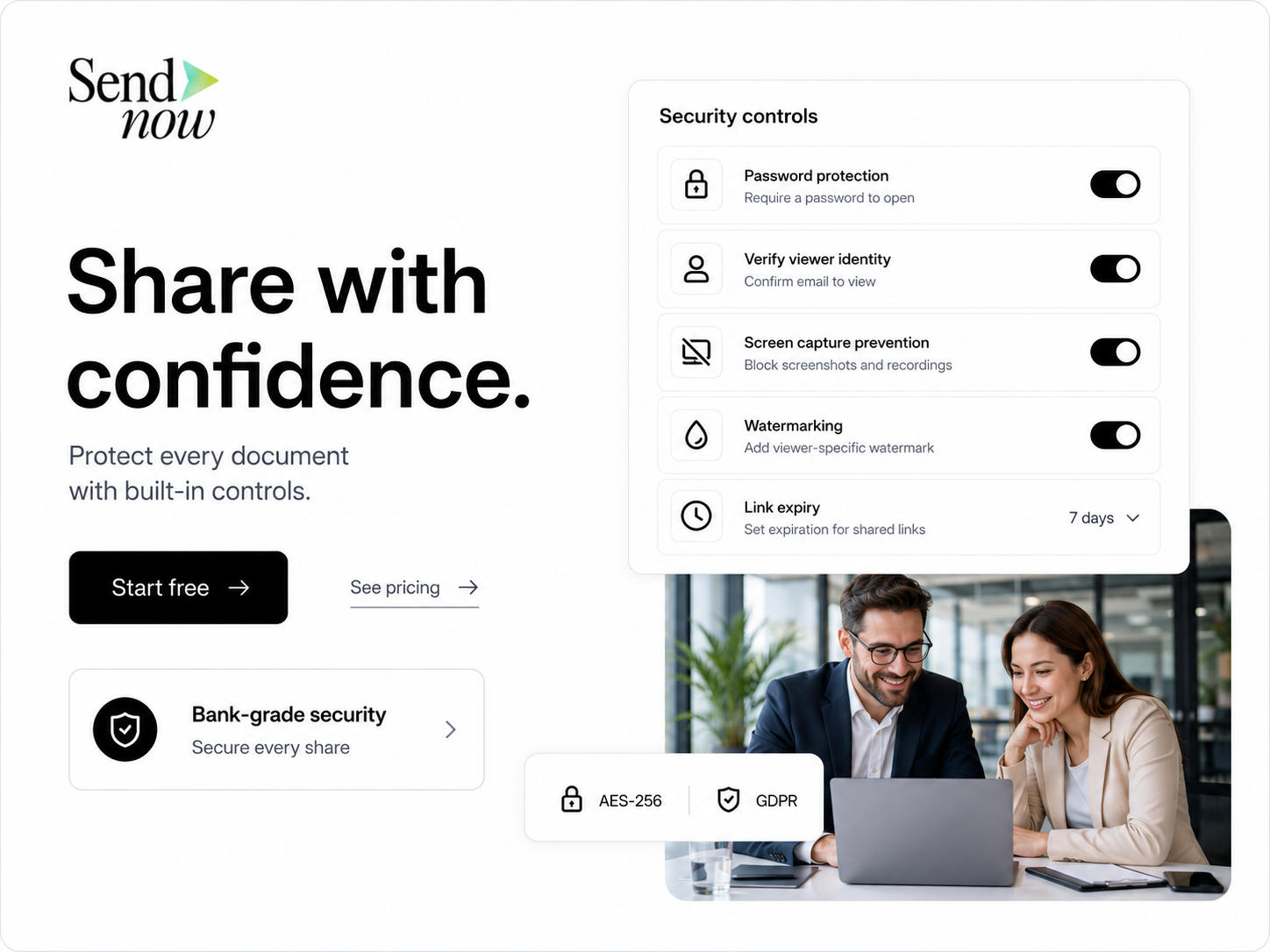
Egnyte's research on link-based sharing found that links offer distinct advantages over attachments: version control, access revocation, and the ability to track who opened what and when. (Source: Egnyte) For finance professionals, the critical controls that come with a secure link include password protection, expiry dates, download blocking, NDA gating, and real-time open notifications.
Each of these addresses a specific failure mode of the traditional email attachment workflow. Password protection stops unauthorized openers. Expiry dates keep links active only for the duration of a deal window. Download blocking prevents recipients from saving local copies. NDA gating creates a consent record before the document loads. Open notifications alert you the moment a counterparty reads your materials.
3. How Do Finance Teams Share Confidential Documents Safely?
Finance teams that handle the most sensitive materials — M&A due diligence files, investor memoranda, and financial models — typically use one of three approaches: virtual data rooms, secure document sharing platforms, or encrypted file transfer portals.
Virtual data rooms are the heavy end of the market, designed for M&A transactions with dozens of counterparties and thousands of documents. They are comprehensive but come with complex setup and high per-user pricing.
Secure document sharing platforms like SendNow sit in the practical middle ground: purpose-built for deal teams that need control and analytics without enterprise contract overhead. A finance professional can upload a pitch deck, require NDA sign-off before it opens, block downloads, and see which pages an LP spent time on — all in under two minutes. This makes secure link sharing viable for daily deal workflows, not just once-a-year transactions.
FileInvite's research found that 70% of financial firms rely on four or more systems to track secure communications with third parties, and that "security incidents continue to rise despite efforts" when teams bolt additional tools onto email. (Source: FileInvite) A unified, link-based document platform removes that fragmentation.

4. What Happens When a Confidential Email Attachment Gets Forwarded?
Nothing — and that is the problem.
Once a recipient forwards your attachment to a third party, you receive no notification, no alert, and no record of the event. The file is now on another device, in another inbox, potentially on a network you have never assessed.
Better Proposals documented this chain of events in practical terms: "Even if we ignore the fact that sending email attachments is outdated, the truth is that it comes with other risks that can harm both your business and client relationships." (Source: Better Proposals)
In financial services, the consequences are sharp. A forwarded pitch deck can reach a competitor's LP network. A forwarded financial model can reach a counterparty's advisor before deal terms are agreed. In the worst cases, an NDA-protected memorandum reaches someone who never signed the NDA — and you have no record that the breach occurred.
With a secure link, forwarding the URL is structurally different. The link still opens through the same controlled viewer. If you have set an email-gated access requirement, a forwarded link simply does not open for an unauthorized address. You can also revoke the link entirely, rendering all copies of the URL inactive within seconds of deciding the document should no longer be accessible.
5. Is Email GDPR Compliant for Sharing Financial Data?
Email is not inherently GDPR compliant for sharing sensitive financial personal data, and the compliance bar has risen sharply in recent years.
Under GDPR, organizations must ensure personal data is processed with appropriate technical safeguards, including data in transit. Standard email attachments fail at least three GDPR requirements: they lack documented access controls, they have no audit trail of who accessed the data, and they cannot be deleted after the fact as GDPR's right-to-erasure provisions require.
FileInvite's analysis of the FTC Safeguards Rule — the US equivalent framework for financial services — found that email "fails to meet" updated requirements around encryption, authentication, and customer data disposal. (Source: FileInvite) The same logic applies directly to European financial services firms operating under GDPR.
Secure document sharing platforms that store data on GDPR-compliant AWS infrastructure, maintain full audit logs of every access event, and support access revocation give finance teams a defensible compliance posture. Email alone does not.
6. What Are the Risks of Sharing Financial Documents by Email?
The risk profile of email attachment sharing breaks into four categories.
Interception in transit. Although most modern email providers use TLS encryption between servers, attachments can be intercepted if either endpoint is misconfigured or compromised. Secureframe's data breach statistics report found that financial services organizations saw average breach costs of approximately $6.08 million in 2025, with email as a primary initial access vector. (Source: Secureframe)
Accidental misdirection. Autocomplete in email clients regularly suggests the wrong recipient. A document sent to the wrong address is a reportable data breach under GDPR regardless of intent.
Forwarding and redistribution. Once an attachment leaves your outbox, there is no mechanism to prevent or track redistribution. Consecutive forwards create exponentially more untracked copies.
Version proliferation. Finance documents go through many drafts. Email attachments create a new static copy with every send. Recipients may act on outdated financial projections without knowing a newer version exists, which creates its own liability risk in deal contexts.
Rekall Tech summarized the exposure plainly: for professional services firms, these risks "directly threaten not just your operations, but your client relationships, regulatory compliance, and ultimately your business survival." (Source: Rekall Tech)
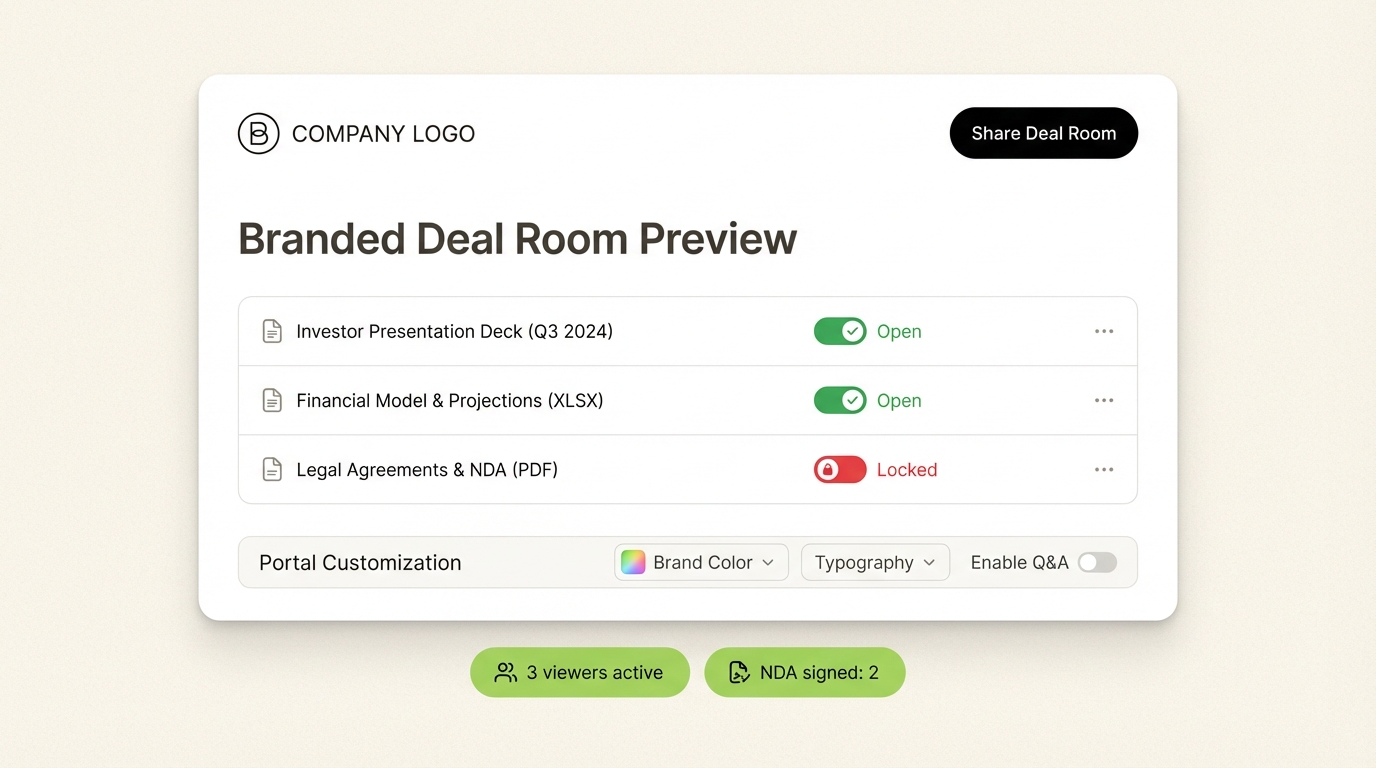
7. What Features Do Finance Teams Need in a Secure Document Platform?
Finance teams have requirements that general-purpose file sharing tools do not fully address. Based on how deal professionals use document platforms, the critical features are:
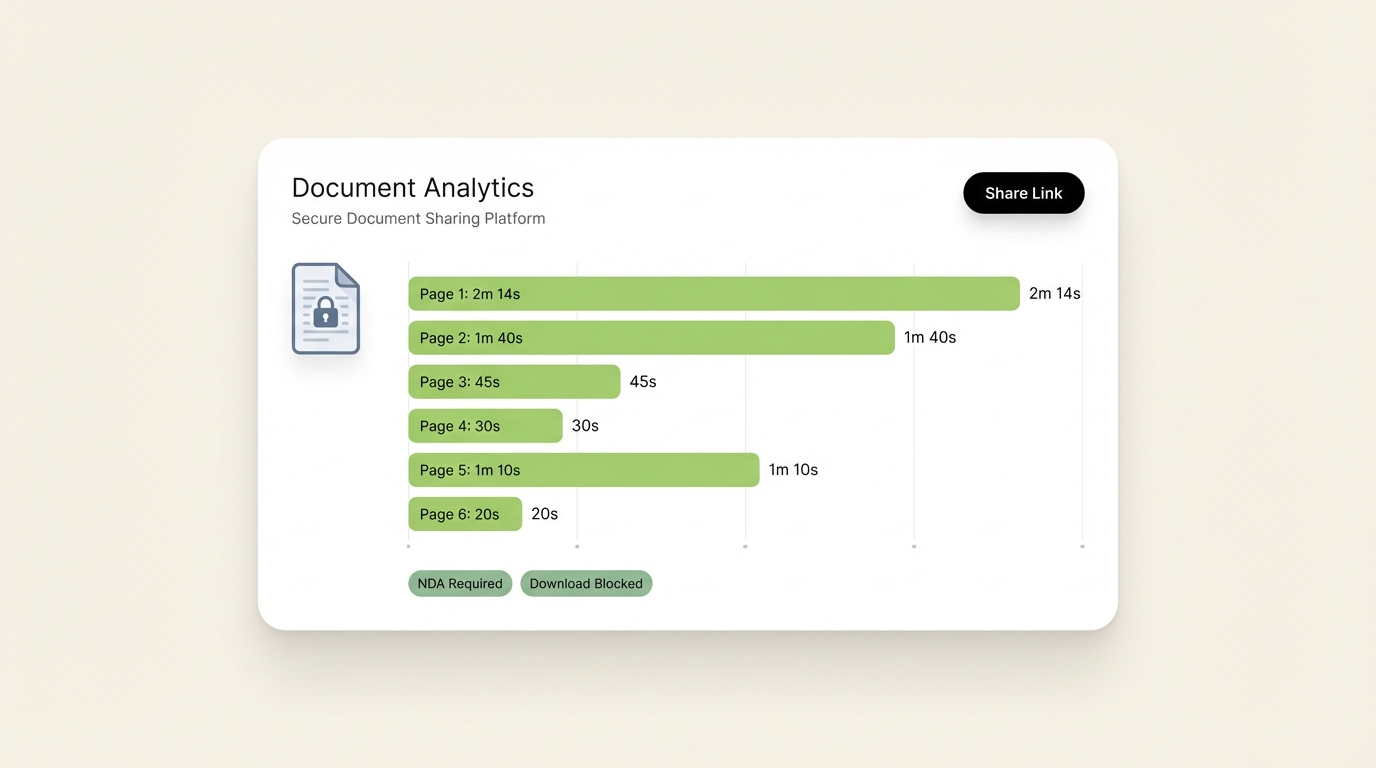
Page-by-page analytics. Knowing which LP spent four minutes on the revenue projections page tells you more than knowing they "opened the deck." Engagement scoring at the page level helps deal teams prioritize follow-up and refine materials based on where attention actually falls.
NDA gating. Requiring a recipient to accept a non-disclosure agreement before a document opens creates a legally auditable consent record tied to each individual viewer. This is non-negotiable for firms sharing pre-deal materials.
Access revocation. When a deal falls through or an NDA expires, you need the ability to disable access to all previously shared links instantly. Email attachments make this structurally impossible.
Download and screenshot blocking. Documents that cannot be saved locally or captured by screen recording stay within the controlled environment. This matters most for financial models and investor memoranda that contain forward-looking projections.
Branded deal rooms. Finance professionals expect a polished experience. A white-labeled microsite with the sender's branding communicates professionalism and keeps all deal materials in one organized, named space.
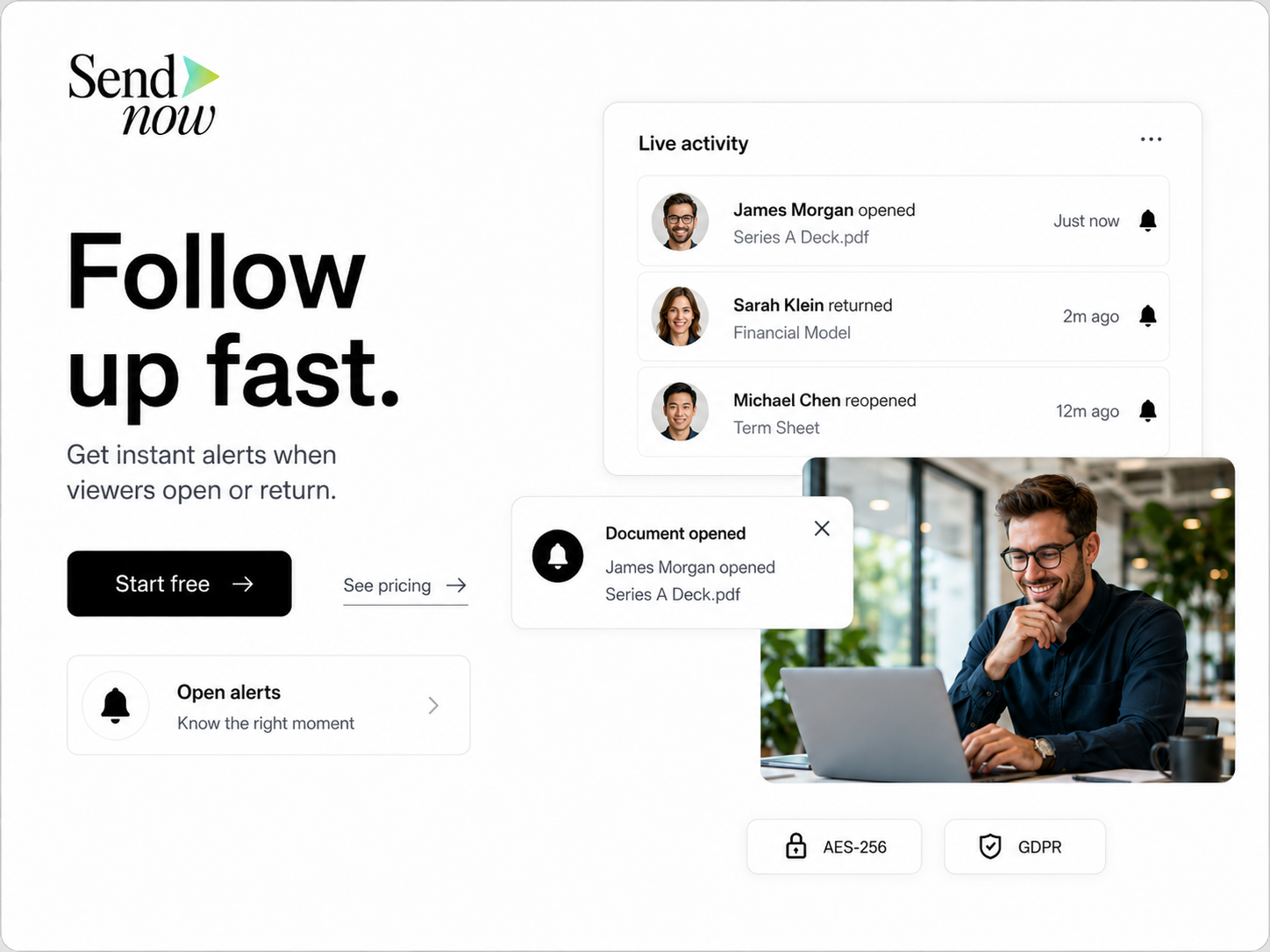
Real-time open notifications. Knowing the moment an investor opens your pitch deck gives deal teams the timing advantage to follow up when engagement is at its peak.
AI engagement scoring. Advanced platforms score overall document engagement across multiple sessions and recipients, helping deal teams understand which prospects are most actively engaged without manually cross-referencing analytics reports.
DocSend removed its free plan in March 2025, a change that pushed many finance teams to evaluate alternatives with comparable functionality at lower price points. (Source: Peony.ink)
Conclusion
Email attachments are a liability that most finance teams carry out of habit rather than deliberate design. The moment a PDF leaves your outbox, you lose control of who sees it, where it goes, and how long it stays in circulation.
Secure document sharing links change the physics of how deal documents move. You share the experience of reading a document, not an uncontrolled copy of the file itself. Every access event is logged. Access can be revoked. Recipients who never signed an NDA never get past the gate.
For VCs, investment bankers, PE firms, and financial advisors managing sensitive materials on a daily basis, the shift from attachments to secure links is a professional standard — not a technical upgrade.
SendNow is built specifically for this workflow. Upload a document, configure access controls, and share a link that tracks page-by-page engagement, requires NDA sign-off, and locks down downloads and screenshots. Plans start from $9/month with a free trial and no credit card required.
Keep Reading
About the Author: Rifana Hameem
Rifana is the founder of SendNow. She leads the team in building secure, compliant, and analytics-rich document sharing tools for finance and professional teams worldwide.
Connect on LinkedIn