What Financial Documents Should Never Go as Email Attachments

- Email attachments give you zero control over a document once it leaves your outbox: no tracking, no revocation, no protection.
- Financial documents that contain deal terms, personal account data, valuations, or unreleased performance figures are the highest-risk attachments you can send.
- The average global cost of a data breach reached $4.44 million in 2025, with financial services consistently among the most targeted sectors.
- Dynamic watermarking, NDA gating, screenshot protection, and access expiry controls are the baseline standards for sharing sensitive financial documents.
- Secure document sharing platforms give you a tracked link instead of an attachment — so the document stays under your control from first open to last view.
- DocSend removed its free plan in early 2025, pushing finance teams toward alternatives that offer similar or stronger capabilities at lower price points.
- The best secure document sharing tools combine analytics, access controls, and branded delivery in one workflow designed for financial professionals.
What Financial Documents Should Never Go as Email Attachments
Description: A definitive guide for finance professionals on which financial documents carry too much risk to send as email attachments and why secure document sharing platforms are the standard alternative. Covers seven critical document types, real breach statistics, and best practices for protecting sensitive financial data in transit.
Introduction
Picture this scenario. A portfolio company sends you their Q3 financial model as a Gmail attachment. You download it to your laptop. Later that afternoon, you forward it to a colleague for review. They email a section to an advisor. Somewhere in that chain, the document ends up in an inbox that gets phished. The financial projections — numbers your client spent three months building — are now in the hands of a bad actor with no audit trail, no legal recourse, and no way to know how far the file traveled.
This is not a hypothetical. It is the lived experience of financial professionals who rely on email attachments to share sensitive documents.
Email is the most widely used business communication tool in the world, but it was designed for messages, not for the secure exchange of material financial information. It has no built-in access controls, no revocation mechanism, no audit trail at the document level, and no visibility into what a recipient does with a file after they download it.
This guide answers the seven most important questions finance professionals ask about email document risk — and it covers exactly which documents should never travel as attachments.
1. Why Is Email Not Safe for Financial Documents?
Email fails financial document security on multiple fronts simultaneously.
Transit exposure. Standard email passes through multiple servers and networks on its route to the recipient. Storen Financial notes that "an email passes through many servers and networks on the way to its destination," and that each hop is a potential interception point. Even TLS-encrypted email does not protect documents at rest once they arrive.
Recipient-side risk. Once you send an attachment, it exists on every device, email client, and backup system that the recipient uses. If their account is compromised — either by phishing, credential stuffing, or malware — your document is compromised with it.
Forwarding without visibility. You have no way to know whether the recipient forwarded your attachment to ten people. The University of Maryland IT Security team describes email as one of the most common ways sensitive information gets exposed, specifically because users frequently send to the wrong recipient or fail to encrypt attachments before sending.
No revocation. Unlike a tracked link, an email attachment cannot be revoked. Once the PDF lands in someone's inbox, you cannot take it back.
CISA's official guidance states clearly: avoid using email for sensitive data. The agency lists financial documents alongside personal identifiers as categories that should not travel as standard attachments.
2. What Financial Documents Should Never Be Sent as Email Attachments?
Not every financial document carries the same level of risk. The following categories represent the highest-risk document types based on the nature of the data they contain, the compliance implications of unauthorized disclosure, and the real-world damage that a breach causes.
Term sheets and LOIs. These documents contain the negotiated terms of a deal. If a term sheet leaks to a competing bidder, it destroys your negotiating position and can kill the transaction entirely.
Financial models with projections. Forward-looking financial models contain material non-public information (MNPI) for public companies and highly sensitive valuation assumptions for private ones. In M&A contexts, premature disclosure can trigger regulatory scrutiny.
Due diligence packages. A full diligence package for a financing round or acquisition typically includes audited financials, cap table, customer concentration data, and litigation history. The aggregate of this information is extraordinarily sensitive.
Capital account statements and investor letters. For fund managers, these documents contain each limited partner's performance data. Disclosure violates fiduciary duty and likely breaches your fund agreement.
Bank account numbers and routing information. Global Tech Solutions lists bank account numbers as among the nine pieces of information never to send via email, noting that this data is the most direct path to financial fraud.
Tax returns and Schedule K-1s. These contain Social Security Numbers, entity identification numbers, and detailed income data. Nelson CPA states flatly: "Documents containing information like social security numbers and bank account numbers should never be sent to your tax accountant via email unencrypted."
Pitch decks containing unreleased product or financial data. For startups in fundraising mode, pitch decks often contain competitor analysis, unreleased product roadmaps, and revenue figures that represent genuine competitive intelligence.
3. What Does a Data Breach Actually Cost in Finance?
Finance professionals sometimes treat document security as an abstract compliance concern rather than a financial one. The numbers tell a different story.
According to DeepStrike's 2025-2026 Data Breach Analysis, the global average cost of a data breach reached $4.44 million in 2025, down slightly from a record $4.88 million in 2024. IBM reports that financial services consistently rank among the most expensive industries for breach remediation.
Verizon's 2024 DBIR recorded 12,195 confirmed data breaches from 139 countries, with email-based social engineering attacks remaining one of the top vectors for initial access.
The 2025 ITRC Annual Data Breach Report reported approximately 3,158 breaches in the US alone in 2024 — a near-record count driven by several "mega" breaches each exposing over 100 million records.
For finance teams, the cost of a breach extends beyond remediation. It includes:
- Regulatory fines under SEC, FINRA, GDPR, or state privacy laws
- Reputational damage with LPs, clients, and counterparties
- Litigation from affected parties
- Deal collapse if sensitive terms are disclosed mid-negotiation
- Loss of competitive advantage if proprietary models or strategies leak
The financial case for secure document sharing is not a close call.
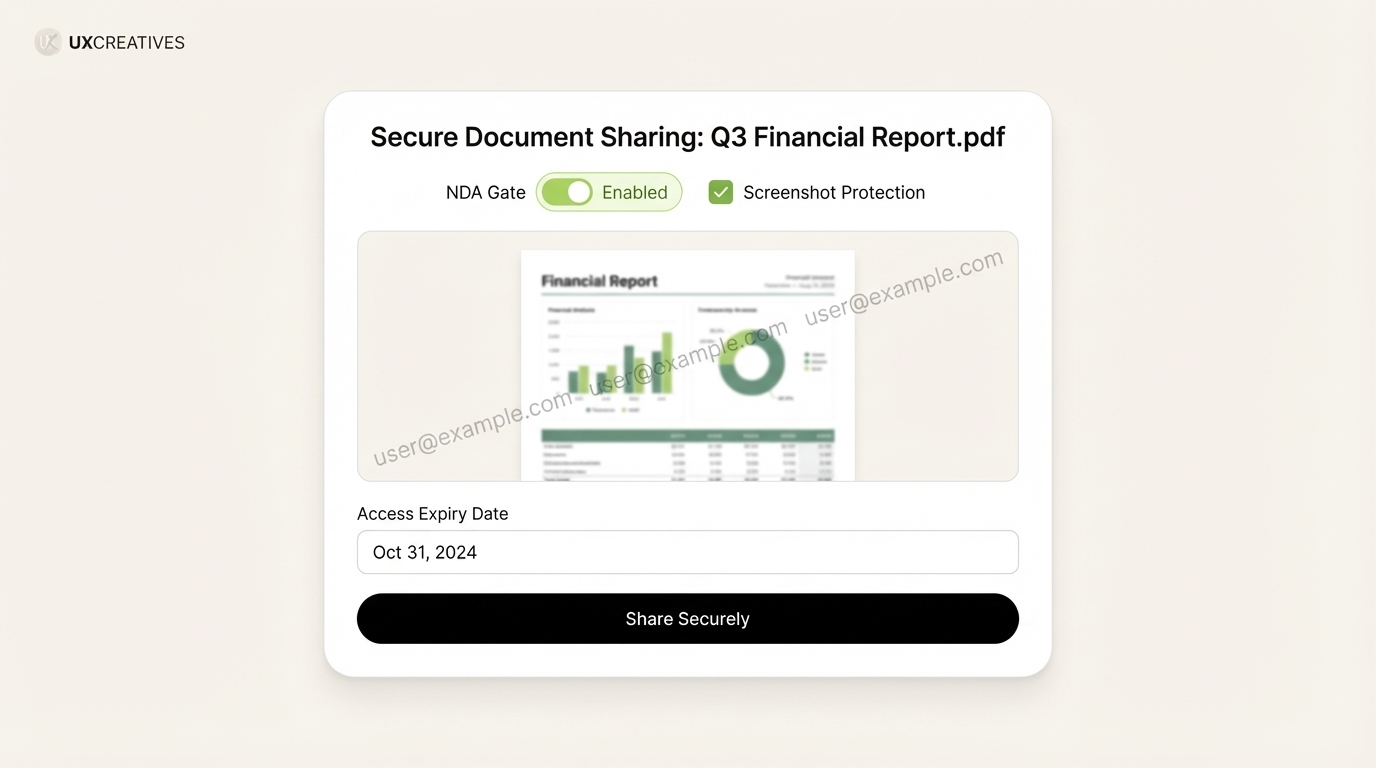
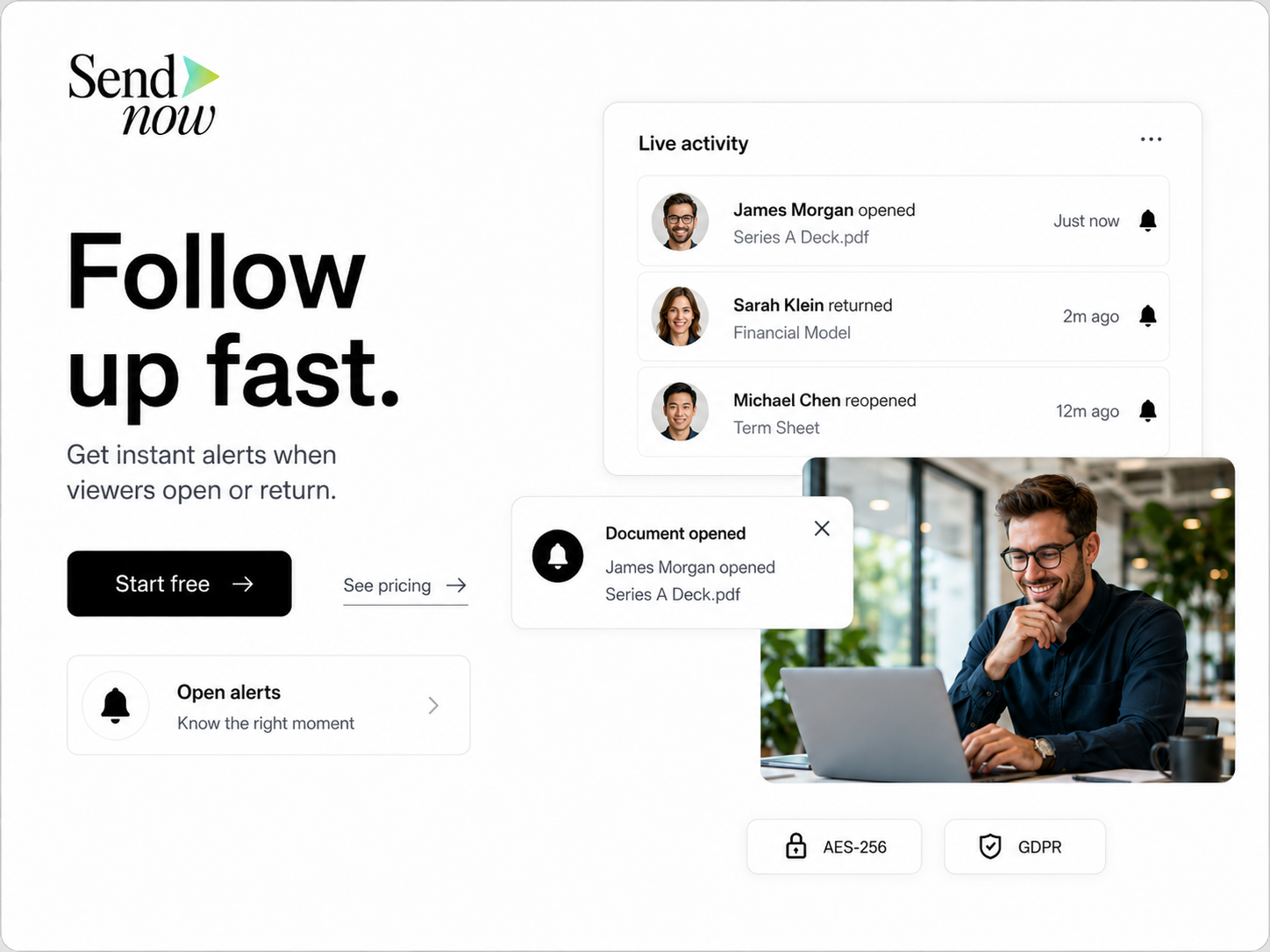
SendNow's document security panel lets you enable NDA gating, screenshot protection, and dynamic watermarking before sharing any sensitive financial document.
4. What Does Dynamic Watermarking Do for Financial Documents?
Dynamic watermarking adds a personalized, visible identifier to every page of a shared document — typically the viewer's email address, IP address, timestamp, or a combination of these — rendered directly over the content.
The practical effect is significant. If a watermarked document gets photographed, screenshotted, or printed and then leaked, you can trace the disclosure back to the specific individual who had access at that time. This deters unauthorized sharing far more effectively than a standard confidentiality footer at the bottom of an email.
Dynamic watermarks differ from static watermarks (which embed a fixed label like "CONFIDENTIAL" at document creation) because the watermark data changes per viewer. The document a VC partner opens shows their email address. The document their associate opens shows the associate's email address. Both documents look identical in every other way, but each carries a unique forensic identifier.
For finance professionals sharing sensitive materials with multiple counterparties — syndicated term sheets, fund performance letters, M&A pitch packages — dynamic watermarking is the most practical deterrence tool available short of full document rights management.
Combined with screenshot protection (which disables screen capture on supported browsers) and access expiry (which revokes access after a set date or number of views), dynamic watermarking closes most of the gaps that email attachments leave wide open.
5. What Is Secure Document Sharing?
Secure document sharing is a method of providing access to sensitive documents through a controlled link rather than an attachment, where the sender retains ongoing control over who can view the content, for how long, and under what conditions.
Instead of sending a file that the recipient downloads and owns permanently, you share a link that opens the document within a protected viewer. The document never leaves your custody — the viewer sees it, but the raw file stays on your platform.
PDCflow describes secure document sharing as essential for compliance, noting that "failing to protect customer information with secure document sharing practices can create compliance issues, damage your reputation, lead to customer loss, and result in financial penalties."
ElDoc frames it precisely: "Secure file sharing is no longer just an IT responsibility; it has become a fundamental business requirement."
The core capabilities of a proper secure document sharing platform include:
- Access controls — who can view, and for how long
- Viewer authentication — email verification or NDA signature before access
- Audit trail — a complete log of who opened what, and when
- Revocation — the ability to kill a link instantly, even after sharing
- Analytics — page-by-page view data showing exactly which sections the viewer read
- Watermarking — dynamic identifiers on every page
SendNow provides all of these controls in a single workflow designed for financial professionals. Every document you share through SendNow generates a protected link with full analytics, not a downloaded file you lose control over.
6. How Do You Ensure Compliance When Sharing Financial Documents?
Compliance requirements for financial document sharing vary by jurisdiction, document type, and the regulatory framework governing your firm. The baseline obligation across most frameworks is the same: demonstrate that you took reasonable steps to protect sensitive information.
Audit trails. Regulators and auditors increasingly expect documented evidence of who accessed sensitive financial information and when. A timestamped access log from your document sharing platform satisfies this requirement in ways that a forwarded email thread cannot.
Consent and NDA gating. For documents containing MNPI, requiring recipients to sign an NDA before access creates a clear legal record of their confidentiality obligation. GVW Law notes that "both the management of the target company as well as the selling shareholders" carry confidentiality obligations during due diligence, and a signed NDA at the point of access provides enforceable documentation.
Access expiry. Setting a document to expire after the transaction closes or a negotiation period ends limits the window of risk. A financial model you share during a fundraise does not need to be accessible to that VC eighteen months later.
Data residency. If your clients or counterparties are subject to GDPR or other data residency requirements, confirm that your document sharing platform stores data in compliant regions. This is especially relevant for cross-border M&A and European fund managers.
Encryption. Documents in transit and at rest should be encrypted to a minimum of AES-256 standard. ShareVault and Onehub both reference bank-level encryption as the appropriate standard for financial file sharing.
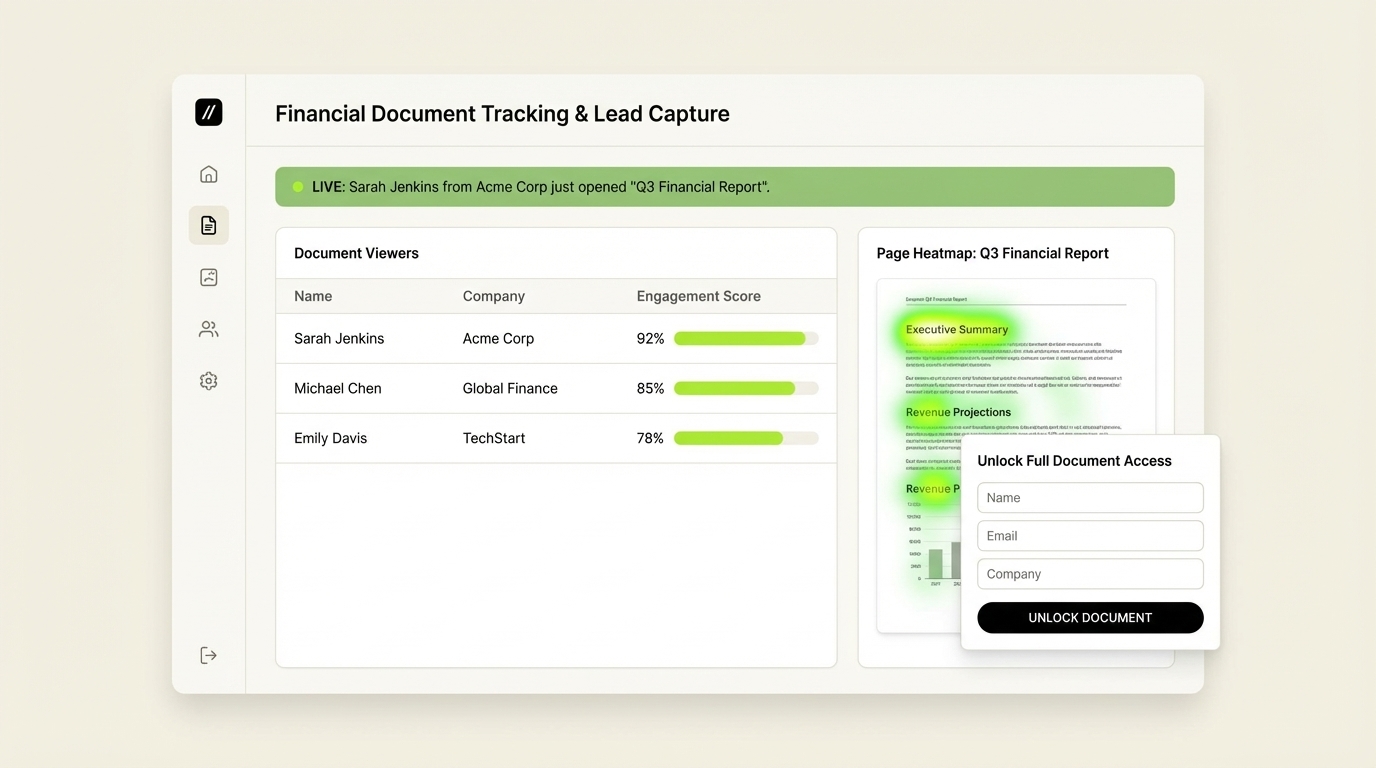
SendNow's viewer tracking dashboard shows exactly who opened your financial documents, which pages they read, and their AI engagement score — all in real time.
7. What Is the Best Alternative to Email for Financial Document Sharing?
The right tool depends on what you are sharing, with whom, and how much security you need. Here is how the leading options stack up for finance professionals.
Virtual Data Rooms (VDRs) such as iDeals and Datasite are built for large-scale M&A due diligence. They offer sophisticated permission structures and are appropriate for transactions involving hundreds of documents and dozens of counterparties. However, VDRs are expensive (often $400-$1,000+ per month for full access), complex to set up, and far more than most finance teams need for routine document sharing like investor updates, pitch decks, or term sheets.
DocSend was the dominant tool for tracked document sharing among VCs and startups for years. However, DocSend removed its free plan in March 2025, increasing the cost of entry significantly. It remains a capable platform for pitch deck tracking but lacks finance-specific features like built-in NDA gating and AI engagement scoring.
Digify offers strong security controls including expiry, watermarking, and access management. It is a solid choice for teams that prioritize security over sales-oriented features.
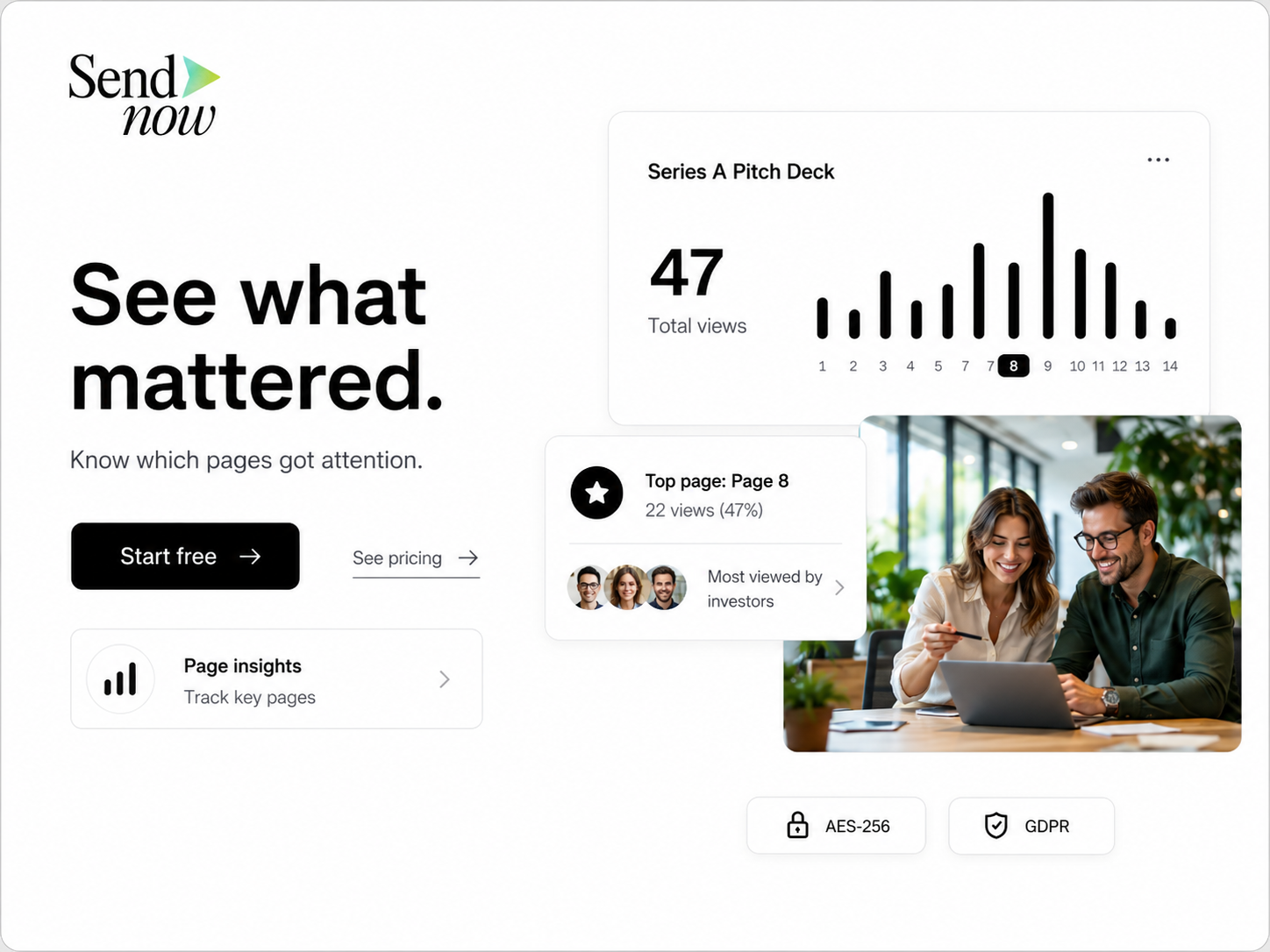
SendNow is built specifically for finance and sales teams that need the security of a VDR and the deal intelligence of a document analytics platform without enterprise pricing. Its features — page-by-page analytics, AI engagement scoring, NDA gating, screenshot protection, dynamic watermarks, branded deal rooms, custom domains, lead capture, and Slack integrations — are designed as a cohesive workflow for the moment of financial document exchange.
The real SendNow screenshot below shows the platform in action:

SendNow in production: real-time document engagement data showing page-by-page viewer activity and AI engagement scoring for a financial document.
Plans start from $9/month for the Pro plan with no credit card required for the free trial. For teams transitioning away from DocSend or from email-based document workflows, the pricing and feature set represent a direct upgrade.
The Standard Has Changed
Five years ago, sending a financial model as an email attachment was an accepted workflow. Today, it is an exposure — legal, competitive, and reputational.
The tools to replace that workflow are no longer expensive, complex, or inaccessible. A finance team of one can set up a properly controlled, analytics-equipped document sharing environment for less than a single business lunch.
The question is no longer whether secure document sharing is worth it. The question is how many more attachments you plan to send before you make the switch.
Protect Your Documents. Start Free Today.
SendNow gives financial professionals complete control over every document they share: NDA gating, dynamic watermarks, screenshot protection, page-by-page analytics, and real-time Slack alerts when a prospect opens your materials.
No credit card required. Free trial available now.
Start your free trial at sendnow.live
Keep Reading
About the Author: Rifana Hameem
Rifana is the founder of SendNow. She leads the team in building secure, compliant, and analytics-rich document sharing tools for finance and professional teams worldwide.
Connect on LinkedIn