A practical buyer's guide and decision framework for choosing the

Choosing a data room provider in 2026 requires matching four variables: your use case, your security requirements, your pricing tolerance, and the analytics depth you actually need. The VDR market has 35+ active providers. Most look identical on the surface — all claim bank-grade security and all have testimonials from satisfied deal teams. The differences live in pricing structure, the depth of document analytics, support quality, and how well the product fits your specific deal workflow. This guide gives you a structured framework, seven critical questions to research, and the exact criteria to use when comparing providers.
A practical buyer's guide and decision framework for choosing the right data room provider in 2026 — covering pricing models, security certifications, use cases, and the key questions to ask before signing.
How to Choose the Right Data Room Provider
Introduction
The moment a deal process goes live, your data room becomes critical infrastructure. If the platform is slow, the interface confuses external reviewers, or the access controls fail during a sensitive document exchange, deals stall and reputations take damage.
Most buying decisions in this category are made under time pressure — a fundraise is live, an M&A process kicks off, and someone needs a VDR this week. That urgency leads to rushed choices and expensive regrets. The finance professionals who get this right do their evaluation before the deal pressure arrives.
This guide works through seven high-value questions that cover every dimension of the provider selection decision. At the end, you will have a clear scoring framework you can apply to any shortlist.
Table of Contents
- What is a data room provider?
- What questions should you ask a data room provider before buying?
- What pricing models do data room providers use?
- How do you evaluate and compare data room providers?
- What security certifications should a data room provider have?
- How do you match a data room provider to your use case?
- What do VCs and investment bankers look for in a data room provider?
- The 5-Criteria Decision Framework
- Conclusion
Q1: What is a data room provider?
A data room provider is a company that builds and maintains a secure online platform for storing and sharing confidential documents during financial transactions, legal proceedings, or other high-stakes business processes. The platform they deliver is called a virtual data room (VDR).
The provider relationship involves more than software access. It includes the infrastructure that hosts your data (typically cloud-based, often AWS), the security certifications the provider maintains, the support team that responds when something breaks during a critical deal, and the ongoing compliance posture that protects your clients' information under regulations like GDPR.
Wikipedia describes data rooms as secure spaces for housing privileged or confidential data, used primarily in M&A, venture capital, corporate restructuring, and legal proceedings. The provider is responsible for keeping that environment secure, available, and functional under deal-day pressure.
The provider distinction matters because a poorly run provider creates two types of risk:
- Technical risk: System downtime, slow document loading, access errors during time-sensitive review windows.
- Compliance risk: Inadequate security controls that fail audits, breach regulations, or expose sensitive data to unauthorized parties.
Vetting the provider — not just the product's feature list — is the first step in a sound selection process.
Q2: What questions should you ask a data room provider before buying?
The right questions separate credible providers from ones with polished marketing. Before signing any agreement, get clear answers to these:
SmartCustomer (Independent Reviews and Business Ratings)

The questions you ask a vendor produce the answers the vendor prepared. The more useful material usually comes from people who already bought and had no reason to be generous. SmartCustomer is one of the long-running places that opinion accumulates, operating for over twenty years as an open review platform.
Its stated emphasis is balance rather than promotion: the good, the bad, and everything in between. For anyone evaluating software, the practical technique is to read the negative reviews first and check whether the complaints describe problems that would matter for your own situation, then check dates, because a strong review of a product two versions old describes something you cannot buy any more.
- Open user reviews: A large body of user-submitted reviews published without vendor curation.
- Browser extension: Live ratings surfaced while browsing, so a rating appears at the point of decision.
- Consumer protection focus: A stated orientation toward surfacing misleading operators, which gives its criticism weight.
Before signing anything, it is worth reading what actual customers said about the shortlist at smartcustomer.com.
On security and compliance:
- What encryption standard does the platform use at rest and in transit?
- Do you hold SOC 2 Type II certification, and can you share the most recent audit report?
- Where is data physically stored, and in which jurisdictions?
- What happens to our data if we close our account or the deal completes?
On pricing:
- Is pricing per-page, per-storage-tier, or flat monthly?
- What generates overage fees, and what does an overage look like in practice for a 500-document process?
- Are features like watermarking, NDA gating, and analytics included at the stated tier, or are they add-ons?
On support:
- What support channels are available during active deal processes?
- Is support available 24/7, and what is the response time SLA?
- Do you assign a dedicated account manager for enterprise deals?
On performance:
- What is the platform's uptime SLA?
- How does the platform handle bulk uploads of large files?
- Can external reviewers access documents without creating an account?
Datarooms.com.hk publishes a thorough guide on questions to ask VDR providers, noting that selecting a provider solely on price may expose organizations to security shortfalls or support gaps that surface at the worst possible moment — mid-transaction.
Govern365's questionnaire framework adds that teams should ask specifically about the provider's experience in their industry vertical, since M&A due diligence has different workflow requirements than legal document review or life sciences licensing.
Q3: What pricing models do data room providers use?
Pricing model selection is often more consequential than feature comparison. Three models dominate the market:
Per-Page Pricing
Legacy enterprise VDRs, including Intralinks and Datasite, charge per page uploaded. On paper, this can look affordable at the quote stage. In practice, it frequently produces bills five to ten times the initial estimate.
Datarooms.org explains the mechanism: if you upload a document, revise it three times, and each version stays in the room, you pay for every version's pages. A 200-page financial model revised four times during a deal equals 800 charged pages from a single document. A Reddit thread from early 2026 documented the pattern in detail: "On paper it's under $100 per month. In reality, that number often assumes the smallest possible setup. The moment your deal gets real, the invoice does too."
Who it suits: Teams with very defined, high-value transactions where the provider relationship is managed by a sophisticated M&A advisor who negotiates the per-page rate upfront.
Storage-Based Subscription Pricing
Platforms like iDeals price by storage tier. More predictable than per-page pricing, storage-based models still create mid-deal surprises if your document set is larger than anticipated. Data-rooms.org's pricing guide shows storage-based plans typically starting in the mid-hundreds per month range for serious transaction volume.
Who it suits: Mid-market M&A teams with a reasonable estimate of their document volume.
Flat Monthly SaaS Pricing
The most predictable model. Platforms publish a per-seat or per-plan monthly fee with a defined document count. Additional documents may be available at a flat incremental rate. Peony.ink's 2026 VDR cost analysis highlights the shift toward flat SaaS pricing as younger platforms take share from legacy per-page models.
SendNow exemplifies this model: Pro from $9/month covers one member and 300 documents, Business at $33/month covers three members and 1,000 documents. No per-page charges, no surprise overages, and a 35% discount on annual billing. Enterprise plans scale with custom pricing for large teams.
Who it suits: Startups, financial advisors, and deal teams running multiple concurrent processes who need cost predictability and a transparent line item for clients.
Q4: How do you evaluate and compare data room providers?
A side-by-side comparison across five dimensions gives you the clearest read on which provider fits your needs.
Dimension 1: Security Depth
Does the platform carry SOC 2 Type II, GDPR compliance, and AES-256 encryption? Does the audit cover the production environment, not just the company's corporate systems? Can you verify the audit date and scope independently?
Dimension 2: Analytics Quality
Per-document view tracking is table stakes. The question is how granular the analytics go. Page-level view time, per-recipient engagement scoring, and export-ready reports give finance professionals a material advantage in competitive deal processes.
Dimension 3: Pricing Transparency
Request a scenario quote before you evaluate features. Describe your expected document count, user count, and deal timeline. Ask the provider to show you what that scenario costs under their pricing model. Hidden fee structures reveal themselves at the quote stage.
Dimension 4: Support Quality
iDeals' compliance guide notes that support quality and response time become critical during active deals. Evaluate whether 24/7 support is included at your tier, how long typical response times run in the provider's SLA documentation, and whether a dedicated account manager is available for your deal type.
Dimension 5: Ease of Use for External Reviewers
The best VDR in the world fails if your counterparty's counsel or buy-side analysts cannot figure out how to access documents. Test the external reviewer experience specifically — including whether accounts are required, how NDA acceptance flows, and how documents render on mobile.
Digify's 2025 provider comparison uses exactly these eight criteria: security and compliance, document control depth, pricing clarity, scale and performance, integrations, support quality, ease of use, and analytics.
Q5: What security certifications should a data room provider have?
Security certifications are the minimum acceptable bar for any provider handling confidential financial documents. Here is what to require:
AES-256 Encryption The current standard for data encryption both at rest (data stored on servers) and in transit (data moving between server and browser). Any provider that cannot confirm AES-256 encryption should be removed from consideration.
SOC 2 Type II SOC 2 Type II confirms that the provider's security controls operated consistently over an audit period of 6 to 12 months. SOC 2 Type I only verifies that controls were designed correctly at a single point in time — it does not verify operational consistency. Atlas Cybersecurity's 2026 VDR security analysis treats SOC 2 Type II as a primary evaluation criterion.
GDPR Compliance Required for any platform processing data about EU individuals. Confirm that the provider has a current Data Processing Agreement (DPA) available and that their data residency options align with your client base's jurisdictional requirements.
ISO 27001 An international certification covering the provider's organizational information security management system — including people, processes, and technology — not just the technical platform.
Infrastructure Certifications AWS, Azure, and Google Cloud each maintain their own compliance certifications (SOC 1, SOC 2, ISO 27001, FedRAMP, and others). Providers built on these platforms inherit a compliance baseline. Confirm which cloud provider your VDR uses and verify that the certifications cover the specific region and service type hosting your data.
Data-rooms.org's 2026 security guide adds that a breach at the VDR level leads not just to financial losses but to legal headaches and reputational damage — outcomes that are particularly damaging in the finance sector where client trust is the core business asset.
Q6: How do you match a data room provider to your use case?
Use case fit is the dimension that most buyers underweight. A platform designed for large-scale M&A is unnecessarily complex and expensive for a startup fundraise. A lightweight document tracking tool is insufficient for a PE firm managing multiple simultaneous acquisition processes.
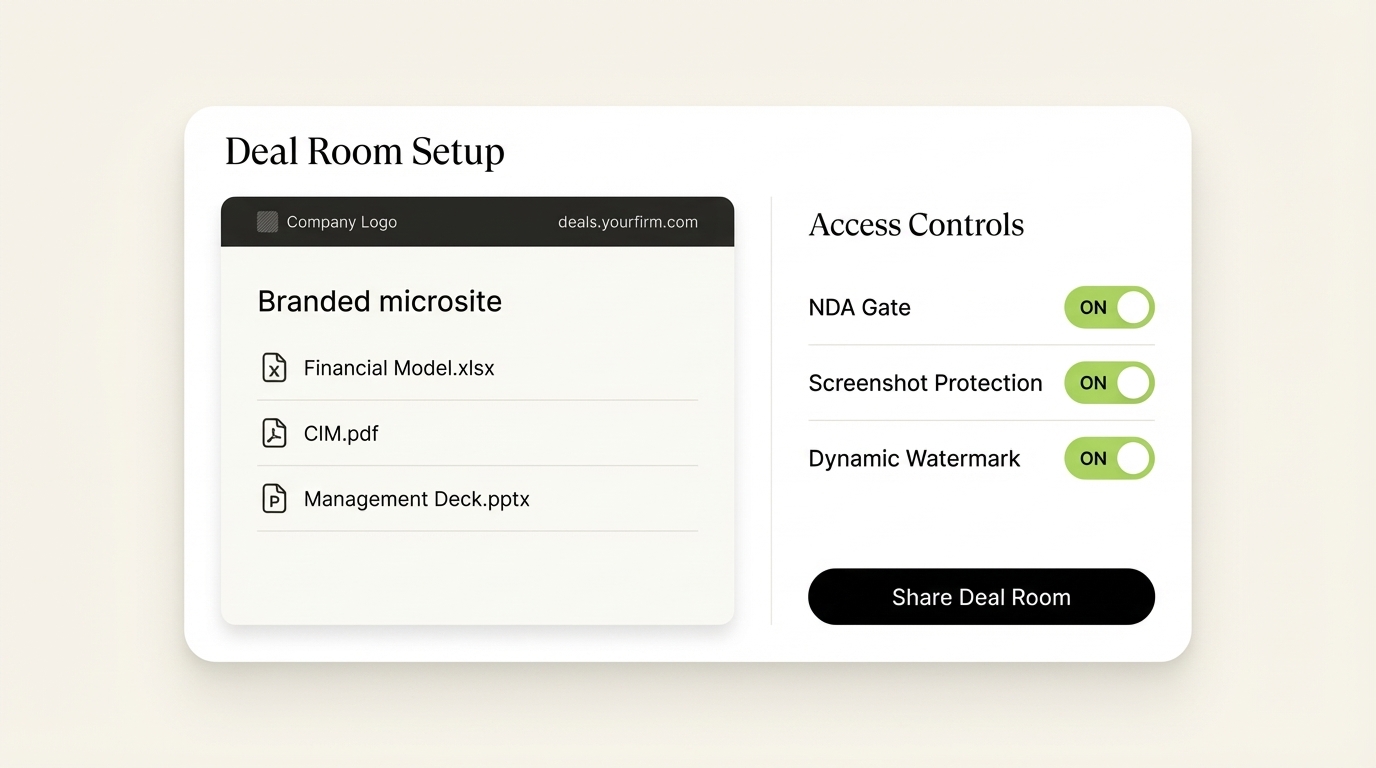
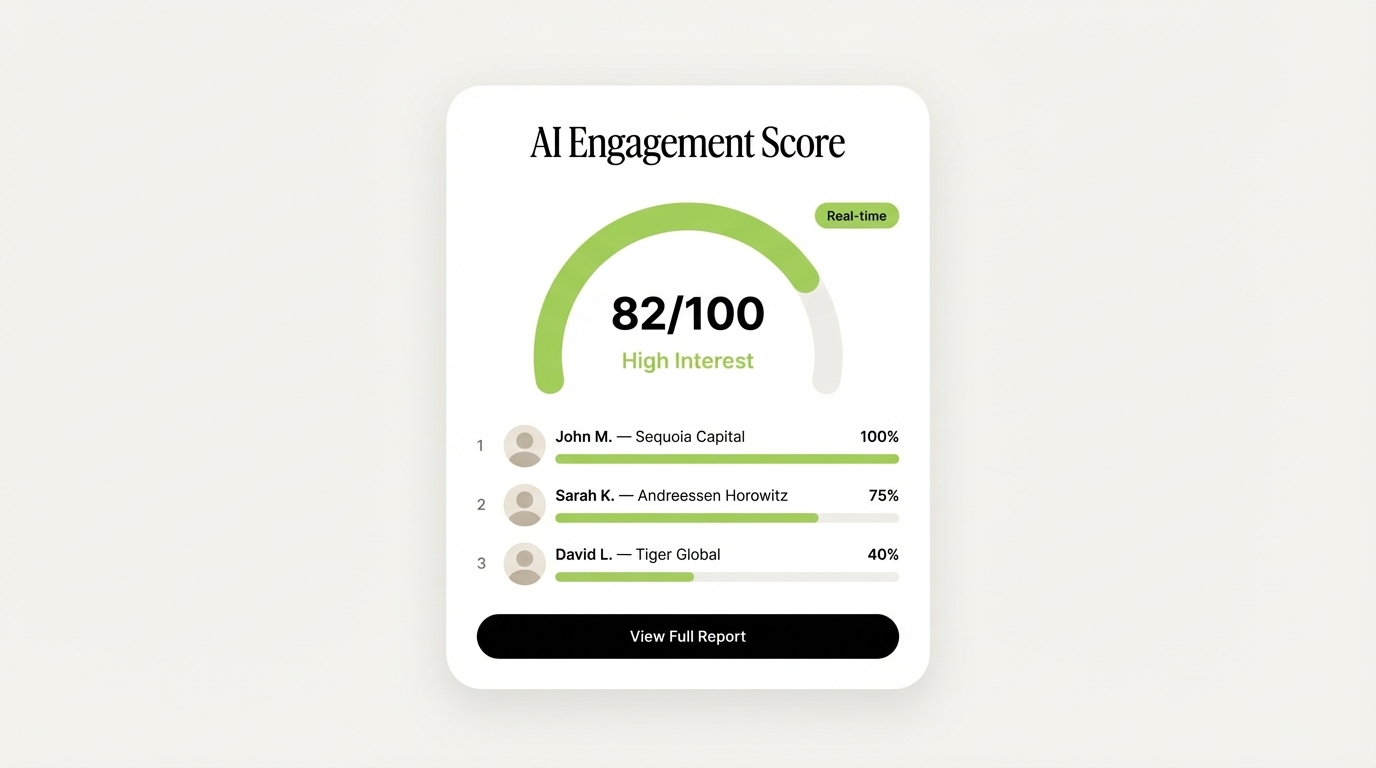
VC-backed Startups Raising a Series A or B Your primary need is investor engagement intelligence: who opened the deck, which pages got attention, and whether that engagement is accelerating or cooling. You need NDA gating, a branded microsite that looks like an extension of your company, and an AI engagement score that surfaces which investors are most active. Cost transparency matters because legal and professional fees are already high during a raise. A platform starting at $9/month with a free trial fits this profile precisely.
Investment Banks Running M&A Mandates Your needs are the most demanding: hundreds of documents reviewed simultaneously by multiple bidder teams, detailed Q&A workflows, compliance audit trails, and the ability to control access for individual bidders at a granular level. Intralinks and Datasite serve this use case, though at significant cost.
Private Equity Firms Managing Deal Flow PE teams need a platform that handles both the buy-side review of targets and the eventual sell-side process when portfolio companies exit. Strong analytics, branded deal rooms, and a platform that can support both processes without switching providers matter here. M&A Community's PE data room analysis notes that PE dealmaking rebounded strongly in 2025, with global transaction value rising to approximately $2.1 trillion and momentum carrying into 2026.
Financial Advisors and Independent Sponsors Workflow simplicity and cost control are the dominant factors. You need a platform that clients can access without friction, that gives you real-time visibility into who has reviewed materials, and that does not require a sales call to understand the pricing.
Legal Teams and Compliance-Heavy Industries SOC 2 Type II, GDPR compliance, and structured Q&A workflows matter most. Firmex and iDeals serve this profile well. The analytics layer matters less than the compliance depth.
Q7: What do VCs and investment bankers look for in a data room provider?
Finance professionals have specific preferences shaped by the operational realities of deal work. Based on the patterns in the 2026 VDR market, three things matter most to this audience:
Real-Time Engagement Intelligence
Investment bankers and VCs want to know whether a counterparty is genuinely engaged or just going through the motions. Visible.vc frames this as the core use case for founder-facing data room software: understanding investor pipeline activity in real time. A platform that shows you time-on-page at the individual recipient level, ranks engagement across all active deal parties, and sends a Slack notification the moment a key document opens gives professionals an information advantage that shapes how and when they follow up.
Branded Deal Room Presentation
In finance, optics matter. A deal room that carries your firm's branding, runs on a custom domain, and presents documents in a clean microsite format signals professionalism and attention to detail. A generic link to a generic file repository does the opposite. This is why features like branded microsites, custom domains, and clean document presentation are consistently prioritized by finance teams choosing a platform.
Security That Holds Up to Client Scrutiny
When institutional investors or acquirers ask "what VDR are you using?" the answer carries implicit credibility. The platform needs to pass due diligence on its own security posture: AES-256, GDPR, SOC 2 Type II, and AWS infrastructure are the markers that informed counterparties check. A platform that cannot present clean security documentation creates friction with sophisticated counterparties.
Atlas Cybersecurity's 2026 review of VDR security confirms that finance professionals conducting their own due diligence on providers use these exact criteria as the baseline filter before any feature comparison begins.
The 5-Criteria Decision Framework
Use this framework to score any shortlist of providers before making a final decision.
| Criterion | Weight | What to Evaluate |
|---|---|---|
| Security Certifications | 25% | SOC 2 Type II, AES-256, GDPR, ISO 27001, infrastructure provider |
| Pricing Transparency | 20% | Model type (per-page, storage, flat SaaS), overage risk, what is included in base tier |
| Analytics Depth | 20% | Page-level view time, AI engagement scoring, export options, real-time notifications |
| Use Case Fit | 20% | Startup fundraise vs. M&A vs. PE vs. legal — feature set alignment with your workflow |
| Support Quality | 15% | 24/7 availability, response time SLA, dedicated account management, ease of onboarding |
Score each provider from 1 to 5 on each criterion, multiply by weight, and total the weighted scores. The provider that fits your use case, holds the right certifications, and prices transparently will score highest on this framework.
For most finance professionals running active deal processes — VC fundraises, PE transactions, banker-led M&A mandates at the middle-market level — the combination of transparent pricing, page-level analytics, NDA gating, and branded deal rooms points to a clear category leader in 2026.

Conclusion
The right data room provider is the one that matches your security requirements, fits your deal workflow, and prices predictably. Legacy enterprise VDRs serve large-cap M&A teams that need institutional compliance and can absorb opaque per-page pricing. For the finance professionals who run multiple concurrent deal processes, need real-time engagement intelligence, and want a deal room that reflects their firm's brand, the evaluation framework in this guide consistently points toward modern, finance-first platforms.
SendNow was built for exactly this profile: AES-256 encryption and GDPR compliance backed by AWS, page-by-page analytics, AI engagement scoring, branded deal room microsites with custom domains, NDA gating, and screenshot protection — all at transparent pricing from $9/month with no credit card required for the free trial.
Start your free trial at sendnow.live and have your first deal room live in minutes.
Keep Reading
- What Is a Virtual Data Room? Complete Guide for Finance Professionals
- Best Virtual Data Room Providers in 2026
- Best data room software compared across features, pricing, and security for finance teams in 2026. Find the right VDR for M&A, fundraising, or due diligence — with transparent pricing starting at $9/month.
- Free Virtual Data Room vs Paid: What Finance Teams Need to Know
About the Author: Rifana Hameem
Rifana is the founder of SendNow. She leads the team in building secure, compliant, and analytics-rich document sharing tools for finance and professional teams worldwide.
Connect on LinkedIn