
From Pitch Deck to Investor Data Room: The Complete Fundraising

From Pitch Deck to Investor Data Room: The Complete Fundraising Document Workflow
Founders often think about the pitch deck and the data room as separate tools.
I think they are better understood as two stages of the same workflow.
The deck creates interest.
The data room supports conviction.
Stage 1 — Pitch deck
The first job is clarity.
Share:
- problem,
- solution,
- market,
- traction,
- team,
- business model,
- fundraising ask.
Keep the experience low friction.
Stage 2 — Engagement
Track the deck if doing so helps prioritize follow-up.
Useful signals include:
- opens,
- viewer identity,
- page engagement,
- return visits.

Again, these signals do not prove investor intent.
Stage 3 — First supporting documents
A serious investor may ask for:
- KPI data,
- financial model,
- customer metrics,
- market material.
Do not immediately expose every legal document.
Stage 4 — Investor data room
Once diligence begins, move the process into an organized multi-file environment.
A typical room might include:
Fundraising
- current deck,
- round structure,
- use of funds.
Financials
- model,
- historicals,
- runway.
Corporate
- incorporation,
- cap table.
Commercial
- customer metrics,
- key agreements.
Legal/IP
- material contracts,
- assignments,
- registrations.
Stage 5 — Permission management
Not every investor needs identical access.
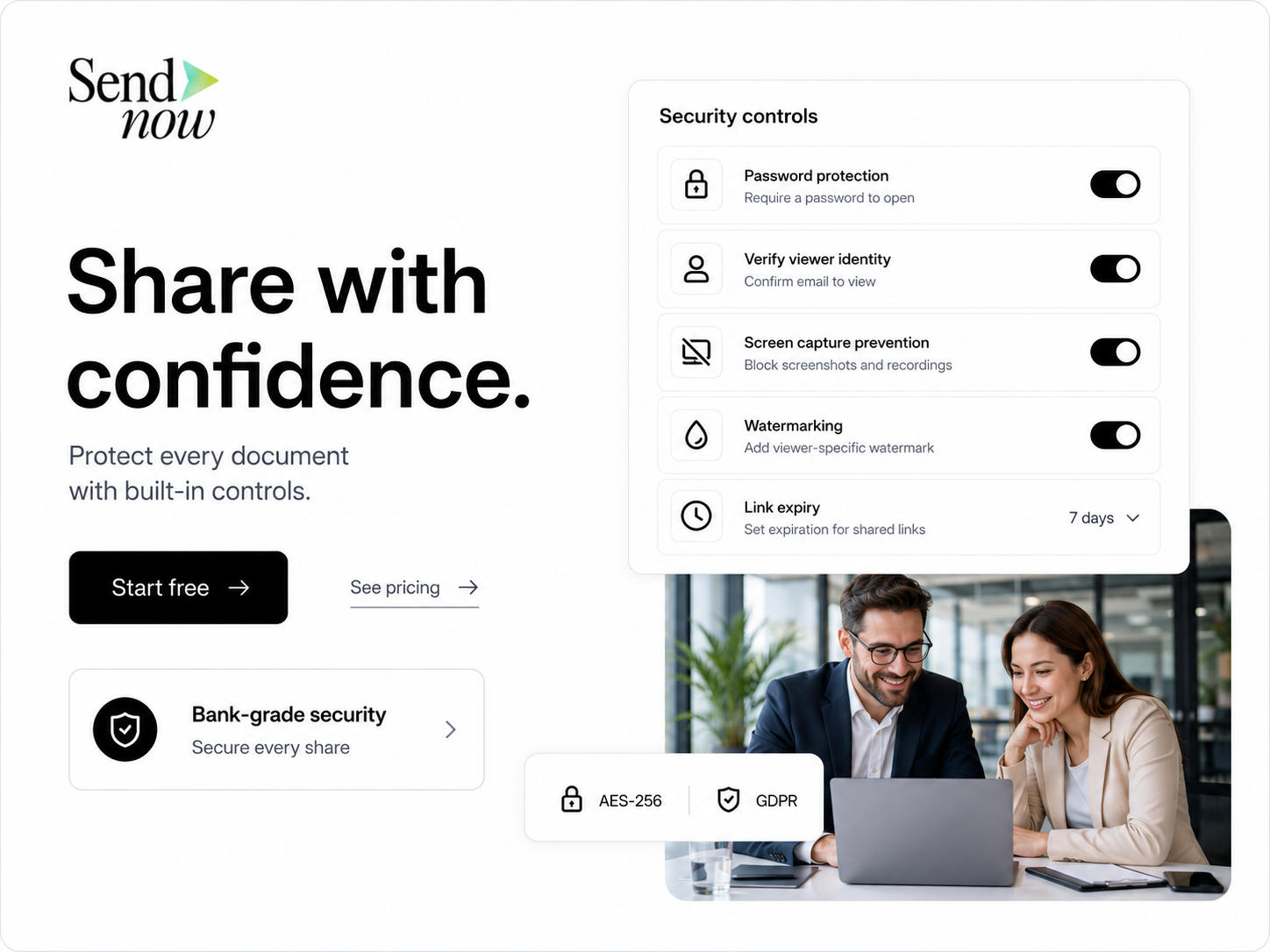
Use staged permissions and stronger controls as the sensitivity increases.
Why one connected workflow matters
The founder should not have to rebuild the sharing process every time investor interest increases.
A product that supports both a single tracked document and a multi-file Microsite can create a natural progression:
pitch deck → engagement → supporting documents → investor room.
That is the workflow SendNow is increasingly built around.
FAQ
Should the pitch deck be inside the data room?
Yes, once the room becomes the investor's primary resource.
When should I share the cap table?
Usually after meaningful investor interest rather than during cold outreach.
Do I need an NDA?
It depends on the information and transaction. Many VCs will not sign an NDA simply to view an initial pitch deck.
What should I track?
Use engagement signals to improve prioritization, not as a substitute for investor communication.
Should I create separate rooms for each investor?
Only if your permission or workflow needs justify it. Per-viewer links and document permissions may be enough.
Sources
- DocSend startup fundraising guidance and pitch-deck engagement resources
- Dropbox DocSend data-room analytics documentation
- Papermark fundraising and due-diligence data-room guides
- Microsoft PowerPoint web-sharing documentation
Conclusion
The pitch deck is not the end of the fundraising document process.
It is the first layer.
The strongest workflow makes it easy to start with one presentation and expand into a controlled investor room only when the conversation earns that level of detail.
About the Author: Rifana Hameem
Rifana is the founder of SendNow. She leads the team in building secure, compliant, and analytics-rich document sharing tools for finance and professional teams worldwide.
Connect on LinkedIn