
Private Equity Deal Room Best Practices for 2026

- A PE deal room organizes all deal-critical documents in a single secure, permissioned, and analytics-enabled environment for authorized parties.
- Due diligence in private equity typically runs 45 to 90 days; poor deal room organization extends timelines by weeks and introduces re-trade risk.
- Best-practice deal rooms use a standardized folder taxonomy, NDA-gated entry, dynamic watermarks, and page-level analytics from day one.
- AI engagement scoring tells PE deal teams which investors are reading which sections — and precisely when to follow up.
- The global VDR market is valued at $3.68 billion in 2026 and is growing at a 10.17% CAGR through 2031.
Private Equity Deal Room Best Practices for 2026
A well-structured private equity deal room cuts due diligence timelines, builds investor confidence, and protects sensitive financial data from the moment a deal goes live. This guide covers seven essential questions PE deal teams face when building, managing, and securing deal rooms in 2026.
Introduction
Private equity deal teams operate in compressed timelines with significant information asymmetry. A sell-side advisor packages a company for sale. Buyers submit IOIs, enter NDAs, and begin due diligence. At every stage, the quality of the deal room directly affects deal velocity, buyer confidence, and final valuation.
A poorly organized deal room creates friction: buyers request documents that should already be available, sellers scramble to fill gaps, and timelines slip. A well-built deal room signals operational maturity to potential acquirers, reduces back-and-forth requests, and — through analytics — gives the sell-side team a real-time read on where every buyer stands.
This guide covers what every PE deal room needs in 2026: from folder structure and security standards to the analytics capabilities that separate modern platforms from legacy VDRs.
Q1: What Is a Private Equity Deal Room?
A private equity deal room — also called a virtual deal room or VDR — is a secure, cloud-based repository where deal-critical documents are stored, organized, and shared with authorized parties during an M&A or investment transaction.
Unlike general cloud storage, a PE deal room includes:
- Granular permission controls by user, group, or individual document
- Full audit trails capturing every view, download, and access attempt
- NDA gating at the entry point
- Document analytics showing how each buyer engages with specific materials
- Branded presentation of the deal, building professional trust with counterparties

According to Carta, the due diligence process in private equity examines financial performance, operational metrics, legal compliance, and market position — all of which require organized, accessible documentation that authorized parties can review quickly and securely.
The global VDR market is valued at $3.68 billion in 2026 according to Mordor Intelligence, growing at a 10.17% CAGR through 2031 — a direct reflection of how central deal rooms have become to transaction infrastructure.
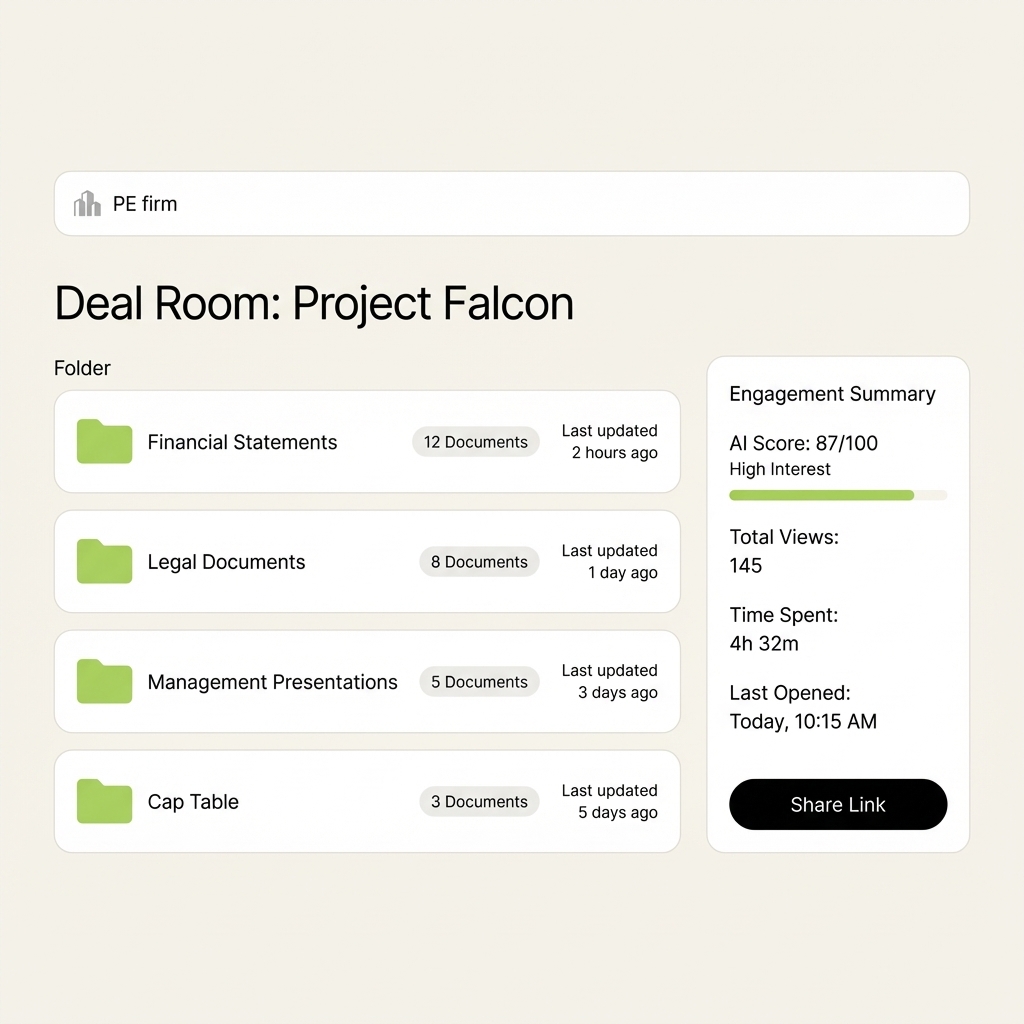
A SendNow branded deal room for a PE transaction: organized folder structure, real-time engagement summary, and a shareable branded link — configured in minutes.
Q2: What Documents Belong in a PE Deal Room?
A standard PE deal room covers five core categories. The specific documents vary based on whether you are on the buy side (requesting materials) or the sell side (providing them), but the taxonomy is consistent across deal types.
1. Corporate and Legal Documents
- Certificate of incorporation and articles of association
- Shareholder agreements and current cap table
- Board minutes and resolutions (last three years minimum)
- Material contracts, customer agreements, and live NDAs
- Regulatory licenses and permits relevant to the business
2. Financial Information
- Audited financial statements (three to five years)
- Management accounts (year-to-date and last twelve months)
- Financial model with documented key assumptions
- Debt schedules, banking covenants, and existing facility agreements
- Revenue breakdown by customer, product line, and geography
3. Commercial Materials
- Confidential Information Memorandum (CIM)
- Management presentation deck
- Competitive positioning analysis
- Customer concentration analysis
- Pipeline and backlog data
4. People and Organization
- Organizational chart with reporting structure
- Key employee contracts and equity arrangements
- Benefits and pension obligations summary
- Any pending HR disputes or employment litigation
5. IP, Technology, and Operations
- IP ownership documentation and active registrations
- Material technology agreements (SaaS contracts, infrastructure)
- Cybersecurity policies and any prior incidents
- Key vendor contracts and supply chain risks
According to NMS Consulting's PE due diligence checklist, the purpose of a due diligence document set is not to dump every document the company owns. It is to prove or disprove the investment thesis and surface the key value levers and risks a buyer needs to price the deal appropriately.
According to Affinity's PE due diligence guide, as deal volume rebounds from its 2023 low, competition for quality deals is intensifying. A sell-side team that lets buyers move quickly through a complete, well-organized deal room has a genuine competitive advantage over one that fields document requests throughout the process.
Q3: How Long Does Private Equity Due Diligence Typically Take?
PE due diligence typically runs 45 to 90 days from LOI execution to deal close, though complex cross-border transactions or deals in heavily regulated industries (healthcare, financial services) regularly extend to 120 days or more.
According to datarooms.org, the single biggest source of delay in due diligence is document availability. Buyers submit requests; sellers scramble. Every day the deal room sits incomplete is a day the deal can fall apart through buyer fatigue or competing bids.
Software Equity Group frames best-in-class due diligence as confirmatory rather than exploratory — buyers should validate what they already believe from the management presentation, not uncover surprises. This means the deal room must be complete and organized before any LOI is signed, not assembled in response to buyer requests.
Three practices consistently reduce due diligence timelines:
- Pre-populate the deal room before going to market. Every document a buyer is likely to request should be organized and accessible when the first NDA is executed.
- Use a structured Q&A workflow. Modern platforms allow buyers to submit document requests directly within the deal room environment, keeping all communications trackable and organized in one audit trail.
- Monitor engagement analytics daily. Knowing which buyers are active in the deal room — and which sections they are reading — lets sell-side teams prioritize responsive parties and identify at-risk buyers before they go quiet.
Q4: How Should a PE Deal Room Be Organized for Maximum Efficiency?
The standard folder taxonomy for a PE deal room follows a top-down structure: deal identity at the top level, functional categories at the second level, and individual documents at the third.
Recommended folder structure:
Keep Reading
- A complete guide to private equity due diligence: the five types PE investors run, what they examine in financials and operations, red flags that kill deals, and how to prepare your company for a successful transaction.
- Best Deal Room Software for Investment Bankers in 2026
- Virtual Data Room vs Deal Room: Key Differences Explained
- How to Build a Deal Room That Actually Closes Deals
About the Author: Rifana Hameem
Rifana is the founder of SendNow. She leads the team in building secure, compliant, and analytics-rich document sharing tools for finance and professional teams worldwide.
Connect on LinkedIn