
How to Build a High-Security VC Investment Deal Room in Minutes

How to Build a High-Security VC Investment Deal Room in Minutes
A vc deal room allows venture capital firms and startups to securely share sensitive investment documents like cap tables, financial models, and term sheets. By leveraging a modern virtual data room, teams can configure NDA gating, dynamic watermarking, and screenshot blocking to protect intellectual property and close transactions faster. Setting up a high-security deal portal takes just minutes and provides complete visibility into investor engagement.
The Stakes of Modern Venture Capital Diligence
Venture capital transactions move at high speed, but they involve some of the most sensitive financial and strategic documents a company will ever produce. From early-stage seed rounds to late-stage Series C growth investments, the diligence process requires sharing proprietary source code, detailed customer lists, employee salaries, cap tables, and tax history.
Sharing these files via standard email attachments or generic cloud storage folders (like Google Drive or consumer Dropbox) is a recipe for data leaks. Once an attachment is sent, you lose control over it. It can be forwarded to competitors, downloaded onto insecure personal devices, or printed without authorization. Furthermore, you have no way of knowing whether a prospective investor has actually read your materials or merely skimmed them.
To mitigate these risks, modern investment teams utilize a dedicated vc deal room. A secure, branded deal portal ensures that all transaction materials remain protected under bank-grade security protocols, while giving the deal team real-time visibility into investor engagement. This guide outlines how to build a high-security venture capital deal room in minutes, ensuring a smooth, secure, and rapid fundraising or investment process.
What is a VC Deal Room?
A VC deal room (or virtual data room for venture capital) is a secure online repository designed to store, manage, and share confidential documents during the due diligence phase of an investment transaction. It serves as a central hub where founders, venture partners, investment analysts, legal counsel, and accountants can collaborate under strict security controls.
Unlike generic file-sharing platforms, a specialized venture capital deal portal offers an advanced governance layer. It allows you to:
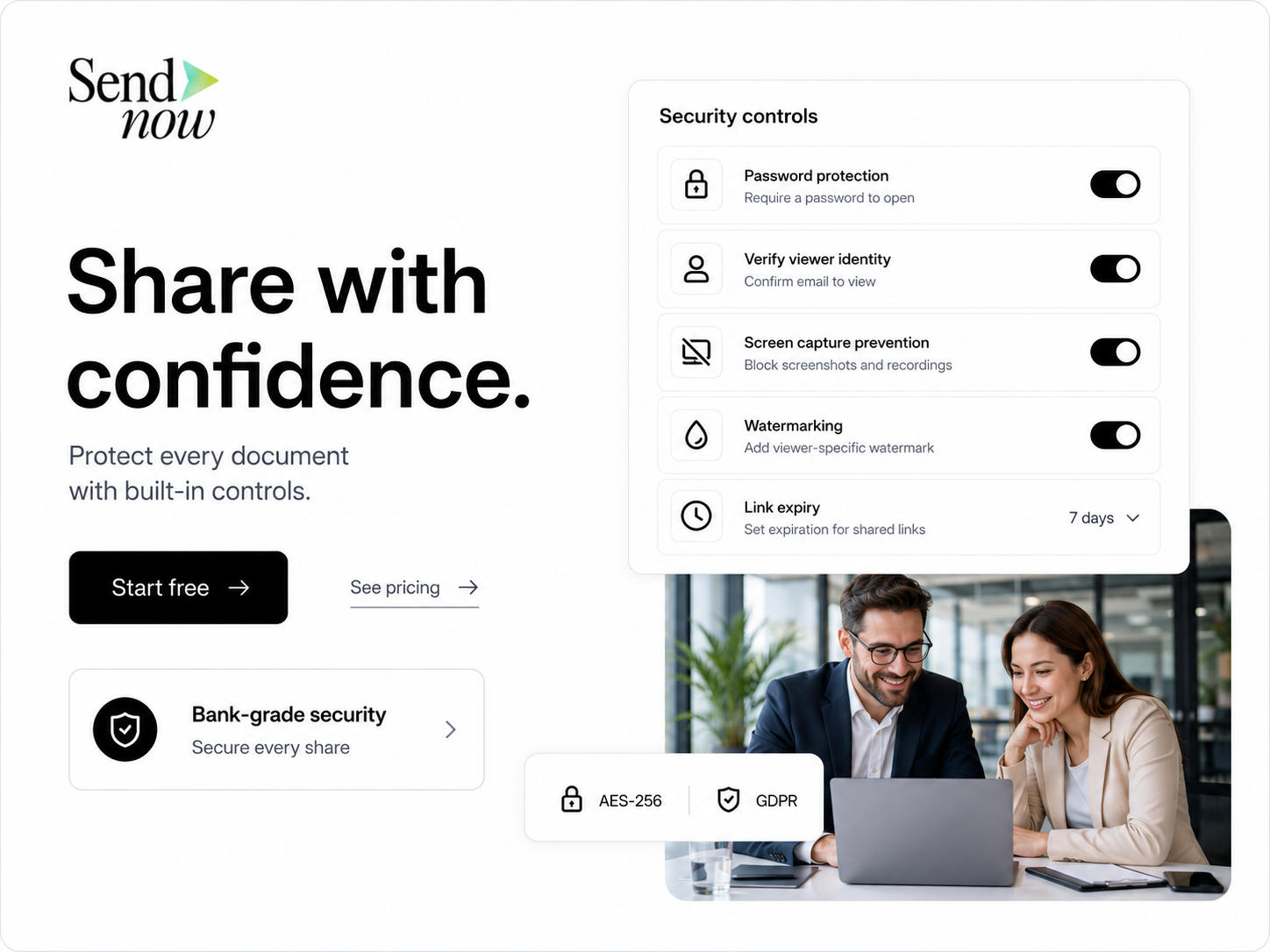
- Enforce legally binding Non-Disclosure Agreements (NDAs) before files can be viewed.
- Trace the source of any leak using personalized, dynamic watermarks.
- Disable downloads and print capabilities, forcing view-only access.
- Prevent screenshot capture on web and mobile browsers.
- Generate page-by-page analytics showing how long an investor spent on your financial model or IP documentation.
By centralizing and protecting these assets, you build trust with your counterparties, demonstrate professional maturity, and significantly reduce the time required to close transactions.
Core Security Pillars of a VC Investment Deal Room
Before uploading documents, you must understand the security mechanisms that shield your intellectual property. A robust deal room rests on five primary security pillars.
1. AES-256 Encryption at Rest and in Transit
Encryption is the baseline of digital security. Any document uploaded to your deal room must be encrypted using the Advanced Encryption Standard (AES) with a 256-bit key length. This is the same cryptographic standard utilized by financial institutions and military organizations. Data must be encrypted while stored on the server (at rest) and while traveling across the internet between the server and the viewer's browser (in transit, secured by SSL/TLS protocols).
2. Granular Access Permissions
Not all deal participants require access to all documents. For instance, an external tax advisor needs access to tax returns and historical audits, but does not need to see technical IP source code or employee performance reviews. A secure VC deal room allows administrators to grant specific permissions down to the individual document and user level. You can restrict access to:
- View-only: The user can view the document in a secure web viewer but cannot download, copy text, or print.
- Downloadable: The user can download the original file to their local machine.
- Time-limited: Access expires automatically after a specified date or duration.
3. Dynamic Watermarking
If a document is downloaded or viewed, there is always a risk that a recipient could photograph their screen or share the document. Dynamic watermarking deters this behavior. The system overlays the viewer's email address, IP address, and the exact timestamp of their access onto each page of the PDF or document. If a document leaks, you can instantly trace it back to the specific recipient who allowed the leak.
4. Screenshot Protection
Screen capture blocking (or screenshot protection) prevents users from using native print-screen options, snippet tools, or browser-based extensions to capture sensitive document pages. While no software can prevent someone from taking a physical photo of a screen with a smartphone, screenshot blocking stops the quick, high-resolution duplication of proprietary data.
5. NDA Gating
Manual NDA signing is a major bottleneck in venture deals. Lawyers must draft the agreement, send it via email, wait for a signature on an external signature platform, manually verify the signature, and then send the document link. NDA gating automates this entire cycle. When an investor clicks your deal room link, they are presented with a customizable NDA. They must check a box, enter their details, and digitally sign the agreement before the deal room unlocks. The signature, IP address, and timestamp are immediately logged in your audit history.
Step-by-Step: How to Build Your VC Deal Room in Minutes
Building a secure deal portal does not require an IT department or hours of configuration. By using a modern platform like SendNow, you can have a deal room live in under ten minutes.
Step 1: Organize Your Due Diligence Checklist
Before logging into your VDR provider, assemble and organize your files. A messy data room slows down diligence and raises red flags for investors. Create a clear, hierarchical folder structure. Below is a standard taxonomy for a Series A or B venture round:
| Folder Number | Folder Name | Common Contents |
|---|---|---|
| 01_Corporate_Governance | Legal & Corporate Structure | Certificate of Incorporation, bylaws, board meeting minutes, shareholder agreements. |
| 02_Financial_Data | Financial Performance & Models | Audited financial statements, tax returns, 5-year operating model, cap table. |
| 03_Intellectual_Property | Patents & Core Technology | Patent filings, trademark registrations, software architecture diagrams, IP assignments. |
| 04_Commercial_Contracts | Customer & Partner Agreements | Enterprise customer contracts, vendor agreements, strategic partnership NDAs. |
| 05_Human_Resources | Team & Compensation | Executive employment agreements, organizational chart, option pool details, compensation tables. |
| 06_Regulatory_Compliance | Audits & Compliance Logs | GDPR compliance documentation, SOC 2 reports, insurance policies, active litigation logs. |
Step 2: Upload Files and Define Folder Taxonomy
Once your folder structure is ready, log into your VDR dashboard. If you are using SendNow, navigate to the dashboard at https://share.sendnow.live/dashboard. Create a new deal room and upload your structured folders. SendNow supports bulk drag-and-drop uploads, maintaining your local folder structure exactly as you designed it.
Keep your file names clear and consistent. For example, use 02_Financial_Data_2025_Tax_Return.pdf instead of Scan_Document_12.pdf. This makes navigation seamless for investment analysts.
Step 3: Configure Security Settings and NDA Gates
With your documents uploaded, configure your global security policies.
- Enable NDA Gating: Upload your standard mutual non-disclosure agreement or input your custom legal text. Enable the rule requiring a digital signature prior to room access.
- Apply Screenshot Shield: Turn on screenshot blocking to prevent unauthorized screen captures.
- Turn on Dynamic Watermarking: Configure the watermark settings. Ensure it displays the viewer's verified email address and the date of access across the center of each document page.
- Disable Downloads: For the initial phase of diligence, disable download rights. Keep documents view-only until you reach the term sheet stage.
Step 4: Set Up Email Whitelisting and Domain Gates
If you are sharing the deal room link with a specific venture capital firm, you can restrict access to their institutional email domain. For example, if you are pitchting Sequoia Capital, you can whitelist the domain sequoiacap.com.
If someone forwards your deal room link to an unauthorized party (e.g., a competitor or a hotmail address), the domain gate will block their access. The system will prompt them for email verification, and if their domain does not match your whitelist, they will be shut out.
Step 5: Invite Your Team and Assign Roles
Before inviting external investors, add your internal deal team. Assign appropriate administrative roles:
- Owner/Admin: Full rights to upload documents, modify security settings, and view visitor analytics (typically the CEO, CFO, or lead investment partner).
- Contributor: Can upload files and organize folders, but cannot delete files or change security parameters.
- Viewer: Internal team members who only need to audit the content.
Once your team is in place, review the data room in preview mode to verify that the viewer experience matches your expectations.
Step 6: Generate and Distribute the Secure Link
Now you are ready to distribute your deal room. Rather than sending individual files, generate a single, secure link for the entire deal room. Copy this link and share it with your prospective investors.
You can create distinct links for different venture firms. For instance, generate one link for Firm A and another for Firm B. This allows you to track their engagement separately and revoke access for one firm without affecting the other.
Real-World Workflow: Managing Diligence in a Series B Round
To understand how a secure VDR accelerates transactions, let us look at a real-world scenario. A SaaS company, CloudScale, is raising a $15M Series B. They have multiple term sheets on the table and need to manage three competing venture capital firms during due diligence.
Instead of sending zip files, CloudScale's CFO sets up a branded deal room on SendNow. They configure the following access flow:
graph TD
    A[Investor Clicks Deal Room Link] --> B[NDA Gating Page]
    B -->|Investor Signs NDA| C[Email Verification Gate]
    C -->|Verifies Email Domain| D[Access Granted: View-only VDR]
    D -->|Analytics Logged| E[CFO Receives Real-time Alert]
    D -->|Q&A Chatbot| F[Investor Asks Questions in Secure Chat]
- Phase 1: Initial Interest: Investors click the link and must sign the digital NDA. They verify their email domain. Once inside, they have view-only access to the corporate governance and commercial folders. Downloads are blocked.
- Phase 2: Engagement Tracking: The CFO monitors the analytics dashboard daily. They notice that Partner A spent 45 minutes analyzing the financial model and 20 minutes reviewing customer contracts, while Partner B has not opened the link in 4 days. The CFO prioritizes follow-up calls with Partner A, knowing they are highly engaged.
- Phase 3: Q&A Management: Partner A has questions about the cap table. Rather than exchanging emails, they use SendNow's embedded secure Q&A tool to request clarifications. The CFO uploads the updated document, and the system notifies all authorized users.
- Phase 4: Confirmatory Diligence: Once Partner A submits a formal term sheet, the CFO grants them permission to download specific legal and financial files to complete their final regulatory check.
- Phase 5: Closing: The deal closes in record time, and CloudScale revokes access for the other two venture firms with a single click.
Maximizing Diligence Efficiency with Q&A Workflows
During a venture capital deal, the exchange of questions and answers (Q&A) can quickly become chaotic. Standard procedures often involve investors compiling spreadsheets of questions, sending them to the founder, who then distributes them to various department heads. The answers are compiled back into the spreadsheet and emailed back. This process is slow, prone to version control errors, and lacks security.
A modern vc deal room simplifies this by integrating a secure, built-in Q&A workflow module. Within the portal:
- Investors submit queries directly linked to specific documents. For example, if an analyst has a question about a row in the corporate tax returns, they can flag that specific file and ask their question.
- Administrators receive instant notifications and can assign the question to a specific team member, such as the VP of Engineering or the Head of HR.
- Answers are approved and published within the portal. The Q&A history is archived, ensuring that if another investor asks the same question, the answer is already documented and ready.
- Confidentiality is maintained by routing questions privately. Investors cannot see each other's questions, preserving competitive dynamics in a multi-bidder scenario.
By moving Q&A from messy spreadsheets and email threads into the VDR, you reduce communication overhead by up to 40% and keep the transaction moving forward.
Leveraging Page-Level Intelligence and AI Engagement Scores
Traditional data rooms function as passive repositories. They tell you when a user logged in and which files they downloaded. In today's competitive landscape, this level of detail is insufficient. Modern platforms like SendNow introduce active document intelligence through page-level analytics and AI-powered engagement scoring.
Understanding Page-Level View Time
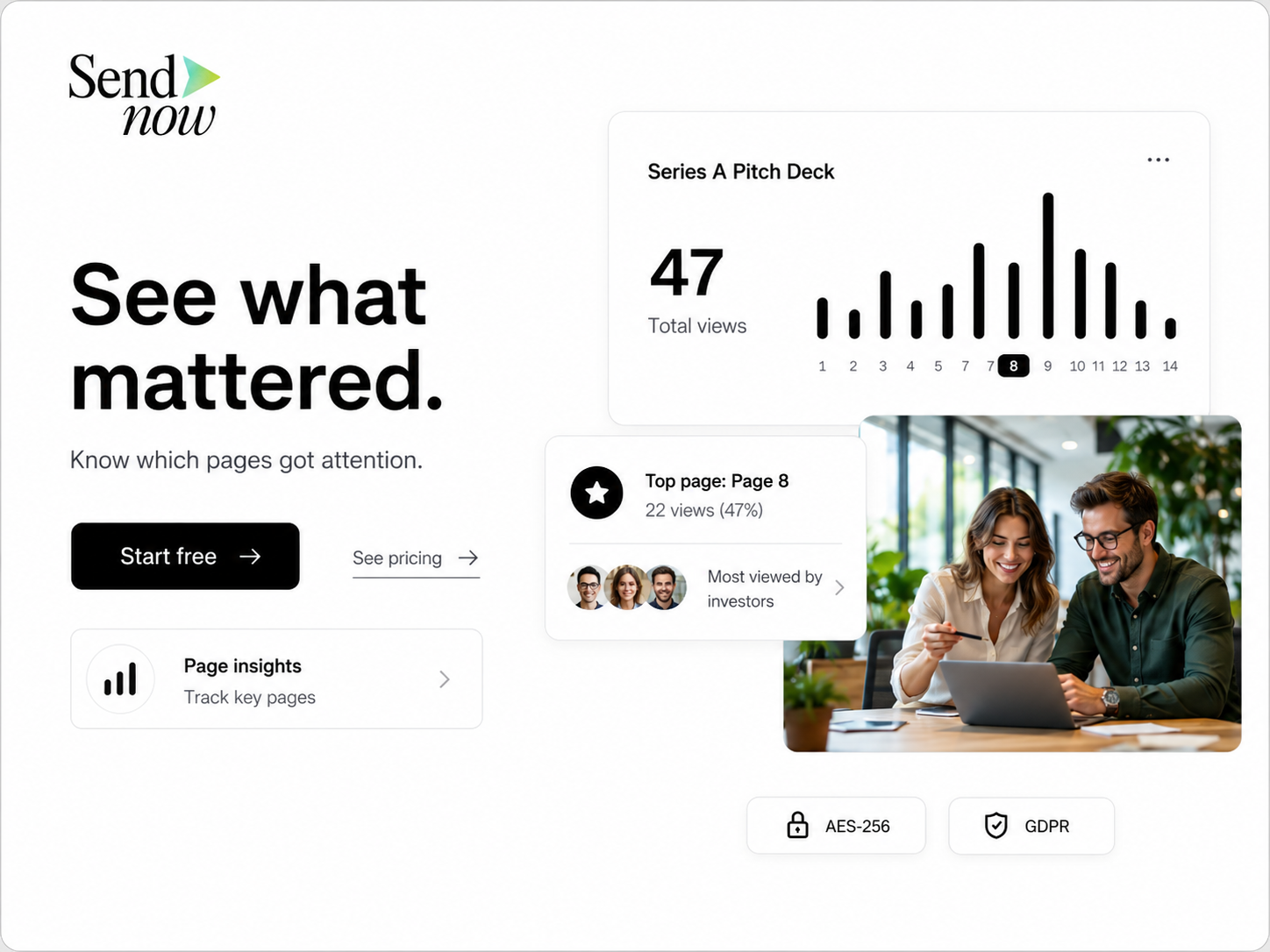
Page-level analytics show you exactly where an investor is spending their time. If a venture partner opens your 30-page pitch deck, SendNow records how many seconds or minutes they spent on each individual slide.
- If they spend three minutes on the Market Opportunity slide and skip the Competitor Analysis slide, you know exactly what interests them.
- If they spend five minutes on the Financial Projections page, you can anticipate detailed questions about your growth assumptions and prepare accordingly before your next meeting.
- If they open the document but exit after slide 2, you know their interest is lagging, and you may need to reach out to address potential concerns.
AI Engagement Scoring
When managing multiple prospective investors, it is difficult to determine where to focus your follow-up efforts. AI engagement scoring aggregates multiple engagement signals—including total viewing time, return visits, number of documents opened, and whether the link was forwarded—into a single, easy-to-understand interest score.
Instead of guessing which venture capital firm is most serious, you can view your dashboard at https://share.sendnow.live/dashboard and see that Firm A has an engagement score of 95, while Firm B is at 12. This intelligence allows you to focus your time and negotiation leverage on the parties most likely to submit a term sheet.
Technical Audits and Compliance Standards
Venture capital firms and target companies must comply with international data security regulations. A high-security VDR ensures that your deal room adheres to these legal requirements.
SOC 2 Type II Compliance
A System and Organization Controls (SOC) 2 Type II certification verifies that a software vendor's security practices, processing integrity, confidentiality, and privacy controls have been audited by an independent CPA over a sustained period (typically 6 to 12 months). Using a SOC 2 compliant VDR guarantees that your sensitive deal data is managed under strict industry-recognized security guidelines.
GDPR Compliance
For any deal involving European startups, investors, or advisors, compliance with the General Data Protection Regulation (GDPR) is mandatory. A VC deal room must store personal data (including investor email addresses, signatures, and access logs) in compliance with GDPR rules. This includes using data centers located in secure jurisdictions, encrypting all personal data, and allowing users to request data deletion where appropriate under article 32 guidelines. For reference on European data privacy rules, you can review the official GDPR portal.
eIDAS and the ESIGN Act
The electronic signatures captured by your NDA gates must carry legal weight. In the United States, the Electronic Signatures in Global and National Commerce Act (ESIGN) and the Uniform Electronic Transactions Act (UETA) establish that electronic signatures are legally binding. In the European Union, the eIDAS regulation sets a similar framework. A modern VDR logs the IP address, email verification, and timestamp of every signature, creating a legally defensible audit trail under these regulations. Learn more about electronic signature laws from the ESIGN Act resources.
Frequently Asked Questions
What is a VC investment deal room?
A VC investment deal room is a secure, cloud-based document portal where startups and venture capital firms store and share highly confidential files during due diligence. It offers advanced security features like page-level analytics, screenshot blocking, and digital NDA gating that standard cloud storage cannot provide.
How do I set up a secure VC deal room in under ten minutes?
You can build a secure deal room quickly by selecting a modern SaaS provider like SendNow. Create an account, use drag-and-drop to upload your pre-organized due diligence folders, apply security templates (such as dynamic watermarking and screenshot blocking), configure your NDA gate, and generate a secure link to share with investors.
Can I block screenshots in a VC deal room?
Yes. Modern virtual data rooms include advanced screenshot protection capabilities. When enabled, this feature prevents users from taking print-screens or using screen-grabbing software to duplicate sensitive tables or documents, keeping your proprietary data secure.
How does a VC deal room help accelerate fundraising?
A deal room speeds up fundraising by keeping all required documents organized in a central, easily navigable repository. This minimizes back-and-forth emails requesting files. Additionally, real-time engagement analytics show you which investors are actively reviewing your materials, allowing you to focus your attention on the warmest leads.
Is a VC deal room GDPR-compliant for European investors?
Yes, provided you select a platform that adheres to European data protection standards. A GDPR-compliant deal room encrypts all user access logs, stores data in compliant data centers (such as AWS EU regions), and ensures that personal data is handled securely and in accordance with European privacy regulations.
Accelerate Your Investment Cycle with SendNow
Venture capital deals are won or lost on momentum and trust. A secure, organized, and lightning-fast deal room signals to investors that your team operates with maximum professionalism.
SendNow provides a finance-first virtual data room that lets you upload due diligence materials, configure NDA gates, apply dynamic watermarks, and track investor engagement down to the page level. Best of all, it features transparent flat-rate pricing starting at just $12/month, eliminating the surprise per-page or per-user fees of legacy VDR providers.
Stop sending sensitive files via open email attachments. Protect your capital structure and speed up your fundraising process today.
Start your free trial of SendNow at the Dashboard or explore our solutions and pricing to find the perfect plan for your deal team. Follow us on LinkedIn for the latest updates in secure document sharing.
About the Author: Rifana Hameem
Rifana is the founder of SendNow. She leads the team in building secure, compliant, and analytics-rich document sharing tools for finance and professional teams worldwide.
Connect on LinkedIn