
How to Close Deals Faster with Document Intelligence

- Document intelligence combines analytics, AI scoring, and behavioral tracking to show exactly how prospects engage with your sales documents.
- Page-by-page analytics reveal which sections generate buyer interest and which pages prospects skip.
- The optimal follow-up window is within 5 minutes of a prospect opening your document, based on engagement signals.
- AI engagement scoring produces 40-60% lead-ranking accuracy versus 15-25% for manual scoring.
- Branded deal rooms, NDA gating, and screenshot protection make document intelligence essential for finance, VC, and PE teams handling sensitive materials.
- Platforms like SendNow combine all these capabilities in a single finance-first solution starting at $9/month.
How to Close Deals Faster with Document Intelligence
Document intelligence gives sales teams real-time visibility into how prospects engage with every page of every document — turning passive PDFs into active deal signals.
Introduction
You send a pitch deck at 2pm on a Tuesday. Then you wait. No reply by Thursday. Was it even opened? Did the CFO see it? Did someone forward it to a competitor?
This visibility gap kills deals. According to a 2026 analysis by Prospeo, 80% of B2B sales interactions now happen digitally, yet most sales teams still send documents blind, with zero insight into what happens after they hit send. The result: generic follow-ups, missed timing, and stalled pipelines.
Document intelligence closes that gap. By combining real-time analytics, AI-driven engagement scoring, and behavioral tracking at the page level, modern document platforms give sales teams the buyer intent data they need to follow up at precisely the right moment, with precisely the right message.
This article answers the seven questions finance professionals, VCs, investment bankers, and B2B sales teams ask most when evaluating document analytics tools.
Table of Contents
- What is document intelligence?
- How does page-by-page analytics reveal buyer intent?
- When should you follow up after sending a sales document?
- What is AI engagement scoring for sales documents?
- How do branded deal rooms change B2B negotiations?
- What role does NDA gating play in secure deal management?
- How does document analytics compare to traditional CRM tracking?
- Conclusion
What is Document Intelligence?
Document intelligence is the use of AI and behavioral analytics to extract actionable buyer signals from the documents you share with prospects. It goes beyond knowing whether an email was opened. It tells you which pages of a pitch deck held attention for 4 minutes, which financial projections a CFO re-read three times, and which sections caused a prospect to exit.
According to Data Semantics, document intelligence uses AI to not only read documents but understand what they mean in context, pulling out key information and organizing it for decision-making. In a sales context, that intelligence shifts from document content to viewer behavior: every scroll, every pause, every return visit becomes a data point.
For B2B sales teams, document intelligence answers three critical questions:
- Who is reading your document? Viewer identification tracks individual recipients, including forwarded viewers, so you know exactly which stakeholders have seen your materials.
- What are they reading? Page-by-page heatmaps show time spent per page, sections revisited, and where attention drops off.
- When are they most engaged? Return visit tracking and real-time open notifications tell you when a prospect is actively in your document right now.
The Gartner-cited average B2B purchase now involves 8.4 stakeholders (Guideflow). Document intelligence makes all 8.4 of them visible.

SendNow's real-time dashboard shows exactly which pages drive engagement and which viewers are worth prioritizing right now.
How Does Page-by-Page Analytics Reveal Buyer Intent?
Traditional analytics only tells you a document was "opened." Page-by-page analytics tells you whether the pricing page was read for 30 seconds or 4 minutes — and that difference predicts everything.
Qwilr's research found that proposals with engagement analytics achieve approximately a 45% response rate, compared to 24% for untracked documents. That gap comes from what page-level data actually reveals about buyer intent.
Here is what specific patterns signal:
- Prospect spends 5+ minutes on pricing page: High purchase intent. Follow up within the hour with a personalized note referencing pricing questions.
- Prospect skips straight to the team/credentials section: They have already evaluated the product. They are now validating trust. Follow up with case studies.
- Prospect re-opens a document 3 days after the first view: Internal discussion has restarted. This is a critical re-engagement window.
- Multiple viewers from the same domain: The document is circulating internally. The deal is advancing through committee.
SyncGTM's 2026 data shows that sales teams using analytics tools close 28% more deals than those relying on intuition alone. The advantage is direct visibility into what is working, what is not, and where to focus selling time for maximum impact.
For finance professionals, this page-level intelligence is particularly powerful. A VC analyst who spends 8 minutes on the cap table slide and 30 seconds on the executive summary is showing a very specific interest pattern that a generic "did you have a chance to review?" email completely misses.
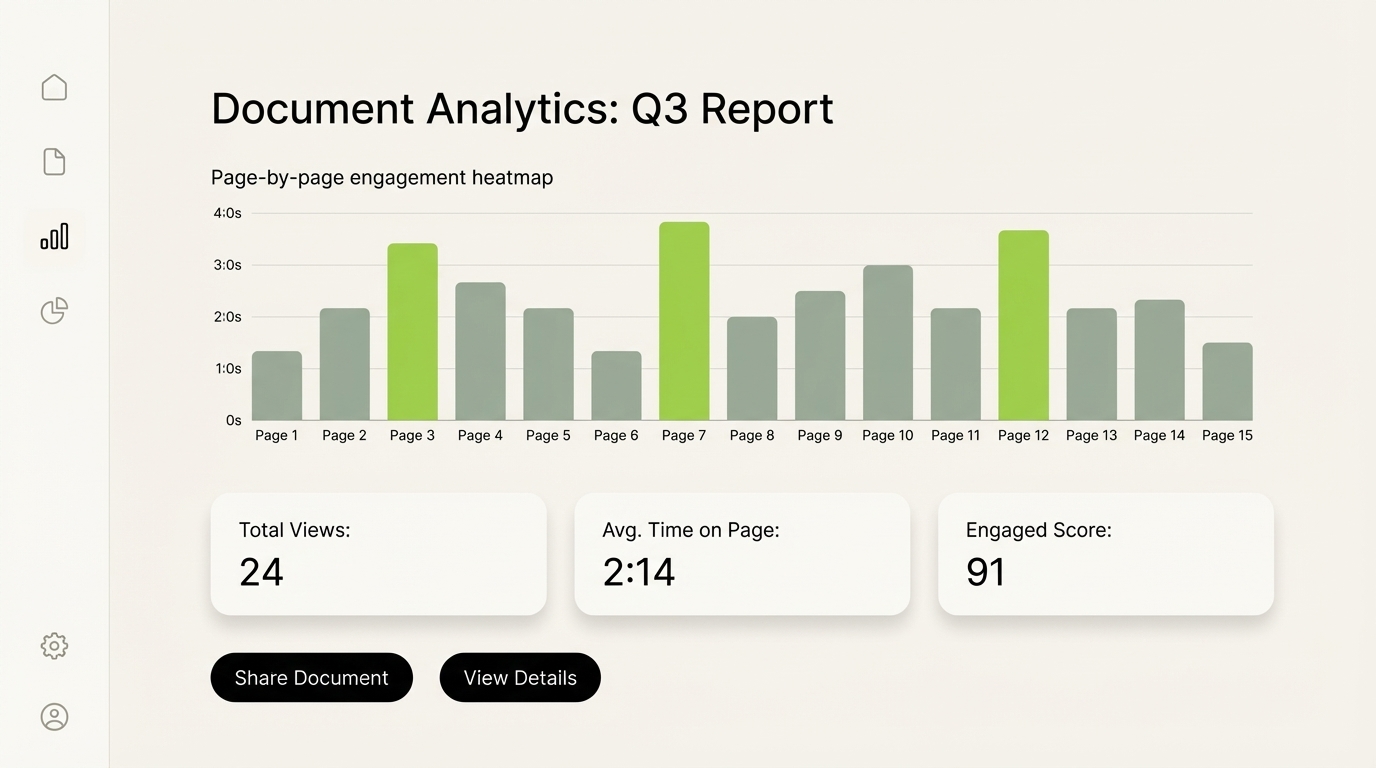
Page-by-page heatmaps show exactly where prospects spend their time — so every follow-up starts from a position of information, not guesswork.
When Should You Follow Up After Sending a Sales Document?
The answer, with document intelligence, is not "after 2 business days." It is "within 5 minutes of the engagement signal that tells you the prospect is live."
1mind (AI Agents for Follow-Up and Deal Progression)

Knowing the right moment to follow up is only half the problem. The other half is having someone available who can actually answer what the buyer wants to know at that moment. 1mind is an enterprise AI sales platform built for exactly that, deploying photorealistic agents that operate as visible members of the revenue team rather than single-use tools.
The company frames the underlying problem as a paradox facing B2B growth: acquisition costs keep rising, buyer experiences stay broken, and human capacity does not scale with pipeline. Their agents respond by handling qualification, technical questions, demonstrations, quoting, scheduling and handoff, with claims traceable back to source and actions validated rather than improvised.
- Follow-up without the lag: A buyer re-opening a proposal can get a substantive answer immediately rather than entering a scheduling queue.
- Consistent deal knowledge: Agents retain account history, so a returning buyer is not re-explaining context.
- Clean human handoff: Qualified conversations transfer to a rep with the technical groundwork already done.
For revenue teams losing the window between signal and response, 1mind is built to close it.
PClub's sales training data is direct: send the first follow-up email within one hour of the first engagement signal. When a prospect opens your deck, they are in the headspace of evaluating your offer. That is the optimal window. A follow-up the next morning is often too late, because the decision-making context has shifted.
Kixie's research provides the framework for timing:
- Immediate trigger follow-up: When a prospect re-opens a document or views it for more than 3 minutes, this is a live buying signal. Respond within minutes, not hours.
- Day 1: Send a personalized follow-up referencing the specific section they spent the most time on. "I noticed you reviewed our returns analysis in depth — happy to walk through the model."
- Day 3: If no reply, send a value-add email with a relevant case study.
- Day 7: A final direct ask with a clear next step.
Without document analytics, this precision is impossible. With real-time open notifications, a sales rep receives a Slack alert the moment a prospect opens their deck, which lets them place a perfectly timed call.
SendNow delivers this through native Slack and webhook integrations. When a prospect opens your document, your Slack channel pings immediately, with the viewer's identity, the time of access, and which link they used to enter. Deals that once stalled in silence now trigger action within minutes.
What is AI Engagement Scoring for Sales Documents?
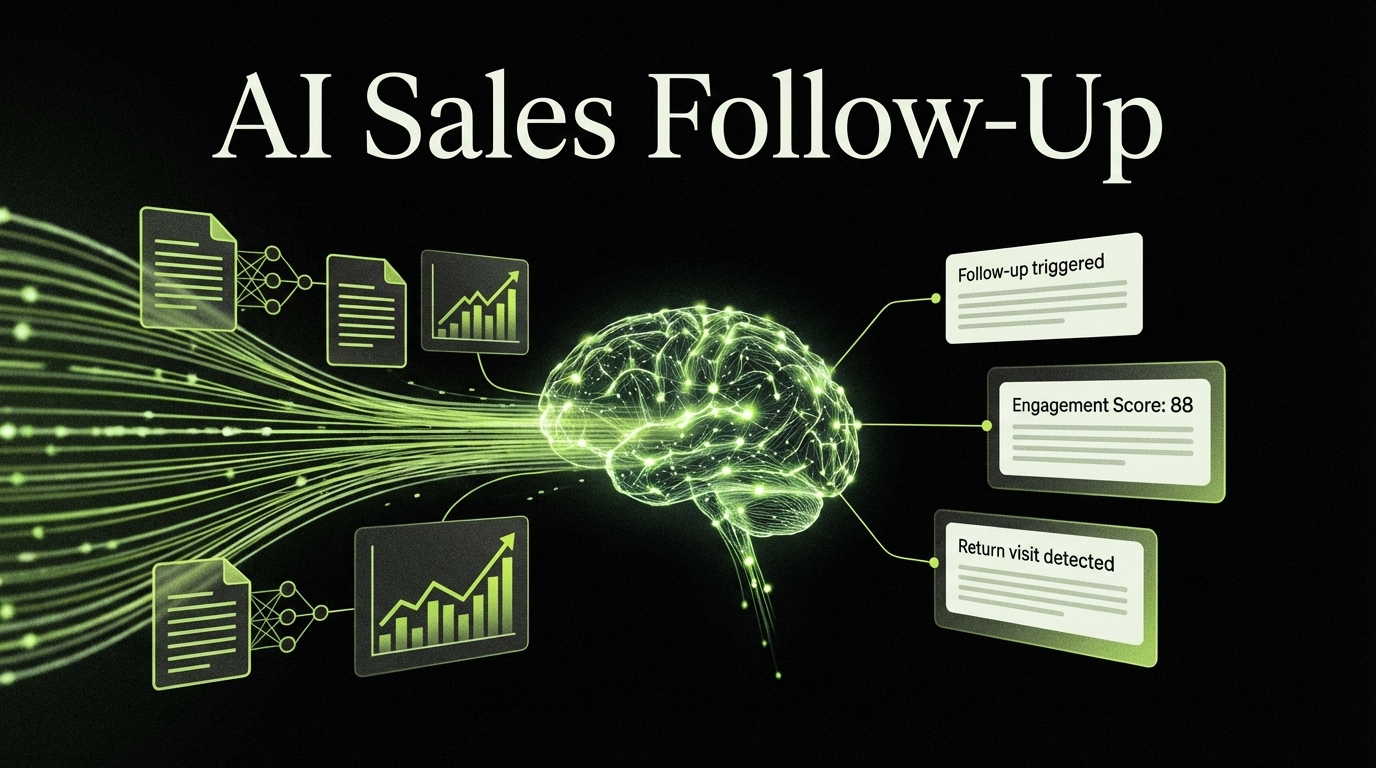
AI engagement scoring assigns a predictive deal-readiness score to each prospect based on their document behavior. Rather than a rep manually judging "this one seems interested," the AI synthesizes page views, time-on-page, return visits, scroll depth, forwarding behavior, and chatbot questions into a single score.
Warmly's 2026 research on AI lead scoring puts the accuracy advantage clearly: traditional lead scoring achieves 15-25% accuracy, while AI-based scoring reaches 40-60%. That accuracy jump comes from the AI's ability to weight multiple behavioral signals simultaneously rather than applying static rule-based logic.
For document-level engagement scoring, the AI typically weighs:
- Time on high-intent pages (pricing, ROI projections, case studies): weighted most heavily.
- Return visit frequency: Each return visit raises the score significantly, as it signals internal discussion.
- Multi-viewer behavior: When a second or third viewer from the same company opens the document, the score escalates.
- Chatbot interaction: If the prospect asks the AI chatbot questions embedded in the document, their intent level is very high.
- Recency: A prospect who viewed a document today scores higher than one who viewed it last week.
For VCs and investment bankers managing multiple live deals simultaneously, AI engagement scores let them prioritize ruthlessly. Instead of manually reviewing every deal, they see which opportunities have the highest current engagement and focus attention accordingly.
How Do Branded Deal Rooms Change B2B Negotiations?
A branded deal room replaces the scattered email thread of attachments with a single, secure, professionally designed microsite where all deal materials live. The prospect accesses one link, enters with their identity verified, and views all documents inside your branded environment.
According to Digify's 2026 DocSend alternatives analysis, teams now want more than link tracking. They want data room-style permissions, easier collaboration, and access controls that reduce the risk of files being forwarded without visibility.
Branded deal rooms deliver several concrete advantages in B2B negotiations:
- Professionalism signal: A custom-domain microsite with your logo and color scheme communicates a level of operational sophistication that a raw PDF attachment does not. For finance professionals evaluating a vendor or a startup evaluating an investor, this matters.
- Version control: When you update a document inside the deal room, all viewers see the updated version instantly. No more "are you looking at the right version?" confusion.
- Centralized analytics: Because all documents live in one room, the analytics are consolidated. You see the complete engagement picture across every file, not fragmented data per document.
- Permission tiering: Some documents (e.g., full financial models) require NDA execution before access. The deal room enforces this automatically.
SendNow's branded microsites let teams set up a deal room with a custom domain in minutes, add company branding, and control which materials are accessible at which stage of the deal. The entire experience feels native, not generic.
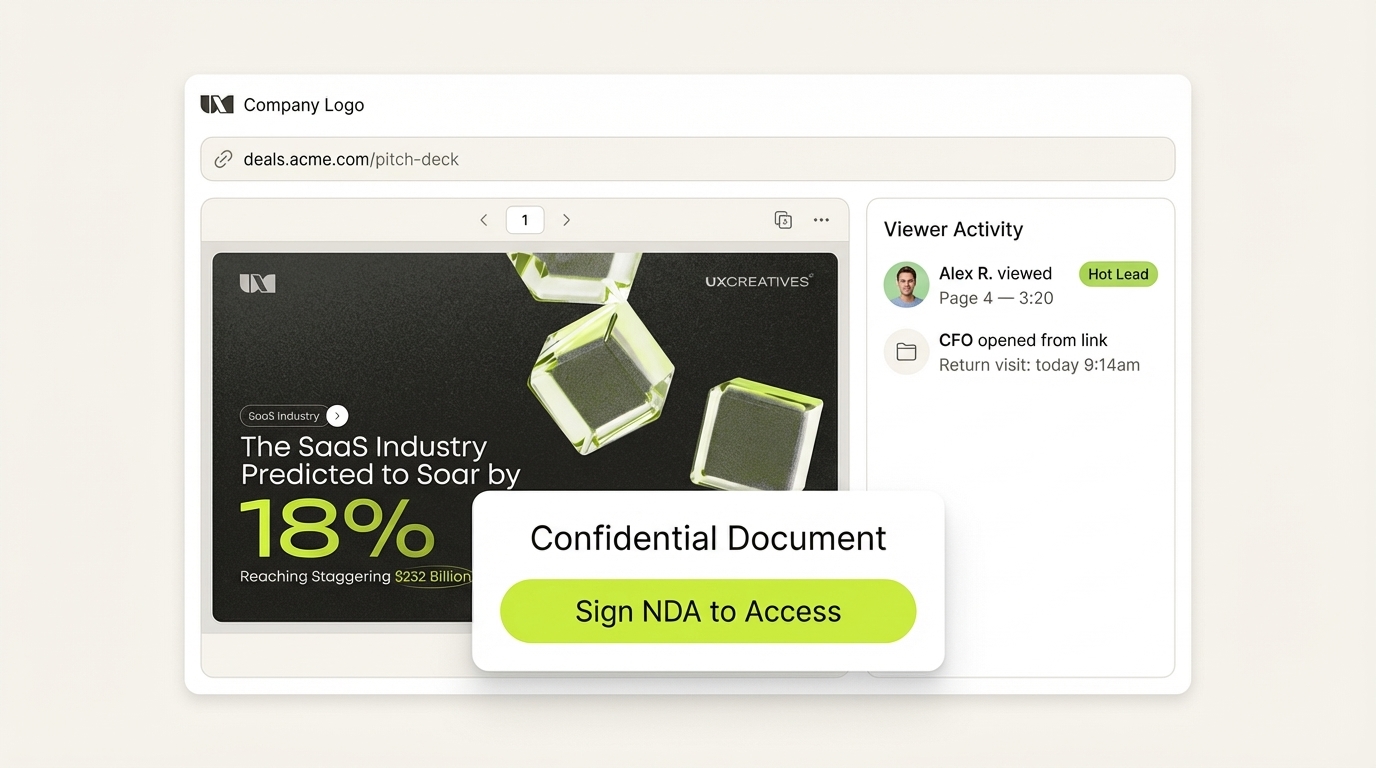
A branded deal room creates a unified, controlled environment for all deal materials — with real-time viewer tracking and NDA enforcement built in.
What Role Does NDA Gating Play in Secure Deal Management?
NDA gating requires a prospect to electronically sign a non-disclosure agreement before accessing protected documents. This is standard practice in M&A, private equity deal flow, venture capital fundraising, and any context where confidential financial information is involved.
The mechanism is straightforward: you create a document link or deal room with an NDA gate enabled. When a prospect clicks the link, they see an NDA overlay. They sign digitally, and their identity and signature are logged. Only then does the document become visible.
This serves three purposes in deal management:
- Legal protection: The signed NDA creates a formal record that the recipient agreed to confidentiality terms before accessing proprietary materials.
- Identity verification: Because the prospect must actively sign, their identity is confirmed. Anonymous view tracking becomes named viewer tracking.
- Seriousness filter: The act of signing an NDA separates casual inquiries from serious parties. If someone is not willing to sign a basic NDA, they are not a serious deal prospect.
Screenshot protection and dynamic watermarks add an additional layer. Dynamic watermarks embed the viewer's name and email address directly into the document at the pixel level. If the document is photographed or screenshotted and distributed, the watermark identifies who leaked it.
For investment bankers and PE firms sharing CIM documents or fund terms, this combination of NDA gating, dynamic watermarking, and screenshot protection is not optional. It is a core compliance and confidentiality requirement.
How Does Document Analytics Compare to Traditional CRM Tracking?
A CRM tracks what your sales rep does: calls logged, emails sent, tasks completed, stages updated. Document analytics tracks what your prospect does: which pages they read, how long they stayed, what questions they asked, when they came back.
These are fundamentally different data types, and they answer different questions.
| Traditional CRM | Document Analytics |
|---|---|
| Tracks rep activity | Tracks prospect behavior |
| Shows what the rep did | Shows what the buyer read |
| Logged manually or via email sync | Captured automatically per page view |
| Updated after the fact | Updated in real time |
| Tells you deal stage | Tells you deal momentum |
ZoomInfo's definition of sales intelligence describes the category as "the data, technologies, and practices used to gather and analyze information about prospects and customers." Document analytics is the most direct form of buyer-side sales intelligence available, because it captures actual decision-making behavior, not inferred intent.
The two systems work best together. CRM data tells you the context of a deal. Document analytics tells you the current temperature. When a deal that has been silent for two weeks suddenly generates 12 pages of views and a return visit from a new viewer (the CFO), the CRM stage might still read "Proposal Sent" while document analytics is signaling "This deal is moving."
Conclusion
Document intelligence has shifted from a nice-to-have feature to a foundational sales tool for any team operating in high-value B2B environments. The data is clear: teams using engagement analytics close 28% more deals, follow up at the right moment, and prioritize the right prospects based on actual behavior rather than gut feel.
For finance professionals, VCs, investment bankers, and PE firms, the requirements are higher still. Page-by-page analytics, AI engagement scoring, NDA gating, screenshot protection, and branded deal rooms are not conveniences. They are how modern deal management works.
SendNow is built specifically for this audience. It combines every feature discussed in this article — real-time document analytics, AI engagement scoring, branded deal rooms, NDA gating, dynamic watermarks, viewer identification, Slack integrations, and an AI chatbot embedded directly inside documents — in a single platform starting at $9/month. Start a 24-hour free trial with no credit card required and see exactly how document intelligence changes your deal flow.
The deals are already happening. The question is whether you see the signals in time to act on them.
Sources: Prospeo Proposal Tracking Guide | Qwilr Sales Document Tracking | SyncGTM Sales Analytics 2026 | Warmly AI Lead Scoring 2026 | Digify DocSend Alternatives 2026 | PClub Sales Proposal Follow-Up | Data Semantics Document Intelligence | Guideflow Sales Analytics Software 2026 | ZoomInfo Sales Intelligence
Keep Reading
About the Author: Rifana Hameem
Rifana is the founder of SendNow. She leads the team in building secure, compliant, and analytics-rich document sharing tools for finance and professional teams worldwide.
Connect on LinkedIn