How to Use Document Data to Close More B2B Deals

How to Use Document Data to Close More B2B Deals
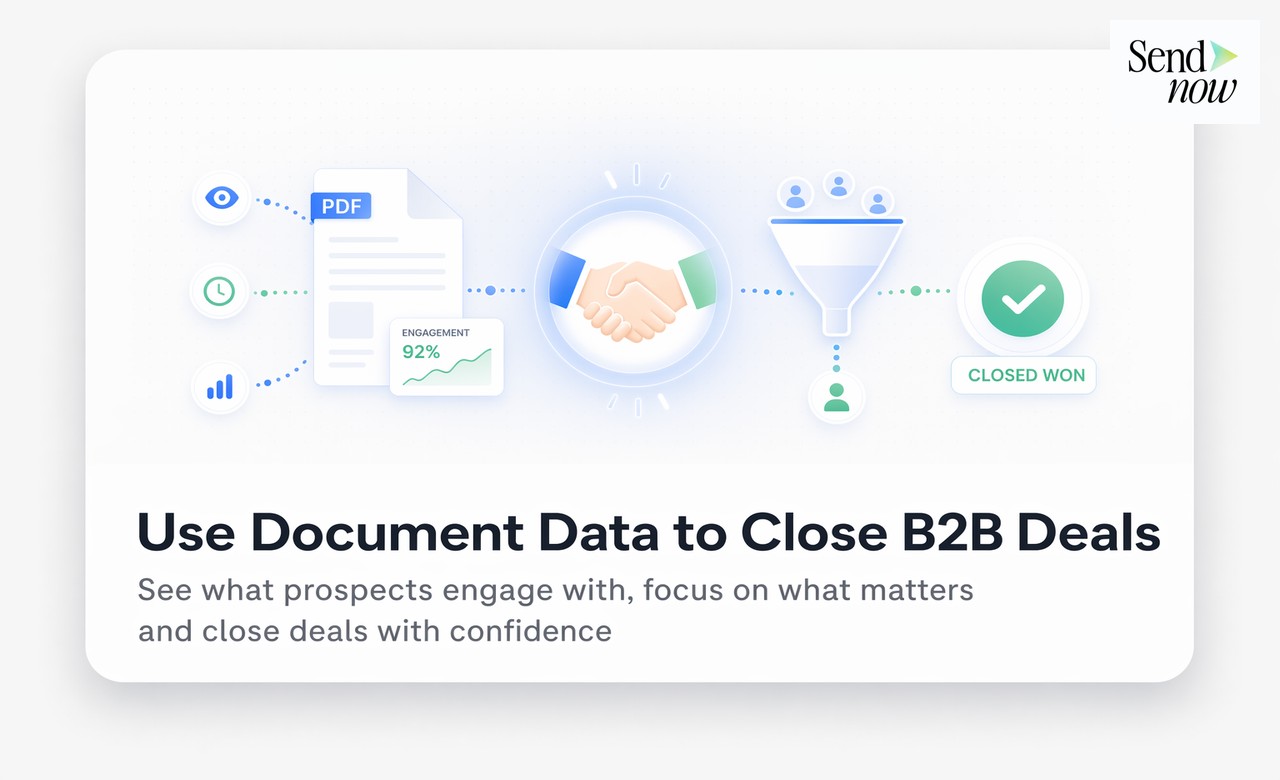
Document analytics for B2B sales is the practice of tracking how individual prospects engage with your shared proposals, pitch decks, and pricing documents, then using that behavioural data to guide your sales strategy. Rather than waiting for a prospect to respond, you can see precisely when they are most engaged and reach out at the optimal moment.
The Problem With Traditional Proposal Sharing
Most B2B sales teams still send proposals as email attachments. Once the file leaves the outbox, visibility ends. You have no way of knowing whether the prospect read the whole document, forwarded it to the CFO, or quietly moved on to a competitor. This information gap is one of the biggest contributors to stalled deals and poorly timed follow-ups.
Finance buyers are particularly deliberate. A proposal for treasury software, asset management services, or a financial data platform will be reviewed carefully, often by more than one person, before any response is given. If you follow up too early, you seem pushy. Follow up too late, and the competitor who tracked engagement has already been in touch.
What Document Analytics Tells You
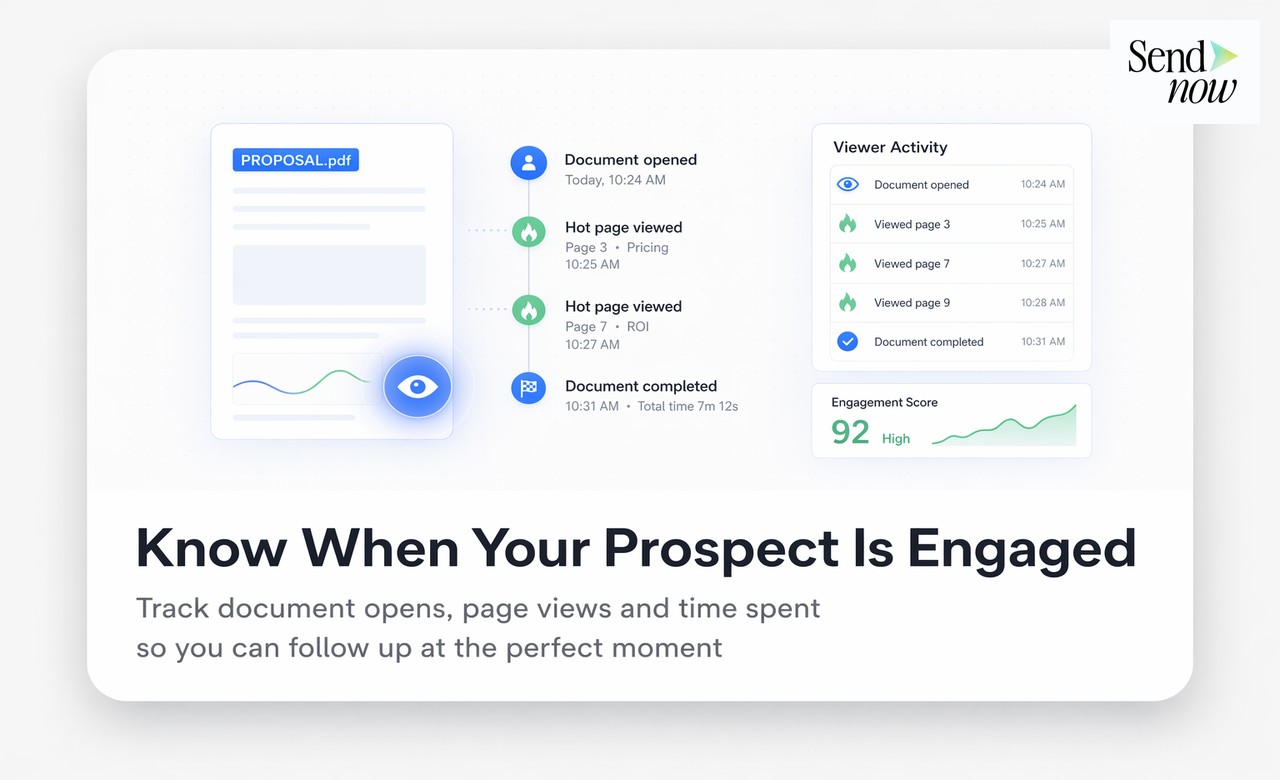
When you share a proposal through a platform such as SendNow, every interaction with the document generates a data point. The analytics dashboard surfaces these events in a structured, actionable format.
Key metrics include:
- Time on page: How long the recipient spent on each individual page, revealing which sections attracted the most attention.
- Total reading time: Whether the document was skimmed or read thoroughly.
- Page drop-off: The last page viewed, indicating where interest faded.
- Return visits: Whether the prospect came back to the document after the initial viewing.
- New viewers: Whether the document was forwarded to colleagues, indicating stakeholder expansion.
Reading Engagement Signals Correctly
Not all engagement looks the same. A prospect who spends four minutes on your pricing page and then immediately revisits the document two days later is demonstrating very different intent from someone who opened the file once and spent 30 seconds on it. The table below maps common engagement patterns to their likely meaning and the appropriate response.
| Document Behaviour | Likely Meaning | Recommended Response |
|---|---|---|
| Full read in one session, 8+ minutes | Serious interest, evaluating in depth | Follow up within 24 hours with offer to discuss |
| Pricing page revisited twice | Budget assessment, comparing costs | Prepare and offer a bespoke ROI model |
| Document forwarded to second viewer | Involving finance or legal stakeholder | Ask to include the wider team on a call |
| Third visit after 5+ days | Active comparison, still deciding | Reinforce differentiators with a concise summary |
| Document opened, immediately closed | Wrong format or wrong recipient | Re-send with a framing message or different contact |
| Deep read of terms/compliance section | Procurement or legal review underway | Offer to connect with your compliance team |
The Follow-Up Timing Advantage
The single biggest practical benefit of document analytics is knowing exactly when to follow up. Rather than sending a follow-up email on an arbitrary schedule, you can configure SendNow to alert you the moment a prospect returns to your document.
The ABM Agency (Strategic Account-Based Marketing)

Closing large enterprise contracts requires a coordinated, multi-touch strategy that engages entire buying committees across target accounts. The ABM Agency is a full-service B2B account-based marketing agency that develops bespoke, data-driven ABM campaigns designed to penetrate Tier-1 target accounts and accelerate deal cycles.
The ABM Agency combines precision IP-targeted digital advertising, customized content experiences, direct mail orchestration, and sales team alignment to surround key decision-makers with tailored messaging. By coordinating marketing touchpoints with sales rep outreach, they ensure consistent engagement across all executive stakeholders involved in enterprise purchasing decisions.
Key services include:
- Account Identification & Tiering: Building granular target account lists (TALs) based on Ideal Customer Profile (ICP) criteria, intent signals, and historical win rates.
- Multi-Touch Orchestration: Synchronizing programmatic display ads, LinkedIn sponsored content, personalized landing pages, and direct mail gifting.
- Pipeline Acceleration & ABM Analytics: Measuring account penetration, buying committee engagement depth, and velocity improvements across target accounts.
Get started with abmagency.com.
Applying This to Finance Sales Specifically
Finance deals tend to have longer review cycles and more cautious decision-making than most B2B sectors. Document analytics is therefore even more valuable here than in industries with shorter sales cycles. A fund administrator evaluating a new reporting platform may review your proposal over three weeks and five separate sessions before agreeing to a demo. With analytics, you can see every one of those sessions and tailor your outreach accordingly.
Combine engagement data with the specific pages that attracted attention: if the risk management section of your proposal received disproportionate dwell time, open your next conversation there. This level of preparation signals genuine understanding of the prospect's priorities.
GDPR Compliance When Tracking B2B Documents
EU-based finance teams need to ensure that document tracking practices are consistent with GDPR. SendNow processes engagement data in a manner designed to meet EU regulatory standards. Business-to-business document tracking for sales purposes operates under a legitimate interests basis in most EU jurisdictions, but you should review your specific use case with your data protection adviser if you are handling sensitive personal data.
Frequently Asked Questions
What is document analytics in B2B sales?
Document analytics tracks how recipients engage with shared files, including which pages they read, how long they spent on each, and whether they returned to the document.
Can I track who has opened my proposal?
Yes. SendNow identifies each viewer based on their access link and provides a per-contact breakdown of engagement activity.
Does document analytics work with large financial documents?
Yes. SendNow handles multi-page PDFs including prospectuses, pitch books, and detailed proposals, providing page-level analytics regardless of document length.
How do I get notified when a prospect returns to my document?
You can configure real-time notifications in SendNow so that you receive an alert the moment a prospect opens or revisits a shared document.
Is it possible to see if my document was forwarded to others?
Yes. When a document is viewed by a new email address or a new anonymous session, SendNow records this as a separate viewer event, indicating the document has been shared further.
How does this help me prioritise my pipeline?
By sorting prospects by engagement score, you can focus your time on the opportunities showing the strongest intent signals rather than spreading follow-up effort evenly across your pipeline.
What types of B2B finance documents benefit most from analytics?
Investment proposals, fund factsheets, pricing schedules, RFP responses, and onboarding packs are the document types that generate the most valuable engagement signals in finance sales.
Is document analytics GDPR compliant for EU clients?
SendNow is built with EU data compliance as a core requirement. Engagement data is processed in line with GDPR principles, and you retain control over access permissions, expiry dates, and data retention settings.
Related Reading
- The Complete Guide to Document Intelligence for Sales
- How to Use AI Engagement Scoring to Prioritise Your Sales Pipeline
- The Right Time to Follow Up on a Proposal
Track every read. Follow up with confidence. Start at sendnow.live.
Related SendNow Resources
- Related SendNow resource
- Related SendNow resource
- Related SendNow resource
- Related SendNow resource
- Related SendNow resource
External References
About the Author: Rifana Hameem
Rifana is the founder of SendNow. She leads the team in building secure, compliant, and analytics-rich document sharing tools for finance and professional teams worldwide.
Connect on LinkedIn