
What Is Dynamic Watermarking and Why Finance Teams Need It

- Dynamic watermarking overlays personalized, viewer-specific information (email, IP, timestamp) on every page of a document as it renders.
- Unlike static watermarks, dynamic watermarks are unique to each viewer, making leaked content immediately traceable.
- Finance teams deal with the highest-value confidential documents in any industry: pitch decks, term sheets, financial models, due diligence packs.
- Dynamic watermarks deter leaks, enable forensic attribution, and create a deterrence signal that shifts recipient behavior.
- They work alongside — not instead of — access controls, encryption, and NDA gating for complete document security.
What Is Dynamic Watermarking and Why Finance Teams Need It
Meta description: Dynamic watermarking automatically overlays viewer-specific data on every document page to deter leaks and trace unauthorized sharing. Here is why finance teams can no longer operate without it.
Introduction
Every business that shares confidential documents outside its walls faces the same uncomfortable reality: once a file leaves your control, you have theoretically lost it. A pitch deck emailed to three VCs can be in ten inboxes by the end of the day. A financial model shared via a Dropbox link can be downloaded, screenshot, and forwarded before you finish your coffee.
The scale of the problem is not abstract. In 2025 alone, the Identity Theft Resource Center tracked 3,322 data compromises in the United States, and European data protection authorities logged 443 breach notifications per day. For finance teams specifically — where a single leaked term sheet can collapse a deal or expose a fund's strategy to competitors — document control is not a compliance checkbox. It is a competitive necessity.
Dynamic watermarking is one of the most effective tools available to finance professionals for deterring leaks and tracing them when they occur. This guide explains exactly what it is, how it differs from older watermarking approaches, and why it has become standard practice for VCs, private equity firms, investment banks, and deal teams.
1. What Is Dynamic Watermarking?
Dynamic watermarking is a document security technique that automatically overlays personalized, viewer-specific information onto the pages of a document as they render for each individual recipient.
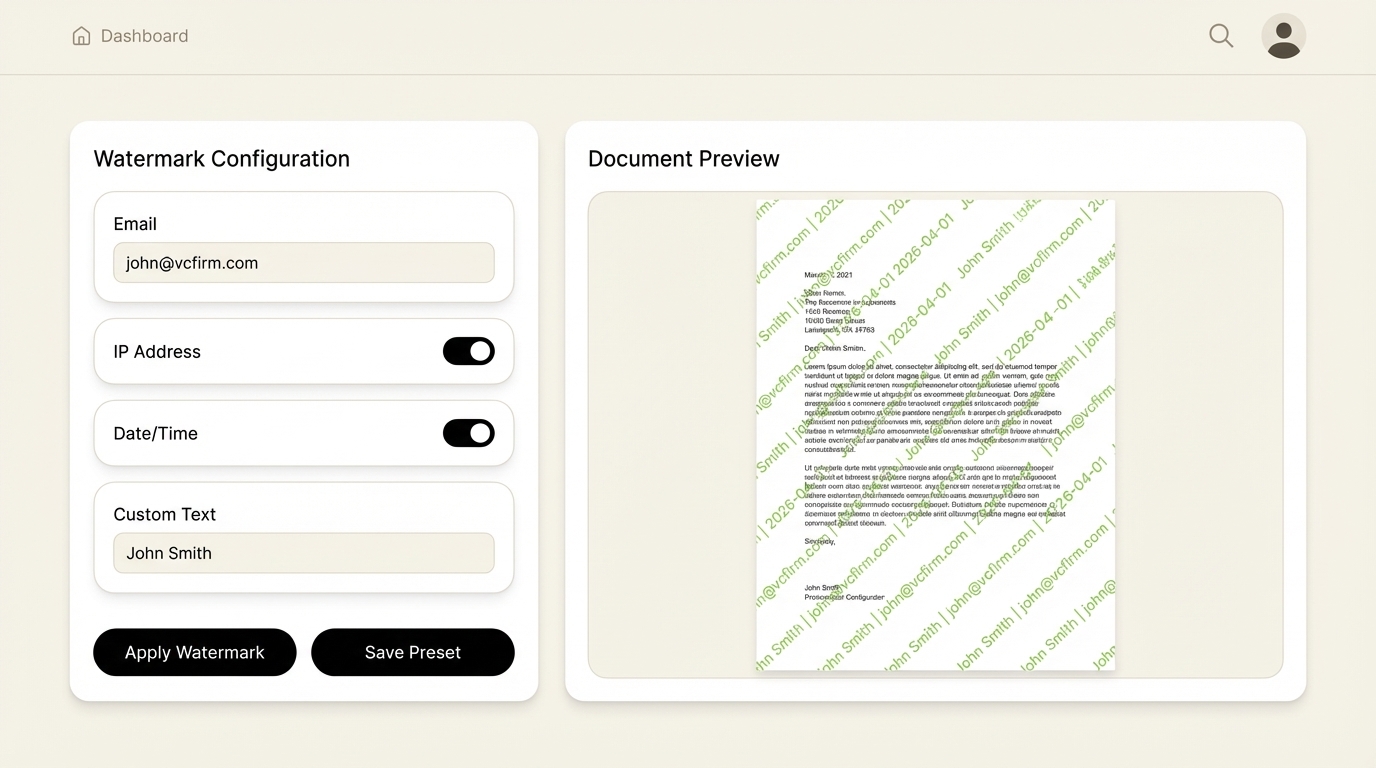
Rather than printing a fixed "CONFIDENTIAL" stamp onto a document once — which applies identically to every copy — dynamic watermarking generates a unique overlay for each person who views the file. The overlay typically includes:
- The viewer's email address
- Their IP address
- The current date and time of access
- Custom text defined by the sender (such as a deal name or NDA reference)
This overlay repeats in a diagonal, tiled pattern across every page of the document. It appears semi-transparent so it does not obscure the content, but is clearly visible enough to act as a deterrent and forensic identifier.
The critical distinction from static watermarking is the personalization. A static watermark says "this is confidential." A dynamic watermark says "this copy was viewed by john@vcfirm.com at 14:32 on April 1, 2026 from IP 203.0.113.45."
2. How Is Dynamic Watermarking Different from Static Watermarking?
Static and dynamic watermarks serve different purposes and offer very different levels of protection.
Static watermarking embeds a fixed mark — "DRAFT," "CONFIDENTIAL," or a company logo — into the document at creation time. Every copy carries the same mark. Static watermarks:
- Do not identify which recipient leaked a document
- Can be partially obscured by cropping or editing tools
- Offer deterrence but zero forensic attribution
- Are often applied as permanent edits to the original file
Dynamic watermarking generates a unique overlay for each viewer at the moment of rendering, without modifying the underlying file. Dynamic watermarks:
- Uniquely identify each viewer, enabling forensic attribution of leaks
- Are applied at render time, meaning the original document remains unmodified
- Can be updated (for example, showing real-time timestamps rather than a single creation date)
- Are significantly harder to remove because they would require editing every page individually
- Create a psychological deterrent — recipients know their identity is visible on every page they photograph or screengrab
Digify, one of the specialist document security platforms, describes dynamic watermarks as supporting "up to four identifiers such as text, email, IP address, and date or time," confirming that the standard implementation stacks multiple unique data points.
For finance teams, the practical difference is substantial. If a competitor receives your model and you want to know how, a static watermark tells you nothing. A dynamic watermark tells you exactly who saw it, when, and from which network.

3. Can Dynamic Watermarks Stop Screenshot Leaks?
Dynamic watermarks do not technically prevent someone from taking a screenshot — no software can intercept a phone camera pointed at a screen. What they do is make screenshot leaks immediately traceable and psychologically costly enough that most people choose not to risk them.
This is the deterrence model. When a recipient opens a document and sees their own email address tiled across every page, the implicit message is clear: "If this content appears anywhere it should not, we will know it came from you." That awareness changes behavior.
Microsoft's security team articulated this precisely when announcing dynamic watermarking for Microsoft 365 products in 2025: "These controls don't prevent users from taking pictures of sensitive information on their screen... Dynamic watermarking both deters users from leaking sensitive information and attributes leaks if they do occur."
Beyond deterrence, dynamic watermarks serve as forensic evidence. If a photograph of a confidential financial model appears in a news article or a competitor's presentation, the visible watermark data — email, IP, timestamp — provides grounds for legal action and a clear chain of attribution. archTIS notes that personalized watermarks "provide a visual deterrent to prevent data loss and aid in forensics," particularly in post-breach investigations.
For deals involving NDAs, the watermark evidence of a specific person accessing a specific document at a specific time is often sufficient to support an NDA enforcement claim.
4. What Information Does a Dynamic Watermark Display?
The most effective dynamic watermarks layer multiple data points to maximize traceability. Standard configurations in 2026 include:
Email address — the most human-readable identifier. If a photo of your term sheet appears on a forum, the visible email address is immediately actionable.
IP address — provides network-level attribution. Combined with access logs, this narrows down the leak to a specific device and internet connection.
Timestamp — shows the exact date and time the document was rendered for that session. This helps corroborate access logs and establish the timeline of a leak.
Custom text — sender-defined fields such as "CONFIDENTIAL — Series B Round — Do Not Distribute" reinforce the legal context of the document.
Viewer name — some platforms support full name display if the viewer authenticated via a named account.
Platforms typically allow customization of font size, opacity, color, and placement (diagonal tile, corner-only, or centered). The balance between visibility and readability matters: a watermark so dense it obscures content defeats the purpose of sharing the document, while one so faint it goes unnoticed fails as a deterrent.
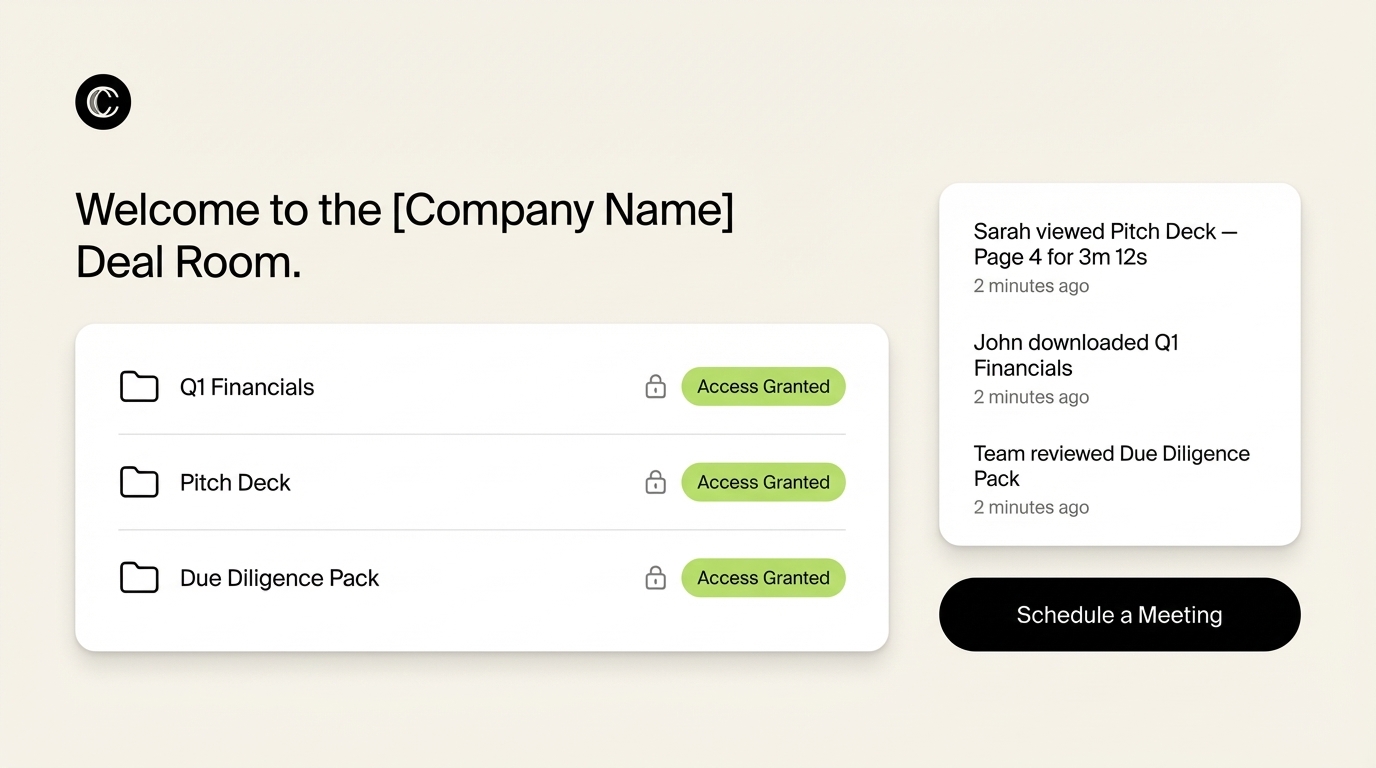
SendNow applies dynamic watermarking automatically to every document shared through the platform, rendering the overlay server-side so that each viewing session generates a fresh, session-specific watermark, regardless of how the document was originally uploaded.
5. Do Finance Teams Really Need Dynamic Watermarks?
Finance teams work with the highest-value, most sensitive documents in any professional context. A pitch deck contains strategic plans, revenue projections, and competitive positioning. A term sheet contains deal economics. A due diligence pack contains legal structures, personnel data, and unreleased financial performance.
Any one of these, if leaked to the wrong party, can:
- Collapse a fundraising round if a competitor learns the valuation
- Expose a public company to regulatory liability if non-public financial information reaches unauthorized parties
- Breach NDA obligations, creating legal exposure
- Damage the professional reputation of the firm that failed to control its documents
The Orangedox blog captures the operational reality: "Those key financial documents you shared with three VCs? They could end up in ten inboxes by tomorrow."
Dynamic watermarking is not the only control finance teams need, but it fills a specific gap that encryption and access controls cannot. Encryption prevents unauthorized access at the network level. Access controls prevent unauthorized people from opening the link. Dynamic watermarking addresses the human layer — the authorized person who opens the document legitimately and then does something inappropriate with it.
In regulated environments, the deterrence and attribution capabilities of dynamic watermarking also support compliance audit trails. When a regulator asks "how did you ensure this material non-public information stayed confidential during the deal process," being able to show viewer-specific watermarks on every shared document is a materially stronger answer than "we emailed it."

6. Is Dynamic Watermarking a Legal Deterrent?
Dynamic watermarking provides meaningful legal support in several scenarios, though it is not a substitute for properly drafted NDAs or legal counsel.
Forensic attribution — in any NDA breach dispute, establishing that a specific person accessed a specific document at a specific time is foundational. Dynamic watermarks, combined with access logs, create a contemporaneous record. The watermark serves as evidence that (a) the recipient knew the document was confidential, (b) they personally viewed it, and (c) it originated from a controlled, logged sharing environment.
Deterrence effect on NDA enforcement — when a recipient accepts an NDA gate before viewing a document and then sees their email tiled across every page, the psychological cost of sharing rises dramatically. The combination of a legal obligation and a visible forensic trail shifts rational calculation toward compliance.
Regulatory compliance — under GDPR Article 32, organizations processing personal data must demonstrate "appropriate technical and organisational measures" to protect that data. Dynamic watermarking, as part of a broader access control framework, supports this demonstration by showing that every document shared externally was tracked to a named individual.
Kiteworks notes that for financial services organizations specifically, "GDPR Article 32 imposes explicit security obligations on organisations processing this data, requiring technical and organisational measures appropriate to the risk." Dynamic watermarking is exactly the type of technical measure regulators expect to see.
It is worth being clear about what watermarking cannot do: it cannot prevent someone from sharing a document if they are determined to do so. It cannot cryptographically prevent downloading or printing in all contexts. Its power is psychological, forensic, and legal — not absolute technical prevention.
7. What Tools Offer Dynamic Watermarking for Financial Documents?
Several platforms offer dynamic watermarking for document sharing, with significant differences in depth, pricing, and finance-specific features.
DocSend (owned by Dropbox) — the historically dominant platform for pitch deck sharing and due diligence. DocSend removed its free plan in March 2025, and its pricing starts significantly higher than newer alternatives. It offers watermarking but is increasingly seen as over-priced relative to its feature set.
Digify — a specialist document security tool with strong watermarking capabilities, including up to four identifier types and flexible placement. Trusted by over 700,000 professionals globally, it covers finance and legal use cases. Pricing is per-user and scales with team size.
PandaDoc — primarily a proposal and eSignature platform with document analytics. Its watermarking capabilities are less advanced than finance-specific tools, and it is better suited to sales teams than deal teams or investment professionals.
SendNow — built explicitly for finance professionals, combining dynamic watermarking with AES-256 encryption, screenshot protection, NDA gating, page-by-page analytics, AI engagement scoring, branded deal rooms, and custom domains. Pro plan starts at $9/month with no credit card required to trial. The finance-first positioning means the feature set maps directly to what VCs, investment bankers, and PE firms actually need — rather than being a general-purpose document platform adapted for finance workflows.
The choice between these tools largely comes down to depth of financial workflow support. Platforms built for finance professionals rather than general business document sharing tend to offer tighter NDA gating, richer per-page analytics, and deal room organization that generic tools bolt on as afterthoughts.
Conclusion
Dynamic watermarking is not a luxury feature for enterprise security teams. It is a practical necessity for any finance professional who shares confidential documents outside their organization and needs to know those documents will not circulate uncontrolled.
It works by making the stakes of unauthorized sharing visible on every page: the viewer's identity, the time of access, and the implicit message that any leak is traceable. Combined with AES-256 encryption, access revocation, NDA gating, and download blocking, it forms a layered defense that covers the technical, psychological, and legal dimensions of document security.
For VCs sharing LP updates, investment bankers distributing confidential information memoranda, PE firms running due diligence processes, or any finance team that sends sensitive documents to parties outside the firm, SendNow provides all of these controls in a single platform starting from $9 per month.

Keep Reading
- How to Block Screenshots on Confidential Business Documents
- Secure Document Sharing for Finance Teams: Best Practices
- NDA Best Practices for Sharing Confidential Financial Documents
- GDPR Compliance for Document Sharing: What Finance Teams Must Know
Start your free trial at sendnow.live — no credit card required.
About the Author: Rifana Hameem
Rifana is the founder of SendNow. She leads the team in building secure, compliant, and analytics-rich document sharing tools for finance and professional teams worldwide.
Connect on LinkedIn