GDPR Compliance for Document Sharing: What Finance Teams Must Know

GDPR applies to every document that contains personal data, which covers most finance-industry deal files, investor reports, and client agreements. Core obligations include: encrypting data at rest and in transit, maintaining a complete audit trail, obtaining documented consent before sharing, and honoring right-to-erasure requests promptly. Non-compliance can result in fines up to €20 million or 4% of annual global turnover. Regulators issued over €3 billion in GDPR fines in 2025 alone. Platforms like SendNow embed GDPR compliance into the document-sharing workflow through AES-256 encryption, built-in audit logs, NDA gating, access revocation, and AWS-hosted infrastructure.
GDPR Compliance for Document Sharing: What Finance Teams Must Know
Finance teams that share client data, deal documents, and investor reports carry serious GDPR obligations that go far beyond basic password protection. This guide answers the seven most-searched questions finance professionals ask about GDPR-compliant document sharing, backed by expert sources and practical steps.
Introduction
A VC analyst in London shares a financial model with a potential LP in Frankfurt. An investment banker forwards a CIM to a prospective buyer. A private equity associate emails a data room link to an advisory firm in Amsterdam. Each of these transactions has one thing in common: if the document contains personal data about identifiable individuals, GDPR governs how it is shared, stored, accessed, and deleted.
For finance teams, this is not a theoretical concern. European data protection authorities received an average of 443 daily breach notifications in 2025, a 22% increase on the prior year, according to law firm DLA Piper's annual GDPR enforcement study (CertPro). Fines in 2025 exceeded €3 billion in the first half of the year alone (GDPR Register).
Finance professionals operate in one of the most data-intensive industries in the world. Every pitch deck, term sheet, financial statement, and investor update can carry personal data. The obligation to protect that data does not end when you hit "send." Below are the seven questions finance teams ask most often about GDPR and document sharing, each answered with expert guidance and actionable steps.
What Is GDPR Compliant File Transfer?
GDPR-compliant file transfer means sending documents that contain personal data in a way that meets the EU General Data Protection Regulation's technical and organizational requirements throughout the entire transfer process.
According to the GDPR file transfer guide published by SendMeSafe, compliant transfer requires: end-to-end encryption, strict access controls, documented data processing agreements (DPAs), data minimization practices, and complete audit trails. Failing to meet these requirements exposes organizations to fines of up to €20 million or 4% of annual global turnover, whichever is higher (SendMeSafe).
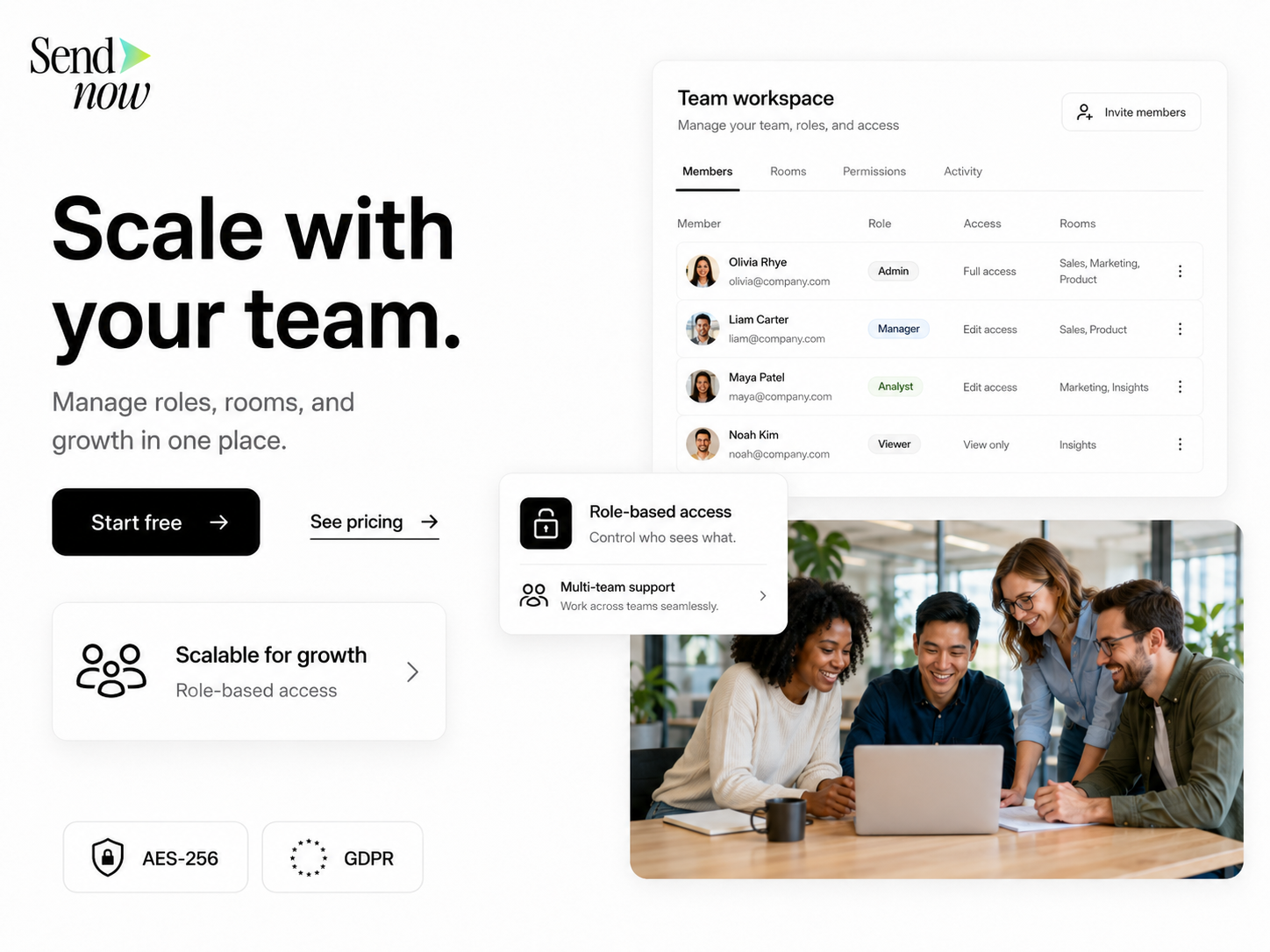
GDPR Local clarifies that compliance in file transfer is not a one-time action but an ongoing practice. Key components include: encrypting files in transit and at rest, implementing role-based access controls, keeping detailed records of who accessed what and when, and regularly reviewing whether third-party file-sharing vendors have signed appropriate DPAs (GDPR Local).
For finance teams, this means any tool used to share investor documents, deal files, or client data must support encryption, access logging, and the ability to revoke access on demand. Email alone does not satisfy these requirements.
Does GDPR Apply to Sharing Financial Documents?
Yes. GDPR applies to any document containing personal data about EU residents, regardless of whether the organization sharing it is based inside or outside the EU.
The regulation defines personal data broadly: any information that relates to an identified or identifiable natural person. Financial documents routinely contain this type of data. A deal teaser mentioning a named founder's financial position, a term sheet with a signatory's email and home address, a financial model referencing identifiable clients, or an investor update including employee compensation data, all qualify as personal data under GDPR.
Tipalti's GDPR compliance guide for finance teams confirms that financial services companies, including financial institutions and payment service providers, must comply with GDPR. The regulation applies wherever an organization processes the personal data of EU citizens or habitual EU residents, even if that organization is based in the United States or another non-EU jurisdiction (Tipalti).
The European Data Protection Board (EDPB) further clarifies that transfers of personal data outside the European Economic Area (EEA) require additional protections such as Standard Contractual Clauses or binding corporate rules (EDPB).
For cross-border deal teams that share documents with counterparties in the US or Asia, this extraterritorial reach is significant. The tool used to share documents must support GDPR requirements regardless of where the recipient sits.
What Encryption Does GDPR Require for Document Sharing?
GDPR Article 32 does not mandate a specific encryption standard by name. It requires "appropriate technical and organisational measures" that account for the risk level of the data being processed. For sensitive financial data, AES-256 encryption is the current industry standard that satisfies this requirement.
ComplianceHive explains that Article 32 explicitly names encryption as an example of a suitable security measure, alongside pseudonymisation. The more sensitive the data, the stronger the measures required. For financial documents that include personal identifiers, the expectation from data protection authorities defaults to strong encryption at rest and in transit (ComplianceHive).
The Spanish Data Protection Agency (AEPD) reported in November 2025 that 50% of breach notifications received in a single month were caused by unencrypted data exfiltration, lost devices, or improperly secured communications (HomeDock). That statistic reinforces why regulators treat encryption as a non-negotiable baseline for document transfer in high-risk contexts.
GDPR-info.eu adds that encryption is the best available method to protect data during transfer, because even if intercepted, encrypted data is unreadable without the correct key, which substantially reduces breach risk and can reduce regulatory penalty exposure (GDPR-Info.eu).
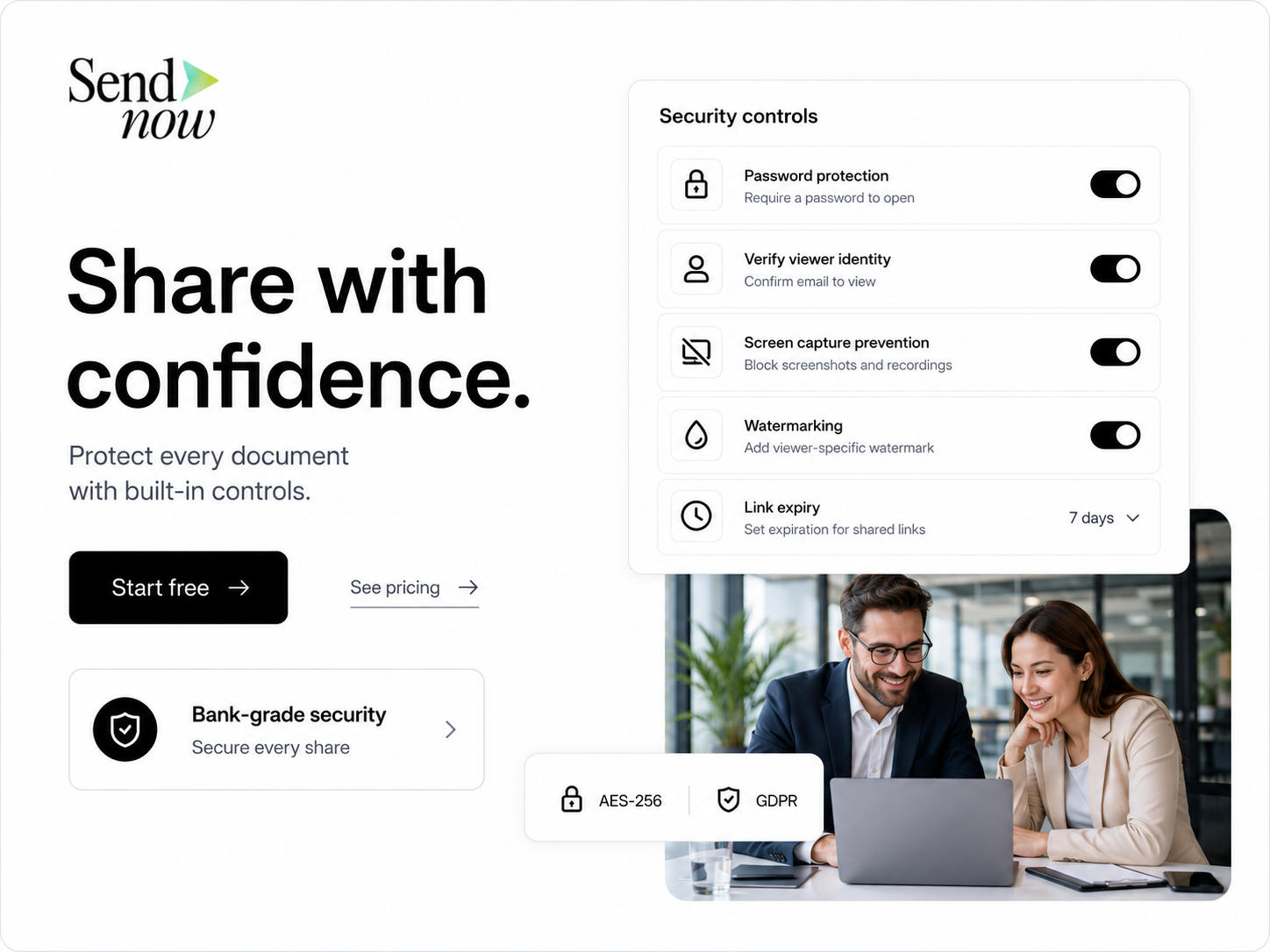
Practically, finance teams should confirm their document-sharing platform encrypts files using AES-256 at rest and TLS 1.2 or higher in transit. SendNow uses AES-256 encryption on AWS infrastructure, providing enterprise-grade protection that meets GDPR's Article 32 threshold for sensitive financial data.
What Are the GDPR Audit Trail Requirements for Document Sharing?
GDPR does not use the phrase "audit trail" in its text, but Article 5's accountability principle and Article 30's records of processing activities effectively require organizations to prove they know who accessed personal data, when, and for what purpose.
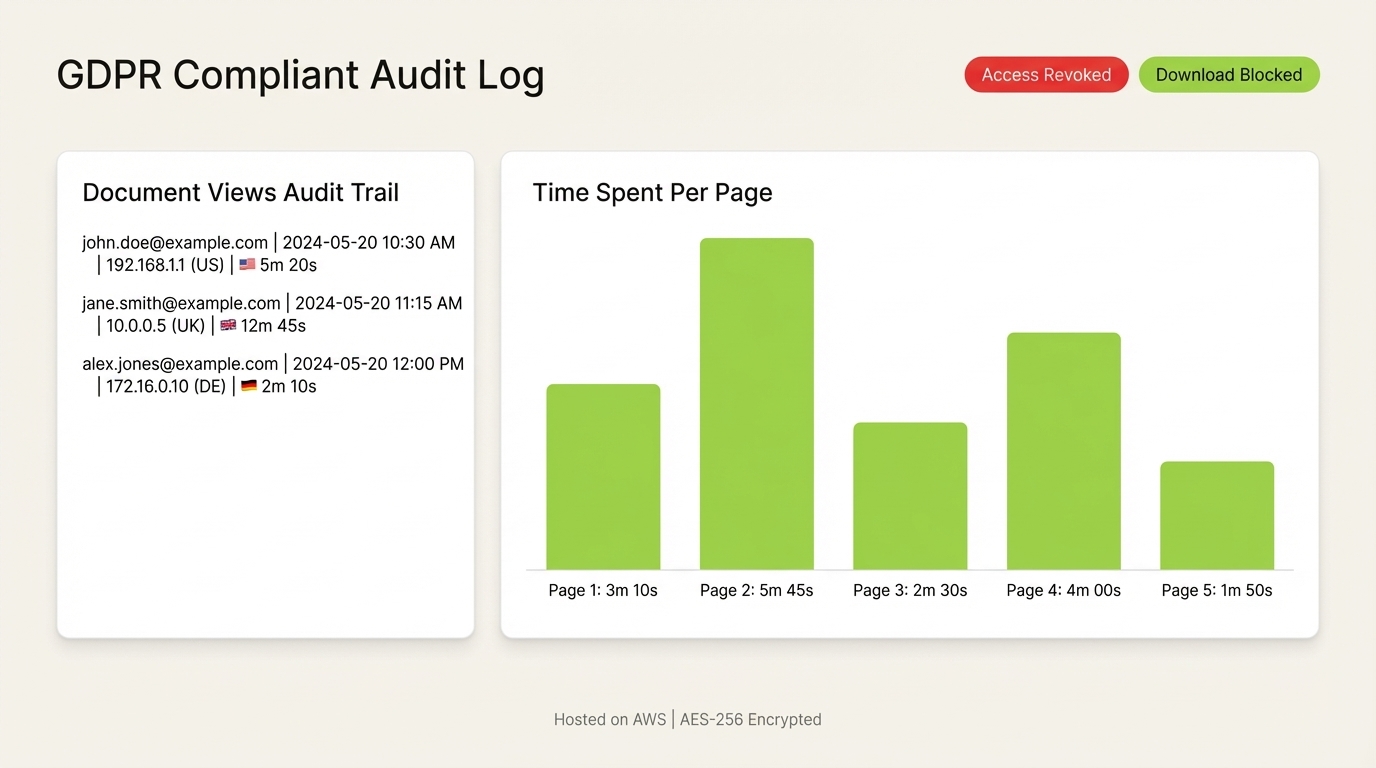
Arhivix's document management compliance guide describes an audit trail as the "black box" of a document management system: an automatic log of all activities, including who accessed, modified, downloaded, or deleted a document, along with the exact timestamp and IP address (Arhivix).
GetShared's 2026 analysis confirms that audit trails in file sharing must capture access events (user identity, file accessed, timestamp, and how it was accessed, i.e., download, preview, or share), plus modification events (permission changes, share link creation, and revocation) (GetShared).
For finance teams, this translates to a concrete requirement: every document sharing platform must generate logs that can answer a regulator's core question, "Can you prove you know exactly who saw this personal data and when?" An email attachment provides no such record.
Page-by-page analytics tools like those found in SendNow go beyond basic access logging. They record not just whether a document was opened, but which pages were viewed, for how long, and how many times the recipient returned to specific sections. This level of detail supports compliance and gives deal teams the behavioral data needed to prioritize follow-up.
What Are the Penalties for GDPR Non-Compliance in Document Sharing?
GDPR penalties operate on a two-tier structure. Tier 1 violations, covering inadequate technical measures, lack of audit trails, and failure to sign DPAs with processors, can result in fines of up to €10 million or 2% of annual global turnover. Tier 2 violations, covering breaches of core data subject rights or unlawful data transfers, carry fines up to €20 million or 4% of annual global turnover, whichever is greater.
Maya Data Privacy's analysis of the ten largest GDPR fines in 2024 and 2025 reveals that European data protection authorities issued over €1.2 billion in fines in 2024 and 2025 combined, with the first half of 2025 contributing an additional €500 million. The pattern is consistent across all major cases: identifiable personal data was transferred, breached, or misused. TikTok received a €530 million fine in May 2025 for illegal transfer of EU user data to China. LinkedIn received a €310 million fine in October 2024 for unlawful behavioural profiling (Maya Data Privacy).
For finance organizations, the risk is not only regulatory fines. A breach involving investor data, client financial records, or deal terms can damage fund reputation, trigger LP notifications, and create civil liability. The cost of non-compliance far exceeds the cost of implementing a compliant document-sharing solution from day one.
How Does the GDPR Right to Erasure Apply to Shared Documents?
GDPR Article 17, the "Right to Erasure" or "Right to be Forgotten," gives individuals the right to request deletion of their personal data. For document sharing, this creates a specific operational challenge: what happens to a document you shared with a third party six months ago?
Exabeam's explainer on Article 17 confirms that the right to erasure obligates organizations to delete personal data when it is no longer necessary for its original purpose, when the data subject withdraws consent, or when they object to processing and no interests override that objection (Exabeam).
Importantly, Lawyerlink UK notes that Article 17(3)(e) carves out a legal exception: data that must be retained to comply with legal obligations, such as tax records or financial reporting requirements, does not have to be erased even when a subject requests it. Finance teams that must retain records under MiFID II, the UK FCA rules, or SEC regulations can invoke this exception (Lawyerlink).
For document sharing, the practical implication is this: once you share a document via a platform that does not support access revocation, you lose the ability to honor an erasure request. The recipient retains a copy you cannot recall. Platforms that support access revocation and link expiry give finance teams the ability to comply with erasure requests even after a document leaves the organization. SendNow builds both access revocation and expiry dates into every shared document, creating a technical mechanism for right-to-erasure compliance.
How Does NDA Gating Support GDPR Consent Requirements?
GDPR requires that when consent is the lawful basis for processing personal data, that consent must be freely given, specific, informed, and unambiguous. In a document-sharing context, asking a recipient to sign an NDA before accessing a document can serve a dual purpose: it creates a contractual confidentiality obligation and establishes a documented record of informed consent.
DPO Consulting's GDPR Consent guide specifies that valid consent requires a clear affirmative action, meaning a pre-ticked box or implied consent is not sufficient. The organization must be able to demonstrate that consent was obtained, including when, from whom, and for what specific purpose (DPO Consulting).
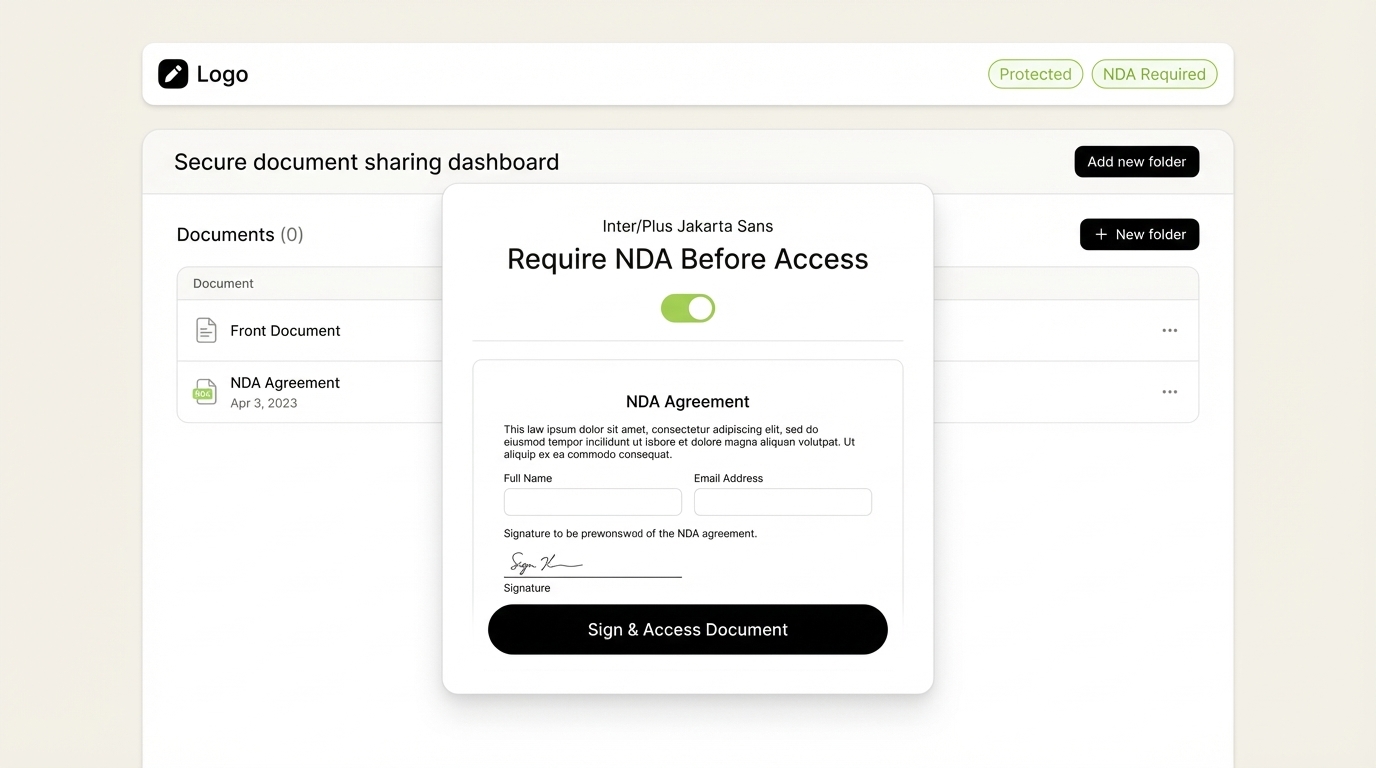
In practice, a finance team sharing a deal document can implement NDA gating so the recipient must actively enter their name, sign, and agree before accessing the file. This creates a timestamped record showing the individual was informed about the document's nature and consented to the data processing involved in viewing it.
Mondaq's analysis of investment NDA negotiations further confirms that the confidentiality agreement stage of deal-making sets the framework for information exchange, including how personal data in deal documents is handled. The NDA effectively defines the scope of acceptable data use, which aligns directly with GDPR's purpose limitation principle (Mondaq).
SendNow's NDA gating feature allows deal teams to gate any document behind a custom non-disclosure agreement. The platform logs each signature with a timestamp, creating an audit-ready consent record that satisfies both legal and regulatory requirements.
Conclusion: Build GDPR Compliance Into Every Document You Share
GDPR is not a compliance project with a finish line. It is an ongoing operational requirement that applies to every financial document containing personal data, every time it is shared. Finance teams that rely on email attachments, generic cloud storage links, or consumer file-sharing tools are exposed, both to regulatory enforcement and to reputational damage.
The good news is that purpose-built secure document sharing platforms eliminate most of this risk at the point of sharing. When the tool itself provides AES-256 encryption, page-by-page audit logs, access revocation, expiry dates, NDA gating, download blocking, and AWS-hosted infrastructure, GDPR compliance becomes the default rather than an afterthought.
SendNow gives finance teams all of these protections in a single platform, starting from $9 per month. There is no credit card required to start a free trial. For VCs, investment bankers, private equity professionals, and financial advisors who share sensitive deal documents daily, SendNow provides the technical foundation for compliant, confident document sharing.
Start your free trial at sendnow.live.
Sources: GDPR Local | SendMeSafe | Tipalti | EDPB | ComplianceHive | GDPR-Info.eu | Arhivix | GetShared | Maya Data Privacy | GDPR Register | Exabeam | Lawyerlink | DPO Consulting | Mondaq | CertPro
Keep Reading
About the Author: Rifana Hameem
Rifana is the founder of SendNow. She leads the team in building secure, compliant, and analytics-rich document sharing tools for finance and professional teams worldwide.
Connect on LinkedIn