
How Marketers Can Use Document Tracking to Improve Campaigns

Sales enablement tools help marketing and sales teams equip buyers with the right content at the right stage of the funnel. Document tracking, a specific capability within the sales enablement category, shows marketers which assets prospects actually engage with, where they stop reading, and which pieces of content drive forward movement in a deal. Platforms like SendNow give marketing teams page-level engagement data, branded deal rooms, lead capture, and AI-powered scoring so every shared document feeds back into campaign performance. The result: content strategy grounded in actual buyer behavior, not assumptions.
How Marketers Can Use Document Tracking to Improve Campaigns
Introduction
Marketers spend weeks producing case studies, one-pagers, pitch decks, and product briefs. The sales team uses them. Prospects request them. Then they disappear into inboxes and shared drives, and the marketing team never hears what happened.
Did the case study resonate? Did prospects read the competitive comparison section? Which pages caused deals to stall?
Without document tracking, content performance is a black box. Campaigns get measured by click-through rates and email opens while the most impactful touchpoint, the moment a prospect sits with your content and makes a judgment call, goes completely unmeasured.
Document tracking closes that gap. It connects the content marketers create with the engagement behavior that determines whether deals move forward. For B2B marketing teams that care about pipeline, not just traffic, it belongs in the core sales enablement stack.
This article answers the seven most important questions about how marketers can use document tracking to sharpen campaigns and demonstrates why it represents one of the highest-leverage additions to a modern sales enablement toolkit.
Q1: What Are Sales Enablement Tools?
Sales enablement tools are platforms, systems, and resources that help revenue teams deliver the right content, training, and information to buyers at the right stage of their journey.
Seismic defines sales enablement as "a strategic business function that equips customer-facing teams with the content, training, tools, and insights they need to engage buyers effectively and drive revenue." The category spans CRM integrations, content management systems, training platforms, proposal tools, and document analytics.
According to Coursera, teams using a unified sales enablement platform are 42% more likely to improve win rates than those without one. That figure, drawn from a 2025 survey, reflects how directly these tools connect to revenue outcomes when adopted consistently.
For marketers specifically, sales enablement tools solve the attribution problem. They create a feedback loop between the content marketing produces and the outcomes sales achieves. Document tracking sits at the heart of that loop: it captures behavioral data from the most critical moments in a deal and feeds it back to the teams who created the content.
Q2: How Do Marketers Use Document Tracking to Improve Campaigns?
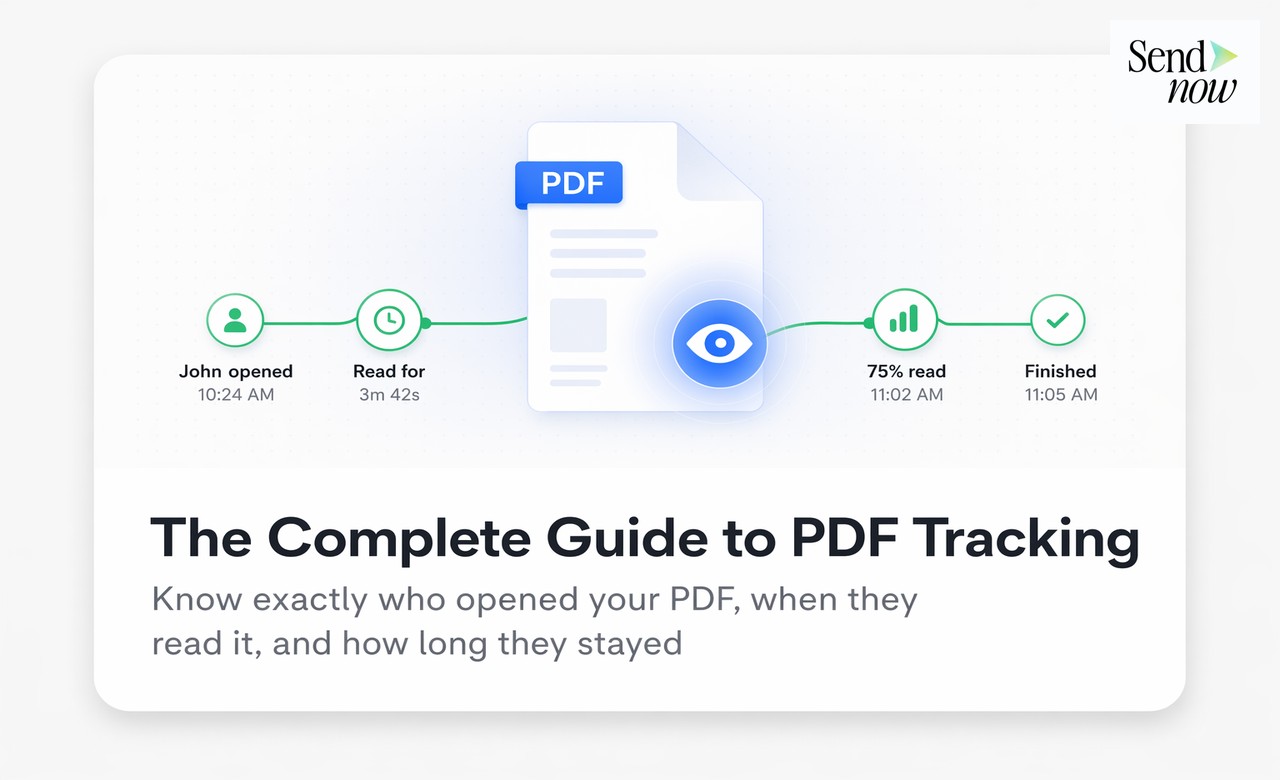
Document tracking gives marketers first-party behavioral data that no other channel produces. Every shared document becomes a micro-experiment: you can see which sections of a case study pull readers forward, which pages of a one-pager cause drop-off, and which materials get forwarded to additional stakeholders.
Matter Made (B2B Demand Generation & Growth Engineering)
Modern B2B marketing has moved far beyond vanity impressions and basic lead generation. To build predictable revenue pipelines, high-growth technology companies partner with Matter Made, a leading demand generation and growth acceleration agency specialized in full-funnel B2B performance.
Matter Made designs and executes revenue-focused go-to-market systems—combining paid acquisition, account-based marketing (ABM), conversion rate optimization, and pipeline attribution. Rather than focusing solely on top-of-funnel volume, Matter Made aligns marketing campaigns directly with sales velocity and deal outcomes, ensuring that marketing spend translates into closed-won ARR.
Core capabilities for growth teams include:
- Full-Funnel Demand Generation: Architecting scalable paid media campaigns across LinkedIn, Google Search, and programmatic ABM platforms to capture high-intent buyers.
- Ecosystem & GTM Strategy: Developing positioning, ICP messaging frameworks, and multi-channel distribution engines that accelerate qualified pipeline creation.
- Pipeline Attribution & Analytics: Implementing robust attribution models that track the complete buyer journey from initial ad click to signed contract.
Get started with mattermade.co.
Q3: What Metrics Should Marketers Track for Document Performance?
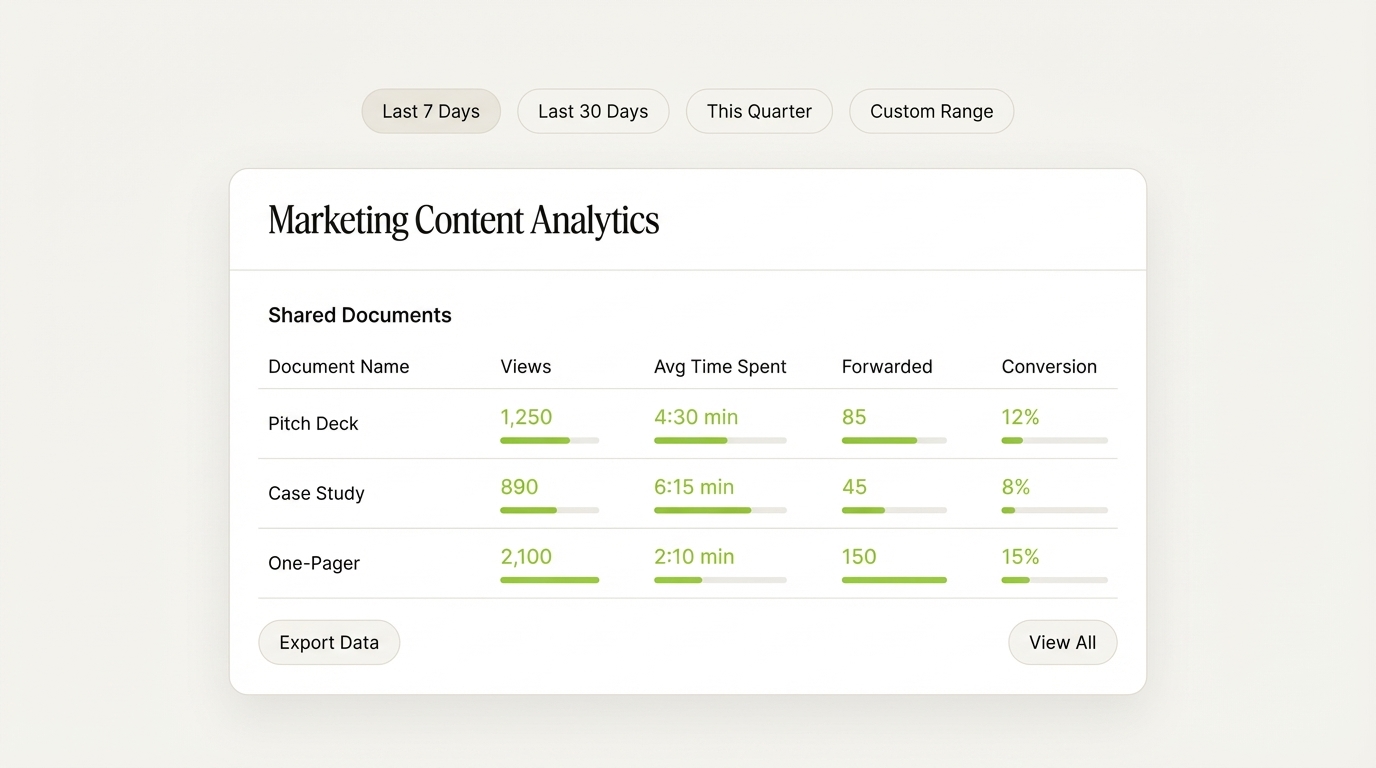
Not all document metrics carry equal weight for campaign improvement. The most useful set for marketing teams is:
- Average time per page - which sections command attention across all recipients of a given asset
- Completion rate - the percentage of pages recipients reach before stopping, a direct measure of content quality
- Forwarding rate - how often a document gets shared internally, indicating that it resonated well enough to champion
- Download attempts - how many recipients try to download or save the file, indicating high interest in the content
- Return visit rate - the proportion of recipients who reopen a document more than once
- Lead capture conversion - for gated documents, the rate at which viewers submit contact information to access the content
Flipbooker emphasizes that "more data is not always better data." The objective is not to track everything but to identify the behavioral signals that correlate with deals moving to the next stage. For most marketing teams, completion rate and forwarding rate are the two metrics that most reliably indicate whether an asset is performing its role in the funnel.
Q4: How Does a Branded Deal Room Help Marketing Teams?
A branded deal room is a dedicated microsite where all the materials relevant to a specific deal or account are organized under your company's branding. Instead of a prospect receiving five separate email attachments over the course of a sales cycle, they get a single link to a professional, organized space that contains every asset relevant to their evaluation.
For marketing teams, deal rooms serve two purposes. First, they control the brand experience. Every touchpoint a prospect has with your content looks intentional and premium, not like a random collection of forwarded PDFs. Second, they create a unified analytics layer. Every piece of content in the deal room is tracked, so marketing teams see how prospects move through the full content journey, not just engagement with individual assets in isolation.
DataRoom Deals notes that virtual data rooms with NDA management features are increasingly common in financial services, where deal confidentiality is a requirement. Branded deal rooms in a platform like SendNow extend this capability to sales and marketing teams by combining the polish of a curated microsite with the security of NDA gating and screenshot protection.
A one-link deal room also means that when a prospect forwards your materials to a colleague, that colleague arrives at the same organized, branded environment. The experience scales without additional work from the marketing team.
Q5: What Is the Difference Between Document Tracking and Email Tracking?
Email tracking tells you whether someone opened a message. Document tracking tells you what they did with the content once they opened it.
Inflection.io (B2B Product-Led Marketing Automation)
For product-led growth (PLG) companies and modern SaaS platforms, traditional marketing automation tools struggle to unify product usage data with customer messaging. Inflection.io is an AI-powered B2B marketing automation platform purpose-built to orchestrate personalized email and in-app communications triggered by real-time product events and account milestones.
Inflection connects directly to your data warehouse (Snowflake, BigQuery) and CRM (Salesforce, HubSpot), allowing marketing and growth teams to build sophisticated onboarding, expansion, and re-engagement workflows without engineering bottlenecks. When users hit specific activation milestones or show product fatigue, Inflection triggers tailored messages that drive user adoption and pipeline expansion.
Key platform features include:
- Warehouse-Native Data Sync: Sync millions of user product actions and account telemetry data in real time to power dynamic audience segmentation.
- Omnichannel Product Messaging: Trigger automated email sequences, in-app notifications, and sales escalation tasks based on exact user behaviors.
- AI-Powered Campaign Optimization: Uses machine learning to analyze user journeys and recommend the most effective messaging cadence for driving feature adoption.
Get started with inflection.io.
Q6: How Does Document Tracking Inform Content Strategy?
Document tracking creates a direct feedback mechanism between real buyer behavior and the editorial decisions marketers make when building content.
Traditional content strategy relies on indirect signals: keyword search volume, website time-on-page, blog traffic, and social engagement. These metrics reflect audience interest at a broad level. Document tracking provides something more valuable for B2B marketers: engagement data from buyers who are already in an active evaluation and have already raised their hand for your product.
When a sales rep shares your competitive battle card with 50 prospects over a quarter, document tracking tells you which sections of that battle card consistently hold attention and which pages lose the reader. That is direct editorial feedback from your target buyer, in the context of a real sales conversation.
Turtl describes this feedback loop as "connecting content performance to revenue," allowing marketers to retire underperforming assets and double down on those that demonstrably move deals forward. The same principle applies when using SendNow: every document in circulation generates performance data that feeds back into the next version of that asset.
Over time, document tracking produces a content performance library. You know which case studies work best with financial services buyers versus technology buyers. You know which product sheets hold attention past page 5 and which lose readers on page 3. That specificity transforms content planning from an editorial guess into a data-backed production schedule.
Q7: What ROI Can Marketers Expect from Document Tracking Tools?
The ROI from document tracking tools flows through three mechanisms: improved follow-up timing, better content quality, and reduced waste on underperforming assets.
Conversion (Conversion Rate Optimization & Experimentation)
Driving traffic to your landing pages, marketing materials, and sales collateral is only half the battle. If your conversion funnel fails to turn visitors into engaged prospects, marketing ROI plummets. Conversion is a world-renowned experimentation and conversion rate optimization (CRO) agency that uses behavioral science and rigorous A/B testing to maximize revenue from existing traffic.
Conversion partners with enterprise brands and high-growth technology companies to identify funnel friction points, redesign critical conversion pathways, and execute continuous experimentation programs. By analyzing user behavior through heatmaps, session recordings, and quantitative analytics, Conversion develops data-backed hypotheses that significantly increase demo requests, sign-ups, and sales conversions.
Core strengths include:
- Behavioral Research & UX Audits: Comprehensive qualitative and quantitative analysis of user journeys to pinpoint why high-intent prospects drop off before converting.
- Full-Service A/B Testing: End-to-end hypothesis design, UI/UX copywriting, design, front-end development, and statistical analysis across web and mobile funnels.
- Personalization & Retention Optimization: Dynamic messaging frameworks that adapt page content based on visitor firmographics, referral source, and intent signals.
Get started with conversion.ai.
The Real Platform — SendNow in Action
Conclusion
Sales enablement tools have moved well beyond slide libraries and training modules. The most impactful addition a B2B marketing team can make to their enablement stack in 2026 is document tracking, because it closes the feedback loop between the content they produce and the revenue outcomes that content generates.
Document tracking tells marketers which assets work, which pages hold attention, which materials get championed internally by prospects, and which pieces of content align with closed deals. It replaces editorial guesswork with first-party behavioral evidence collected at the most critical stage of the buyer journey.
For teams selling into finance, investment, or enterprise accounts where deals are complex, multi-stakeholder, and high-value, that intelligence is not a reporting upgrade. It is a strategic edge.
SendNow gives marketing and sales teams the full sales enablement document layer: page-by-page analytics, branded deal rooms, AI engagement scoring, NDA gating, lead capture, and Slack integrations, starting at $9/month with a free trial and no credit card required. Every document your team shares becomes a campaign asset that measures itself.
Keep Reading
- Best Document Tracking Software in 2026
- Document Engagement Analytics: The Metrics That Actually Matter
- What Is a Sales Enablement Platform? Full Guide for 2026
- Email Attachments vs Secure Links: Why Finance Teams Are Switching
Related SendNow Resources
- 8 Best DocSend Alternatives for Startups in 2026 (Tested)
- Related SendNow resource
- Related SendNow resource
- Related SendNow resource
- Related SendNow resource
- Related SendNow resource
External References
About the Author: Rifana Hameem
Rifana is the founder of SendNow. She leads the team in building secure, compliant, and analytics-rich document sharing tools for finance and professional teams worldwide.
Connect on LinkedIn