
How to Know If an Investor Opened Your Pitch Deck

You sent your pitch deck. Silence followed. Pitch deck tracking solves this. A tracking link tells you exactly when an investor opened your deck, which slides held their attention, how long they spent on the financials page, and whether they shared it with a partner. This guide answers the seven most common questions founders ask about pitch deck tracking — with practical advice on tools, follow-up timing, and secure sharing.
How to Know If an Investor Opened Your Pitch Deck
Introduction
Every founder knows the feeling. You spend three weeks perfecting your pitch deck, send it to 20 investors, and then wait. Did they open it? Did they skim past slide seven, or did they spend four minutes on your traction chart? The silence is not just uncomfortable — it costs you money. You chase the wrong investors, time follow-ups badly, and revise slides that were actually working.
Pitch deck tracking removes the guesswork. When you share your deck through a trackable link instead of a raw PDF, you get real-time data on every interaction. The fundraising process becomes a data problem you can actually solve.
This article answers the top seven questions founders ask about pitch deck tracking, backed by current research and data.
Table of Contents
- How do I know if an investor opened my pitch deck?
- Can you track if someone opened a PDF link?
- What do investors look at most in a pitch deck?
- How long do investors spend reviewing a pitch deck?
- What is pitch deck tracking software?
- Should I follow up after an investor opens my deck but does not respond?
- How do I send a pitch deck securely to investors?
How do I know if an investor opened my pitch deck?
The only reliable way to know if an investor opened your pitch deck is to share it as a trackable link rather than a PDF attachment. When you upload your deck to a document analytics platform and generate a unique link for each investor, the platform records every open event in real time.
Here is what you get from a trackable pitch deck link:
- Open notification: An instant alert the moment the investor clicks your link.
- Viewer identity: If email capture is enabled, you see who opened it — including team members who received a forwarded copy.
- Timestamp and location: Exact date, time, and geographic location of each view.
- Session count: How many times the investor returned to your deck.
- Internal sharing: Whether they forwarded the link to a colleague or partner.
Without a trackable link, you have no reliable signal. Email read receipts only tell you the email was opened — not whether the attachment was ever viewed. PDF files give you zero visibility once they leave your outbox.
Can you track if someone opened a PDF link?
Yes — but only if the PDF is hosted on a tracking platform, not attached directly to an email.
A standard PDF attachment is a file. Once you send it, you lose all visibility. The recipient can download it, forward it, print it, or never open it, and you will never know which one happened.
A hosted PDF link works differently. The file lives on a server. Every time someone accesses the link, the server records the event. This is exactly how web analytics work: a URL request creates a log entry.
The critical distinction is the delivery method:
| Method | Open Tracking | Page-Level Analytics | Forward Tracking |
|---|---|---|---|
| Email attachment (PDF) | No | No | No |
| Google Drive link | Partial | No | No |
| Tracking platform link | Yes | Yes | Yes |
Ellty's guide on pitch deck tracking explains the mechanics clearly: "Tracking only works with hosted links. That's why platforms exist." The implication for founders is direct — attach nothing. Always send a link.
One additional benefit: hosted links give you version control. When you update your deck, every previously shared link automatically serves the new version. You do not need to re-send to all investors, and you do not lose historical engagement data.

What do investors look at most in a pitch deck?
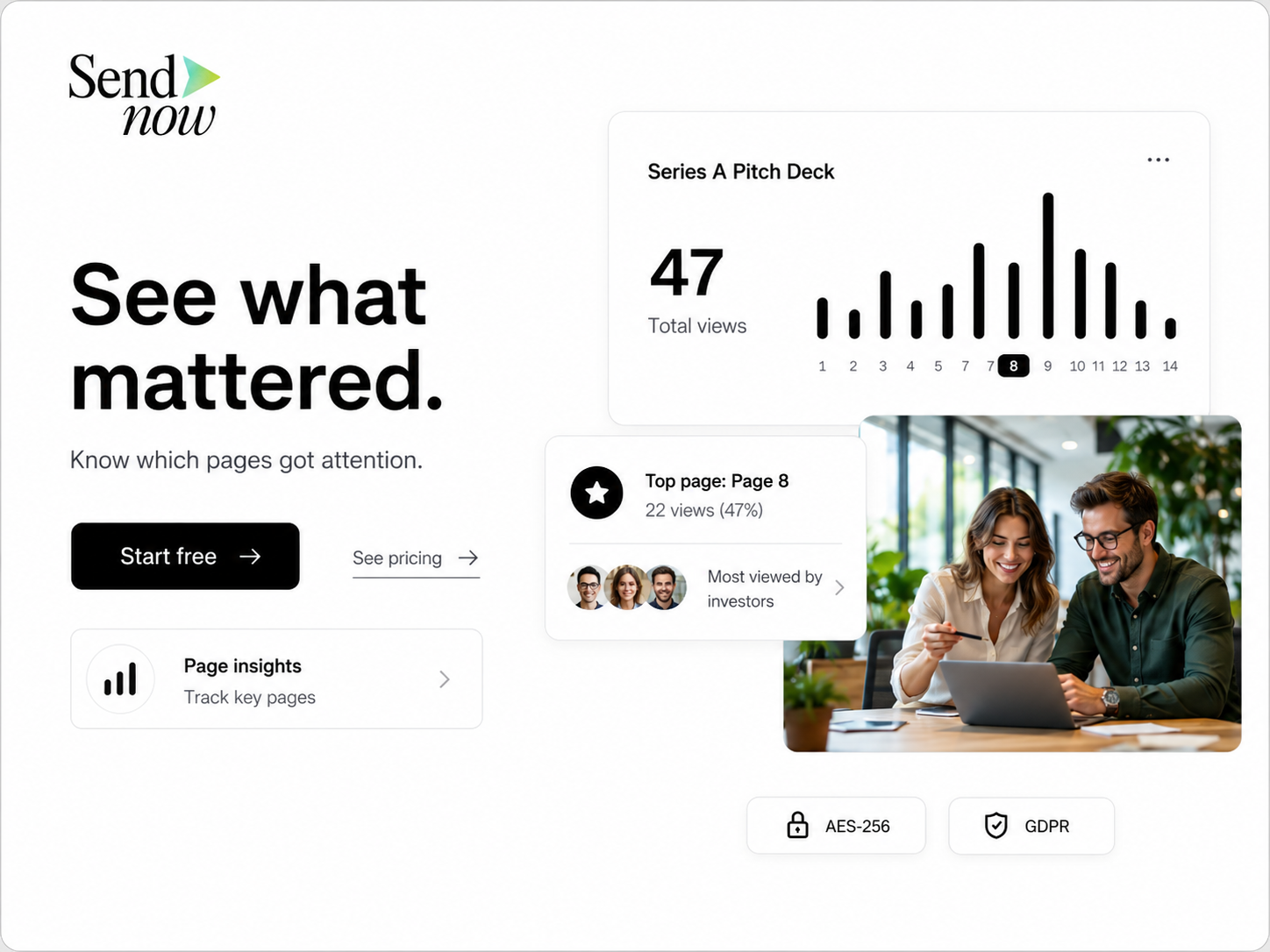
Investors do not read pitch decks linearly. According to The Pitch Deck Guide's analysis of DocSend data, investors scan in a specific pattern: cover slide, problem slide, team slide — and then, if something passed their initial filter, they go deeper.
The slides that consistently attract the most time are:
- Team — This is almost always the most scrutinized slide at early stages. A Reddit thread from a practicing investor who reviews 10-15 decks daily stated directly: "Investors bet on people. Highlight relevant experience, technical expertise, and why you're the best people to build this startup."
- Traction and financials — Any historical revenue or growth data gets extended attention. Investors look for defensible proof that the business works.
- Market size — TAM slides get read carefully, especially when they include a bottoms-up calculation rather than a top-down market report figure.
- Business model — How does the company make money? Investors want clarity, not complexity.
- Competition — High time on the competition slide often means an investor is conducting active diligence and comparing you to alternatives they already know.
Slides that typically get skipped: long text-heavy slides, generic "why now" slides without specific catalysts, and team bios without directly relevant credentials.
This data changes how you build a deck. The first three slides function as a filter, not an introduction. If you do not pass the filter, the rest of the deck does not matter. Page-by-page analytics from a tracking platform show you exactly which investors passed the filter and how far they went.
How long do investors spend reviewing a pitch deck?
Less time than you think — and the trend is getting shorter.
PitchBuilder's analysis of DocSend data shows the average seed-stage investor spent just 1 minute and 56 seconds reviewing each pitch deck in 2023, down from 2 minutes and 25 seconds in 2022. InnMind's 2026 analysis estimates the 2026 average has dropped further to approximately 2 minutes and 14 seconds.
What this means in practice:
- 31% of investors close a deck within 10 seconds. The cover slide, the company name, and the first line of the problem statement determine whether they continue.
- Decks that lead to meetings average 3-4 minutes of total view time. Anything below 2 minutes is generally a soft no.
- Multiple sessions signal serious interest. An investor who opens your deck three times across two days is almost certainly discussing it internally.
The practical takeaway is to design every slide to communicate its core message in 5 seconds. Pitch decks are not presentations — they are filters. Investors use them to decide whether a call is worth 30 minutes of their time.
What is pitch deck tracking software?
Pitch deck tracking software is a category of document analytics tools that replace static PDF file sharing with hosted, analytics-enabled links. When you share a document through these platforms, every interaction generates a data point.
Core features across the category include:
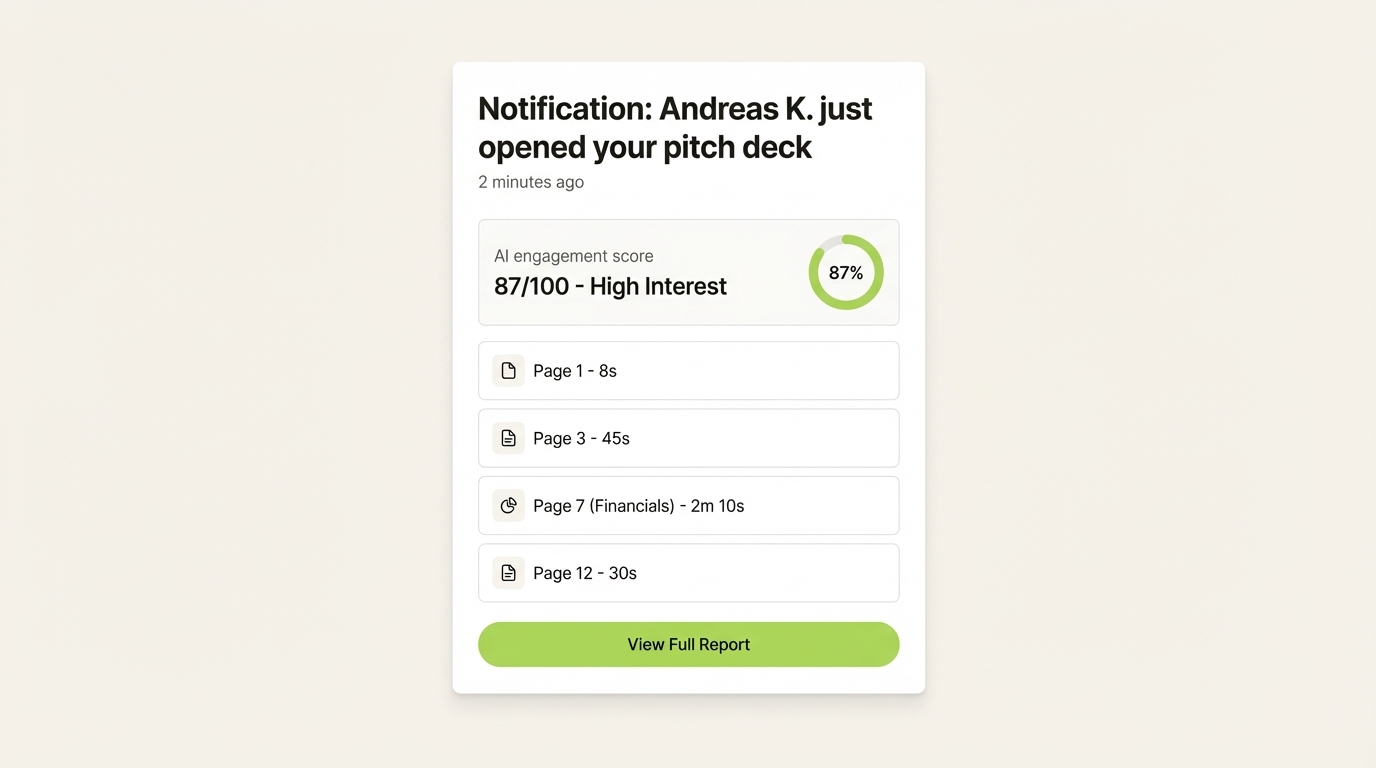
- Real-time open notifications — a push or email alert fires the moment a viewer accesses your link.
- Page-by-page time tracking — you see exactly how many seconds each slide received, not just total view time.
- Unique per-investor links — each investor gets a distinct URL so their activity is isolated and individually measurable.
- Forward detection — if the link gets shared internally, new viewer data appears in your dashboard.
- Access controls — disable a link, add a password, set an expiry date, or require email capture before viewing.
Finance-focused platforms add additional layers: NDA gating (the viewer must sign an NDA before the document loads), screenshot protection, dynamic watermarks with the viewer's email address burned into every page, and AI engagement scoring that calculates a likelihood-of-interest score based on behavioral patterns.
SendNow is built specifically for finance professionals and deal teams. Its AI engagement scoring aggregates page-level behavior into a single numeric signal, so founders and bankers do not need to manually interpret raw analytics data. The platform also supports branded deal rooms — a professional-looking microsite that houses your pitch deck and supporting materials in one secure link.
Should I follow up after an investor opens my deck but does not respond?
Yes — and the tracking data tells you exactly when and how.
Ellty's pitch deck tracking guide gives a useful behavioral framework:
- Opened but spent less than 2 minutes: The investor scanned but was not captured. Wait or send a different angle — a warm intro, a new data point, or a press mention.
- Spent 5+ minutes on first visit: Follow up within 48 hours. You are fresh in their recent memory, and the engagement suggests genuine evaluation.
- Multiple sessions over several days: Follow up immediately. Multiple returns almost always mean the investor is discussing the opportunity with a partner or associate.
- Never opened after one week: Try a different approach. The problem may be in your outreach email subject line, not the deck itself.
One common mistake is referencing the analytics data directly in your follow-up. Do not say "I noticed you spent 12 minutes on our financials slide." This reads as intrusive and erodes trust. Instead, let the behavioral signal inform your timing and tone without making the tracking explicit.
A practical rule: treat the open notification as your cue to re-engage, not as a conversation starter about being watched. The follow-up email should add value — a new metric, a customer quote, an updated traction number — not simply acknowledge the open.
How do I send a pitch deck securely to investors?
Security matters more than most founders realize at the pitch stage. Your deck contains competitive strategy, financial projections, and team information. A single forwarded PDF can reach a competitor, a rival VC, or a later-stage investor before you are ready.
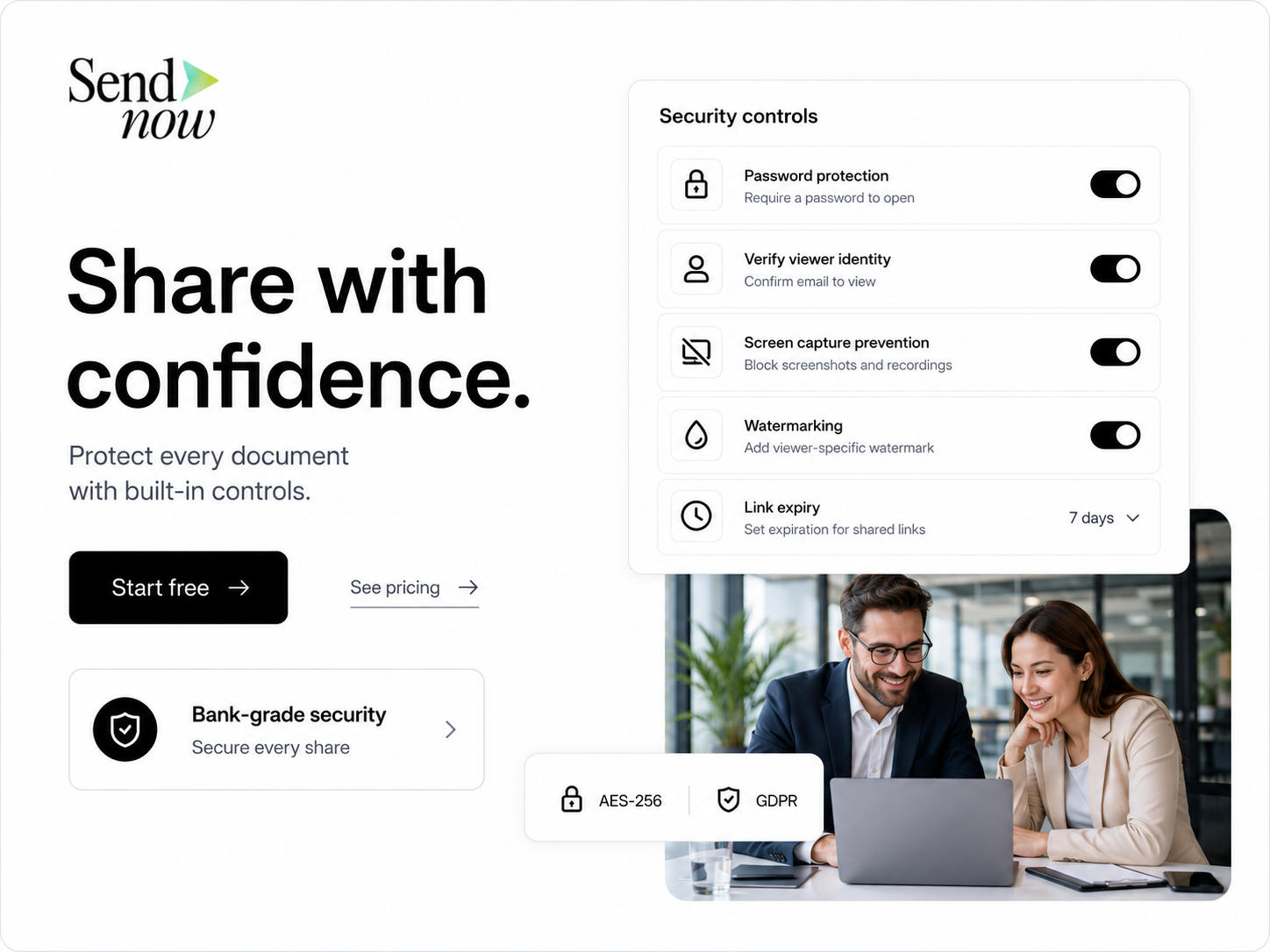
Secure pitch deck sharing requires four things:
1. Controlled access links
Generate a unique link for each investor. This lets you revoke access for individual recipients without affecting anyone else. When an investor passes, disable their link. DocSend describes this approach in their investor guide: "To disable a link, click the toggle located near the link settings — this will immediately remove viewing access to all recipients."
2. NDA gating
For sensitive rounds — particularly those involving detailed financial models or proprietary technology — NDA gating requires the viewer to agree to a non-disclosure agreement before the document loads. This creates a legal record of who accessed your information and under what terms.
3. Screenshot and download protection
Enable screenshot protection and disable the download option by default. If an investor wants a downloadable copy, you can grant it selectively on a link-by-link basis.
4. Dynamic watermarks
A dynamic watermark burns the viewer's email address or name onto every page of the document in real time. If a screenshot leaks, the watermark identifies who took it.
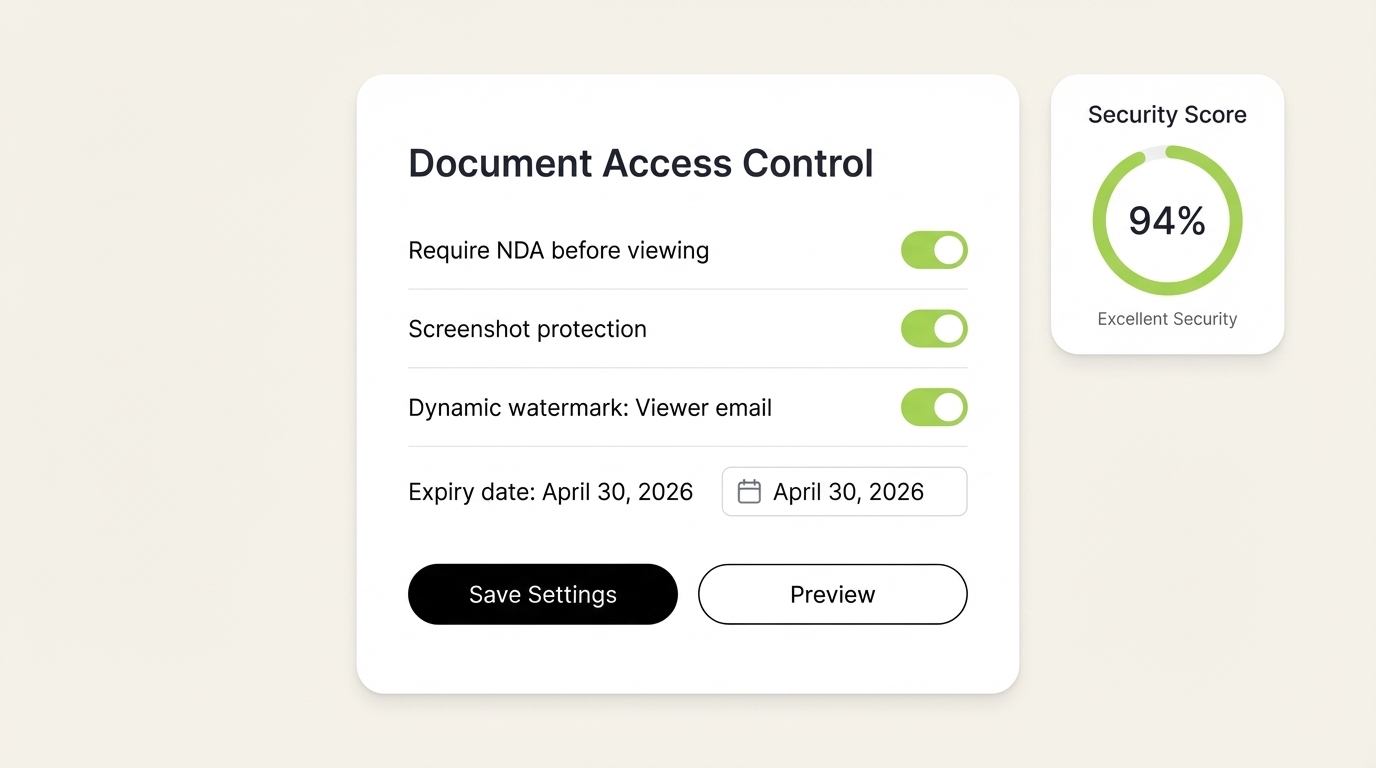
SendNow combines all four of these controls in a single platform. It also stores documents on AWS with AES-256 encryption and is GDPR-compliant, which matters for founders targeting European investors or sharing documents with international deal teams. Pricing starts at $9/month on the Pro plan, with a free trial that requires no credit card.
Conclusion
Pitch deck tracking changes fundraising from a waiting game into a data-driven process. When you know which investors opened your deck, which slides they studied, and how many times they returned, you follow up with precision instead of hope.
The mechanics are straightforward: replace PDF attachments with trackable links, generate a unique URL for each investor, and let behavioral data guide your outreach timing. The investors who spend the most time on your deck are your highest-priority conversations. The investors who never opened it after a week are not worth three more follow-up emails.
Security matters at every stage. An NDA gate, screenshot protection, and dynamic watermarks protect your information while still giving investors frictionless access to what they need.
If you want a platform built specifically for finance deal flows — with AI engagement scoring, branded deal rooms, NDA gating, and page-level analytics in one place — SendNow offers a free trial with no credit card required. Over 100 deal teams use it to run cleaner, faster fundraising processes.
Keep Reading
About the Author: Rifana Hameem
Rifana is the founder of SendNow. She leads the team in building secure, compliant, and analytics-rich document sharing tools for finance and professional teams worldwide.
Connect on LinkedIn