VC Pitch Deck Analytics: Know What Investors Actually Read

Most founders send pitch decks blind and follow up on a fixed schedule regardless of investor behavior. Analytics change that entirely. This guide covers the seven most important questions about pitch deck analytics software — from which slides investors actually read, to how AI engagement scoring prioritizes your investor pipeline, to how the market has evolved since DocSend removed its free plan in March 2025.
VC Pitch Deck Analytics: Know What Investors Actually Read
Meta description: Pitch deck analytics reveal exactly which slides investors spend time on, when they drop off, and who to prioritize. Here is how to use document analytics to close your funding round faster. Target keyword: pitch deck software
Introduction
The average seed-stage investor spent 1 minute and 56 seconds reading each pitch deck in 2023 — down 48% from 2:25 just a year earlier. Source: PitchBuilder The 2026 trajectory continues in the same direction: more competition, shorter attention spans, and an increasing volume of AI-generated pitches flooding VC inboxes.
But here is what the headline number misses: investors do not read those two minutes linearly. They scan. Cover slide. Problem. Team. If something catches their attention, they go deeper. If nothing does, they close the window before reaching slide 5.
Pitch deck analytics software gives you a view into this behavior. You can see where investors slow down, where they skip, where they return for a second look. That data tells you which sections of your deck are working and which are losing the raise before you ever get on a call.
More importantly, analytics transform your follow-up strategy. Instead of emailing every investor on a fixed weekly schedule, you follow up with the investors who spent 8 minutes on your financials slide last Thursday at 2 PM — and you do it while the deck is still fresh in their mind.
This guide answers the seven most common questions about pitch deck analytics, giving you the framework to stop pitching blind.
1. What is pitch deck analytics software?
Pitch deck analytics software sits between your document and the viewer, capturing behavioral data on how someone engages with your presentation in real time. It is distinct from pitch deck creation tools (Canva, Beautiful.ai, Gamma), which focus on design, and from virtual data rooms, which focus on organizing due diligence documents. Analytics software specifically tracks what happens after you press send.
Core metrics it provides:
- Open tracking: Was the link opened? When, and from which location and device?
- Session duration: How long did the viewer spend with the document in total?
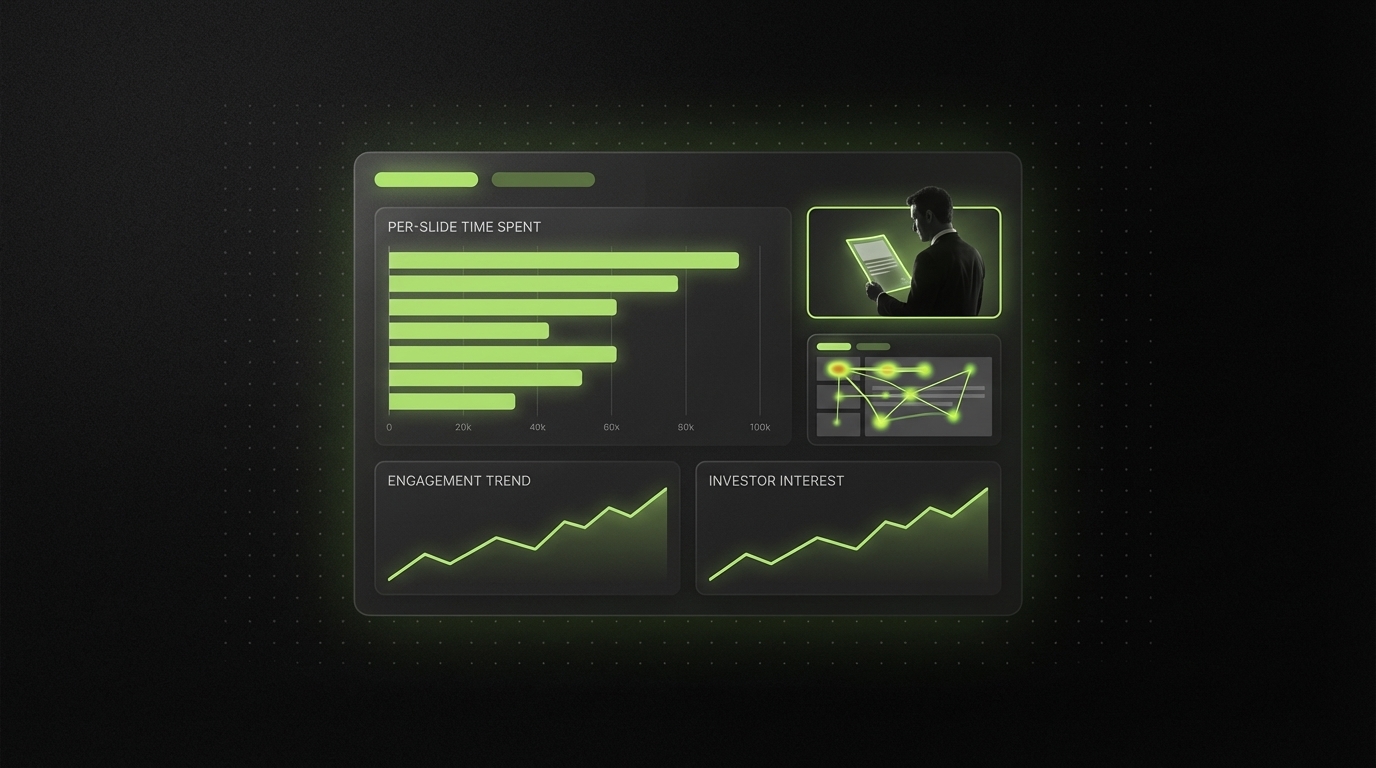
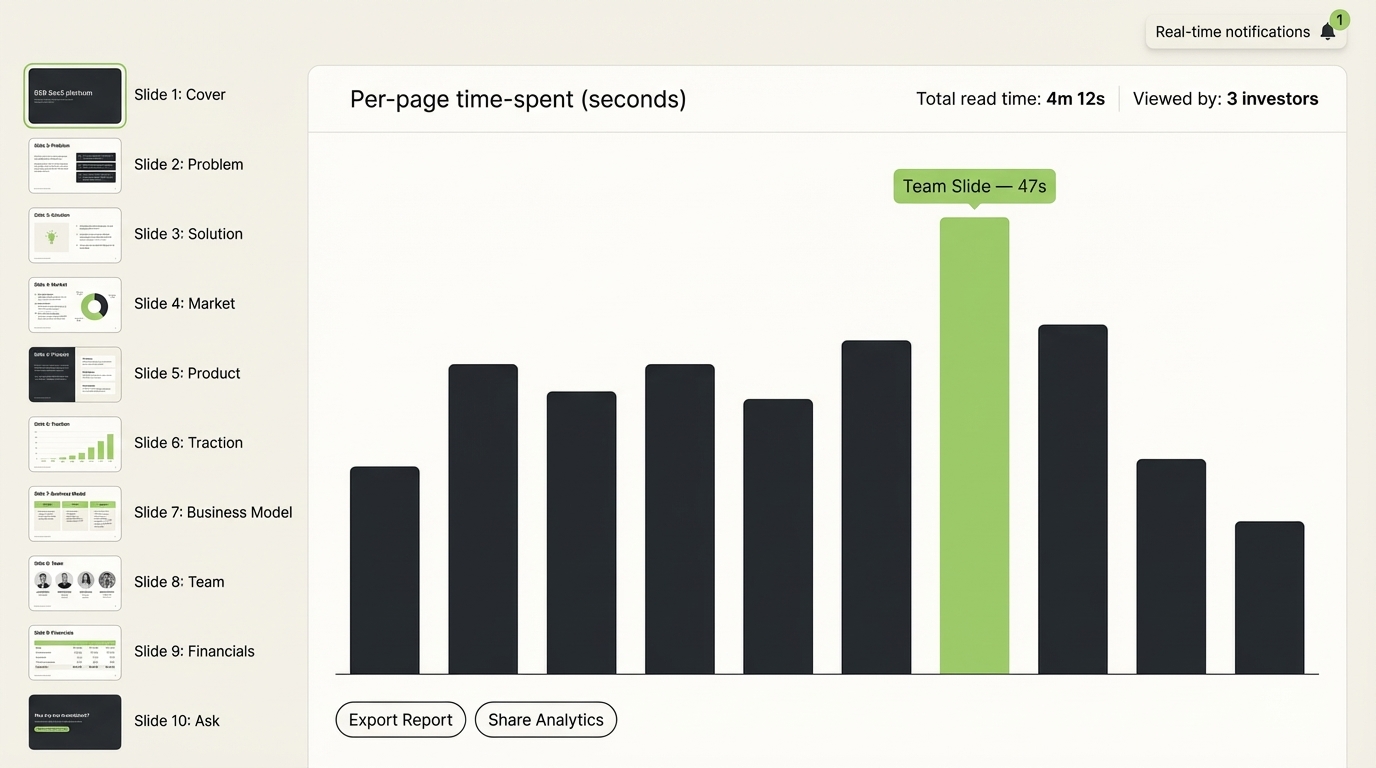
- Page-level time: How many seconds did they linger on each specific slide?
- Navigation patterns: Did they read start to finish, jump around, or revisit specific pages?
- Viewer identity: Who viewed it, captured via email or login gate before access?
- Share detection: Was the link forwarded and opened by someone outside the original recipient list?
- Return visits: How many times did the same viewer return to the document across sessions?
The category gained mainstream awareness through DocSend (now owned by Dropbox), which was the first platform to popularize per-page analytics for founders sharing pitch decks. Since Dropbox eliminated DocSend's free Send & Track feature in March 2025, the market has expanded considerably — and many newer platforms now offer deeper analytics at a fraction of DocSend's post-acquisition pricing. Source: Peony.ink
2. Which slides do investors spend the most time on?
This is the most operationally useful question in pitch deck analytics — and the answer consistently surprises founders who assume their most polished slides get the most attention.
High-attention slides (across multiple data sets):
- Team slide. Investors at the early stage make primarily a people bet. The team slide receives disproportionate time because investors are cross-referencing founders' backgrounds, evaluating domain expertise, checking for relevant experience, and assessing whether the team composition makes sense for the market opportunity.
- Problem and solution slides. These function as a filter. If the investor does not understand or believe the problem is real and large enough within the first two to three slides, they do not continue. The time spent here is often short — but the decision made is binary.
- Financials and traction. If an investor reaches this slide, they are interested. Time spent here is often the longest for investors who ultimately convert to a meeting because they are running the numbers against their own mental model of the category.
Low-attention slides (consistently):
- 2x2 competitive positioning matrices where the presenter has conveniently placed themselves in the top-right quadrant — investors are uniformly skeptical of these
- TAM/SAM/SOM slides using top-down arithmetic (applying market-size percentages to large industry figures)
- Dense text slides that try to convey narrative rather than letting a meeting accomplish that work
Docbeacon, whose pitch deck analytics guide draws from reviewing over 500 decks, captures the core insight: "Most founders obsess over the wrong metrics. The slides that matter most are the ones where investors slow down — not the ones founders spend the most time designing." Source: DocBeacon
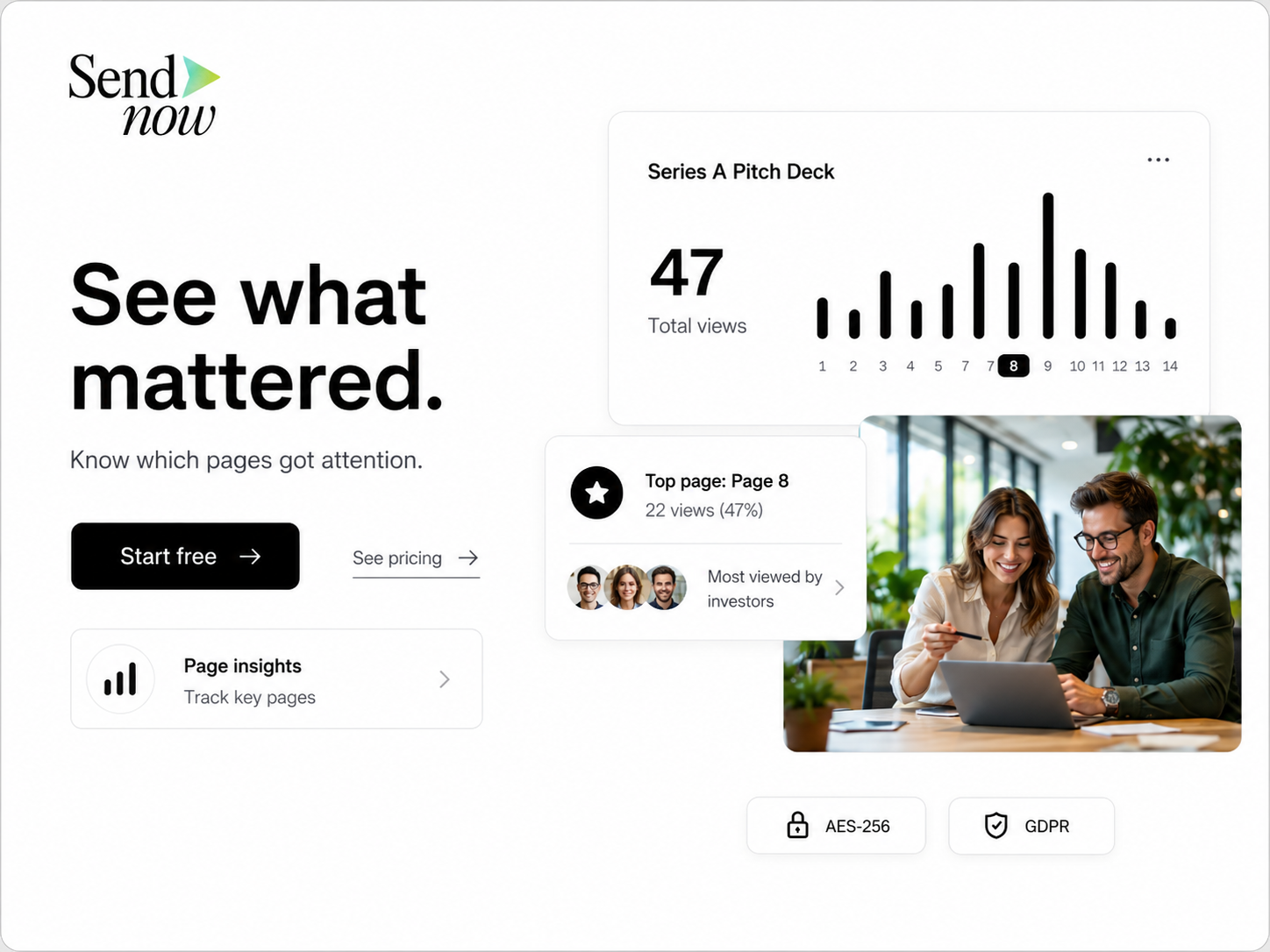
The practical implication: if analytics show an investor spending 6 seconds on your team slide, the team slide is failing regardless of how good the design looks. If they return to the financials three times across two sessions, make that the anchor of your next conversation.
3. How long do investors actually spend reading a pitch deck?
The data from multiple independent sources converges on a clear picture.
Key statistics:
- Average seed-stage investor read time in 2023: 1 minute, 56 seconds — down 48% from 2022. Source: PitchBuilder
- Pitch Deck Guide analysis across investor behavior studies: "Investors spend an average of 2 minutes 15 seconds on a pitch deck. 31% close it within the first 10 seconds." Source: Pitch Deck Guide
- Qubit Capital reports: "Investors spend an average of 2 minutes and 18 seconds reviewing each pitch deck." Source: Qubit Capital
- Storydoc's analysis of 1.3 million presentation sessions (December 2025): "Investors are opening more decks, scanning faster, and bouncing at record rates." Source: Storydoc
What these averages obscure is the non-linear reading pattern. The Pitch Deck Guide's behavioral analysis documents the specific scan sequence most investors follow: cover slide first, then problem/solution, then team. If any of those three stages registers a positive signal, the investor continues. If not, the session ends — frequently before slide 5.
This pattern has a direct design implication: your deck needs to communicate its core thesis in the first three slides at scan speed, not reading speed. It also has a direct analytics implication: a 2-minute session where the investor spent 45 seconds on your financials is categorically more positive than a 2-minute session spread evenly across 12 slides.
4. What is the best pitch deck tracking software in 2026?
The best tool depends on whether you prioritize raw analytics, security controls, or integration into a broader fundraising workflow. Here is how the main platforms compare.
DocSend (by Dropbox): The market incumbent. Strong analytics, deep investor familiarity, and a polished interface. The significant downside: no free plan since March 2025, with basic plans starting at $10/user/month and advanced data rooms at $300/month. The Dropbox acquisition has pushed pricing upward while slowing feature development relative to newer competitors.
Visible.vc: Oriented toward ongoing investor relations rather than active fundraising. Offers version-controlled deck sharing with investor CRM features built in. Better for post-raise reporting relationships than active pipeline management.
Orangedox: Strong Google Drive integration, per-page analytics, NDA functionality, and branded data rooms. A good option for teams already embedded in the Google Workspace environment.
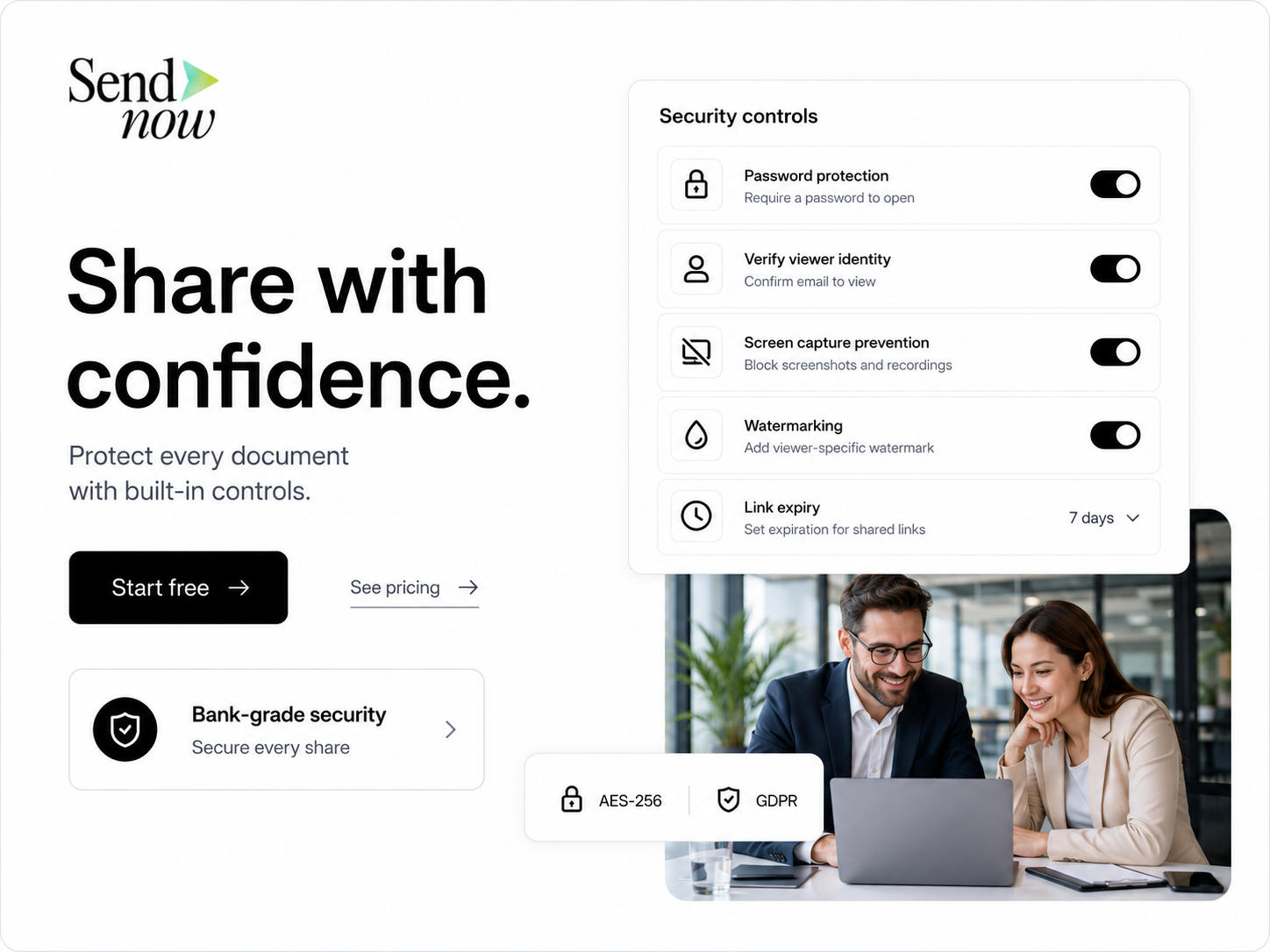
SendNow: Built specifically for finance professionals and founders, with a more robust security layer than most analytics-focused alternatives. Features include page-by-page analytics, real-time open notifications, NDA gating, screenshot protection, dynamic watermarks, AI engagement scoring, custom-branded deal rooms, custom domains, Slack and webhook integrations, AES-256 encryption, and GDPR compliance. Business plan at $33/month covers a team of three with 1,000 documents. Free trial, no credit card required — the most complete finance-first document analytics platform in the category.
The selection criteria that matter most:
| Feature | Why it matters for fundraising |
|---|---|
| Page-level analytics | Identifies which slides are losing investors |
| Real-time notifications | Enables immediate follow-up while deck is active |
| Per-viewer links | Controls access and enables revocation per investor |
| NDA gating | Protects confidentiality without pre-pitch NDA requests |
| Screenshot protection | Prevents unauthorized distribution of sensitive slides |
| AI engagement scoring | Prioritizes investor pipeline without manual interpretation |
| Custom branding | Signals professionalism to institutional investors |
5. How do you know if an investor is actually interested in your pitch?
Engagement analytics translate ambiguous silence into behavioral signals. Here is how to read them.
High-interest signals:
- Multiple sessions. An investor who opens your link three or four times over 48 hours has come back to re-read sections. This is a strong positive signal even if they have not responded to email.
- Extended time on financials. An investor spending 40+ seconds on your financial projections is stress-testing the model in their head. They are evaluating whether the numbers hold together — which means they believe the underlying thesis enough to check the math.
- Internal forwarding. If your analytics flag your link being opened from a new IP, device, or location that matches another address at the same firm, the investor has shared it with a partner. This is pipeline advancement, even without an email response.
- Return to team slide. An investor who views the full deck and then circles back to the team slide is doing a final evaluation of the people bet. This is often the last check before requesting a meeting.
Low-interest signals:
- Total session under 30 seconds
- Only slides 1-3 viewed before exit
- Single session with no return
Ellty's pitch deck tracking guide distills the operational implication well: "Focus on investors who spent 10 minutes reading. Stop chasing those who never opened it. Adjust your deck based on which slides get skipped." Source: Ellty
The PitchWise team adds another behavioral dimension: analytics can "spot investor interest before they call" by identifying patterns — like returning to the same slide repeatedly — that correlate strongly with a follow-up request. Source: PitchWise
6. What is AI engagement scoring for pitch decks?
AI engagement scoring is the layer above raw analytics. Instead of presenting you with raw page-time data and leaving interpretation to you, an AI model analyzes the full behavioral pattern for each viewer and outputs a single prioritized score.
What the model evaluates:
- Time per page relative to expected read time for that content type
- Number of sessions and return-visit frequency
- Navigation pattern (linear reading vs. jump-heavy scanning vs. deep re-engagement)
- Comparison to your own historical baseline from previous investors
- Whether the link was internally forwarded and re-opened by additional viewers
What it outputs: A ranked investor pipeline sorted by engagement quality — not by who responded to email first, but by who has demonstrated the deepest genuine interest in your materials. If you have 40 active pitch deck links in circulation, AI scoring surfaces the three that are genuinely warm so you can focus your energy.
SendNow's AI engagement scoring goes further by pairing the score with prescriptive natural-language insights. The system might surface: "This investor spent 3x average time on the Financials slide. Consider leading your follow-up with a detailed financial model." Instead of descriptive analytics you need to interpret yourself, you get action-oriented recommendations.
The VC Factory documents the challenge from the investor side: "Venture Capital is a high-velocity asset class requiring quick go/no-go decisions multiple times daily." Source: The VC Factory AI engagement scoring addresses the founder-side mirror of that challenge — making equally fast prioritization decisions about which investors to pursue and in what order.

7. Is DocSend the only pitch deck analytics tool?
Far from it — and 2025 and 2026 represent the most active period of market expansion this category has seen, directly driven by DocSend's pricing changes following the Dropbox acquisition.
When Dropbox eliminated the free Send & Track feature in March 2025, it created a migration moment. Thousands of founders who had been using DocSend's free tier for basic tracking needed alternatives. The result: accelerated investment in competing platforms, several of which now offer more specialized features at lower price points than pre-acquisition DocSend.
Peony.ink's March 2026 analysis, based on sending 500+ decks across platforms, identifies 10 viable tools in the space and notes that "the pattern I keep seeing is the same: founders spend weeks agonizing over which pitch deck tool to use." Source: Peony.ink
The competitive landscape now divides into three segments:
Creation-first tools (Beautiful.ai, Gamma, Slidebean, Pitch.com): Focused on design and narrative, with basic or no analytics. Best for founders who need help building the deck rather than tracking it.
Finance-first platforms (SendNow): Built for teams where confidentiality, security, and institutional-grade professionalism are requirements alongside analytics. AES-256 encryption, NDA gating, screenshot protection, dynamic watermarks, custom domains, and AI engagement scoring are features standard in this tier — not add-ons.
For a pre-seed founder sharing a deck with 10 angels, any analytics tool that shows open rates and session duration provides meaningful value. For a Series A founder sharing a deck containing proprietary financial models with 40+ institutional investors, the security architecture of the platform matters as much as the analytics depth.

Conclusion
Every pitch deck you send without analytics is a missed opportunity to learn. The data is available. The tools are accessible. There is no longer a good reason to follow up on a fixed calendar schedule while remaining blind to whether investors are actually reading your deck.
Start with a simple change: replace your current PDF or Google Drive link with a trackable, per-viewer secure link for your next send. Watch the page-level data. If investors exit after slide 3, your problem slide is not landing. If they spend 4 seconds on the team page, that section needs to be rebuilt before the next send. If one investor opens your deck five times in a week without responding to email, send a follow-up today — not next Tuesday.
The best fundraising operators treat pitch deck analytics the same way a great sales team treats CRM data: every interaction generates a signal, every signal informs an action, and the process compounds over time.
Ready to pitch smarter?
Try SendNow free at sendnow.live — no credit card required. Get page-by-page analytics, real-time open notifications, AI engagement scoring, and the security architecture institutional investors expect. Plans start from $9/month for founders, with Business plans at $33/month for deal teams of three.
Keep Reading
About the Author: Rifana Hameem
Rifana is the founder of SendNow. She leads the team in building secure, compliant, and analytics-rich document sharing tools for finance and professional teams worldwide.
Connect on LinkedIn