How to Share Your Pitch Deck with Investors Securely

Sharing a pitch deck as an email attachment or raw Google Drive link gives you zero control once the file leaves your hands. This guide covers the seven most common questions founders ask about pitch deck security — from NDA gating and link controls to screenshot protection, forwarding prevention, and real-time investor tracking. If you are currently emailing PDFs to VCs, this article will change how you approach your next send.
How to Share Your Pitch Deck with Investors Securely
Meta description: Learn the safest methods for sharing your VC pitch deck with investors — from NDA gating and per-viewer link controls to screenshot protection and real-time access tracking. Target keyword: vc pitch deck
Introduction
You spent months on your pitch deck. Every slide represents strategic thinking, market research, and financial modeling. Then you attach it to an email, press send, and it disappears into a VC's inbox — forwarded to a portfolio company, shared with a junior analyst, or screenshot slide-by-slide and passed around a Slack channel.
This is not a hypothetical. It is a documented pattern. Founders routinely lose control of their most sensitive fundraising materials the moment they send them, because they are using channels designed for general file sharing rather than confidential document distribution.
Securing your pitch deck is not about distrust. It is about operating with the same care you expect from your legal, finance, and IR teams. The way you handle your own confidential materials is a signal to investors about how you will handle their capital.
This guide answers the seven most important questions about sharing your VC pitch deck securely, with expert citations and practical steps you can implement in under an hour.
1. Should you share a pitch deck as a PDF or as a link?
Links are the clear answer in 2026, but only if you use the right kind of link.
The case against PDFs: Once a PDF lands in an investor's inbox, they own it. You cannot update it if your financials change. You cannot revoke access if the relationship does not progress. You cannot track whether they opened it, how long they spent on it, or what pages they actually read. A PDF attached to an email is the document equivalent of handing someone a printed brochure — useful at a conference booth, not appropriate for Series A materials.
The case for secure links: A properly configured secure link gives you live control over your document. Update the deck and all existing links reflect the change instantly. Revoke access from a single investor without touching anyone else's link. Set an expiry date so the link stops working after 30 days. Track page-level engagement in real time.
The important qualifier: a raw Google Drive or Dropbox share link is not secure. It can be forwarded, reshared, and downloaded with minimal friction. The link you send needs to come from a purpose-built document sharing platform that enforces access permissions at the viewer level.
Sarah Anto, MBA, CPA, and Techstars mentor, puts it directly: "Sharing a pitch deck as a PDF means you lose control. You cannot update it, cannot revoke access, and have no idea if it was even opened." Source: LinkedIn
The practical takeaway: send a secure, per-viewer link with download restrictions disabled. Never send a PDF as an email attachment to any investor at any stage.
2. Do investors sign NDAs before looking at a pitch deck?
Most venture capitalists will not sign an NDA before reviewing a pitch deck, and requesting one before a first meeting frequently does more harm than good.
Why VCs typically refuse pre-pitch NDAs: VCs evaluate dozens of companies in overlapping categories simultaneously. An NDA creates legal exposure when they later invest in, or even evaluate, a competing business. It also signals inexperience. Cooley GO, one of the most respected startup law firms in the US, identifies four structural reasons why institutional investors decline pre-pitch NDAs — the core issue being inherent conflict with their existing and future portfolio obligations. Source: Cooley GO
Ron Wiener of Venture Mechanics, with 25 years of investing and accelerator experience, states it plainly: "Asking investors to sign an NDA before you pitch your business plan is a rookie mistake. In more than 25 years of investing, I've seen more than a few founders torpedo their own fundraising efforts before they left the dock." Source: Venture Mechanics
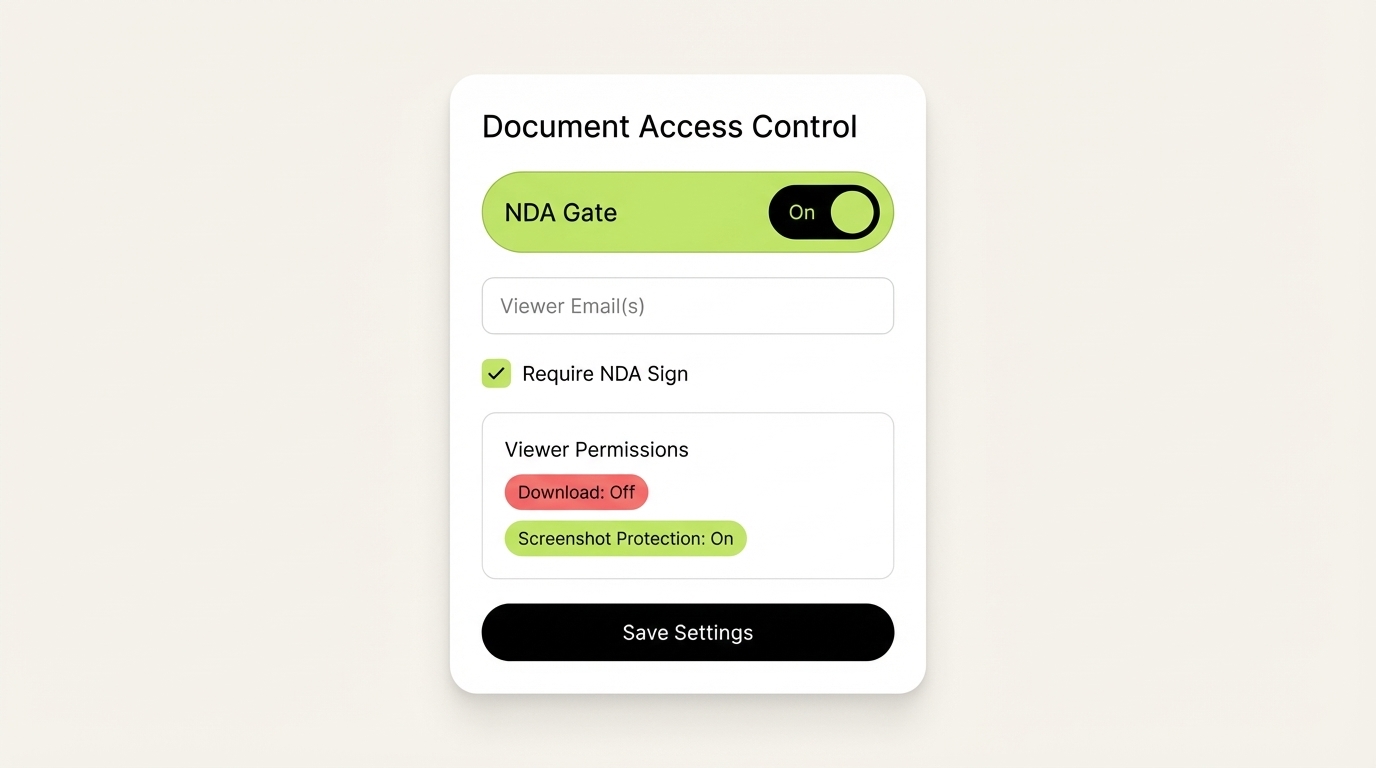
The better alternative: embedded NDA gating. The emerging best practice is not requesting a legal NDA before sharing anything — it is embedding a lightweight, click-sign NDA directly inside the document viewer. The investor clicks a button acknowledging confidentiality before the first slide loads. It takes 10 seconds, requires no negotiation, and creates a legally binding timestamped record of agreement.
This is different from a pre-pitch NDA request in every way that matters: it is frictionless for the investor, automatic for you, and provides real legal protection without damaging the relationship.
3. What should you never include in a pitch deck?
What you leave out of a publicly shared pitch deck is as important as what you put in. Certain categories of information belong in a secure data room, not in the deck you send to investors you have not yet met.
Information to exclude or handle carefully:
- Full customer lists with names and revenue figures. A VC associate could inadvertently reference this with a portfolio company in the same space. Keep customer data as logos or anonymized metrics at the pitch stage.
- Detailed proprietary technology architecture. Your core technical moat should stay protected until diligence is formally underway and confidentiality is established at the deal-level.
- Exact cap table details. Share a high-level equity distribution. The precise cap table — including angel investor names and percentages — belongs in a data room, not a widely shared pitch deck.
- Unannounced strategic partnerships. If a partner relationship is not yet public, including it in a deck you send broadly creates risk for both parties.
- Granular customer cohort data. Aggregate projections and growth rates are appropriate for a pitch deck. Detailed cohort analysis, LTV curves, and individual customer financials belong in the data room.
Crunchbase's editorial team notes that even strong pitch decks lose their edge when they "over-disclose information that belongs in due diligence, not the opening pitch." Source: Crunchbase
The practical rule: your pitch deck is a trailer, not the full feature. It earns the meeting. The data room delivers the evidence.
4. How do you prevent a pitch deck from being forwarded?
Preventing unauthorized forwards is technically challenging but practically achievable with the right layered approach.
1. Disable downloads. If a viewer cannot download the file to their device, they cannot attach it to a forwarded email. Your deck is rendered in-browser and never saved locally.
2. Generate per-viewer links. Create unique links for each investor rather than one shareable URL. This lets you revoke a specific viewer's access without affecting anyone else. It also tells you exactly which link was forwarded if unauthorized access occurs.
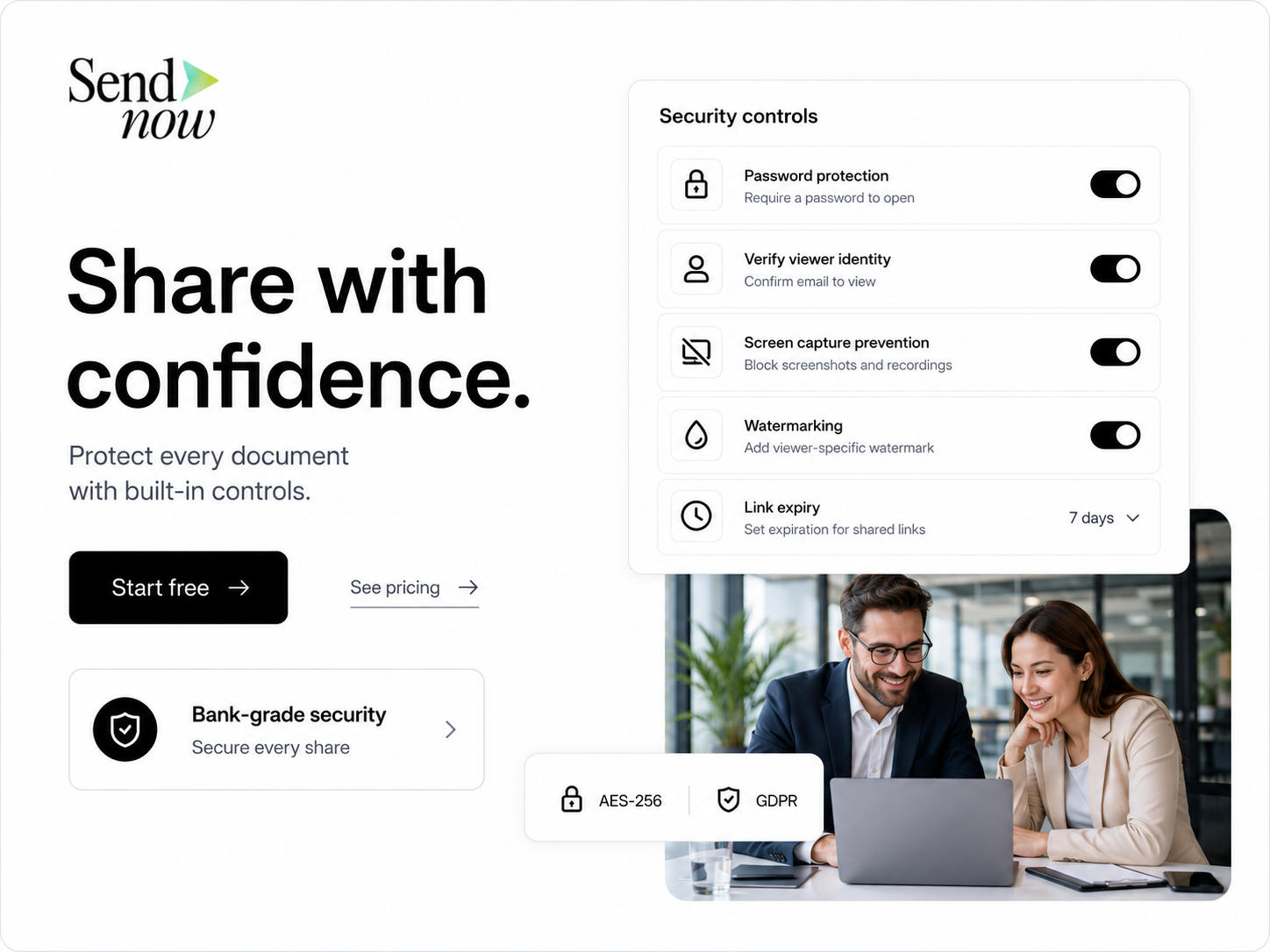
3. Enable screenshot protection. Advanced platforms apply browser-level DRM that intercepts screen capture attempts within the viewer window. SendNow's screenshot protection makes it extremely difficult to capture clean slide images — a particular concern for decks containing proprietary financial models or technology diagrams.
4. Apply dynamic watermarks. Even if someone photographs their screen with a secondary device, a dynamic watermark stamps the viewer's name, email, and access timestamp directly onto every slide. The watermark is generated server-side — the viewer cannot remove it. If your deck leaks, you know who leaked it.
5. Set link expiry. Links configured to expire after a set number of days or views automatically restrict access without any manual action from you. An investor who has been inactive for 60 days no longer needs access to your most current materials.
Orangedox notes that "preventing documents and data rooms from being forwarded" is among the most consistent requirements from deal teams sharing sensitive materials. Source: Orangedox
5. Can investors share your pitch deck with competitors?
The short answer: without a confidentiality agreement and technical controls in place, there is no barrier preventing it.
The legal reality: Most early-stage investors operate under internal codes of conduct that discourage deliberate information sharing across portfolio companies. Established firms are careful because their reputation depends on founder trust. But informal leaks — a forwarded email to a junior analyst, a Slack message with screenshots, a reference to your financials in a competitor's board meeting — are harder to prevent and harder to prove.
A PDF sent by email can be forwarded in two seconds. A Google Drive link set to "view only" can be screenshotted, reconstructed, and forwarded just as easily.
The technical defense: The most effective protection combines per-viewer link tracking with an audit trail. If your link is opened from an IP address or device that does not match your intended recipient's profile, that access appears in your analytics. You did not give them access. Someone forwarded your link.
Crowley Law advises founders to "define permitted use clearly so the other side can only use your information to evaluate the specific deal" — and to pair this with ongoing disclosure tracking. Source: Crowley Law
Technical controls are your first line of defense. Contractual protections are your backup. The two work best together.
6. What is the safest way to send confidential documents to investors?
The gold standard combines a secure sending platform, per-viewer access controls, a branded deal room, and a complete audit trail.
Step 1: Upload to a purpose-built secure document platform. Avoid email attachments and general cloud storage. Use a platform built for financial document sharing — ideally one encrypted with AES-256 in transit and at rest, GDPR compliant, and hosted on enterprise-grade infrastructure like AWS. These are not nice-to-haves when you are sharing cap table structures, financial projections, and proprietary technology details with strangers.
Step 2: Configure per-viewer access controls. Set a unique link for each investor. Disable downloads. Enable screenshot protection. Activate dynamic watermarking so every viewer's email appears on every slide. Set a 30-day or 60-day expiry depending on your fundraising timeline.
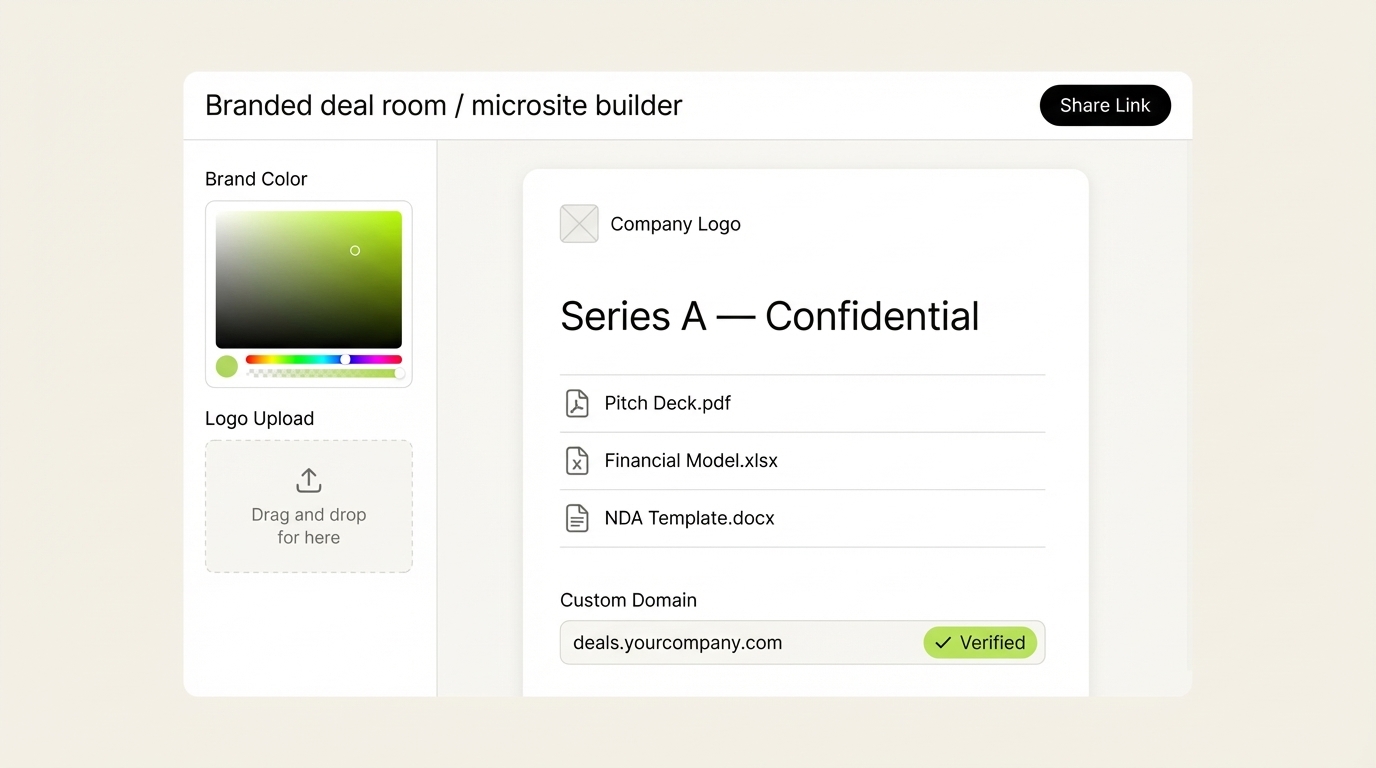
Step 3: Create a branded deal room. Rather than sending individual links for each document, build a branded microsite that houses all your fundraising materials in one place — pitch deck, executive summary, financial model, and data room access. A custom domain (such as raise.yourcompany.com) signals professionalism and keeps every document version centrally managed.
Step 4: Track and audit everything. Every open, every page view, and every session becomes part of your permanent audit trail. If a disclosure dispute ever arises, you have a timestamped record of exactly who accessed what and when.
SendNow builds all four layers into a single platform designed specifically for finance teams and founders. Plans start from $9/month, and a free trial requires no credit card.
7. How do you track if an investor has opened your pitch deck?
Tracking whether an investor opened your deck transforms your follow-up from guesswork into a data-driven process.
Basic open tracking: Any purpose-built document sharing platform will tell you whether your link was opened, when it was opened, from which device type, and from which geographic location. This alone is more actionable than anything email analytics provide for attachments.
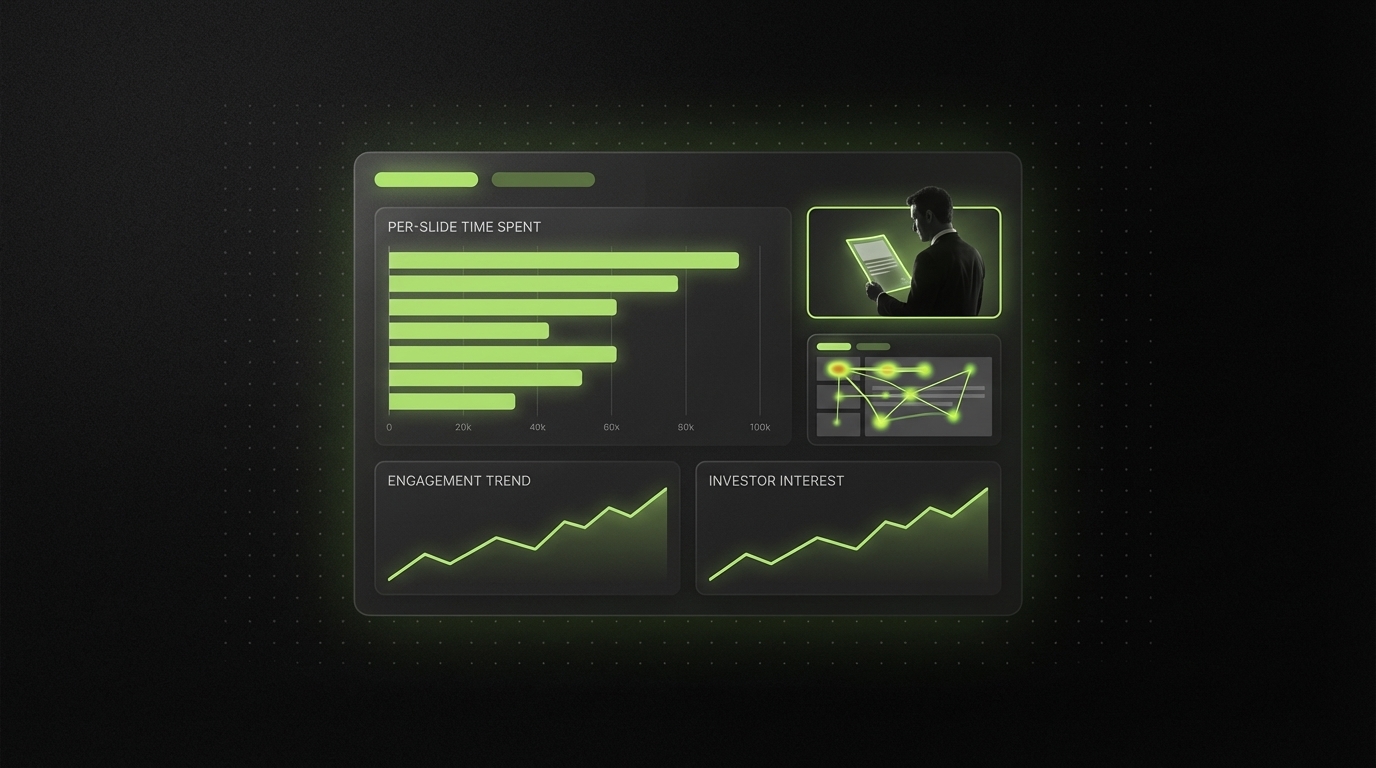
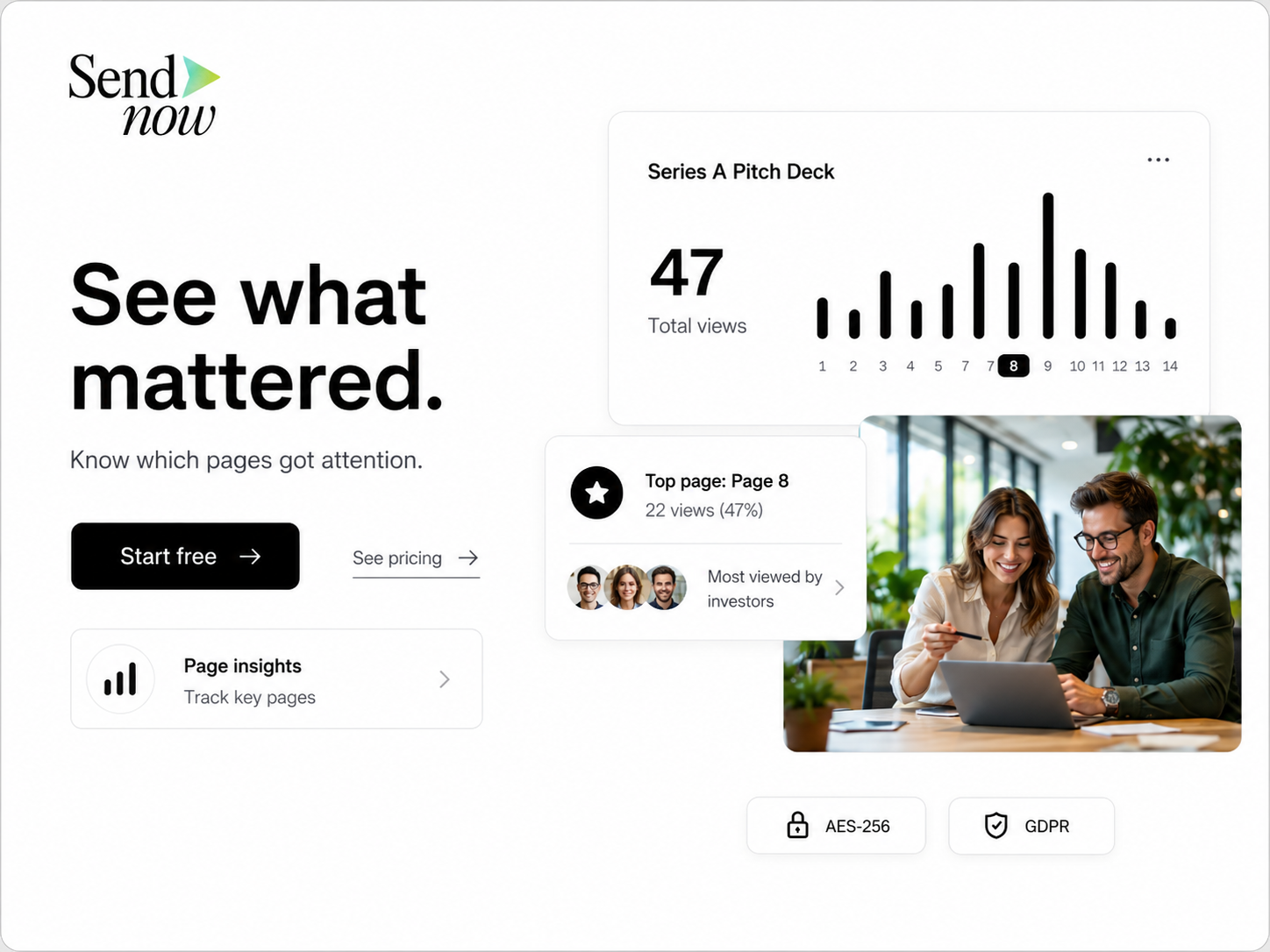
Page-level engagement tracking: The more valuable signal is page-level data. An investor who spent 47 seconds on your financials slide and 3 seconds on the solution slide is telling you something very specific — they found the financials interesting enough to study, but the value proposition did not land immediately. That data directly informs how you restructure the deck for the next investor.
OpenVC, which has helped 24,000+ founders share pitch decks with investors, builds its entire platform around this principle: "Turn uncertainty into clarity. Get tracking and analytics for every deck — making sure your deck passes the AI filters and everything stays organized in your CRM." Source: OpenVC
Real-time notifications: The most immediately practical feature is real-time notification the moment your link is opened. SendNow's Slack integration pushes an alert to your deal team the instant a viewer engages with your document. If an investor opens your deck at 4 PM on a Tuesday, you can follow up with a warm, informed email by 4:30 PM while your materials are fresh in their mind — rather than waiting for a calendar reminder three days later.

Forwarding and re-share detection: When your link is opened from a different IP or device than the original recipient, that activity surfaces in your analytics. An investor who has forwarded your deck to a partner for a second review is a positive signal even if they have not responded to your outreach. You now know the firm is having an internal conversation about you.
Conclusion
Sharing your pitch deck securely is not about being paranoid. It is about being precise — about knowing who has your materials, what they have read, when they engaged, and whether you need to act. Founders who operate this way communicate to investors that they run their processes with rigor.
The setup takes less than twenty minutes: upload your deck, configure per-viewer access controls, activate NDA gating, enable screenshot protection and dynamic watermarks, create a branded deal room, and turn on Slack notifications. From that point, every investor interaction generates intelligence you can act on.
Ready to share your pitch deck the smart way?
Try SendNow free at sendnow.live — no credit card required. Plans start from $9/month for founders, with AES-256 encryption, NDA gating, screenshot protection, dynamic watermarks, branded deal rooms, and real-time Slack notifications built in from day one.
Keep Reading
About the Author: Rifana Hameem
Rifana is the founder of SendNow. She leads the team in building secure, compliant, and analytics-rich document sharing tools for finance and professional teams worldwide.
Connect on LinkedIn