
Virtual Data Room Cost for Small Businesses: What Should You Pay?

Virtual Data Room Cost for Small Businesses
Small businesses often discover virtual data rooms at exactly the moment when cost sensitivity and transaction urgency collide.
The company may be:
- raising capital,
- selling the business,
- sharing documents with a lender,
- working with an adviser,
- entering a partnership.
Suddenly, general file sharing no longer feels sufficient.
But enterprise VDR quotes can be difficult to justify.
So what should a small business actually pay?
The correct answer starts with the workflow, not an arbitrary benchmark.
What determines VDR cost?
Number of users
Some platforms price around administrators or participants.
Number of rooms
A small adviser may need several active client rooms. A founder may need only one.
Storage
Large video, technical, or transaction files can affect pricing.
Security features
Watermarks, NDA gates, permissions, and advanced authentication may sit on higher plans.
Custom branding
Professional client/deal experience may require a higher tier.
Support
Dedicated transaction support can increase cost.
Pricing models small teams should understand
| Pricing model | Advantage | Risk |
|---|---|---|
| Flat subscription | Predictable | May have plan limits |
| Per user | Fair for tiny teams | Can scale quickly |
| Per project | Easy to assign to deal | Expensive across many deals |
| Per GB | Pay for storage | Costs rise with large files |
| Per page | Traditional model | Can become unpredictable |
For most lean teams, predictable subscription pricing is easier to budget.
What should a small business prioritize?
Fast setup
A small business cannot spend days implementing a data room.

Clear recipient experience
Buyers, investors, and clients should understand the room immediately.
Controls that match sensitivity
Do not pay for features you do not need, but do not skip critical controls just to save a few dollars.
Activity visibility
Know whether important information is being accessed.
Multi-file organization
The room should eliminate the email-attachment mess.
Typical small-business use cases
Capital raise
Deck + model + financials + legal.
Business sale
CIM + financials + contracts + diligence.
Financial advisory
Reports + proposals + supporting material.
Large B2B sale
Proposal + pricing + case studies + legal/security documentation.
Cost vs risk
The cheapest possible workflow is often:
email attachments + shared folders
But it has hidden costs:
- version confusion,
- no centralized revocation,
- weak activity visibility,
- inconsistent recipient experience.
A paid room is valuable when those problems become meaningful.
How to compare providers
Create a simple spreadsheet with:
- monthly price,
- annual price,
- administrators,
- viewers,
- storage,
- room count,
- NDA,
- watermark,
- custom domain,
- permissions,
- analytics,
- support.
Then remove any provider that fails a must-have requirement.
Only then compare price.
FAQ
What is a reasonable VDR price for a small company?
There is no universal number. Startups and small teams should compare low-cost SaaS subscriptions against enterprise project pricing and choose based on actual workflow requirements.
Should I pay annually?
Annual plans can be cheaper if the product is used continuously. For a one-time transaction, monthly or project pricing may make more sense.
Do I need a VDR for one document?
Usually not. A tracked document link may be enough. A room becomes valuable when the process involves several related files or stages of disclosure.
Is SendNow cheaper than enterprise VDRs?
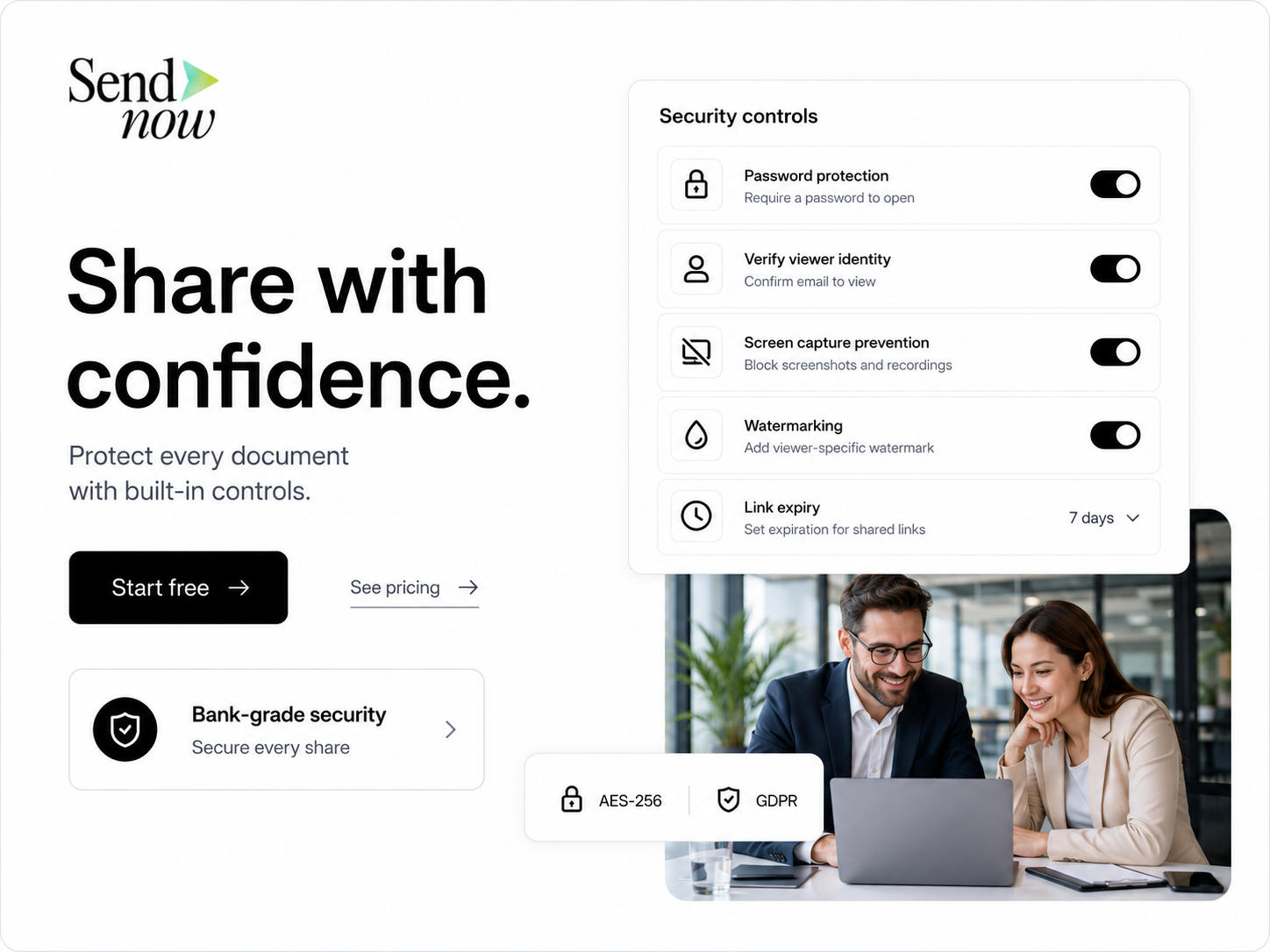
Compare current SendNow pricing against the current official pricing of any alternative you are considering. Do not rely on stale third-party pricing tables.
Final takeaway
A small business should not pay for enterprise complexity by default.
The best VDR price is the lowest cost that still supports the actual security, document, and transaction requirements of the process.
Internal Linking Blueprint
Core commercial VDR cluster
/lightweight-virtual-data-room
→ /affordable-virtual-data-room
→ /virtual-data-room-for-startups
→ /ma-data-room-for-small-deals
→ /boutique-ma-data-room
Finance cluster
/secure-financial-document-sharing
→ /data-room-for-financial-advisers
→ /blog/how-to-send-financial-statements-securely
→ /blog/how-to-share-balance-sheet-with-investors
→ /blog/share-financial-model-with-nda
Fundraising cluster
/virtual-data-room-for-startups
→ /investor-data-room-for-startups
→ existing pitch-deck sharing / analytics pages
→ Microsites
M&A cluster
/ma-data-room-for-small-deals
→ /boutique-ma-data-room
→ canonical CIM article
→ VDR pricing / cost articles
→ Microsites
Pricing / cost cluster
/affordable-virtual-data-room
→ canonical why-virtual-data-rooms-expensive article
→ /blog/virtual-data-room-cost-for-small-business
→ /pricing
Agent QA Checklist
Before publishing:
- Check whether the URL already exists.
- If an equivalent blog exists, improve it instead of publishing a duplicate.
- One H1 only.
- Unique title and meta description.
- Self-referencing canonical.
- Correct sitemap entry.
- No fake hreflang.
- Visible FAQ must match FAQ schema.
- Use
BreadcrumbListwhere the site supports it. - Do not add redundant
SoftwareApplicationschema to every article. - Validate every SendNow feature statement against current production code and plan.
- Verify current SendNow prices from the production pricing source.
- Do not state competitor prices without checking current official pages.
- Do not claim absolute screenshot or download prevention.
- Do not make blanket legal/compliance claims unless current legal documentation supports them.
- Use natural internal links rather than repeating the same exact-match anchor.
- Use a Pexels hero image based on the supplied search phrase.
About the Author: Rifana Hameem
Rifana is the founder of SendNow. She leads the team in building secure, compliant, and analytics-rich document sharing tools for finance and professional teams worldwide.
Connect on LinkedIn