Virtual Data Room Pricing: What You Should Expect to Pay in 2026

Virtual Data Room Pricing: What You Should Expect to Pay in 2026
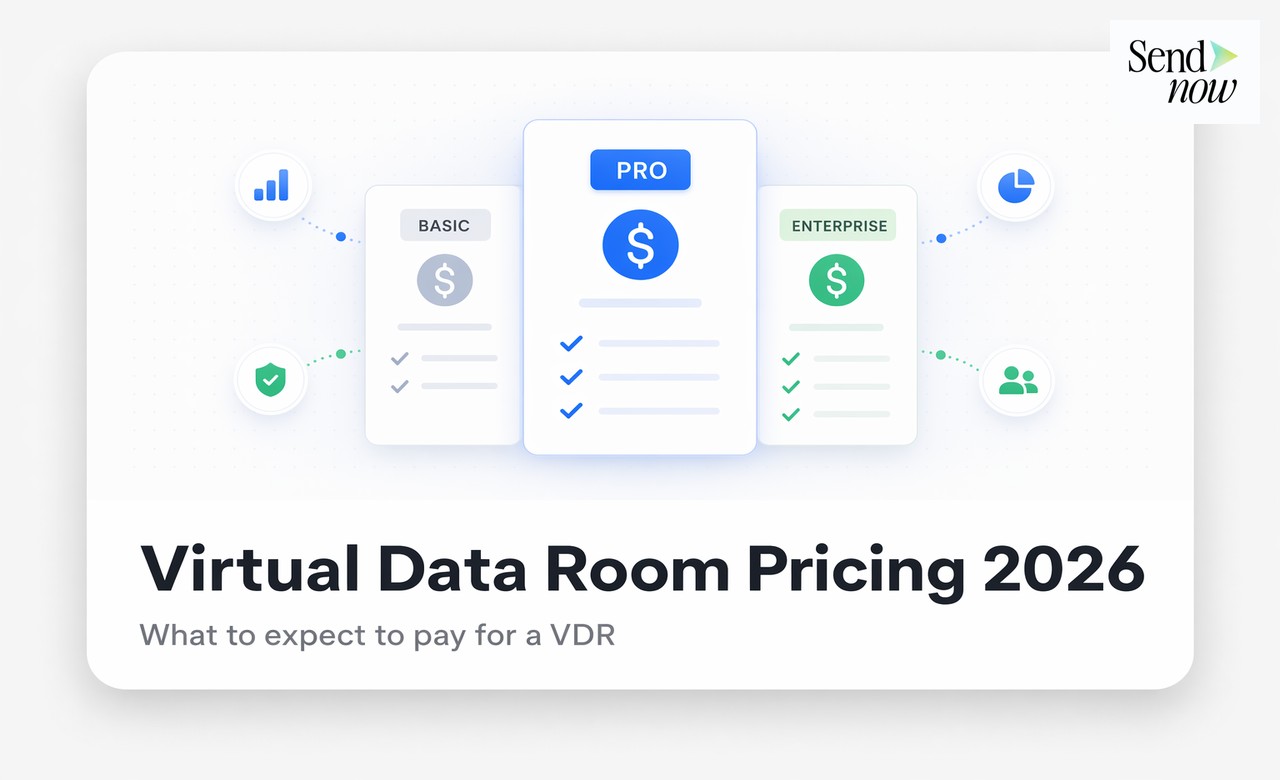
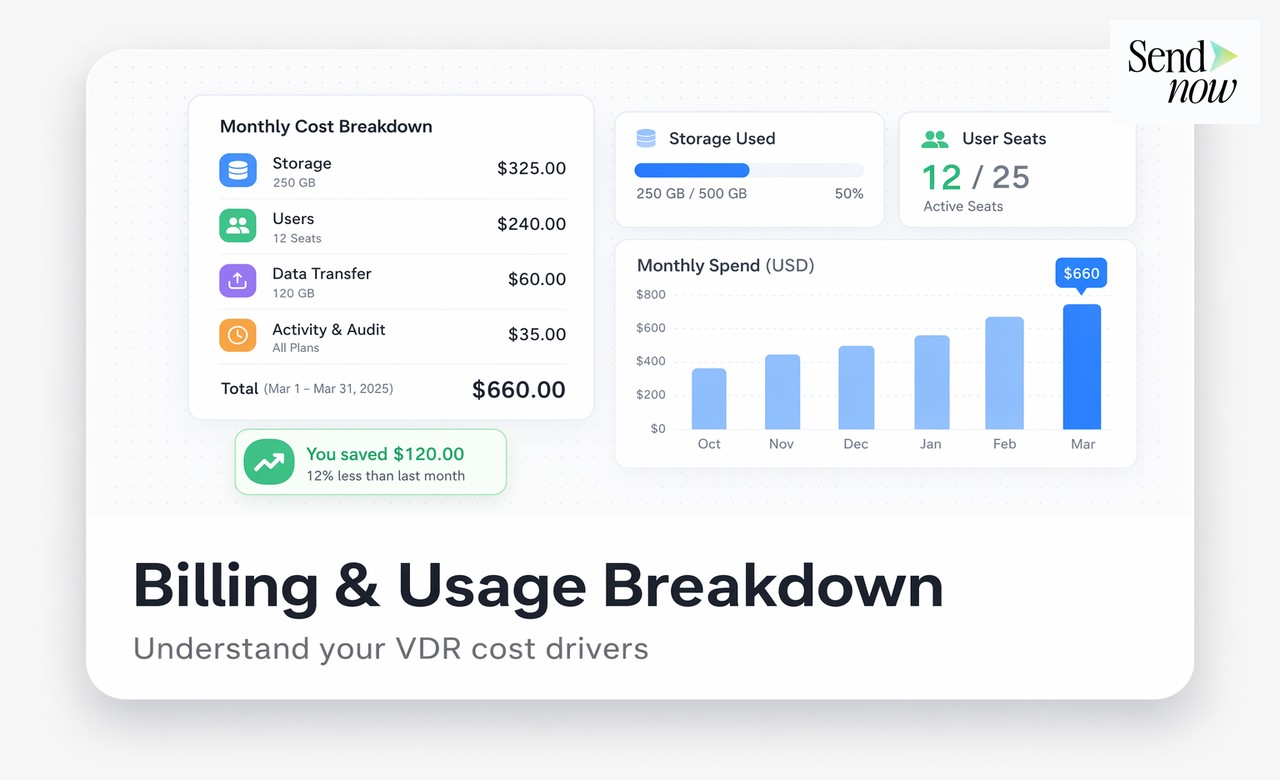
Virtual data room pricing in 2026 typically falls between £0 and £1,500 per month, depending on the pricing model, number of users, and features included. Most enterprise-grade VDRs charge upwards of £400/month, while modern document-sharing platforms offer comparable security and analytics at a fraction of that cost. Understanding the models before you buy saves considerable budget.
The Four VDR Pricing Models Explained
Most providers use one of four structures, and knowing which applies to a quote you receive changes how you evaluate it.
Per-page pricing is the oldest model, inherited from physical data rooms. You pay for each page uploaded, typically £0.40–£1.20 per page. For an M&A deal with thousands of documents, this adds up to tens of thousands of pounds. It is rarely justified in 2026.
Per-user pricing charges a monthly fee per invited user, usually £25–£80 per user. A mid-size deal with 40 participants can cost £1,200–£3,200/month on this model alone, before any platform fees.
Flat-rate (subscription) pricing offers unlimited users and documents for a fixed monthly fee. This is the most predictable model and suits teams running multiple deals simultaneously. Expect £300–£1,200/month for a credible enterprise product.
Storage-based pricing bills by total data stored (per GB). Rates of £3–£10/GB/month are common. For deals involving video files or large CAD drawings, costs can escalate quickly.
Many providers combine models, charging a platform fee plus per-user and per-GB overages. Always request an all-in quote based on your expected deal size.
What VDR Pricing Looks Like Across Tiers in 2026
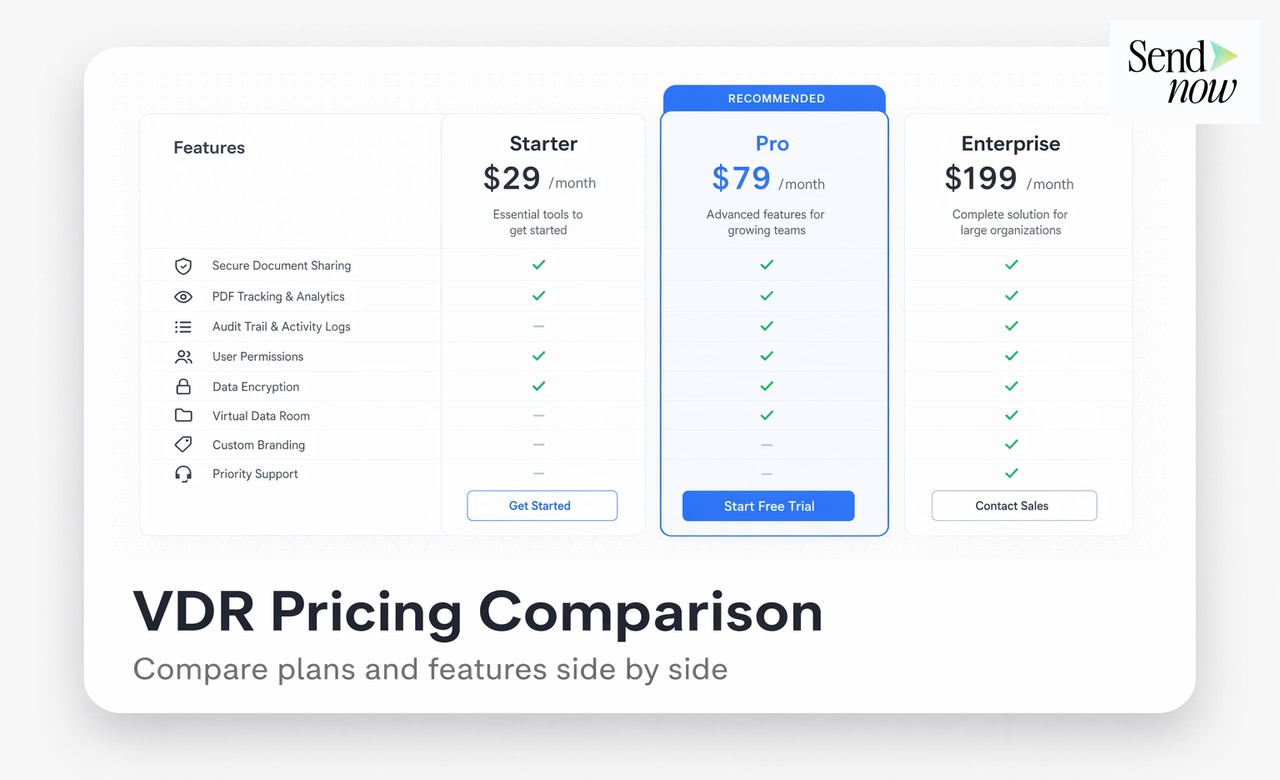
Here is a realistic view of what each spending tier delivers in 2026:
Free / Entry-level (£0–£50/month): Basic link sharing, no watermarking, limited audit trails, no NDA gating. Suitable for early-stage document sharing where deal sensitivity is low. Examples: Google Drive, Dropbox, early-tier SendNow.
Mid-market (£100–£400/month): Password protection, access expiry, basic analytics (views, downloads), email notifications, some watermarking. Enough for seed or Series A fundraising and smaller M&A transactions.
Enterprise (£400–£1,500+/month): Full audit trails, dynamic watermarking, fence view / screenshot blocking, granular permission controls, bulk Q&A modules, SOC 2 / ISO 27001 compliance, dedicated account managers. Built for investment banking-grade deals.
The gap between mid-market and enterprise has narrowed significantly since 2023. Platforms like SendNow now deliver enterprise-level analytics, NDA gating, and AES-256 encryption at mid-market prices, which removes much of the historical justification for six-figure annual VDR contracts.
Feature Comparison Across Pricing Tiers
| Feature | Free | Mid-Market | Enterprise |
|---|---|---|---|
| Document encryption (AES-256) | Partial | Yes | Yes |
| Per-visitor analytics | No | Basic | Full |
| Dynamic watermarking | No | Optional | Yes |
| NDA / access gate | No | Some | Yes |
| Screenshot blocking | No | No | Yes |
| GDPR-compliant hosting | Varies | Yes | Yes |
| Custom branding | No | Optional | Yes |
| Q&A module | No | No | Yes |
| Dedicated support | No | Account manager | |
| ISO 27001 / SOC 2 | No | Some | Yes |
What Drives VDR Costs Up
Several factors inflate quotes beyond the headline monthly rate.
- Minimum contract lengths. Many enterprise VDRs require 12-month commitments, which means you pay for months after a deal closes.
- Overage charges. If your deal generates more pages or users than the base plan, per-unit overage fees apply. These are rarely disclosed prominently.
- Training and onboarding fees. Some providers charge £500–£2,000 for initial setup and user training.
- Currency and regional pricing. US-headquartered VDRs often quote in USD and add VAT on top for EU customers. A "$500/month" plan becomes closer to £500 including conversion and tax.
For EU-based transactions, also factor in GDPR compliance costs. A VDR without EU data residency may require a Data Processing Agreement and additional legal review, adding indirect costs.
Free and Low-Cost Alternatives Worth Considering
Not every transaction needs a full enterprise VDR. For pitch deck sharing, investor due diligence at seed stage, or internal document collaboration, lightweight alternatives often suffice.
See our full breakdown in Free Virtual Data Room Alternatives and Best Deal Room Software for Investment Bankers for a deeper comparison.
The key question to ask is: do you need a Q&A module and a dedicated account manager, or do you need secure document sharing with per-visitor analytics and access controls? Most users outside of late-stage M&A need the latter, not the former.
How SendNow Compares on Price
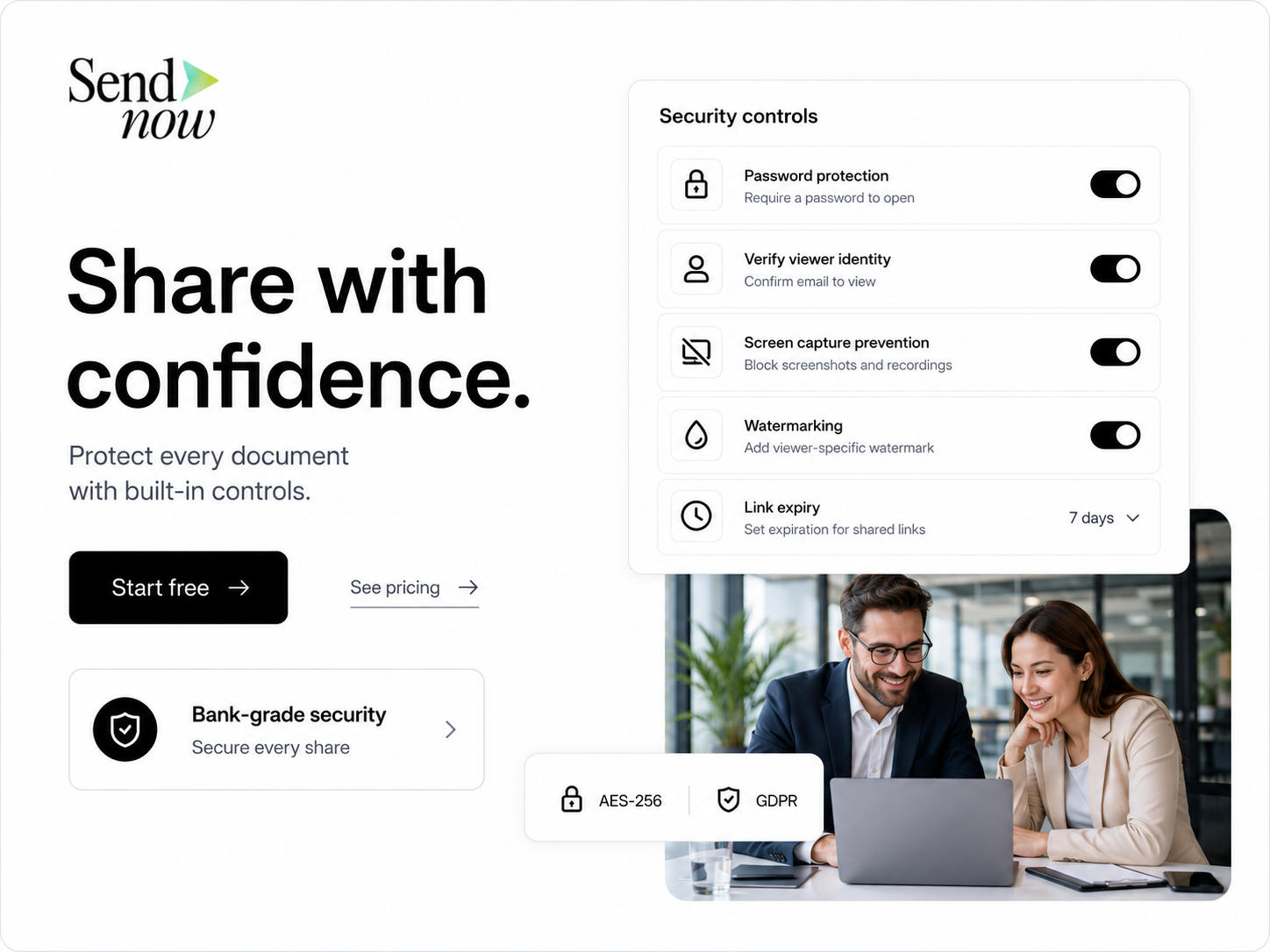
SendNow is designed specifically for finance professionals and founders who need enterprise-level document security without enterprise pricing. Features include AES-256 encryption, per-visitor analytics, NDA gating, screenshot blocking, and GDPR-compliant EU hosting. Pricing starts at a fraction of traditional VDR costs, with no per-page or per-user overage fees.
For the complete picture on virtual data rooms, read our Virtual Data Room Complete Guide.
Start Protecting Your Documents Today
Stop overpaying for features you do not need. Try SendNow free and see how much of the VDR feature set you can access without the enterprise price tag.
Frequently Asked Questions
1. How much does a virtual data room cost per month in 2026? Most VDRs cost between £100 and £1,500 per month. Enterprise platforms from established providers typically start at £400/month, while modern alternatives with comparable features start significantly lower.
2. Is there a free virtual data room? Some platforms offer free tiers with limited features. These generally lack watermarking, NDA gating, and granular analytics. They are suitable for low-sensitivity sharing but not for M&A or formal fundraising.
3. What is the cheapest VDR for startups? For startups, the most cost-effective options are modern document-sharing platforms that include analytics and access controls without per-user or per-page charges. SendNow offers a free trial with core VDR features included.
4. Do VDRs charge per page? Some legacy providers still use per-page pricing. It is worth avoiding unless you have a specific reason to use that provider. Flat-rate subscription VDRs are more predictable and typically cheaper for document-heavy deals.
5. What is included in a virtual data room subscription? Mid-market and enterprise subscriptions generally include document upload and indexing, user access controls, audit trails, watermarking, analytics, and compliance reporting. Enterprise plans add Q&A modules, dedicated support, and advanced security features.
6. Is VDR pricing negotiable? Yes. Enterprise VDR contracts are almost always negotiable, particularly on contract length, user limits, and overage rates. Request a custom quote and compare at least three providers before signing.
7. Do I need a VDR for a Series A fundraise? Not necessarily. Many Series A rounds complete using secure document-sharing platforms rather than full VDRs. The critical requirements are per-investor tracking, access expiry, and NDA gating. A dedicated VDR is more appropriate from Series B onwards or for formal M&A processes.
8. How does GDPR affect VDR pricing for EU companies? EU companies must ensure their VDR provider stores data within the EU and provides a Data Processing Agreement. Some providers charge extra for EU data residency. Platforms built for the EU market, like SendNow, include GDPR compliance as standard.
About the Author: Rifana Hameem
Rifana is the founder of SendNow. She leads the team in building secure, compliant, and analytics-rich document sharing tools for finance and professional teams worldwide.
Connect on LinkedIn