

Setting Up an Audit Trail for GDPR Compliant File Sharing

Setting Up an Audit Trail for GDPR Compliant File Sharing
Setting up a secure audit trail is a critical requirement for achieving GDPR compliance in digital file sharing. By maintaining comprehensive logs of who accessed, viewed, or downloaded files, organizations can fulfill their accountability obligations under EU data protection law. Implementing these practices helps mitigate the risk of data breaches and demonstrates compliance during regulatory audits.
The European Union’s General Data Protection Regulation (GDPR) has established a high standard for data privacy and security globally. For businesses that regularly share sensitive documents containing personal data—such as employee agreements, client records, financial statements, and healthcare files—standard file sharing is no longer adequate. The regulation demands not only that data be encrypted, but also that organizations maintain complete visibility and control over who accesses this information.
Central to these compliance requirements is the principle of accountability. Under GDPR, you must be able to prove that personal data is processed lawfully, securely, and only by authorized individuals. A key tool in establishing this proof is a secure logging system. This guide provides a detailed analysis of how to configure and maintain a compliance-ready log for all outbound document sharing.
1. GDPR Accountability and Technical Safeguards
The GDPR does not simply require organizations to protect data; it requires them to prove that they are protecting it. This is the core of Article 5(2), which outlines the principle of "accountability." It states that the data controller is responsible for, and must be able to demonstrate compliance with, all data protection principles.
Additionally, Article 32 mandates that controllers and processors implement "appropriate technical and organizational measures to ensure a level of security appropriate to the risk." The regulation explicitly mentions the following key safeguards:
- Pseudonymization and encryption of personal data.
- The ability to ensure the ongoing confidentiality, integrity, availability, and resilience of processing systems.
- A process for regularly testing, assessing, and evaluating the effectiveness of technical measures.
If your organization shares files containing personal data without tracking who opens them, you cannot fulfill these requirements. In the event of a data breach or a regulatory audit, the absence of verification logs makes it impossible to prove that your sharing workflows are secure, exposing your business to severe penalties.
2. What is a Secure Audit Trail and Why is it Necessary?
In the context of document sharing, a secure audit trail is an immutable, chronological record of all activities associated with your shared files. It tracks a document's lifecycle from the moment a link is generated to its final deactivation, documenting every interaction along the way.
+-------------------------------------------------------------+
|                      Secure Audit Trail Logs                |
+-------------------------------------------------------------+
                              |
       +----------------------+----------------------+
       |                      |                      |
       v                      v                      v
+--------------+      +---------------+      +---------------+
| Who Opened   |      | When Opened   |      | How Long      |
| (Verified)   |      | (Timestamp)   |      | (Page Views)  |
+--------------+      +---------------+      +---------------+
                              |                      |
                              +-----------+----------+
                                          |
                                          v
                                   +--------------+
                                   | Device & IP  |
                                   | (Forensics)  |
                                   +--------------+
An audit log is necessary for several operational and compliance reasons:
- Identity Verification: It confirms that the individual opening the document is the authorized recipient, preventing unauthorized link sharing.
- Forensic Investigation: If a document is leaked or accessed inappropriately, the log provides the evidence needed to identify the source and scope of the breach.
- Regulatory Reporting: If a data breach occurs, GDPR Article 33 requires you to notify the relevant Data Protection Authority (DPA) within 72 hours, detailing the nature of the breach and the number of affected records. A detailed audit log allows you to assess the breach quickly and accurately.
- Internal Auditing: It enables security teams to review document access patterns and identify anomalous behavior, such as a user viewing sensitive files outside of normal working hours.
3. Technical Requirements for a Compliant Audit Log
A basic log file that simply records "document downloaded" is insufficient for GDPR compliance. A robust system must meet several specific technical criteria:
Immutability
The log must be tamper-proof. Neither the sender, the recipient, nor administrative users should have the ability to alter, delete, or edit log entries. This ensures the integrity of the record, making it defensible in court or during a regulatory inquiry.
Granular Event Tracking
The system must capture detailed information for each viewing event:
- Recipient Identity: The viewer’s verified email address (obtained through an email authentication gate).
- Access Timestamp: The exact date and time the document was opened and closed.
- Network Details: The IP address and geographic location of the device accessing the link.
- Viewer Details: The browser version and operating system used to open the file.
- Engagement Metrics: The specific pages viewed and the duration spent on each page.
GDPR Data Minimization Compatibility
While the audit log must gather sufficient data to identify access events, it must also respect the principle of data minimization (Article 5(1)(c)). The log should not record unnecessary personal details. For example, logging the viewer's location at a country or city level based on their IP address is acceptable for security tracking, but collecting GPS coordinates is excessive and non-compliant.
4. Setting Up Your Audit Trail: A Step-by-Step Guide
Implementing a compliant document tracking workflow requires transitioning from insecure sharing methods to a structured, secure platform. Follow these steps to configure your sharing system:
Step 1: Select a Secure Document Sharing Platform
Choose a dedicated secure document sharing platform (such as SendNow) that features built-in logging, dynamic watermarking, and access controls. Ensure the provider maintains secure hosting infrastructure (such as AWS) and provides data processing agreements (DPAs) in compliance with GDPR Article 28.
Step 2: Upload and Categorize Your Files
Upload your sensitive PDFs to the secure dashboard. Organize them in structured folders based on their confidentiality levels and retention schedules (e.g., HR / Employee Records / 2026).
Step 3: Enable Access Gating and Tracking
When generating a shareable link, configure the following settings:
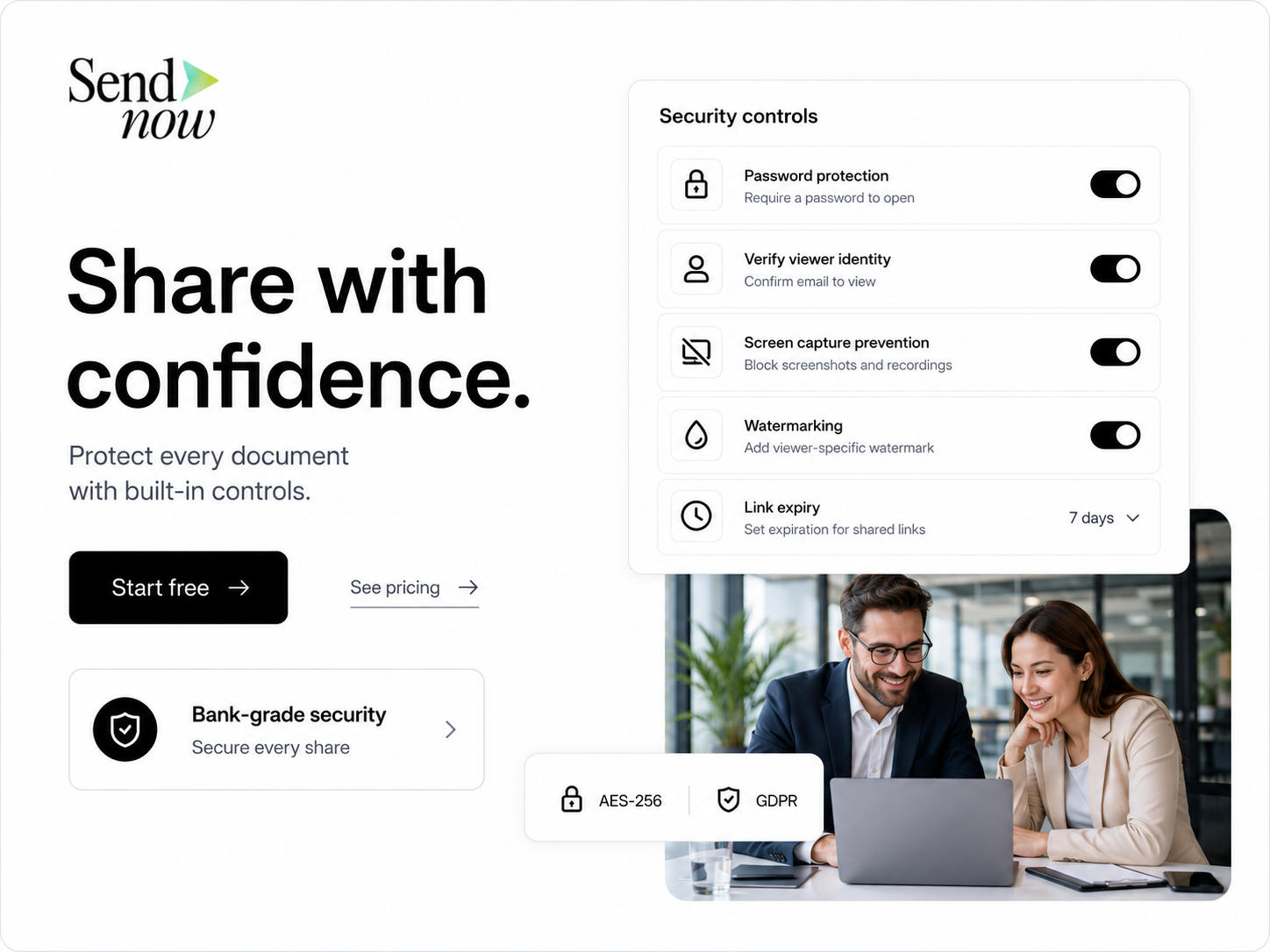
- Enable Email Verification: Require the recipient to input their email and verify it via a one-time code. This links the viewing event to a verified corporate identity rather than an anonymous web visitor.
- Enable Page-Level Tracking: Configure the link to record the exact duration spent on each page of the document.
- Set Automatic Link Expiry: Set the link to deactivate automatically after the recipient has reviewed the document, limiting the window of exposure.
Step 4: Monitor Log Activity in Real-Time
Regularly review the tracking panel. A compliant platform will display a clean dashboard showing all access events, including device details, locations, and timestamps.
Step 5: Export Logs for Compliance Documentation
During an internal audit or a regulatory review, export the audit logs in standard formats (such as CSV or PDF) to serve as physical proof of your technical safeguards.
5. Fulfilling Data Subject Rights
Under the GDPR, individuals ("data subjects") possess broad rights regarding their personal data. Your file sharing logs must be structured to support these rights.
Article 15: Right of Access
Data subjects have the right to request confirmation of whether their personal data is being processed, and to obtain a copy of that data along with information about how it is shared. If a client or employee submits a Subject Access Request (SAR), you must be able to identify every instance where their records were shared. A searchable audit trail allows you to quickly locate these events and provide the necessary compliance reports.
Article 17: Right to Erasure ("Right to be Forgotten")
Individuals can request the deletion of their personal data under certain conditions. When a valid erasure request is processed, you must ensure that all shared links to their files are deactivated and that the files are removed from the storage platform.

Note: While the documents themselves must be deleted, you may have a legal obligation to retain the audit logs for security, compliance, or regulatory reporting purposes. In these scenarios, the logs should be anonymized by removing the individual's email address and replacing it with a randomized identifier, preserving the audit trail without violating their privacy.
6. Practical Security Benefits and Risk Reduction
Beyond fulfilling regulatory requirements, maintaining a secure logging system provides significant operational benefits for your business:
- Mitigation of Insider Threat: Knowing that all document interactions are tracked and watermarked deters employees and contractors from downloading or sharing files inappropriately.
- Accelerated Incident Response: In the event of a suspected leak, your security team can pinpoint the exact moment the file was accessed, the IP address responsible, and whether the file was downloaded or merely viewed.
- Operational Efficiency: Page-level tracking shows you whether stakeholders have actually read the contracts or reports you sent. This helps sales, legal, and finance teams focus their follow-up efforts on engaged recipients.
Implementing a tracked document sharing pipeline transforms data security from a checklist item into a strategic operational advantage.
Related Reading
- Best Practices for Distributing Encrypted Monthly Performance Packages
- Securing Confidential Board Packs for Finance Audits
- Secure Audit Trail Logger for Financial Performance Reports
Frequently Asked Questions
What is a secure audit trail and how does it support GDPR compliance?
A secure audit trail is an unalterable log that records all access events for shared files. It supports GDPR compliance by providing the necessary proof of accountability, demonstrating that personal data is accessed only by authorized individuals and under secure conditions.
Does the audit trail log contain personal data itself under GDPR?
Yes. Email addresses, IP addresses, and specific access patterns are classified as personal data under the GDPR. Therefore, your document platform's logs must be protected with the same security measures (such as encryption and access controls) applied to your shared files.
How long should we retain audit logs for file sharing activities?
Retention periods should be defined in your corporate data retention policy, balancing security requirements with the GDPR principle of storage limitation. A standard retention period for financial and business audit logs is 5 to 7 years, while general operational logs may be retained for 1 to 2 years.
Can audit trail data be tampered with or deleted by users?
No. For an audit trail to be compliant, it must be immutable. Senders, recipients, and system administrators must not have the ability to alter or delete individual log entries, ensuring the integrity of the record.
How does a secure audit trail assist in data breach notifications (Article 33)?
If a breach occurs, the GDPR requires notification to the DPA within 72 hours. A secure audit trail allows you to immediately identify which files were accessed, when the access occurred, and the IP addresses involved. This data is critical for assessing the breach and providing the required details to the authority.
Ensure your document sharing is secure and compliant. Start your trial on SendNow and set up a secure audit trail for all your shared files today.
About the Author: Rifana Hameem
Rifana is the founder of SendNow. She leads the team in building secure, compliant, and analytics-rich document sharing tools for finance and professional teams worldwide.
Connect on LinkedIn