

Secure audit trail logger for financial performance reports
Published on June 9, 2026
Secure audit trail logger for financial performance reports
Deploying a secure audit trail logger is essential to monitor access to your corporate financial reports. By capturing verified viewer actions, IP addresses, and exact viewing durations, organizations can ensure data integrity and compliance. Follow this technical guide to establish an immutable, tamper-proof logging system for your financial performance updates.
Financial performance reports are the lifeblood of corporate communication, detailing profitability, cash reserves, liabilities, and strategic forecasts. When these reports are distributed to investors, auditors, and board members, they leave the safety of the corporate firewall. This makes them highly vulnerable to unauthorized copying, premature disclosure, and regulatory non-compliance.
To maintain control over these critical files, financial teams must implement an active tracking mechanism. A passive "send and forget" approach is no longer acceptable under modern compliance standards. Establishing a secure logging pipeline ensures that every interaction with a shared financial report is verified, recorded, and preserved in a tamper-proof audit trail.
1. The Operational and Regulatory Mandate for Financial Logging
Corporate financial reporting is subject to intense regulatory oversight. Depending on your industry and jurisdiction, several regulations mandate the tracking of document access:
- SOX (Sarbanes-Oxley Act) Section 404: In the United States, public companies must maintain internal controls over financial reporting. This includes securing the systems used to store and distribute financial statements and maintaining verification records of who has reviewed the data.
- GDPR (General Data Protection Regulation): Financial reports often contain personal details, such as executive bonuses, departmental payroll summaries, or client-specific billings. GDPR Article 32 requires technical safeguards to secure this data, while Article 5(2) mandates that companies be able to prove compliance through detailed audit logs.
- SEC Rule 17a-4: For broker-dealers, the SEC requires that records of financial transactions and key communications be maintained in a searchable, immutable format with a complete audit trail.
Beyond compliance, keeping a detailed log is an operational necessity. If a competitor learns of a dip in your quarterly margins before the public release, or if draft financial forecasts are leaked to the media, having an active audit log is the only way to identify the source of the exposure and limit the damage.
2. Core Components of a Secure Audit Trail Logger
A compliance-grade logging system must go beyond recording basic download events. It must capture a comprehensive set of metadata for every access attempt to build a forensic-ready record:
+-------------------------------------------------------------+
|                     Audit Trail Logger Metadata             |
+-------------------------------------------------------------+
                              |
       +----------------------+----------------------+
       |                      |                      |
       v                      v                      v
+--------------+      +---------------+      +---------------+
| Identity     |      | Time & Date   |      | Network & IP  |
| (Verified    |      | (Access &     |      | (Location &   |
| Email Gate)  |      | Duration)     |      | Carrier)      |
+--------------+      +---------------+      +---------------+
                              |                      |
                              +-----------+----------+
                                          |
                                          v
                                   +--------------+
                                   | Device Finger|
                                   | (OS, Browser |
                                   | & Screen)    |
                                   +--------------+
Verified Identity Gating
The logger must associate every action with a verified identity. Anonymous access links do not provide compliance value. The sharing platform must require the recipient to verify their corporate email address via a one-time passcode (OTP) before they can view the financial report, creating a verifiable link between the person and the log event.
Chronological Timestamps
The log must record the exact date and time (using Coordinated Universal Time, or UTC) for every event, including:
- When the sharing link was generated.
- When the recipient passed the verification gate.
- When they opened each page of the document.
- When the session was closed or timed out.
Network and Location Signatures
The logger must capture the viewer's public IP address, their geographic location (country and city), and their network service provider. This information is vital for detecting anomalous access attempts, such as a local auditor accessing files from an unexpected overseas IP address.
Device and Client Fingerprinting
Recording the viewer's operating system, browser type, device type (desktop vs. mobile), and screen resolution helps verify that the access pattern matches the recipient's usual profile, identifying potential credential sharing.
Page-Level View Duration
The logger must track which pages were viewed and how long the viewer spent on each page. For example, if a recipient spends five minutes studying the balance sheet page but skips the disclosures section, this behavior is recorded in detail.
3. Ensuring Log Integrity and Immutability
An audit log has no value if it can be modified or deleted. To be legally defensible and compliant with regulations like SEC Rule 17a-4, the logging system must enforce strict integrity controls:
- Write-Once, Read-Many (WORM): The database storing the logs must be configured to prevent modification or deletion. Once an access event is recorded, it must remain unalterable.
- Cryptographic Hashing: Each log entry should be cryptographically chained to the previous one. Any attempt to modify a historical record will break the chain, alerting security administrators immediately.
- Role-Based Access Control (RBAC): Access to the logs must be highly restricted. The employees who share the documents should not have the ability to view or manage the underlying log database, preventing internal tampering.
- Separation of Duties: The system must separate the roles of document sender, security auditor, and system administrator. No single user should have the permissions required to modify both the document settings and the access logs.
4. How the Audit Trail Logger Works on SendNow
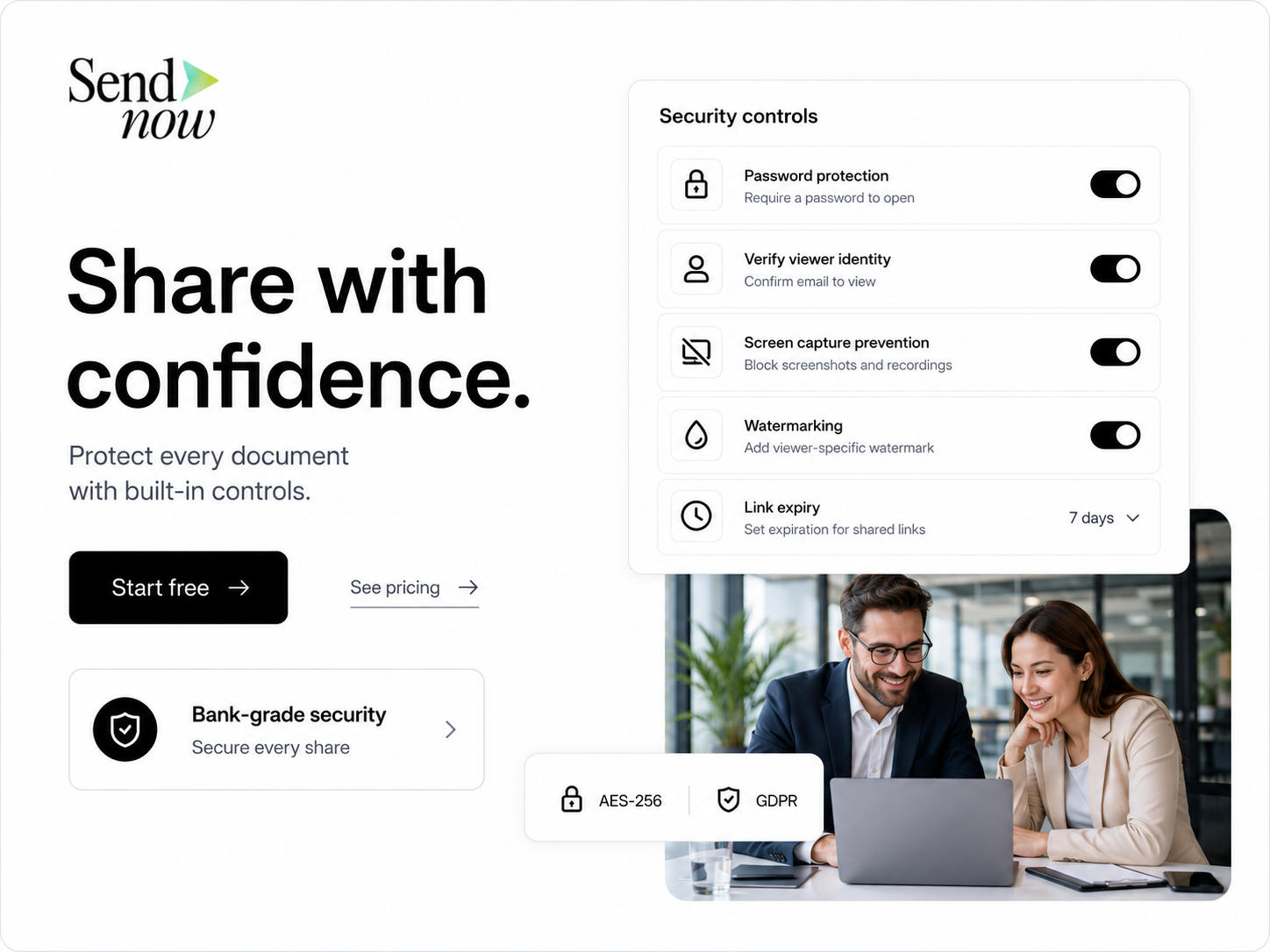
SendNow features a built-in, compliance-ready audit trail logger designed specifically for sensitive corporate communications.
Here is how the platform tracks and records document interactions:
- Interactive Session Heartbeat: When a recipient views a shared financial report, the secure web viewer sends periodic, encrypted heartbeat signals back to the SendNow servers. This allows the system to measure the exact active viewing duration, even if the user leaves the tab open in the background.
- Page-by-Page Mapping: As the user scrolls through the PDF, the viewer logs the transition from one page to the next. The dashboard presents this data as a clean timeline, showing the sequence of pages viewed and the time spent on each.
- Automated Anomaly Detection: The platform alerts you if the same sharing link is opened from two different IP addresses simultaneously, indicating that the link or verification code has been shared.
- Structured Log Export: You can export the audit logs for any shared file in CSV, JSON, or secure PDF formats. These exports are structured to serve as audit evidence for internal reviews or external regulatory filings.
5. Step-by-Step Implementation Guide
Follow these steps to establish a secure logging pipeline for your financial reports:
Step 1: Prepare and Upload the Financial Report
Consolidate your financial tables, disclosures, and summaries into a single PDF. Upload the document to your secure SendNow workspace.
Step 2: Configure the Verification Gate
Select the document, click Share, and configure the link settings:
- Enable Email Verification. Specify the allowed domain (e.g.,
investor-group.com) or list the individual email addresses of authorized recipients. - Disable Allow Downloads. Keeping the document in "view-only" mode ensures the viewer must interact with the secure viewer, allowing the logger to track their activity continuously.
Step 3: Distribute the Link
Share the secure link via your corporate portal or secure email.
Step 4: Monitor Access in Real-Time
As your recipients review the report, log in to your SendNow dashboard and navigate to the Analytics panel. Here you can view the live feed of access events, including:
- Who has opened the file.
- The geographic location of the viewer.
- The specific pages they viewed and their duration.
Step 5: Export the Log for Auditing
At the end of the reporting cycle or audit period, select the document and click Export Audit Log. Save the generated file in your compliance archives.

6. Forensic Investigations and Incident Response
If a data breach or an unauthorized disclosure occurs, your audit log serves as the primary tool for investigation and response.
Tracing the Source of a Leak
If draft financial numbers are published online before the official release, you can compare the leaked sections with your audit logs. By identifying which recipient spent the most time on those specific pages, or which link logged an unexpected access attempt from a non-corporate IP address, you can quickly narrow down the source of the exposure.
Detecting Compromised Credentials
If a board member's corporate credentials are stolen, the attacker may attempt to download or view shared financial packages. The audit log will flag this activity if the access request originates from an unusual location (e.g., a different country) or uses an unexpected device configuration, allowing your IT security team to revoke the link and reset the user's credentials immediately.
Fulfilling Breach Notification Rules
Under GDPR Article 33, organizations must notify regulators of a personal data breach within 72 hours. Having a detailed, searchable audit log allows your legal team to quickly determine whether personal data was accessed during a security incident, the scope of the exposure, and the steps taken to mitigate the risk, fulfilling your regulatory obligations.
Related Reading
- Setting Up an Audit Trail for GDPR Compliant File Sharing
- Securing Confidential Board Packs for Finance Audits
- Best Practices for Distributing Encrypted Monthly Performance Packages
Frequently Asked Questions
What is a secure audit trail logger and why is it needed for financial reports?
A secure audit trail logger is a system that records all access events and interactions with shared documents in an unalterable format. It is needed for financial reports to verify that only authorized recipients have viewed sensitive data, maintain corporate security, and comply with financial regulations.
Are the logged details of external viewers compliant with GDPR?
Yes, provided that your privacy policy informs recipients that their access activity is tracked for security purposes. Additionally, the logged data (such as emails and IP addresses) must be protected with appropriate security measures and retained only for as long as necessary for security and compliance.
How does page-level tracking determine access duration?
Page-level tracking uses an encrypted web connection to send periodic heartbeat signals from the viewer's browser to the platform servers. This records which page is active on the screen and tracks the exact duration the user spends reviewing it, ignoring background tabs or inactive sessions.
Can we export the audit log for external compliance reviews?
Yes. With SendNow, you can export the complete audit log for any shared document in standard formats (such as CSV or PDF), allowing you to provide physical proof of access controls during compliance reviews or regulatory audits.
How does a secure audit trail assist during a regulatory financial audit?
It provides third-party auditors with verification that the financial reports were distributed securely, accessed only by authorized personnel, and kept protected throughout the audit process, demonstrating robust internal controls.
Maintain complete control over your corporate disclosures. Start your trial on SendNow and implement a secure audit trail logger for all your financial performance reports today.