

Best Practices for Distributing Encrypted Monthly Performance Packages

Best Practices for Distributing Encrypted Monthly Performance Packages
Distributing monthly performance packages securely is crucial to protect confidential financial documents from unauthorized exposure. By implementing advanced encryption, multi-factor authentication, and dynamic watermarks, organizations can safeguard executive reports. Follow these industry-proven best practices to optimize your distribution pipeline and guarantee financial data security.
For modern finance departments, corporate treasurers, and Chief Financial Officers, the compilation and distribution of monthly performance packages is a critical operational cycle. These packages contain a detailed analysis of the company's financial health, including profit and loss statements, balance sheets, department-by-department budget variance reports, cash flow forecasts, and executive summaries. Because these materials provide a complete, current picture of corporate performance, they are classified as highly confidential financial documents.
Sharing these reports with board members, investors, lenders, and regional executives is necessary for corporate alignment and decision-making. However, because this distribution cycle occurs monthly, it represents a recurring, high-probability window for data leaks, unauthorized access, and compliance violations. Traditional sharing workflows fail to secure these files adequately. Implementing a structured, encrypted distribution process is essential to maintain confidentiality and protect corporate intelligence.
1. The Critical Role of Monthly Performance Packages in Finance
Monthly performance packages serve as the primary tool for evaluating business performance against strategic targets. They provide the board of directors, private equity sponsors, and major lenders with the financial metrics needed to assess operational efficiency, capital allocation, and debt covenant compliance.
Because these packages aggregate information from multiple enterprise resource planning (ERP) systems, accounting tools, and departmental budgets, they present a comprehensive view of the company’s financial position. The contents typically include:
- Material non-public information (MNPI): Strategic changes, revenue trends, and margin analyses that could impact the valuation of the firm if disclosed prematurely.
- Granular cost structures: Detailed breakdowns of executive compensation, vendor contracts, R&D expenditures, and operational overhead.
- Forward-looking projections: Forecasts and scenarios regarding future acquisitions, product development cycles, or restructuring initiatives.
Given the depth and sensitivity of this data, protecting monthly performance packages is a core security requirement. A single leak of these packages can compromise a firm’s competitive position, harm investor confidence, and trigger regulatory investigations.
2. Security Risks and Pitfalls of Traditional Distribution
Many organizations rely on distribution methods that prioritize convenience over security, creating significant vulnerabilities in their reporting workflows.
Sending Password-Protected PDFs via Email
A common practice is to encrypt a PDF package with a static password and send it as an email attachment, sending the password in a subsequent message. This method is fundamentally insecure:
- Shared transmission path: If an attacker intercepts the recipient's email traffic, they can easily access both the attachment and the password.
- Weak passwords: Users often choose simple, easily guessable passwords or reuse the same password month after month.
- Local storage exposure: Once decrypted, the PDF is stored locally on the recipient’s device, where it remains vulnerable to malware, local device theft, or accidental sharing.
Static Shares on Corporate Intranets or Shared Drives
Some finance teams publish monthly reports to folders on platforms like SharePoint, Microsoft Teams, or Google Drive. While this avoids email attachments, it introduces other risks:
- Over-permissive sharing: Access controls on corporate drives are often complex. A folder intended for executive eyes only may inherit permissions that allow junior employees or IT staff to view the contents.
- No link control: Standard sharing links can be forwarded internally or externally. If an employee copies the link to their personal notes, the security boundary is broken.
- Lack of active monitoring: These platforms rarely alert the finance team when a document is viewed by an unexpected user, or when a file is downloaded outside of standard working hours.
3. Essential Controls for Secure Financial Distribution
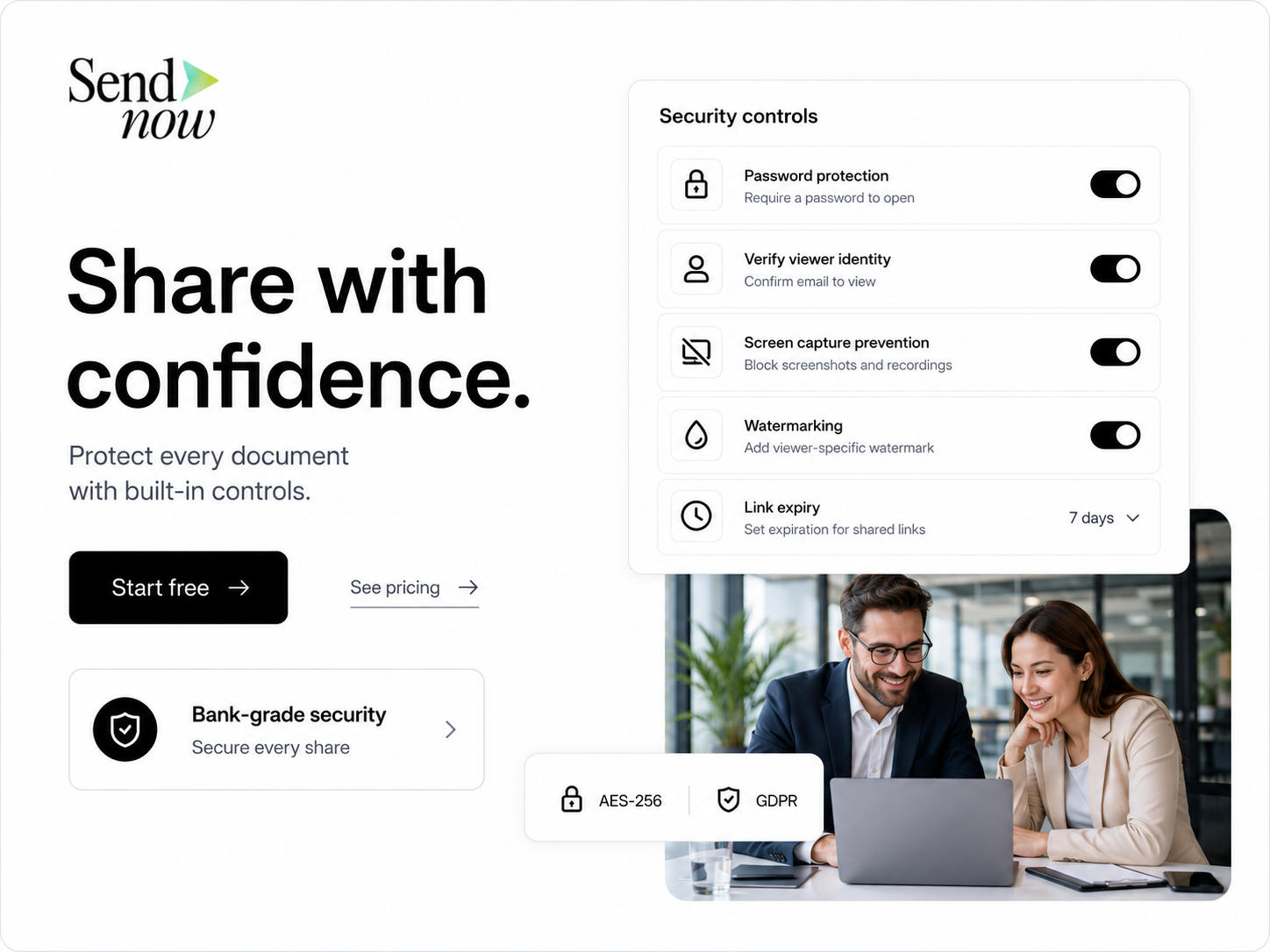
To mitigate these risks, organizations must implement a dedicated document security framework. Securing monthly performance packages requires five core technical controls:
+-------------------------------------------------------------+
|               Secure Document Distribution Pipeline         |
+-------------------------------------------------------------+
                              |
       +----------------------+----------------------+
       |                      |                      |
       v                      v                      v
+--------------+      +---------------+      +---------------+
| AES-256      |      | Multi-Factor  |      | Dynamic       |
| Encryption   |      | Authentication|      | Watermarking  |
+--------------+      +---------------+      +---------------+
                              |                      |
                              +-----------+----------+
                                          |
                                          v
                                   +--------------+
                                   | Real-Time    |
                                   | Audit Logs   |
                                   +--------------+
1. AES-256 Encryption at Rest and in Transit
All financial packages must be encrypted using Advanced Encryption Standard (AES) with a 256-bit key length. This ensures that the data is unreadable while sitting on storage servers (at rest) and while moving across network connections (in transit).
2. Multi-Factor Access Gating
Access to the sharing link must require the recipient to verify their identity. Email verification gates require the viewer to input a one-time passcode sent to their corporate email address before they can view the performance package. For high-security environments, multi-factor authentication (MFA) via SMS or authenticator apps should be enforced.
3. Dynamic Watermarking
Every page of the performance package must overlay viewer-specific information. By dynamically printing the viewer's email address, IP address, and access timestamp across the content, you create a strong deterrent against unauthorized sharing, printing, or screenshotting.
4. Link Expiration and Deactivation
Monthly reports are time-sensitive. A performance package from January is less relevant by March and should not remain accessible forever. Configure sharing links to expire automatically after a set period (e.g., 14 days), or manually deactivate the links once the review cycle is complete.
5. Granular Auditing and Tracking
The finance team must maintain a record of all interactions with the shared packages. The audit log must record:
- Who accessed the document (email address).
- When the document was opened (timestamp).
- How long they spent on each page (duration).
- Where the request originated (IP address and country).
This level of tracking is essential for demonstrating compliance with internal security policies and external regulations.
4. Implementing an Automated and Encrypted Distribution Pipeline
To streamline the monthly reporting cycle, organizations should establish a repeatable, secure workflow. Follow this step-by-step guide to distribute performance packages:
Step 1: Standardize the Package Format
Ensure all reports, spreadsheets, and executive summaries are compiled into a single, high-quality PDF. This ensures that the layout remains consistent across all devices and that security settings can be applied uniformly to the entire package.
Step 2: Upload to your Document Platform
Upload the PDF to a secure document management and sharing platform like SendNow. Organize the files in folders structured by reporting month and recipient group (e.g., 2026-06 / Board of Directors).
Step 3: Configure Security and Tracking Rules
Create a shareable link and apply the following parameters:
- Access Restrictions: Enable email verification and specify the allowed email domains or individual addresses.
- Viewing Permissions: Set the document to "view-only" to disable downloads and printing.
- Dynamic Watermark: Configure the watermark to overlay the viewer's email and IP address at 30% opacity.
- Link Expiry: Set the link to expire after 10 business days.
Step 4: Distribute the Link
Share the link via your executive portal or corporate email. Because the link itself is protected by authentication gates, the distribution channel does not need to be encrypted separately.
Step 5: Review Engagement and Audit Logs
Monitor the link activity. Verify that all board members and investors have reviewed the package before the scheduled performance meeting. If any unexpected access attempt is logged, revoke the link immediately.
5. Regulatory Compliance and Security Frameworks
For financial institutions, publicly traded companies, and organizations handling personal data, secure document distribution is a regulatory requirement.

General Data Protection Regulation (GDPR)
Monthly performance packages often contain personal data, such as executive salaries, employee performance evaluations, or client-specific revenue metrics. GDPR Article 32 requires organizations to implement technical measures, including encryption and access controls, to protect personal data. Insecurely sharing these reports can result in data breaches and significant regulatory fines.
SOC 2 Type II and ISO 27001
Firms seeking SOC 2 Type II or ISO 27001 certification must demonstrate that they have robust procedures for protecting confidential business information. An encrypted document sharing platform that provides complete audit logs and access controls serves as key evidence of compliance during security audits.
SEC and Financial Industry Rules
Regulatory bodies like the SEC in the US and the FCA in the UK mandate that financial firms maintain strict controls over material non-public information. Implementing encrypted distribution pipelines ensures that sensitive financial reports are not leaked to the public, preventing insider trading risks and ensuring compliance with market disclosure rules.
6. Enhancing Engagement and Board Room Alignment
Beyond security, using a modern sharing platform like SendNow provides financial teams with valuable operational insights.
Standard file sharing is a one-way communication: you send the document and hope the recipients read it. With page-level analytics, you can see how long each board member spent on specific sections of the performance package:
- Identify high-interest areas: If board members spend 80% of their time on the cash flow forecast page, you can prepare additional details on working capital before the board meeting.
- Confirm preparation: Knowing whether investors have read the performance package before a call allows you to tailor your presentation and address their concerns directly.
- Streamline reporting: If certain sections of the package are consistently ignored, you can simplify or remove them in future reporting cycles, saving valuable time for the finance team.
Encrypted, tracked document sharing transforms monthly reporting from a security risk into an insightful, efficient process.
Related Reading
- Securing Confidential Board Packs for Finance Audits
- Setting Up an Audit Trail for GDPR Compliant File Sharing
- Secure Audit Trail Logger for Financial Performance Reports
Frequently Asked Questions
What are confidential financial documents and why must monthly packages be encrypted?
Confidential financial documents include any reports that detail a company's financial performance, budget variances, or strategic forecasts. Monthly packages must be encrypted to prevent unauthorized access, protect material non-public information, and ensure compliance with regulatory standards.
Can we send password-protected PDFs via email instead of using a secure platform?
While password-protecting a PDF is better than sending it in plain text, it is not secure. If the email is intercepted, the file can be decrypted. Additionally, once the file is decrypted, it can be downloaded and forwarded without your control. A secure sharing platform provides continuous protection and access tracking.
How do dynamic watermarks protect monthly financial reports?
Dynamic watermarks overlay the viewer's email, IP address, and access date across the document pages. This deters recipients from taking screenshots or sharing copies, as any leaked document can be traced back to the specific viewer.
How does email verification gate access to performance packages?
Email verification requires the viewer to enter their corporate email address and input a one-time security code sent to that address. This ensures that only authorized recipients can open the link, preventing the link from being shared with unauthorized individuals.
What is the best way to revoke access to outdated financial packages?
The best way is to use a platform like SendNow, which allows you to set automatic expiration dates on links. Alternatively, you can manually deactivate the link from your dashboard at any time, immediately blocking access for all recipients.
Optimize your corporate reporting. Start your trial on SendNow today and distribute encrypted monthly performance packages securely and efficiently.
About the Author: Rifana Hameem
Rifana is the founder of SendNow. She leads the team in building secure, compliant, and analytics-rich document sharing tools for finance and professional teams worldwide.
Connect on LinkedIn