
How Investment Bankers Share Documents in 2026

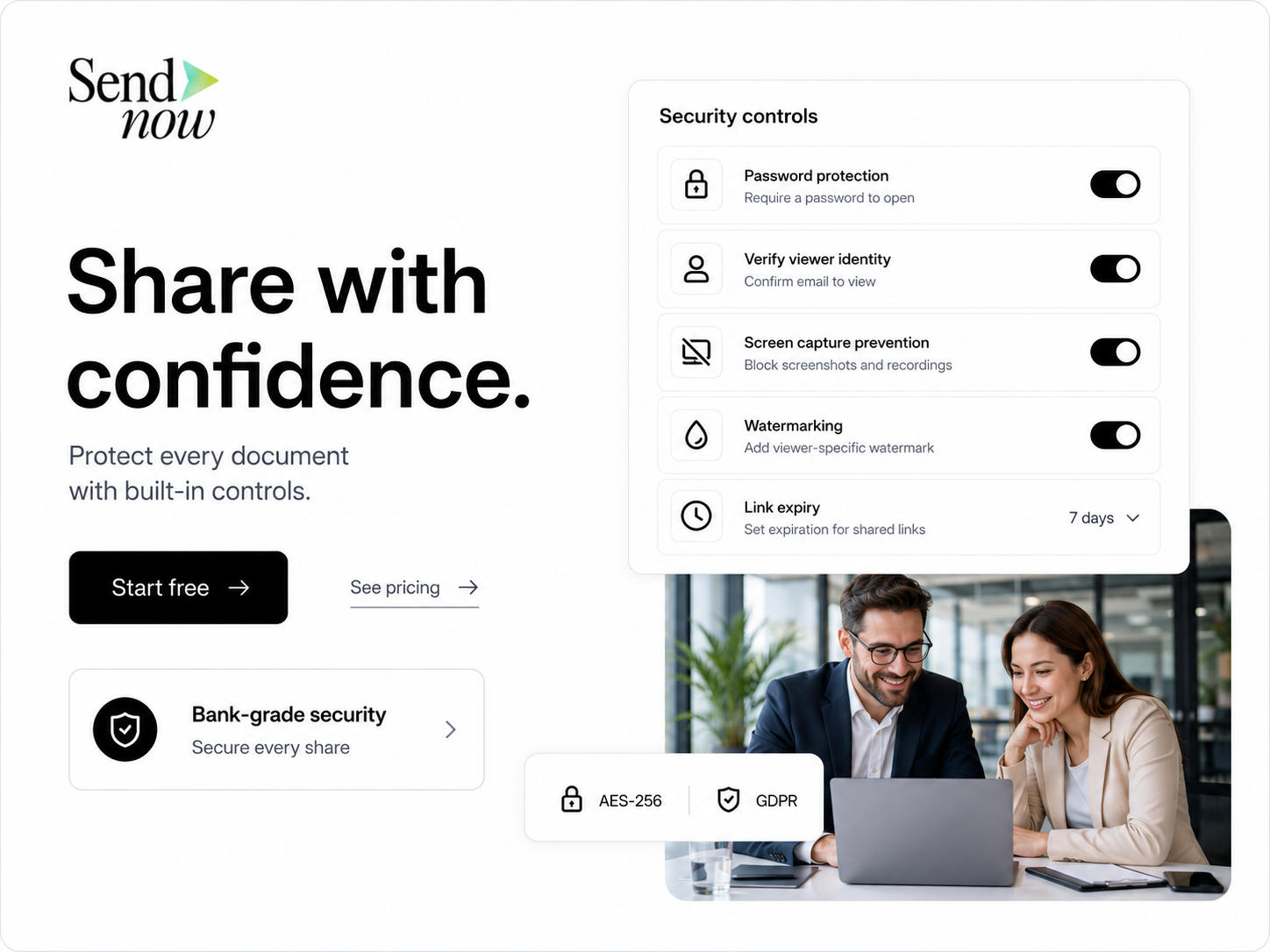
Investment bankers use virtual data rooms (VDRs) for secure document sharing during M&A due diligence, IPOs, fundraising, and deal pitches. Modern VDRs include page-by-page analytics, NDA gating, screenshot protection, AI engagement scoring, and branded deal rooms. Email attachments are no longer acceptable for deal-level document sharing due to security and traceability gaps. Platforms like SendNow offer finance-first VDR alternatives that combine bank-grade security with real-time investor intelligence at a fraction of legacy VDR pricing.
How Investment Bankers Share Documents in 2026
Introduction
Investment banking runs on information asymmetry. The sell side controls what buyers see, when they see it, and how much they can retain. That control used to be physical: a locked room, a printed binder, a notarized NDA before entry. Today it is digital, and the virtual data room is the primary infrastructure.
The global VDR market is on a trajectory toward $17.46 billion by 2034, according to EthosData. That growth reflects a real shift in professional standards. Deal teams no longer tolerate email attachments, shared Dropbox folders, or unsecured PDF links for confidential transaction materials. Every document that leaves a firm's controlled environment carries legal, reputational, and competitive risk.
This article answers the seven questions investment bankers, PE associates, VC analysts, and M&A advisors ask most about document sharing in 2026.
Table of Contents
- What Is a Virtual Data Room in Investment Banking?
- How Investment Bankers Share Confidential Documents
- What Documents Go in an Investment Banking Data Room?
- Virtual Data Room vs. Email: The Key Differences
- How AI Engagement Scoring Works for Document Analytics
- What Is NDA Gating in Document Sharing?
- DocSend Removed Its Free Plan: What Are the Alternatives?
- Conclusion
What Is a Virtual Data Room in Investment Banking?
A virtual data room (VDR) is a secure online repository where companies store and share confidential documents with controlled access, granular permissions, and a full audit trail. Investopedia defines a VDR as something "typically utilized during the due diligence process preceding a merger or acquisition to review, share, and disclose company documentation."
In investment banking specifically, a VDR serves as the central deal workspace where multiple parties access sensitive materials simultaneously: buy side, sell side, legal counsel, auditors, and management teams. Each party receives a distinct permission level — read-only, print-enabled, download-permitted, or full access — all enforced automatically by the platform.
What distinguishes a VDR from general cloud storage:
- Granular document permissions (view-only, no download, no print)
- Full audit trail logging every action on every document
- NDA enforcement before access is granted
- Watermarking that embeds viewer identity into each page
- Real-time notifications when a document is opened or a page is viewed
DFIN frames the market position plainly: VDRs are "secure online environments that store confidential information necessary to complete the largest and most complex financial transactions."
The VDR has also become the first signal of deal readiness. A well-organized data room tells a buyer the seller is professional, organized, and serious. A disorganized room — or no room at all — tells them the opposite.

SendNow's document viewer delivers real-time open notifications and per-page time analytics so deal teams know exactly where buyer attention lands.
How Investment Bankers Share Confidential Documents
Investment bankers share confidential documents through a tiered process tied to deal stage and counterparty trust level.
Pre-NDA Stage
Teasers and one-pagers go out through tracked links with view-only access. No download. No print. Every second spent on each page is recorded. The goal is to create interest without disclosing deal-sensitive detail, while gathering data on which buyers engage most deeply.
Post-NDA Stage
After NDA execution, the full Confidential Information Memorandum (CIM), financial model summary, and management presentation go into a deal room with controlled access. Access is granted per party, usually with separate folder structures for each bidder to prevent cross-party information leakage.
Due Diligence Stage
The full data room opens, containing hundreds or thousands of documents organized by category: legal, financial, operational, HR, intellectual property, customer contracts. Each bidder sees only what their permission level authorizes.
According to datarooms.org, investment banks use VDRs specifically because "bank-level security, control, and audit capabilities" are non-negotiable at transaction scale. A breach during an M&A process can legally invalidate the deal, expose the bank to liability, or leak price-sensitive information to the market before signing.
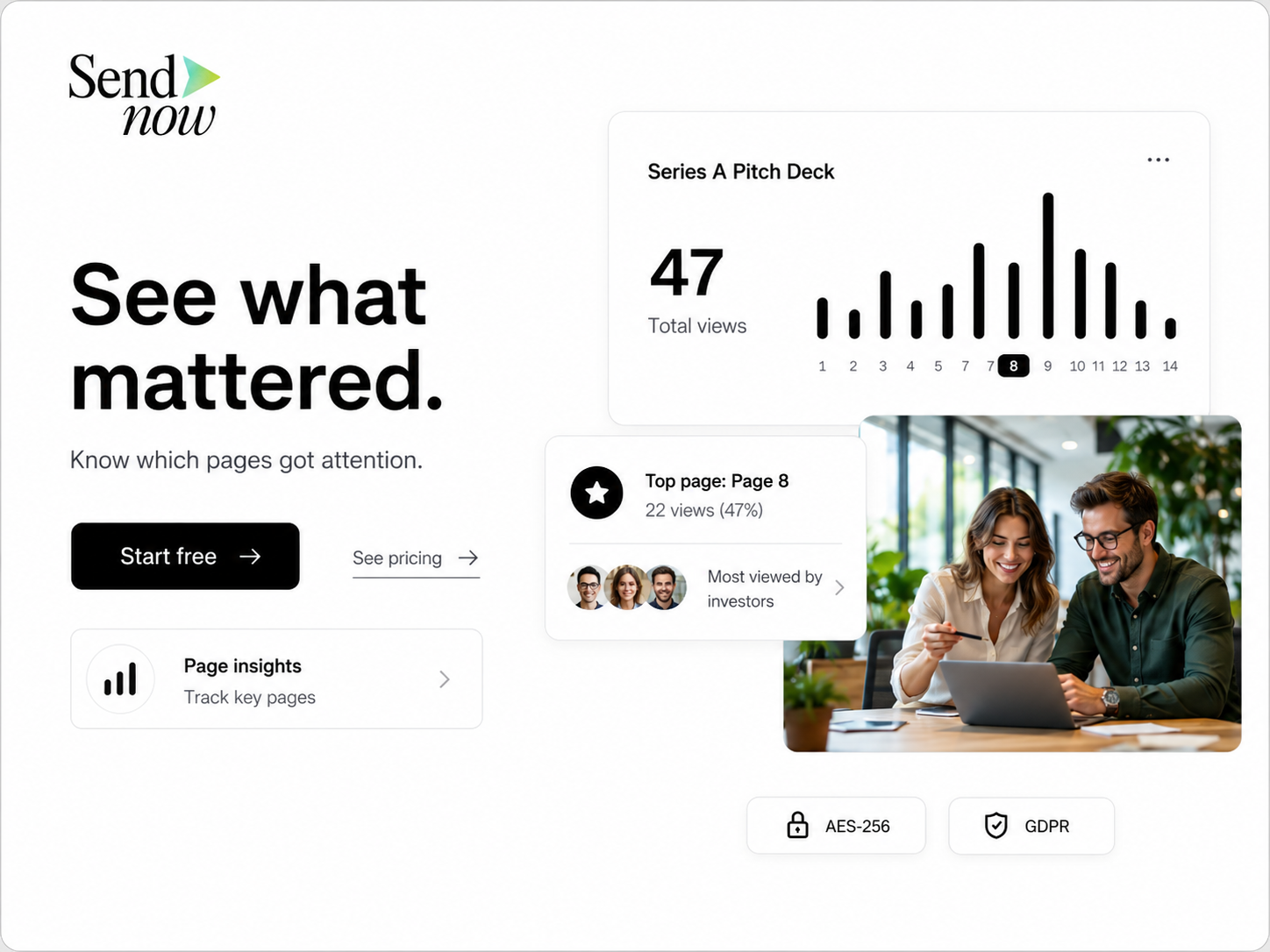
The critical evolution in 2026 is that bankers now also read engagement analytics across every stage. They know which pages of the CIM the buyer's team spent the most time on, which sections they returned to, and who on the buy side is most active inside the room. This intelligence shapes how bankers manage buyer conversations and prioritize follow-up.
What Documents Go in an Investment Banking Data Room?
A well-organized data room contains every document a buyer needs to complete due diligence without friction or delay. According to EthosData and Peony, buyers typically request 174+ document categories, grouped into five core areas:
Corporate Documents
- Certificate of incorporation, shareholder agreements, cap table
- Board minutes, corporate governance policies, subsidiary structure
Financial Documents
- Audited financials (3-5 years), management accounts, and interim statements
- Revenue model, unit economics, cash flow forecasts, and debt schedule
Legal Documents
- Material contracts, customer agreements, supplier terms
- IP registrations, litigation history, compliance certificates, regulatory licenses
Operational Documents
- Org chart, key employee contracts, HR policies, benefit plans
- Technology architecture, data processing agreements, vendor contracts
Commercial Documents
- Customer list, pipeline breakdown, churn and retention data
- Sales materials, competitive positioning, NPS or customer satisfaction data
Completeness matters more than volume. When documents are missing, outdated, or inconsistent, buyers lose confidence and valuations take a hit. EthosData is direct: "When documents are missing, outdated, or inconsistent, buyers lose confidence. When folders are unclear, the diligence process slows down. When files are shared through email or open cloud links, security concerns appear immediately. All of these issues can affect valuation, timelines, and deal outcome."
Virtual Data Room vs. Email: The Key Differences
Email attachments were the default for document sharing in banking for decades. In 2026, that standard no longer holds at the deal level.
The Core Problems with Email
No version control. Once a PDF leaves your inbox, you lose control. Recipients forward it internally, save local copies, print it. You cannot revoke access after sending.
No traceability. You cannot know whether the buyer read page 12 of your CIM or stopped reading at page 3. You are guessing at interest level with no data.
No security layer. Attachments bypass corporate email filters when forwarded externally. A breach is one misdirected email away — and KnowBe4 notes that sending sensitive emails to the wrong person "can result in serious risk to both yourself, your organization, and your organization's clients."
No NDA enforcement. You can send an NDA as a separate document, but you cannot gate access to the confidential materials behind an NDA signature within email. A recipient can open the attachment before they sign.
CapLinked frames the distinction clearly: VDRs provide "strict security and control permissions" that email and file sharing platforms simply do not offer at deal scale.
SterlingVDR adds: "While [file-sharing platforms] do a great job of making it easy to upload and share files, they do not offer the security, accuracy or time-saving features needed to manage M&A transactions."
The practical implication: a banker who shares a CIM via email attachment on a $50M transaction is operating below professional standard in 2026.
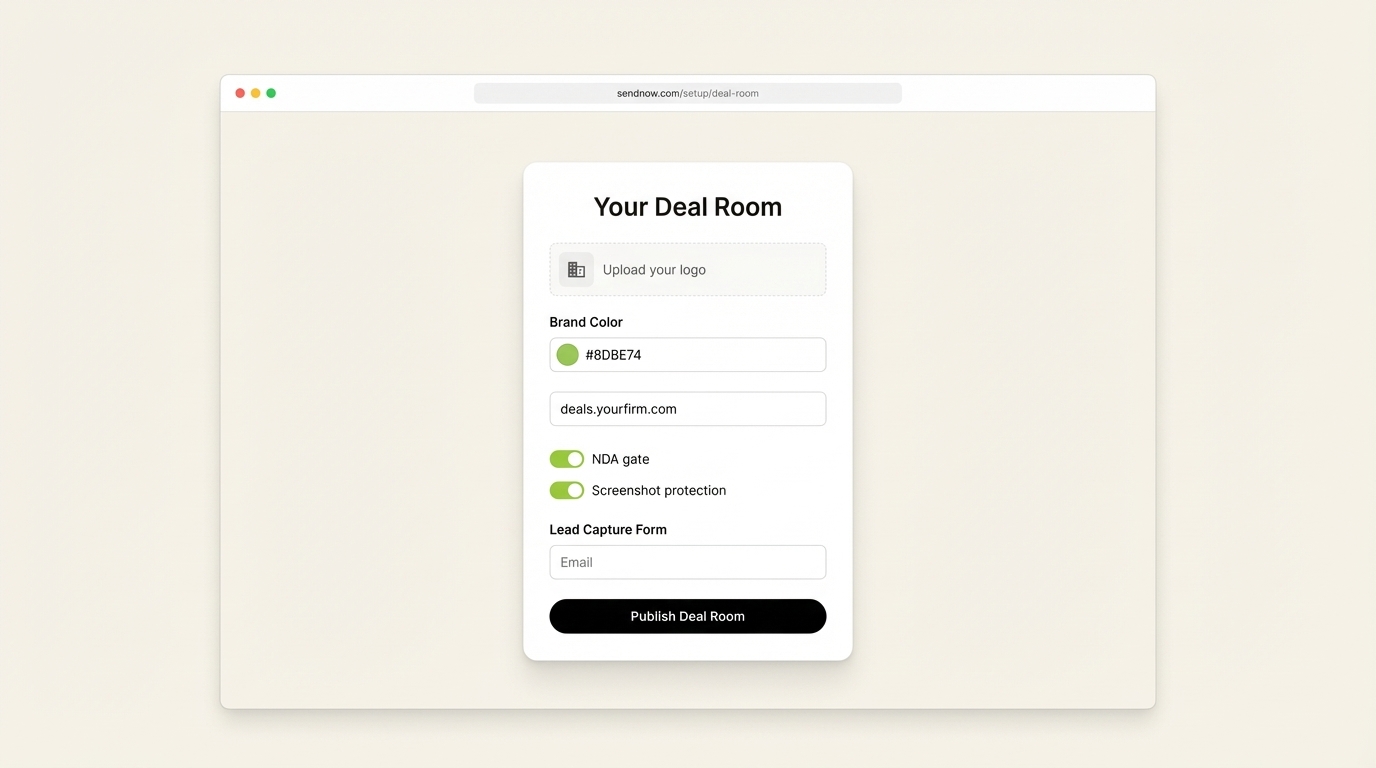
SendNow's branded deal room configuration: set a custom domain, enable NDA gating, turn on screenshot protection, and publish in under five minutes.
How AI Engagement Scoring Works for Document Analytics
AI engagement scoring takes raw viewing data — time per page, number of revisits, scroll depth, unique viewer count, return visit frequency — and converts it into a single actionable score that tells a deal team how genuinely interested a counterparty is.
M Accelerator describes the application: AI "monitors email responses, slide views, and meeting notes to identify interested investors. It detects tone changes in communication, helping you address concerns early. It automates follow-ups based on investor behavior."
In a deal context, engagement scoring answers specific questions:
- Which bidder has spent the most time reviewing the financial model?
- Which pages of the CIM attracted the most attention across all active buyers?
- Is a buyer's engagement declining, suggesting they may be withdrawing from the process?
- Which sections did the most senior decision-makers review versus junior associates?
SendNow builds AI engagement scoring directly into its document viewer. When an investor opens a pitch deck or CIM, the platform analyzes page-by-page time-on-page data and produces a composite engagement score for that session and for that viewer over time. A banker sees at a glance whether the prospect read the financial summary for three minutes or skimmed the cover page in 15 seconds.
This intelligence transforms follow-up conversations. Instead of a generic "Did you get a chance to review our materials?" email, a banker sends a targeted note referencing the specific section the investor spent the most time on — a demonstrably more effective approach.
InvestorFlow reports that IR executives at leading PE firms now view AI-powered engagement tracking as essential rather than supplementary: "AI isn't replacing the fundamentals of strong relationships and proven performance — it's amplifying them."
What Is NDA Gating in Document Sharing?
NDA gating means a recipient must sign a non-disclosure agreement before gaining access to a document or deal room. The NDA is embedded in the document sharing flow, not sent as a separate PDF to be printed, signed, scanned, and emailed back.
Ontra establishes the volume context: "Private equity and venture capital firms, direct lenders, investment banks, and other private markets firms execute many non-disclosure agreements each year." Managing that volume through manual workflows creates delays and compliance gaps that expose the firm to risk.
How Modern NDA Gating Works
- Sender uploads the document and enables NDA gating in the platform settings
- Recipient clicks the share link
- Before viewing any content, the recipient sees the NDA and accepts it digitally
- Acceptance is timestamped and logged with IP address and email
- Sender receives instant confirmation; the document becomes accessible to that recipient
This creates a legally defensible record that the recipient agreed to confidentiality terms before viewing any sensitive content. In an M&A or fundraising context, this record is material. If information leaks to the market or to a competing buyer, the NDA log establishes exactly who had access and when.
Ironclad notes that an NDA "creates the legal framework to protect ideas and information from being stolen or shared" — but only if there is a clear record of who agreed and when. A paper NDA faxed to a deal team does not provide the same clean audit trail as a platform-embedded digital signature with timestamp.
SendNow includes NDA gating across all plans, starting at $9/month for the Pro tier. This makes it accessible to boutique advisory firms, independent sponsors, and fund managers who previously relied on DocSend or on manual NDA distribution.
DocSend Removed Its Free Plan: What Are the Alternatives?
DocSend, now owned by Dropbox, eliminated its free plan in March 2025. The change forced thousands of users — founders sharing pitch decks, advisors distributing CIMs, financial consultants sending reports — to either pay entry-level DocSend pricing or find an alternative.
According to PaperSend: "DocSend does not offer a free plan. Unlike some competitors in the document sharing space, DocSend operates purely on a subscription-based model." DocSend's base tier is $15/month per user, with analytics-complete tiers significantly higher.
The Alternatives That Emerged
Enterprise VDRs: iDeals, Datasite, Intralinks — full-featured, purpose-built for $100M+ transactions, priced accordingly. Opaque pricing models, lengthy onboarding, overkill for firms sharing decks and CIMs rather than running 1,000-document due diligence processes.
SendNow differentiates specifically on the finance vertical. Its feature set — page-by-page analytics, AI engagement scoring, NDA gating, branded deal rooms, screenshot protection, dynamic watermarks, real-time Slack notifications, and custom domains — covers the full workflow of a deal team sharing pre-deal materials, CIMs, and investor presentations.
Pricing: Pro from $9/month (1 member, 300 documents), Business at $33/month (3 members, 1,000 documents), Enterprise custom. Yearly billing saves 53%. Free trial with no credit card required.
The practical answer to DocSend's free plan removal is that better-priced, finance-focused alternatives now exist with comparable or superior feature sets.
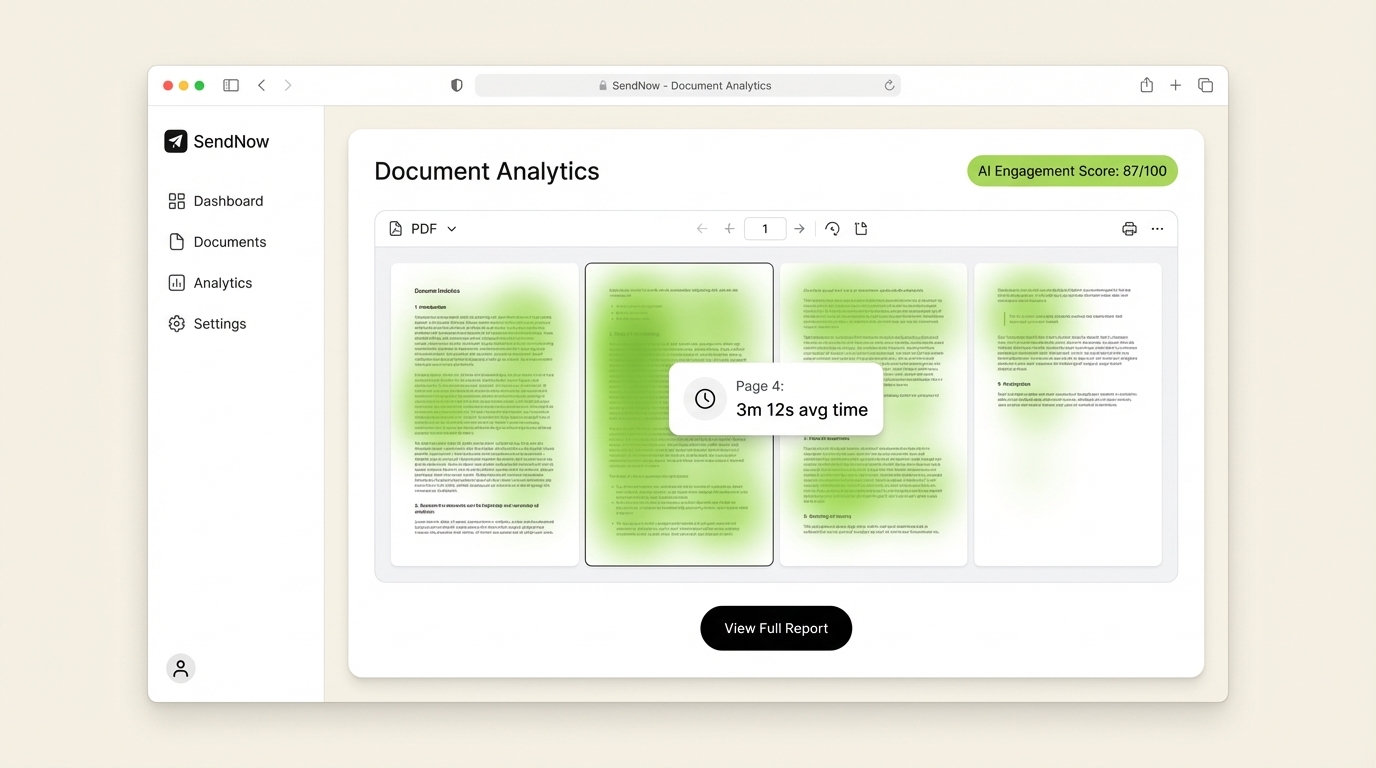
SendNow's AI engagement score surfaces which pages captured the most attention and assigns a composite interest rating per viewer, per session.
Conclusion
The way investment bankers share documents in 2026 reflects a professional standard that moved significantly in the last five years. Email attachments are a liability. Generic cloud links signal carelessness. Deal teams operating at the highest level treat page-by-page analytics, AI engagement scoring, and NDA enforcement as baseline requirements, not premium features.
The VDR market grew because the risk of operating below that standard is now too high — legally, reputationally, and competitively. A buyer who sees an unprotected PDF link in their inbox has already formed an opinion about the seller's operational rigor.
If you share deal materials — pitch decks, CIMs, board packs, investor updates — without knowing whether they were read, which pages held attention, and whether the recipient signed an NDA before viewing, your process has a gap that your counterparties may already notice.
SendNow closes that gap. Start with a free trial, no credit card required. Pro from $9/month. Business plan is $43/month (or $20/mo annual). Annual plans save 53%.
Sources: EthosData | Investopedia | DFIN | datarooms.org | Peony | CapLinked | SterlingVDR | KnowBe4 | M Accelerator | InvestorFlow | Ontra | Ironclad | PaperSend
Keep Reading
- Secure Document Sharing for Finance Teams: Best Practices
- What Is a Virtual Data Room? Complete Guide for Finance Professionals
- NDA Best Practices for Sharing Confidential Financial Documents
- What Is Dynamic Watermarking and Why Finance Teams Need It
- A complete guide to private equity due diligence: the five types PE investors run, what they examine in financials and operations, red flags that kill deals, and how to prepare your company for a successful transaction.
About the Author: Rifana Hameem
Rifana is the founder of SendNow. She leads the team in building secure, compliant, and analytics-rich document sharing tools for finance and professional teams worldwide.
Connect on LinkedIn