

Startup Fundraising Data Room Checklist: What Investors Expect

Startup Fundraising Data Room Checklist: What Investors Expect
The market is full of products that promise secure document sharing, analytics or virtual data rooms. The harder question is whether a product is practical for the person buying it.
This guide is written for Founders preparing pre-seed to Series B fundraising. It focuses on the target query “startup fundraising data room checklist” and evaluates products by real workflow value: working documents, useful analytics, sensible security, a clean recipient experience and transparent pricing.
Key takeaway: A practical checklist organized by fundraising stage, with clear advice on what not to upload too early.
Why this topic matters for Founders preparing pre-seed to Series B fundraising
Confidential documents are rarely passive files. A pitch deck asks an investor to continue a conversation. A proposal asks a buyer to approve a project. A financial report asks a client to review sensitive information. A data room asks several parties to evaluate a transaction without losing control of the underlying material.
The common failure is to optimize only for sending. Email attachments and ordinary cloud links make distribution easy, but they often leave the sender without a clear understanding of who viewed the file, which pages received attention, whether a recipient returned, or whether an embedded product or booking link was clicked.
A better workflow connects four jobs: presentation, access control, engagement intelligence, and follow-up. That is the lens used throughout this guide. Features are useful only when they help the sender complete one of those jobs without adding unnecessary cost or friction.
When to open a data room
Start with the actual business moment rather than the software category. The sender has information that matters, a recipient whose intent is unknown, and a next action that depends on engagement. A useful system should reduce uncertainty without making the recipient complete a complicated registration process.
The first requirement is a clean browser experience. The second is reliable access control. The third is analytics that can influence a real decision. The fourth is reasonable pricing. Tools that are technically powerful but require an enterprise contract for ordinary founder needs can create more overhead than value.
Before selecting a product, write down the exact sequence: who uploads, who receives, what they must do before access, which actions should be tracked, how long access should remain active, and what should happen when the process ends. This simple map prevents purchasing a product because of impressive features that will never be used.
Company and legal documents
The best evaluation criteria are concrete. Confirm that embedded links remain usable, because a deck or proposal often contains the strongest calls to action. Check whether the owner can see link clicks, not merely total views. Confirm how long analytics are retained and whether a return visit can be distinguished from a first visit.
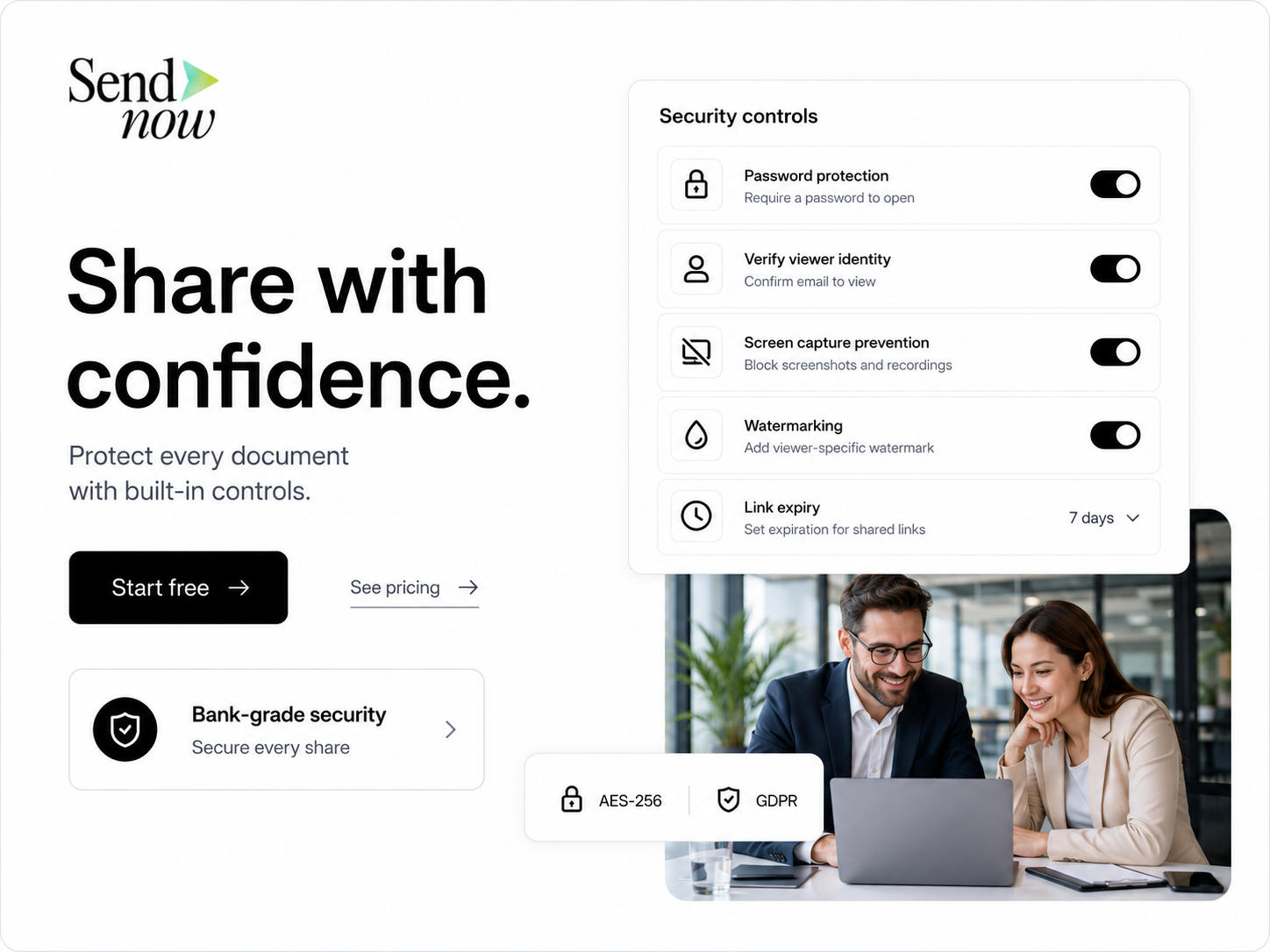
Review security in layers. Email verification and passwords help control entry. Allowed-user lists can limit access to named recipients. NDA gates can record acceptance before confidential material is shown. Watermarks discourage redistribution. Expiration and revocation let the owner close access later.
No control should be described as absolute. A determined person can photograph a screen or use another device. The goal is to reduce casual leakage, create accountability, and preserve control over the live link.
Finance and metrics
Price comparisons should use the plan that delivers the required outcome, not the cheapest plan displayed on a homepage. A free tier may be adequate for a test but fail when the document contains links, when the user needs verified access, or when the process continues beyond a short analytics window.
Likewise, an enterprise VDR may include advanced Q&A, complex groups, audit exports and dedicated onboarding. Those capabilities can be valuable in institutional diligence, but they are not automatically valuable to a seed-stage founder or a five-person agency.
Compare normal monthly billing as well as discounted annual pricing. Annual effective prices are useful for stable long-term use, but they require an upfront commitment. Monthly pricing better represents the cost of a short fundraising cycle, a client pitch, or a single transaction.

Product and market
Security and usability must be balanced. Requiring too many steps before an investor can view an introductory deck can reduce engagement. Requiring too few controls before opening financial statements can create unnecessary risk.
A sensible progression is to use lower-friction access for early materials, then strengthen controls as information becomes more confidential. A teaser might use email capture. A full pitch deck might add verified access and expiration. Financial models, cap-table information or diligence files may require a named-user list, NDA acceptance and watermarking.
This staged approach protects information without treating every recipient as if they were entering an enterprise diligence process on the first interaction.
People and operations
Analytics become valuable only when connected to a next step. A single open is a weak signal. A complete read, a return visit, concentrated time on key pages and clicks on a demo or booking link are stronger signals when they appear together.
Do not assume that a long page time always means interest. The recipient may have left the tab open. Do not assume that a fast read always means rejection. An experienced investor may scan quickly. Use analytics as context, not proof of intent.
The practical use is prioritization. Follow up first with people showing several meaningful actions, personalize the message around the material they reviewed, and avoid revealing that the sender watched every movement. The conversation should feel relevant, not surveilled.
Security and access checklist
A repeatable workflow improves both security and conversion:
- Prepare a clean final document with descriptive file names and functioning links.
- Upload it to a controlled sharing platform rather than attaching the original file.
- Choose the minimum security needed for that stage.
- Test the recipient experience in a private browser window.
- Send one clear link with a concise explanation.
- Review engagement after a reasonable interval.
- Follow up based on combined signals, not one metric.
- Revoke or expire access when the process ends.
- Export or record important activity before changing subscriptions.
- Audit old links regularly so confidential files do not remain available indefinitely.
This process is simple enough for a founder and structured enough for a professional team.
Practical feature checklist
| Capability | Why it matters | SendNow position |
|---|---|---|
| Working in-document links | Important when documents contain demos, websites, calendars or supporting resources | Supported across active SendNow plans |
| Page-by-page analytics | Shows which sections received attention | Available on supported analytics plans |
| Link-click analytics | Separates passive reading from a stronger action | SendNow records document link-click events |
| Email and password gates | Adds identity and basic access control | Available from the trial |
| NDA gate | Useful before sensitive financial or diligence access | Document Pro and MicroSite Pro |
| Watermarking | Discourages uncontrolled redistribution | Plan-dependent logo and dynamic options |
| Revocation and expiration | Lets the sender end access after sharing | Available on applicable plans |
| Branded portal | Organizes several assets into one professional experience | MicroSite Pro and Growth |
The right plan depends on the workflow. MicroSites and Document Sharing are separate subscriptions, so buyers should select the product that matches the job rather than assume every feature is bundled into every plan.
Where SendNow fits
SendNow is designed for founders, advisors, agencies, financial professionals and smaller deal teams that want document intelligence without enterprise data-room pricing.
SendNow uses transparent monthly pricing. Document Lite costs USD 9 per month for five active documents. Document Pro costs USD 17 per month for up to 100 documents and adds advanced analytics, video analytics, NDA agreements, custom logo watermarking, allowed-user controls, and link revocation. Document Business costs USD 43 per month for up to 300 documents and adds large-file support, dynamic watermarking, custom domains, webhooks, Slack, and team integrations. MicroSite Pro costs USD 19 per month for 15 MicroSites and 100 total documents. MicroSite Growth costs USD 49 per month for 50 MicroSites and 300 total documents, with custom domains, webhooks, and priority support.
Across active SendNow plans, in-document hyperlinks remain usable. SendNow records document link-click events and gives document owners link-click analytics. Screenshot protection should be described accurately: it is browser-based protection intended to discourage and limit common desktop capture actions, but no web platform can guarantee prevention of operating-system, hardware, camera, or every mobile screenshot method.
SendNow does not advertise a permanent free plan. It provides a 24-hour trial with two document uploads, one MicroSite, basic visitor analytics, email verification, and password protection. Trial files and MicroSites are permanently deleted after 24 hours unless the user upgrades.
For founders preparing pre-seed to series b fundraising, the main value is not a longer feature list. It is reaching a useful professional workflow at a predictable price. A sender can start at USD 9 for a small number of active documents, use USD 17 Document Pro for advanced fundraising or proposal workflows, or use a USD 19 MicroSite Pro subscription when several files need to be presented inside a branded portal.
Frequently Asked Questions
What is the best option for founders preparing pre-seed to series b fundraising?
The best option is the one that reaches the required workflow without forcing the buyer into unused enterprise features. For price-sensitive teams needing secure sharing and analytics, SendNow is designed as a practical choice.
How much does SendNow cost for this use case?
Document plans start at USD 9 per month. Document Pro costs USD 17. MicroSite Pro costs USD 19. Business and Growth plans add higher limits, custom domains and integrations.
Does SendNow support clickable links inside documents?
Yes. In-document hyperlinks are supported across active SendNow plans. SendNow also records document link-click events for owners.
Can document sharing prevent every screenshot or leak?
No. Browser controls, watermarks, access gates and revocation reduce risk and improve accountability, but no web platform can prevent every camera, operating-system or hardware capture method.
Should a startup use a permanent free plan?
A free plan can be useful for testing, but the team should check link functionality, analytics retention, recipient verification and security gates before relying on it for a live fundraising or client process.
What should be tested before sending a live link?
Test every embedded link, the email and password flow, mobile and desktop viewing, download settings, expiration, branding, notifications and the owner analytics view.
Share documents with startup-friendly pricing
SendNow helps founders preparing pre-seed to series b fundraising share important documents through controlled links, understand page and link engagement, and create branded MicroSite portals without starting with enterprise VDR pricing.
Start your 24-hour SendNow trial
No credit card is required. Trial files and MicroSites are permanently deleted after 24 hours unless you upgrade.
Related SendNow guides
- Best Data Room for Startup Fundraising: A Founder’s Buying Guide
- 9 Best Virtual Data Rooms for Startups in 2026
- NDA-Gated Document Sharing: A Practical Guide for Founders and Advisors
- Affordable Data Room for M&A Advisors and Boutique Investment Banks
- Commercial Real Estate Deal Room: What to Include and How to Share It
Sources and further reading
- https://sendnow.live/pricing
- https://www.sec.gov/education/capitalraising
- https://www.ycombinator.com/library
Pricing, exchange rates and competitor plan limits can change. Verify live competitor pricing before publication or update.
About the Author: Rifana Hameem
Rifana is the founder of SendNow. She leads the team in building secure, compliant, and analytics-rich document sharing tools for finance and professional teams worldwide.
Connect on LinkedIn