What Is Document Completion Rate and Why Does It Matter?

What Is Document Completion Rate and Why Does It Matter?
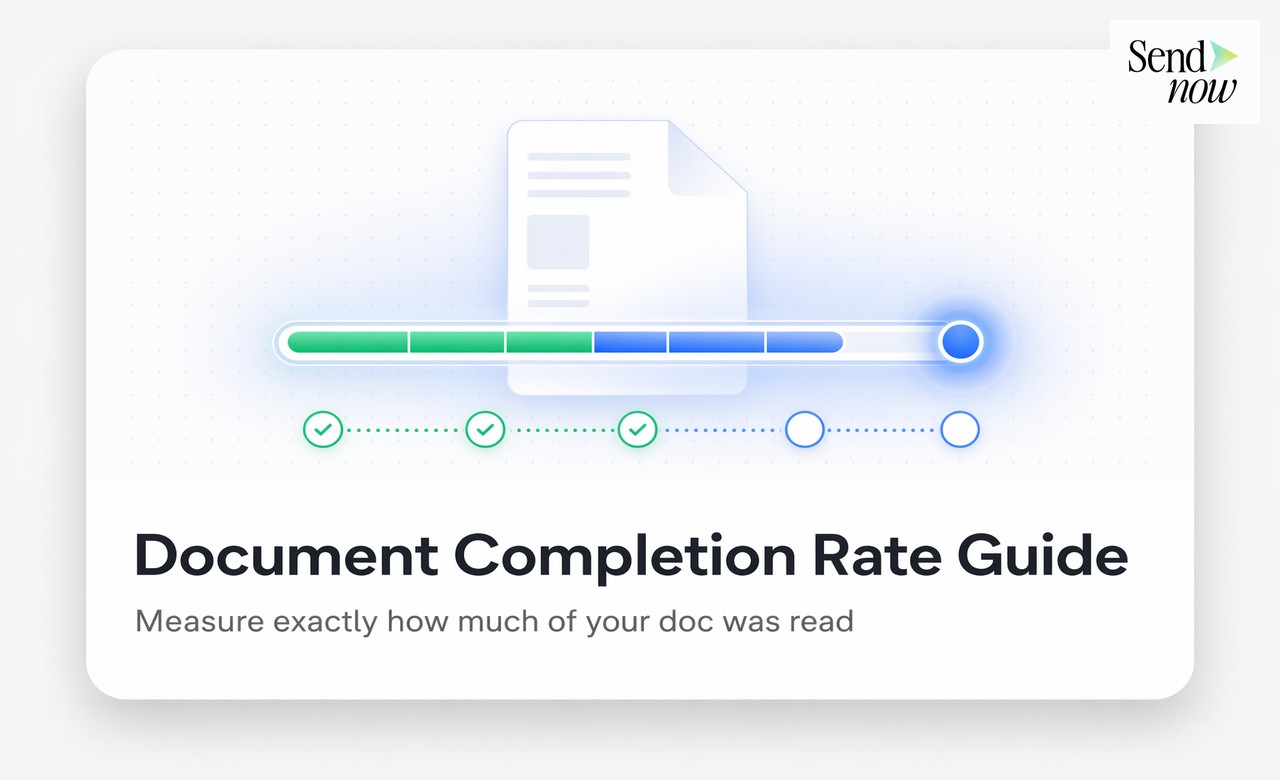
Document completion rate is the percentage of a shared document that a viewer read before closing it. If a recipient opens a ten-page proposal and closes it after page four, their completion rate is 40%. It is one of the most actionable metrics in document analytics because it tells you not just that a document was opened, but how deeply it was engaged with — and precisely where readers stopped.
How Document Completion Rate Is Calculated
Completion rate is calculated by dividing the last page the viewer reached by the total number of pages in the document, expressed as a percentage.
For a twenty-page document:
- Viewer closes after page twenty: 100% completion
- Viewer closes after page ten: 50% completion
- Viewer closes after page two: 10% completion
More sophisticated platforms — including SendNow — weight completion rate by dwell time rather than purely by page reached. A reader who reaches page twenty in fifteen seconds has a very different engagement profile from one who spent two minutes per page. Dwell-weighted completion reflects genuine reading rather than rapid scrolling.
Why Completion Rate Matters for Finance Teams
Finance professionals share long, complex documents: investment proposals, due diligence packs, client reports, onboarding materials, and compliance documentation. The assumption that these documents are read in full is rarely true — and not knowing where readers stop has real consequences.
For proposals and pitch decks — if your typical prospect closes at page four and your pricing section is on page eight, your most important information is never being seen. Knowing this allows you to move pricing forward, or to redesign the early pages to hold attention longer.
For client reports — if clients consistently stop reading after the executive summary, detailed performance commentary on subsequent pages has no audience. This is valuable for resource allocation: you are writing content that goes unread.
For compliance documents — regulated finance firms in the EU often need to demonstrate that clients have read specific disclosures. A completion rate of 100% on a risk disclosure document, attributed to a named viewer, is a meaningful audit record. A completion rate of 8% is a compliance concern.
For due diligence packs — in M&A processes, knowing that the buyer's team consistently stopped reading at the financial statements section (and never reached the legal warranties) shapes how you structure briefings and follow-on calls.
What Is a Good Document Completion Rate?
There is no universal benchmark — it varies by document type, length, and audience. General guidelines for finance documents:
| Document Type | Length | Expected Completion |
|---|---|---|
| Investment proposal | 8-12 pages | 70-90% |
| Client quarterly report | 10-20 pages | 40-70% |
| Due diligence data pack | 30-60 pages | 20-50% |
| Compliance disclosure | 3-5 pages | 85-100% |
| Onboarding materials | 5-10 pages | 60-80% |
A completion rate significantly below these ranges suggests either a structural problem with the document (important content is buried too deep) or a relevance problem (the recipient is not the intended audience).

Reading Completion Data in Context
Completion rate is most useful when read alongside other engagement metrics:
High completion + high time on document — Strong engagement. The reader worked through the document thoroughly. This is a follow-up signal.
High completion + very low time on document — The reader scrolled quickly to the end without reading. The completion percentage is technically high but the engagement was superficial.
Low completion + high time on early pages — The reader became absorbed in the opening sections but did not progress. This may indicate the later content is not visible enough, or that the early sections are already answering their questions.
Low completion across all viewers — A systemic document design issue. The content, structure, or length is causing consistent dropoff at the same point.
Using Completion Rate to Improve Documents
Completion data across multiple viewers provides an aggregate signal about your document's effectiveness:
-
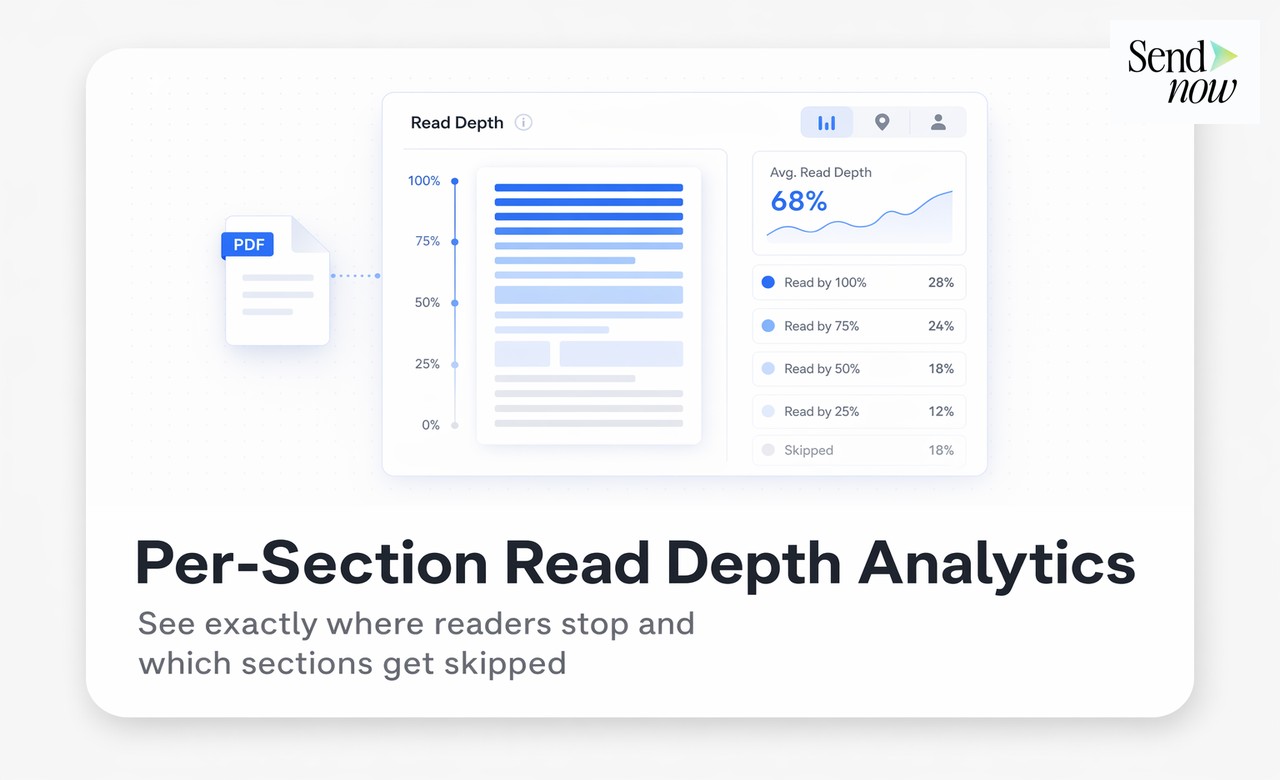
Identify the most common dropoff page — If 70% of readers close at page six, something on pages five or six is causing disengagement. It may be dense text, a confusing chart, or a natural stopping point where they feel they have what they need.
-
Test document restructuring — Move your most critical information earlier. If the pricing section is on page nine and prospects never reach it, move it to page four and measure whether completion and follow-up rates improve.
-
Shorten documents with high dropoff rates — If a twenty-page report shows average completion of 30%, ten of those pages are being written but not read. A twelve-page version that readers finish is more effective than a twenty-page version they abandon.
-
Personalise follow-ups to completion level — A prospect with 95% completion is ready for a detailed discussion. A prospect with 15% completion may need a follow-up that re-engages them with the content rather than assuming they have already reviewed it.
Completion Rate in Compliance Contexts
Under GDPR and EU financial regulation, some documents must be demonstrably received and read by clients. These include:
- Key Information Documents (KIDs) under PRIIPs
- Risk disclosure notices
- Terms of business
- Data processing notices
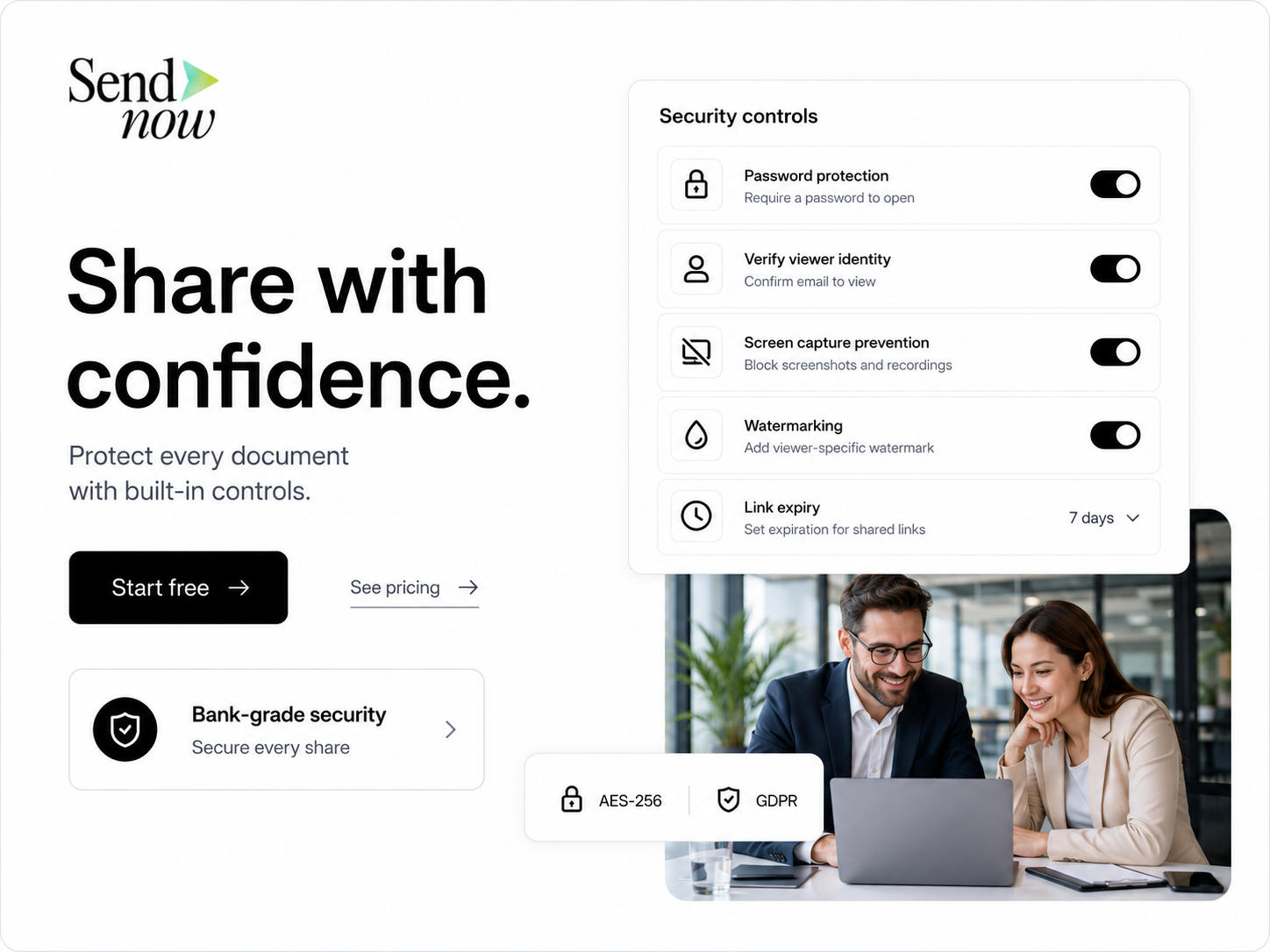
A platform that records completion rate with named viewer attribution provides a GDPR-aligned evidence trail for these requirements. SendNow's email verification and analytics infrastructure are designed to support exactly this use case.
Setting Up Completion Tracking in SendNow
Completion tracking is enabled by default for all documents shared via SendNow:
- Upload your document and share a trackable link
- Open the analytics view for any document
- Select a viewer to see their individual completion rate and page-by-page breakdown
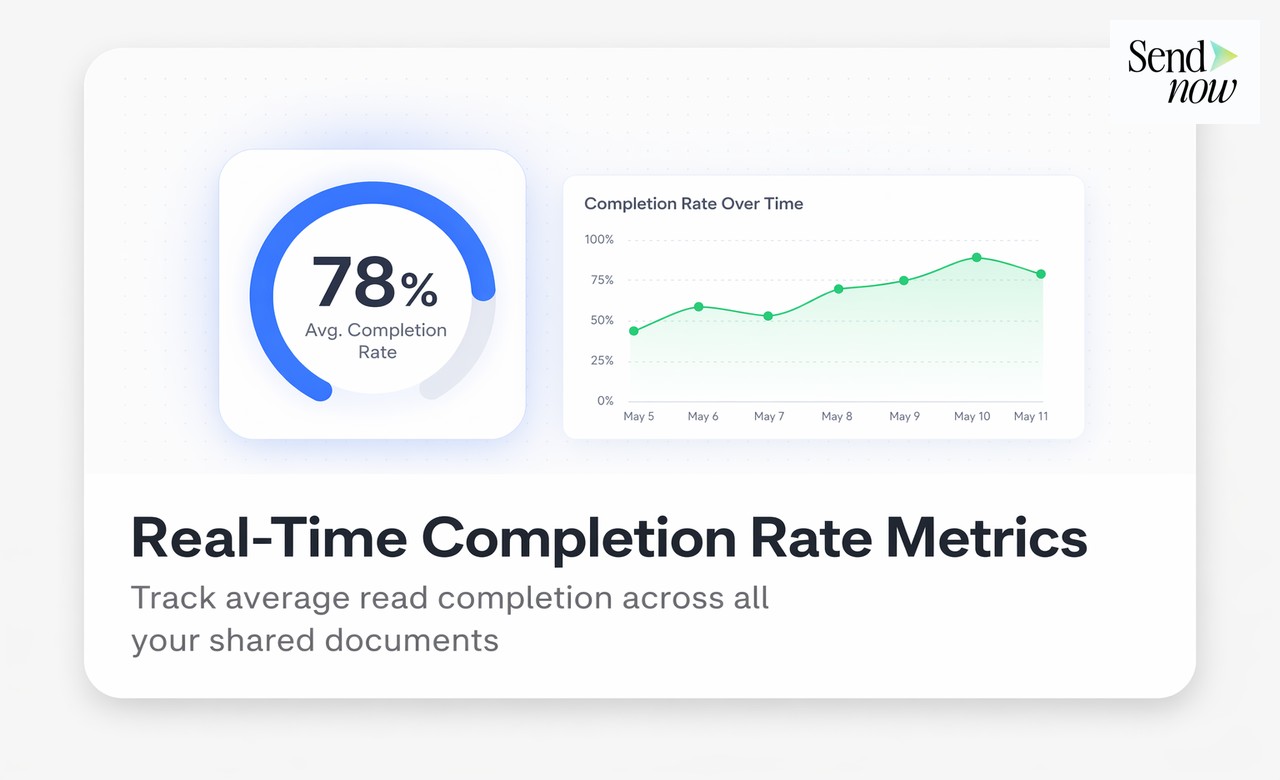
- Use the aggregate view to see average completion across all viewers
No additional configuration is required. Every view session automatically generates completion data.
For more on interpreting page-level analytics, see how to see which pages of your PDF someone actually read. For the full analytics framework, visit the PDF tracking complete guide.
FAQs
Q: What is document completion rate? A: Document completion rate is the percentage of a document that a viewer read before closing it, typically calculated as the last page reached divided by the total number of pages.
Q: What is a good completion rate for a business proposal? A: For a typical eight to twelve-page proposal, a completion rate of 70-90% indicates strong engagement. Below 50% suggests content or structural issues worth addressing.
Q: Can I see individual completion rates per viewer? A: Yes. SendNow shows completion rate for every individual viewer session, alongside time on document and page-level data.
Q: How is completion rate different from page views? A: Page views count the number of pages accessed. Completion rate expresses what percentage of the total document was reached, giving a cleaner single metric for engagement depth.
Q: What does 100% completion mean? A: The viewer reached the final page of the document. Combined with strong time-on-document, it indicates thorough reading.
Q: Does completion rate account for time spent on each page? A: Basic completion rate is based on pages reached. SendNow's dwell-weighted completion rate factors in time per page, providing a more accurate reflection of genuine reading.
Q: How can I improve completion rates? A: Shorten documents, move the most critical information earlier, improve visual clarity, and test different structures. Page-level analytics will show you exactly where readers are stopping.
Q: Is completion tracking available on the free tier? A: Yes. Completion rate is included in SendNow's free analytics dashboard for all tracked documents.
SendNow offers a free trial — no credit card required. Start at sendnow.live.
About the Author: Rifana Hameem
Rifana is the founder of SendNow. She leads the team in building secure, compliant, and analytics-rich document sharing tools for finance and professional teams worldwide.
Connect on LinkedIn