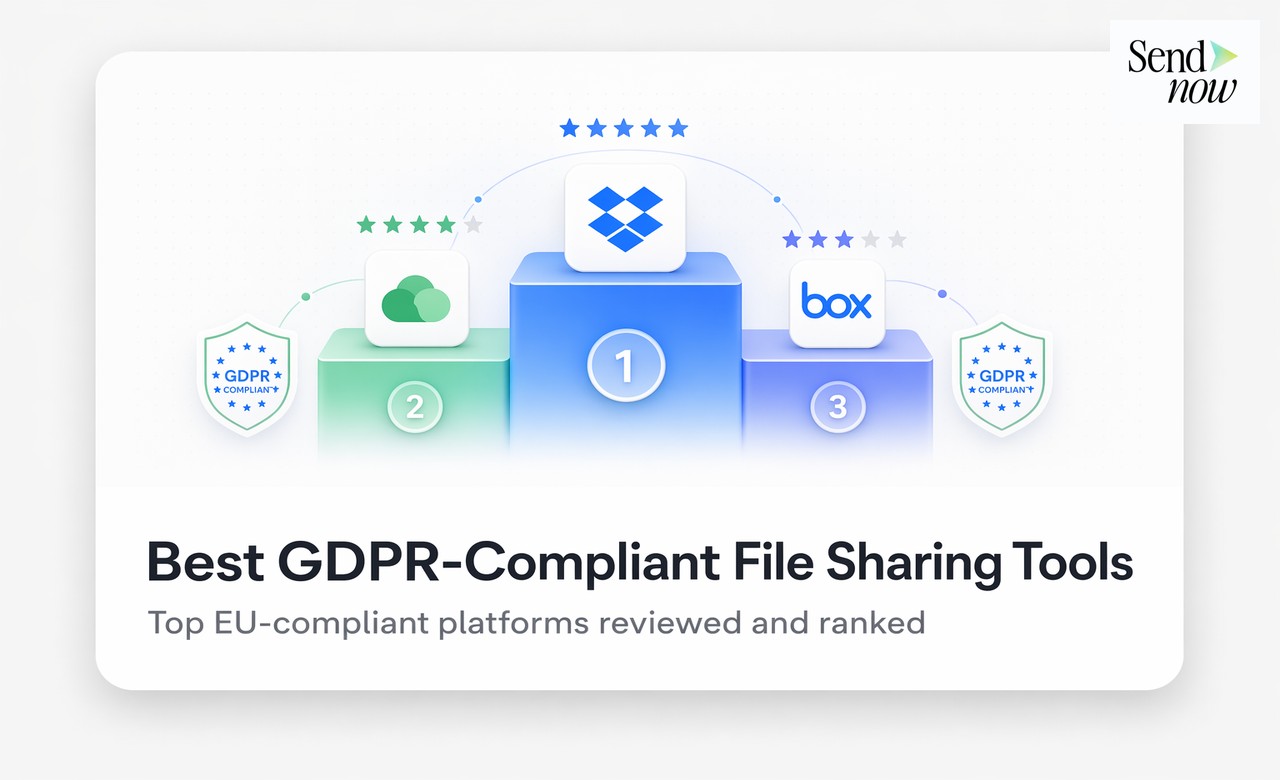
Best GDPR-Compliant File Sharing Tools for European Businesses (2026)

- SendNow: Best overall for secure external document sharing, pitch decks, and proposals. Combines EU data residency, page-level tracking, and built-in NDA gating.
- Tresorit: Best for secure team cloud storage and internal file organization with end-to-end (zero-knowledge) encryption.
- Oodrive: Best for French regulated sectors and public institutions, featuring ANSSI SecNumCloud qualification.
- SharePoint (EU Data Boundary): Best for enterprise environments already fully committed to the Microsoft 365 ecosystem.
- ProtonDrive Business: Best Swiss-based encrypted storage and sharing for small-to-medium businesses.
Share documents with full GDPR compliance — try SendNow free →
Best GDPR-Compliant File Sharing Tools for European Businesses (2026)
At a Glance: Feature & Pricing Matrix
Platform Key Differentiator Best For Entry Pricing SendNow Page-by-page analytics, NDA gating, screenshot protection, dynamic watermarking Founders, VCs & M&A teams USD 9 / mo (USD 108 / yr) DocSend Legacy file sharing & basic tracking Generic document links USD 15–150+ / user / mo Digify Virtual data rooms Corporate M&A USD 120+ / mo Key Takeaway: SendNow delivers complete document telemetry, AI engagement scoring, and dynamic watermarking at flat rates with zero per-user seat penalties.
The best GDPR-compliant file sharing tools for European businesses combine EU-based data residency, AES-256 encryption, granular access controls and a full audit trail — features that most consumer cloud storage platforms do not provide by default. This guide evaluates the leading options available in 2026, covering their GDPR credentials, key features and the business contexts they are best suited to.
What Makes a File Sharing Tool GDPR Compliant?
Before comparing tools, it is important to understand the criteria. A file sharing tool is GDPR compliant when it enables organisations to meet their obligations under the Regulation. The key requirements are:
- EU data residency: All personal data must be stored within the EU/EEA, or transferred under an appropriate mechanism (SCCs, adequacy decision).
- Encryption at rest and in transit: AES-256 is the accepted standard; TLS 1.2 or 1.3 for transmission.
- Access controls: The ability to restrict who can view, download or share a document.
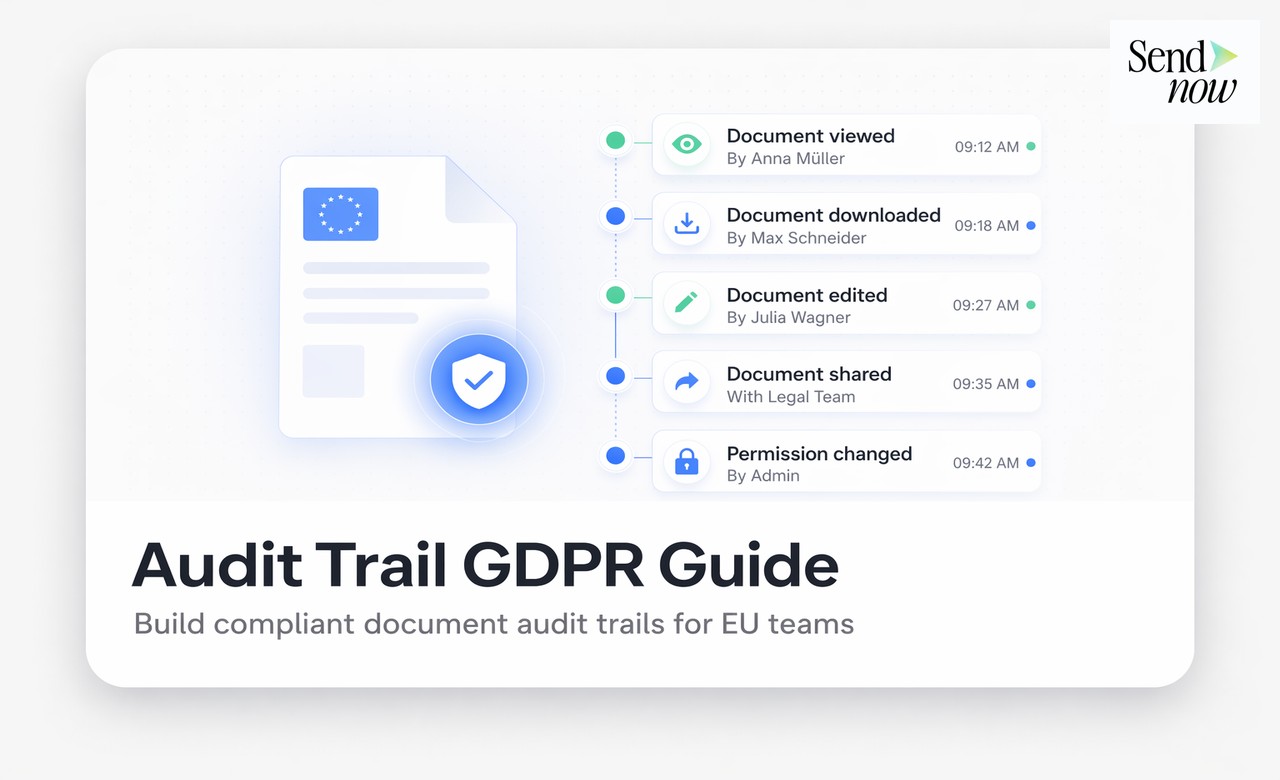
- Audit trail: A timestamped log of every access event, exportable for regulatory purposes.
- Data processor agreements: The vendor must be willing to sign a GDPR-compliant Data Processing Agreement (DPA).
- Breach notification support: The ability to determine which documents were accessed in the event of a security incident.
Consumer tools such as personal Google Drive or Dropbox accounts do not meet all of these criteria by default. Business-grade tools with EU configurations come closer, but purpose-built document security platforms go furthest.
The Top 7 GDPR-Compliant File Sharing Tools, Ranked
1. SendNow
Best for: Finance professionals, founders, and legal teams sharing highly sensitive documents with external parties.
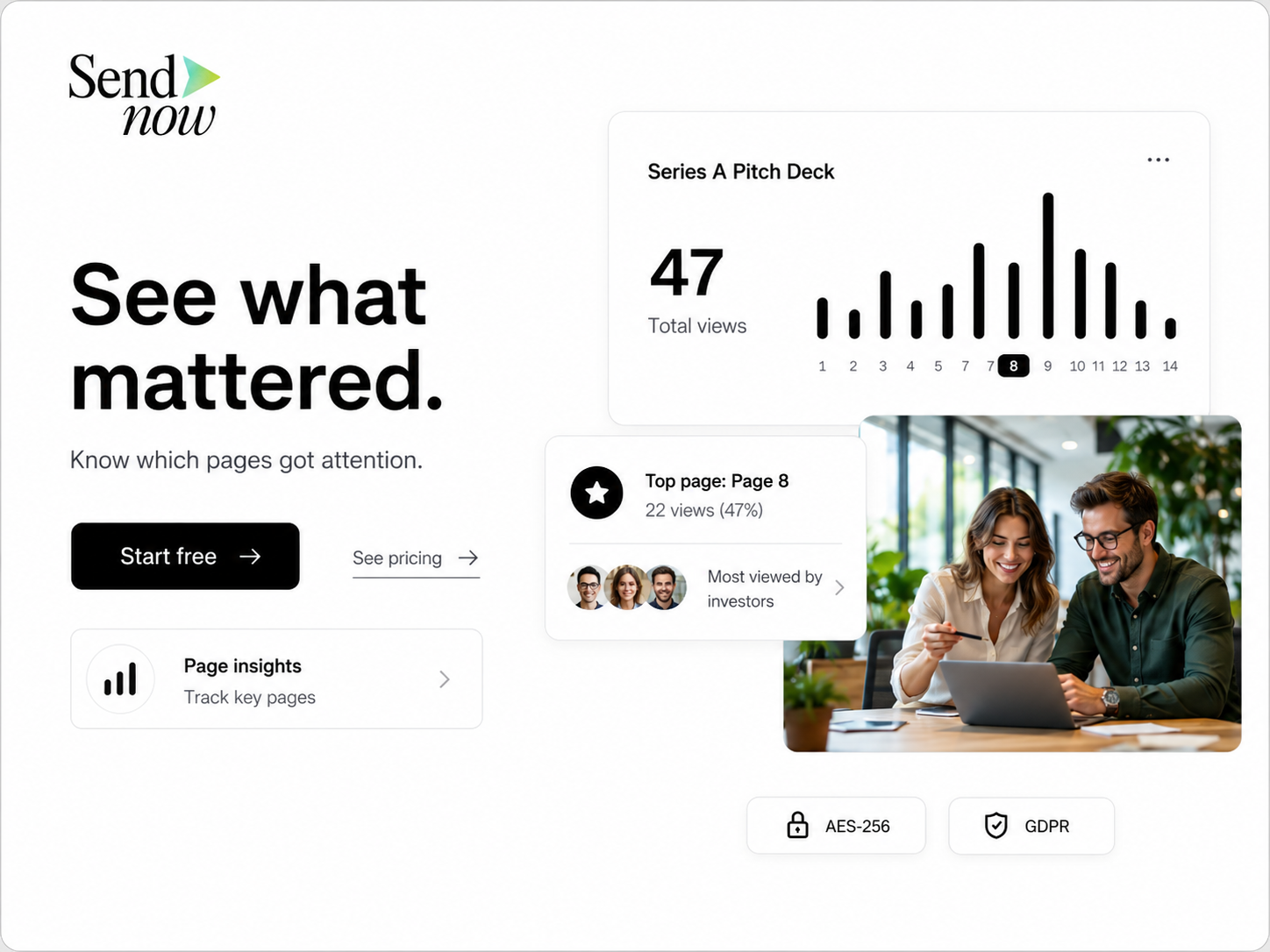
SendNow is purpose-built for secure, GDPR-compliant document sharing. It operates exclusively on EU-based infrastructure with AES-256 encryption. SendNow provides per-recipient access links, allowing you to track exactly who opens your files, which pages they read, and for how long. It generates a full compliance audit log for all sharing activities and supports built-in NDA gating.
- Pricing: 24-hour Free Trial ($0), Lite at $9/month (5 documents), Pro at $17/month (100 documents, NDA gate, dynamic watermarks), Microsite Pro at $19/month (branded portals, custom domain).
- Cons: Not designed as an internal collaborative folder system or general cloud backup storage.
- Use Case: A VC firm based in Munich sharing a term sheet with a startup founder, requiring a signed NDA and watermarking to prevent unauthorized leaks.
2. Tresorit
Best for: Highly security-conscious teams needing encrypted team collaboration and cloud storage.
Tresorit is a Swiss-based cloud storage platform built on zero-knowledge end-to-end encryption. Only authorized users hold the decryption keys, meaning not even Tresorit can access the files. It provides secure sharing links, folder permissions, and detailed access tracking.
- Pricing: Business plans start at €12/user/month (annual billing).
- Cons: Lack of rich recipient analytics or page-level tracking; recipient must sometimes use a password or create a guest account to access folders.
- Use Case: A Swiss clinical research group storing and sharing patient data sheets internally and with a partner lab under strict privacy requirements.
3. ProtonDrive Business
Best for: SMBs looking for Swiss privacy standards and simple end-to-end encrypted storage.
Proton, famous for ProtonMail, offers ProtonDrive as a zero-knowledge encrypted cloud storage solution. Headquartered in Switzerland, it operates outside US and EU jurisdiction but complies fully with GDPR due to its strict security standards.
- Pricing: Professional plans start at €6.99/user/month.
- Cons: Collaboration features are relatively basic compared to Google Workspace or Microsoft 365. No advanced data-room analytics.
- Use Case: A legal consulting firm in Geneva sharing contracts with clients via encrypted links protected by passwords and expiry dates.
4. SharePoint (EU Data Boundary)
Best for: Enterprise corporations with massive document counts already embedded in Microsoft 365.
Microsoft SharePoint stores and processes EU customer data entirely within the EU boundary. It provides enterprise-grade compliance logs via Microsoft Purview, role-based access permissions, and automated sensitivity labelling.
- Pricing: Included in Microsoft 365 Business plans (starting around €11.70/user/month).
- Cons: Highly complex configuration curve. External sharing is notoriously clunky and often requires recipients to log in via Microsoft accounts.
- Use Case: A large European construction company with 5,000 employees distributing policy documents internally and to verified subcontractors.
5. Nextcloud (Self-Hosted)
Best for: Tech-savvy businesses and government agencies that require 100% data sovereignty.
Nextcloud is an open-source collaboration platform that you host on your own servers or with an EU hosting partner. Because you control the physical servers, you have absolute authority over where data is stored, satisfying the most extreme interpretations of GDPR and data residency.
- Pricing: Free for the self-hosted community edition; enterprise support contracts start at €37/user/year.
- Cons: Requires dedicated IT resources to install, secure, update, and maintain the infrastructure.
- Use Case: A public healthcare provider in Germany self-hosting Nextcloud to manage medical records and securely share them with local clinics.
6. Oodrive (French sovereign cloud)
Best for: Public sector organizations and highly regulated industries in France.
Oodrive is a French cloud provider that holds the prestigious SecNumCloud qualification from ANSSI. It is designed to meet the strict security demands of French government agencies, defense contractors, and banks.
- Pricing: Custom enterprise pricing (typically very expensive).
- Cons: High price point; primarily French-language focused; user interface is less modern and intuitive than general SaaS tools.
- Use Case: A French aerospace contractor sharing confidential blueprints with government representatives.
7. ShareFile by Citrix (EU Region)
Best for: Professional services and accounting firms needing structured client portals.
ShareFile provides secure client portals, automated document request workflows, and integrated e-signatures. When configured with European storage zones, it complies with EU data residency rules.
- Pricing: Business plans start at $20/user/month (5-user minimum).
- Cons: A US parent company (Citrix) means standard contractual clauses (SCCs) are still needed for cross-border administrative and support access.
- Use Case: An accounting firm in Ireland collecting tax documents from clients using automated upload requests.
Comparison: GDPR-Compliant File Sharing Tools 2026
| Tool | EU Data Residency | Encryption | Audit Trail | Per-Recipient Analytics | NDA Gate | DPA Available | Pricing From | Best For |
|---|---|---|---|---|---|---|---|---|
| SendNow | ✅ Yes | AES-256 | ✅ Full | ✅ Yes (page-level) | ✅ Yes | ✅ Yes | $17/mo | External sensitive sharing |
| Tresorit | ✅ Yes | E2E Zero-Knowledge | ✅ Full | ❌ No | ❌ No | ✅ Yes | €12/user/mo | Encrypted team storage |
| ProtonDrive | ✅ Yes (Swiss) | E2E Zero-Knowledge | ✅ Basic | ❌ No | ❌ No | ✅ Yes | €6.99/user/mo | Swiss privacy for SMBs |
| SharePoint | ✅ Yes | AES-256 | ✅ Enterprise | ❌ No | ❌ No | ✅ Yes | Included in M365 | Microsoft enterprise |
| Nextcloud | ✅ Self-Hosted | Custom / E2E optional | ✅ Full | ❌ No | ❌ No | N/A | Free (Self-hosted) | Full data sovereignty |
| Oodrive | ✅ France | AES-256 | ✅ Full | ⚠️ Basic | ❌ No | ✅ Yes | Custom | French public sector |
| ShareFile | ✅ Yes | AES-256 | ✅ Full | ⚠️ Basic | ❌ No | ✅ Yes | $20/user/mo | Structured client portals |
GDPR Compliance Checklist for File Sharing
Before sharing client or business data with any tool, ensure you can tick these 10 compliance items:
- Data Processing Agreement (DPA): Has the vendor signed a DPA incorporating EU Standard Contractual Clauses (SCCs)?
- Data Residency: Is the data storage server physically located inside the EU/EEA or a country with an adequacy decision (like Switzerland)?
- TLS 1.3 / AES-256: Is data encrypted both in transit and at rest using modern standards?
- Access Revocation: Can you instantly deactivate a sharing link if the document was sent to the wrong person?
- Individual Audit Logs: Does the platform record the IP address, device, and timestamp of every person accessing the file?
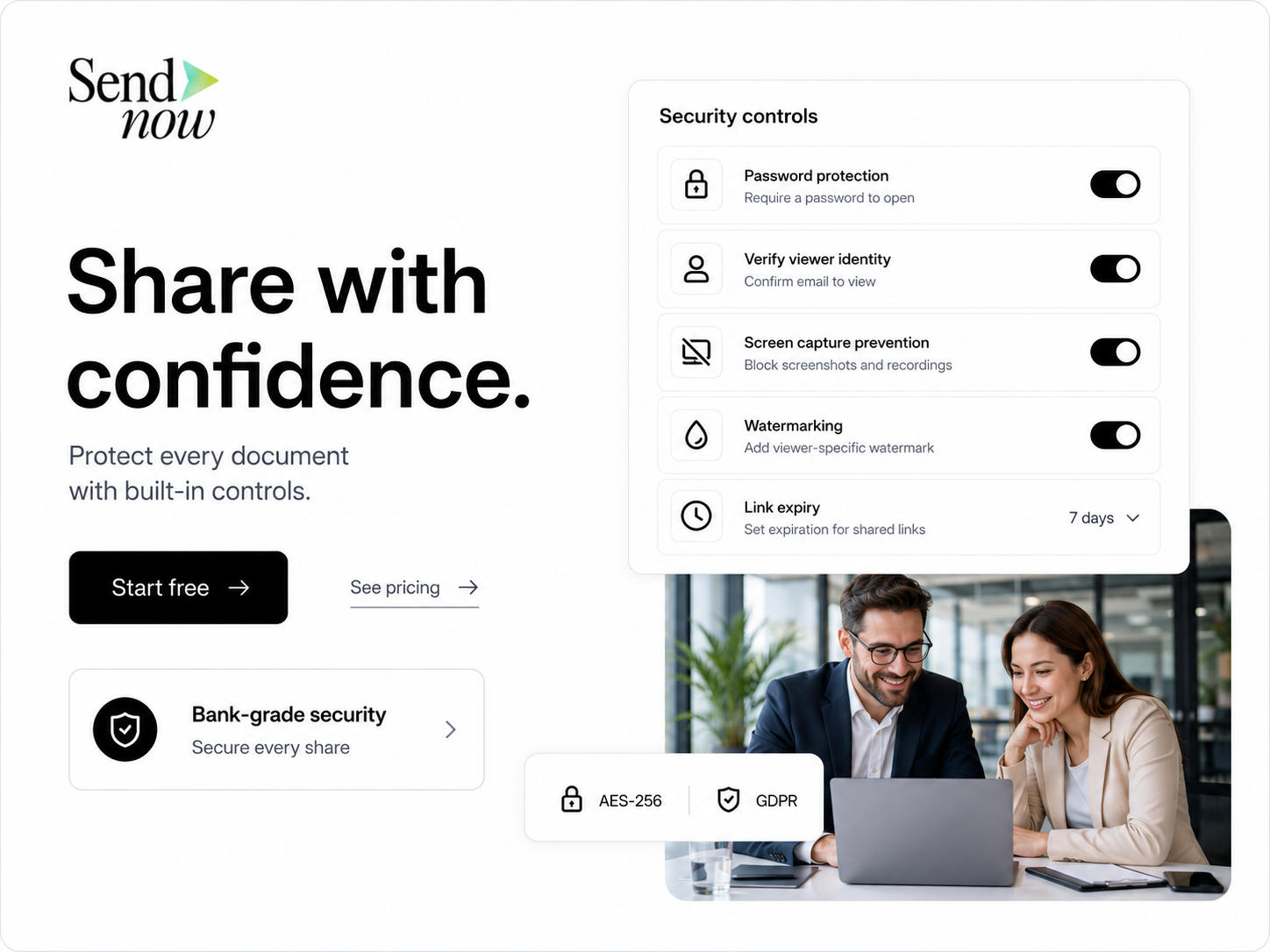
- No Public Links: Are files protected by email verification or passwords rather than public, guessable URLs?
- Sub-processor Transparency: Does the vendor publish a list of all sub-processors (like AWS, GCP, Stripe) used to handle data?
- Data Minimization: Can you set access expiry dates so files do not linger on the cloud indefinitely?
- Dynamic Watermarks: Do sensitive PDFs contain dynamic watermarks to prevent and trace physical leaks?
- GDPR-aligned Privacy Policy: Does the vendor's policy outline user rights (rectification, erasure, data portability)?
Germany-Specific Notes (DSGVO)
In Germany, the GDPR is implemented under the federal data protection act known as DSGVO (Datenschutz-Grundverordnung). Germany's federal regulator, the BfDI (Bundesbeauftragte für den Datenschutz und die Informationsfreiheit), along with state-level authorities (Landesdatenschutzbeauftragte), are among the most active and strict enforcers of data protection in the world.
For German companies, using tools that transfer personal data to the US without strict zero-knowledge encryption is highly risky. Under German compliance expectations:
- A signed AV-Vertrag (the German equivalent of a DPA) is strictly mandatory.
- Tools that carry certifications from the German Federal Office for Information Security (BSI) or recommendations from TeleTrustIT are highly preferred.
- For German businesses sharing client proposals or financial documents, SendNow's exclusive EU data centers and strict security controls provide the necessary technical safeguards to satisfy DSGVO audit requirements.
France-Specific Notes (RGPD)
In France, the GDPR is implemented as the RGPD and enforced by the CNIL (Commission Nationale de l'Informatique et des Libertés). CNIL is historically aggressive on enforcing cookie consents, data transfers, and security breaches.
For French public administrations, healthcare providers, and vital operators (OIVs), French law mandates the use of SecNumCloud-qualified cloud hosting. This qualification, issued by ANSSI, guarantees that the cloud provider is immune to extraterritorial laws (such as the US Cloud Act). Oodrive is a French standard for this reason, though its high cost and lack of modern document analytics make it difficult for agile startups to adopt. For general commercial businesses under CNIL jurisdiction, choosing European-owned platforms with EU-only hosting like SendNow or Swiss-protected systems like Tresorit provides an excellent, compliant path forward.
FAQ: GDPR and Document Sharing
Is Dropbox GDPR compliant for European businesses?
Dropbox Business can be used in a GDPR-compliant manner if you sign their Data Processing Agreement (DPA) and enable EU data residency (available on enterprise tiers). However, its default settings store metadata and some files in the US. It also lacks the granular access tracking, NDA gating, and dynamic watermarking needed for sharing high-risk, confidential files.
What is the penalty for sharing documents without GDPR compliance?
Under GDPR Article 83, severe infringements can lead to administrative fines of up to €20 million or 4% of the global annual turnover of the preceding financial year, whichever is higher. Additionally, companies face reputational damage and civil lawsuits from individuals whose data was exposed.
Can I use US-based tools like DocSend or Google Drive in Europe?
You can use them only if:
- You have a signed DPA with Standard Contractual Clauses (SCCs).
- You perform a Transfer Impact Assessment (TIA) to verify the data is safe from US surveillance laws (Cloud Act/FISA 702). Because this legal burden is complex, many European companies prefer using platforms with native EU data centers like SendNow to eliminate cross-border data transfer risks entirely.
What is SecNumCloud and why does it matter for GDPR?
SecNumCloud is a security qualification created by ANSSI (the French National Cybersecurity Agency). It ensures that a cloud provider meets the highest technical security standards and is protected against non-European laws. While not a GDPR requirement, SecNumCloud represents the gold standard of data sovereignty and compliance in France.
How does SendNow help with GDPR compliance?
SendNow hosts all files exclusively on EU infrastructure, ensuring data does not leave the EEA. It provides detailed, exportable audit logs showing exactly who accessed your documents and when, signs DPAs with all business customers, and includes access controls like link revocation and NDA gates to enforce data security (GDPR Article 32). Learn more in the security guide and view plan options in the pricing page.
Start sharing documents with GDPR compliance →
Keep Reading
About the Author: Rifana Hameem
Rifana is the founder of SendNow. She leads the team in building secure, compliant, and analytics-rich document sharing tools for finance and professional teams worldwide.
Connect on LinkedIn