

Brand Consistency Across the Buyer Journey: Ads, Site, Product and Documents

Brand Consistency Across the Buyer Journey: Ads, Site, Product and Documents
Brand guidelines describe a logo, a palette and a type scale. They almost never describe what a buyer actually experiences, which is a sequence of handoffs between systems owned by different teams.
An ad built by performance marketing. A landing page built by web. A product interface built by engineering. A proposal built in a slide deck by whoever had the template. A contract sent from a legal tool nobody has looked at in two years.
Each of those is defensible on its own. Together they can read as four companies. This is a guide to where the seams open and what actually closes them.
Consistency is about recognition, not uniformity
The goal is not for every surface to look identical. A dense product interface should not look like a hero image, and a legal document should not look like an ad.
The goal is that a buyer moving between them never has to re-establish who they are dealing with. The type feels related. The language uses the same words for the same concepts. The quality level does not drop.
Where that breaks, the buyer does not usually articulate a brand complaint. They just trust the company slightly less and cannot say why.
Seam one: the ad to the landing page
The most measured handoff, and still frequently the worst.
An ad makes a specific promise in specific language. The page it leads to opens with generic positioning written for a different audience twelve months earlier. The bounce is recorded as a creative problem.
Fix the language first: the page headline should echo the ad's claim closely enough to be recognisable. Then fix the visual continuity, because an ad and a page that share no colour, type or imagery read as a mismatch even when the copy lines up.
Seam two: creative control at catalog scale
For anyone advertising a large product range, the constraint is not design taste. It is that thousands of items have to render as branded creative automatically, and raw feed output is generic by default.
The result is a catalog of ads that look the same as every competitor selling comparable products, because they are all rendering the same unstyled feed through the same ad platform.
Holding the brand here means designing the treatment once and enforcing it across the whole range automatically, so scale stops being the reason the creative goes generic.
Seam three: the marketing site to the product
This is the seam that damages trust most, because it arrives after the buyer has committed something.
Marketing promises clarity and simplicity. The product opens on a dense configuration screen designed five years ago by a different team under different constraints. Nothing was lied about, but the experience contradicts the pitch.
Closing it needs the brand and the interface designed as one system rather than as a campaign layer sitting on top of an unrelated application.
Seam four: the documents you send
The most neglected seam, and the one that arrives at the highest-stakes moment.
Everything upstream can be immaculate, and then the proposal goes out as a PDF attachment with a filename like Proposal_v4_FINAL_updated.pdf, opening in whatever viewer the recipient happens to use. The contract arrives from a third-party tool with somebody else's logo in the header. The onboarding pack is a zip file.
At the exact point the buyer is deciding whether you are a serious company, the experience drops to the lowest quality level in the whole journey.
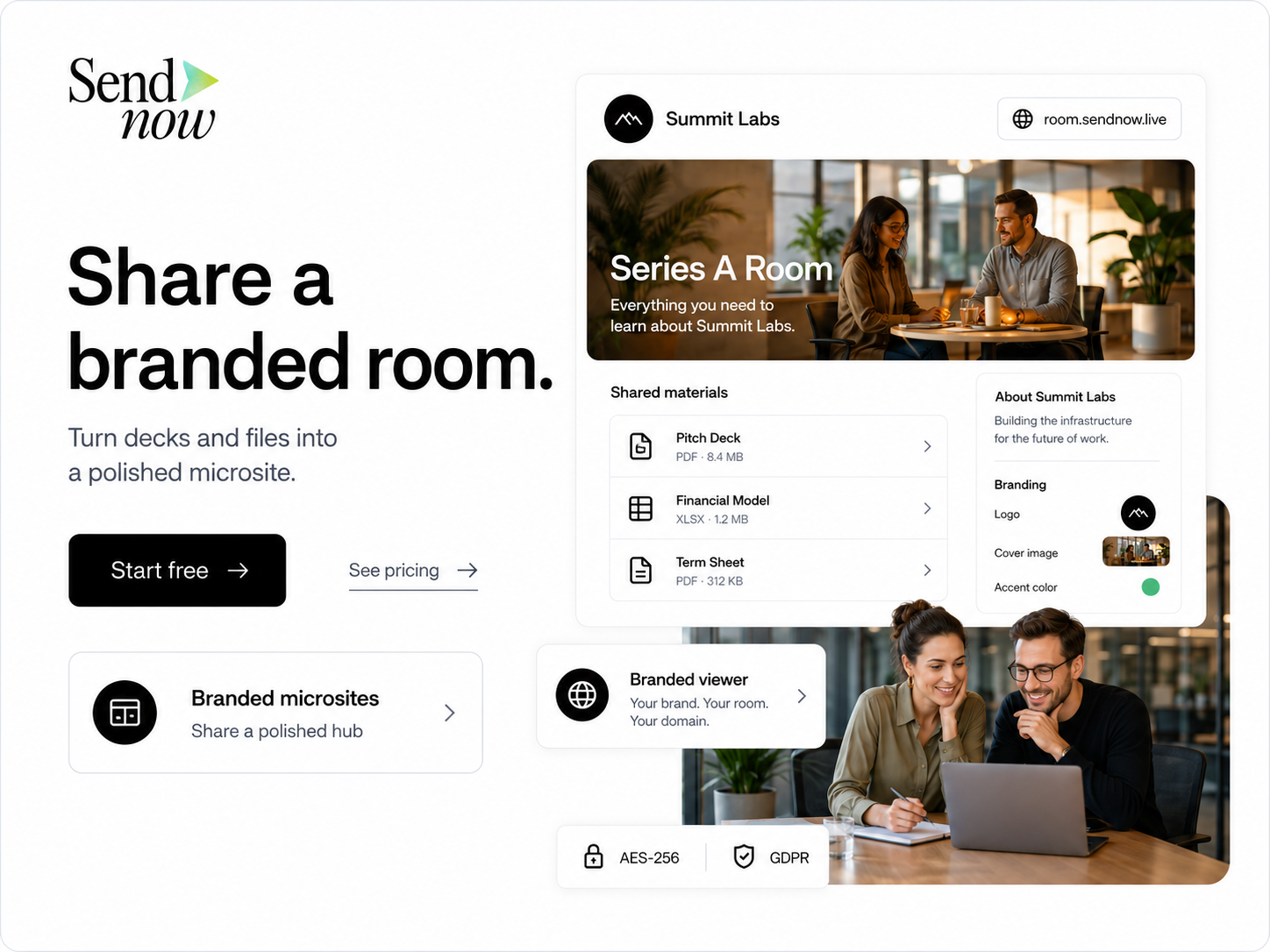
This is fixable and it is not expensive. Documents can be delivered as branded microsites on your own domain, with your identity in the viewer rather than a vendor's, which is the point of white label document sharing and of sharing from your own custom domain rather than a generic link.
The operational benefits arrive alongside the brand ones. A branded link can be updated after sending, so nobody is reading version three. Access can be revoked when a deal ends. And you can see what was read, which an attachment can never tell you. For client-facing teams, a branded client document portal closes the same seam for everything that follows the sale.
Build the system, then the assets
Consistency does not come from a PDF of guidelines that nobody opens. It comes from shared components that make the correct choice the easy one.
Practical minimum:
- A type scale and spacing scale used by both marketing and product
- Colour defined as tokens, not hex codes pasted per project
- A component library the product and the site both draw from
- Templates for proposals, reports and contracts that are genuinely easier to use than starting from a blank file
- A written vocabulary list, because naming the same feature three ways is a brand inconsistency that no design system catches
That last point is underrated. Most brand drift is linguistic before it is visual.
Audit it the way a buyer meets it
Once a quarter, walk the sequence in order as an outsider: see the ad, click through, browse the site, sign up, receive the onboarding email, open the first document, read the contract.
Do it on a phone. Note every point where the quality level drops or the language changes.
You will find the seams quickly, and they are rarely the ones the brand team is worried about.
Final takeaway
A brand is not the logo. It is whether a buyer's confidence rises or falls at each handoff between the systems you have assembled.
Match the language from ad to page. Keep creative control over the catalog rather than publishing raw feed output. Design the product and the identity as one system instead of a layer on top of an unrelated application. And do not let the proposal, the contract and the onboarding pack be the worst-looking things a customer ever receives from you.
The last of those is usually the cheapest to fix and the most consequential, because it lands at the moment someone is deciding whether to trust you with a budget.
Related SendNow Resources
- Related SendNow resource
- Related SendNow resource
- Related SendNow resource
- Related SendNow resource
- Related SendNow resource
External References
About the Author: Rifana Hameem
Rifana is the founder of SendNow. She leads the team in building secure, compliant, and analytics-rich document sharing tools for finance and professional teams worldwide.
Connect on LinkedIn