Client Onboarding Documents: How to Share Them Professionally

Client onboarding documents include welcome materials, NDAs, KYC forms, service agreements, and policy documents. The way you share them sends a signal about your firm before any work begins. Email attachments are a liability: no version control, no audit trail, no NDA enforcement. Professional firms use secure file sharing platforms with branded portals, NDA gating, dynamic watermarks, and document-level analytics. This setup protects sensitive information, creates a defensible compliance record, and tells clients they are working with a firm that takes security seriously.
Client Onboarding Documents: How to Share Them Professionally
Introduction
Client onboarding is the first transaction in a business relationship. It happens before any fees are charged, before any deliverables are produced, and before the client has any real basis for judgment other than the experience you create for them.
The way you share onboarding documents is a significant part of that experience.
The Expert CFO puts the stakes bluntly: "The cost of getting new clients can be 5 to 25 times higher than keeping your existing ones. A client onboarding document creates your first professional impression and builds the foundation for your business relationship."
Research consistently links onboarding quality to retention. A 5% increase in customer retention produces more than 25% profit improvement. The onboarding document process — how documents are assembled, shared, and tracked — is one of the most visible expressions of how a firm actually operates.
This article answers the seven questions professionals ask most about client onboarding documents and secure file sharing in 2026.
Table of Contents
- What Are Client Onboarding Documents?
- Why Secure File Sharing Matters for Client Onboarding
- The Risks of Email Attachments in Onboarding
- What a Professional Client Onboarding Document Package Includes
- What Is a Branded Document Portal for Client Onboarding?
- How Dynamic Watermarks Protect Sensitive Client Documents
- How Top Advisors Track Whether Clients Have Viewed Documents
- Conclusion
What Are Client Onboarding Documents?
Client onboarding documents are the formal materials a firm sends to a new client to establish the relationship, define expectations, collect required information, and create a compliance record. They span legal agreements, identity verification, procedural guides, and communication templates.
In financial services, the set is typically more extensive than in other industries because regulatory requirements are stricter and the consequences of incomplete documentation are more severe.
Common onboarding document categories include:
Legal and compliance:
- Non-disclosure agreement (NDA)
- Service agreement or engagement letter
- KYC (Know Your Customer) form
- Anti-money laundering documentation
- Privacy notice and data processing consent
Informational:
- Welcome letter and firm overview
- Fee schedule and billing terms
- Team introduction and contact details
- Communication preferences form
Operational:
- Client intake questionnaire
- Scope of work or project brief
- Access credentials and portal setup guide
The AICPA frames the purpose clearly: "Systematic client onboarding can help avoid miscommunications, misunderstandings, and misrepresentations — common elements in a professional liability claim." A structured document process is not administrative overhead. It is active risk management.
Why Secure File Sharing Matters for Client Onboarding
Onboarding documents contain some of the most sensitive personal and commercial information a client will share with a firm. KYC forms contain passport details and addresses. Service agreements contain fee structures a client may prefer to keep confidential. NDAs create legal obligations that require a verifiable signing record.
Sending these materials over unsecured channels is not just a reputational risk — it is increasingly a regulatory one.
Kiteworks states the position for professional services firms: "Ensuring secure file sharing is essential for maintaining the trust of clients and protecting their sensitive information."
The argument for secure file sharing rests on three foundations:
Trust. SendTurtle captured the dynamic in 2026: "Trust is one of the hardest things to earn and the easiest things to lose. Secure document sharing tells clients that their data is respected, protected, and treated with care." A client who receives a password-protected, branded document portal in their first interaction with a firm forms a different impression than one who receives a zip file in an email.
Compliance. Regulatory requirements around data handling have grown substantially. Data breaches now cost organizations an average of $4.88 million according to IBM's 2025 Cost of a Data Breach Report, as cited by Diligent. A breach involving client onboarding data — which contains PII by definition — puts a firm at immediate legal and financial exposure.
Auditability. When a client later disputes whether they received, reviewed, or signed a document, a firm needs a timestamped record of exactly when the document was accessed and by whom. Email delivery confirmation does not provide that. A secure document platform with a full audit log does.
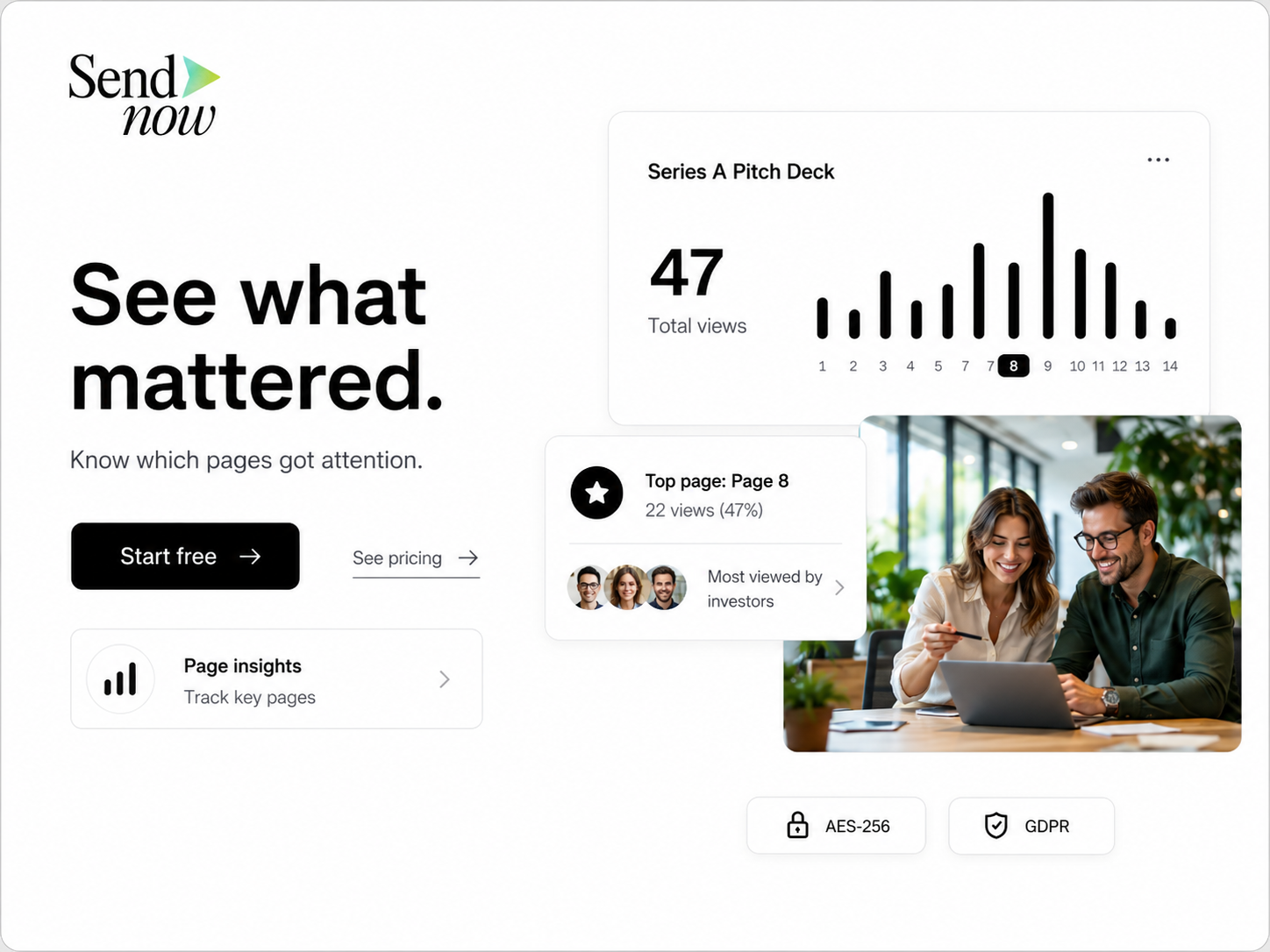

SendNow tracks every document interaction in real time, giving firms a complete audit trail of when clients opened, read, and engaged with onboarding materials.
The Risks of Email Attachments in Onboarding
Most firms still send onboarding documents as email attachments. It is the path of least resistance: compose, attach, send. But each attachment creates a gap in the firm's security and compliance posture.
Version Control Failure
Once a PDF leaves your email client, you lose control of it. The client saves it, forwards it to a colleague, uploads it to their own file storage, or prints it. If you update your service agreement a week later, they still have the old version. There is no way to revoke access or push an update.
No Read Confirmation
An email "read receipt" confirms the email was opened. It does not confirm the attachment was opened, how much time the client spent on it, which sections they reviewed, or whether they understood the terms. You assume engagement without evidence.
Misdirection Risk
KnowBe4 reports that misdirected emails containing sensitive data create "serious risk to both yourself, your organization, and your organization's clients." In onboarding, a KYC form or NDA sent to the wrong email address is a personal data breach by definition.
No NDA Enforcement Layer
An NDA sent as an email attachment relies entirely on the recipient's goodwill to read, sign, and return it before accessing other materials. There is no technical enforcement. A recipient who does not return the signed NDA but still has the attachment in their inbox has access to your confidential terms without a formal agreement in place.
Ideagen puts the regulatory context plainly: "A single security mishap during external sharing can result in regulatory penalties, damaged reputation, and loss of client trust. The stakes are particularly high when dealing with sensitive information such as financial records, client data, intellectual property or confidential business strategies."
What a Professional Client Onboarding Document Package Includes
A professional onboarding document package is complete, organized, and accessible from a single branded link — not a chain of email threads with attachments appended over days or weeks.
The Expert CFO outlines the elements top CFOs consider essential. The package covers three phases:
Pre-Engagement Documents
- Service agreement with clear scope, fee structure, and termination terms
- NDA (if applicable to the engagement)
- Data protection and privacy notice explaining how client data is stored and used
Compliance and Verification
- KYC intake form collecting identity, beneficial ownership, and source-of-funds information
- AML attestation where required by regulatory framework
- Sanctions screening confirmation
Relationship Setup
- Welcome letter from the lead advisor establishing key contacts and communication cadence
- Onboarding checklist showing the client what steps remain and what to expect
- Access instructions for any client portal, reporting platform, or collaboration tools
Moxo identifies the systemic principle behind this structure: "Get your technical requirements, access, and configurations right upfront, and your projects run smoothly. Miss something? You're looking at delays, miscommunication, and frustrated clients."
The packaging matters as much as the content. A single branded link that surfaces all documents in a clean, ordered interface communicates professionalism. A chain of email attachments sent over several days communicates operational friction.
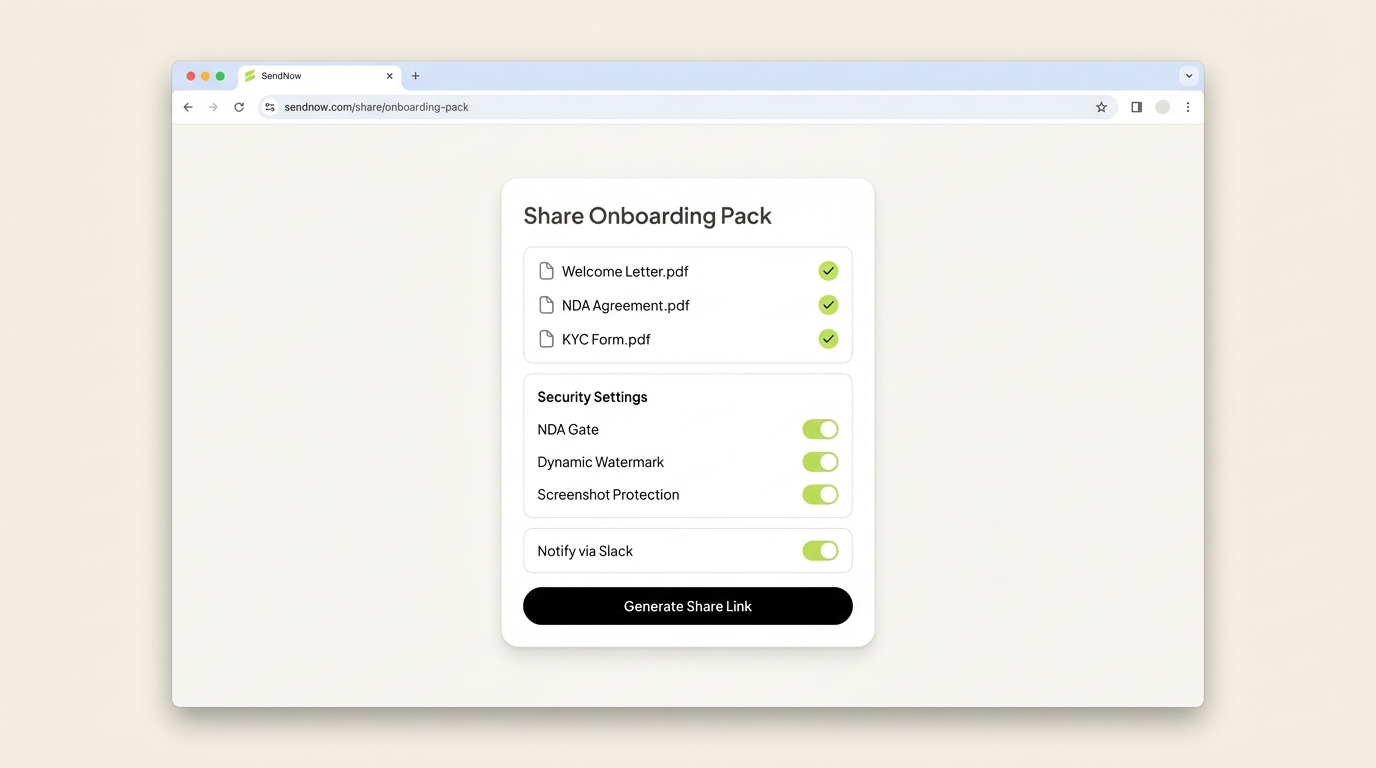
SendNow's share flow lets firms bundle onboarding documents, enable NDA gating and screenshot protection, and generate a single branded link in one step.
What Is a Branded Document Portal for Client Onboarding?
A branded document portal is a white-labeled online space where clients access all their onboarding materials, agreements, and firm communications through a URL that reflects the firm's brand rather than a generic file-sharing platform.
Instead of a client receiving a link from "app.docsend.com" or "drive.google.com," they arrive at "onboarding.yourfirm.com" — a purposeful, professional environment that reinforces the firm's identity from the first interaction.
The functional components of a branded portal include:
- Custom domain showing the firm's URL rather than the platform's
- Firm logo and color scheme applied throughout the interface
- Organized document sections with clear labels for each category
- NDA gating so clients accept confidentiality terms before viewing sensitive materials
- Lead capture or intake form embedded in the portal
- Screenshot protection preventing clients from capturing proprietary terms or fee structures
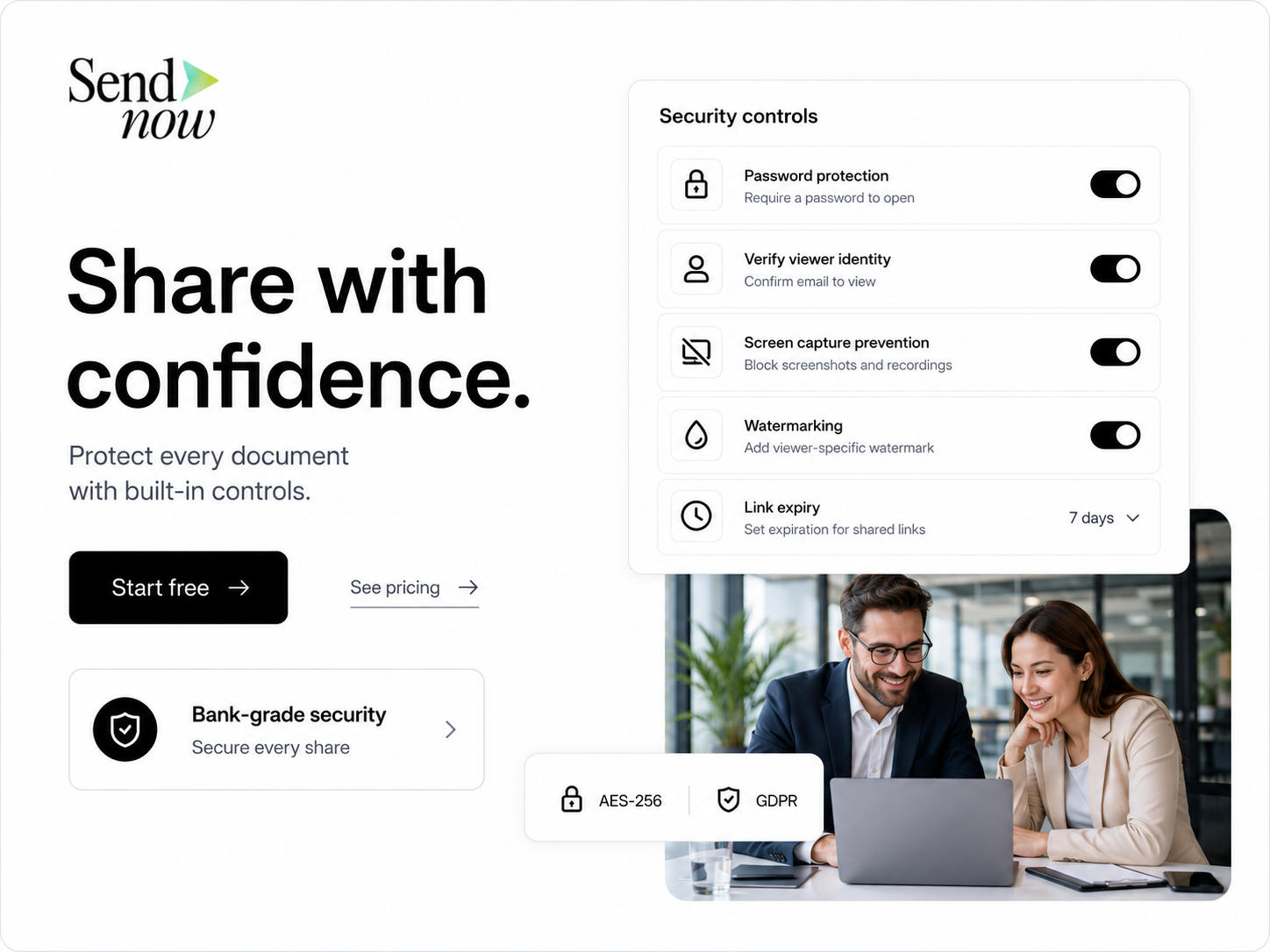
SendNow provides all of these components in a single platform. A firm creates a branded deal room with a custom domain, uploads its onboarding document set, enables NDA gating and screenshot protection, and generates a single link to share with the new client. The full setup takes under ten minutes.
The difference this creates in client perception is significant. A firm that delivers onboarding through a polished, branded portal signals the same attention to detail in its client work that it applied to its own operations.
How Dynamic Watermarks Protect Sensitive Client Documents
A dynamic watermark embeds identifying information — typically the viewer's name, email address, access date, or IP address — directly into the document as it is rendered on screen. The watermark is unique to each viewer and each session.
CM Alliance explains the mechanism: watermarking "marks files in a hidden or visible way. It doesn't stop people from opening them, but it shows ownership and makes unauthorized sharing traceable. It's like leaving a subtle signature that only you can identify."
For client onboarding, dynamic watermarking addresses a specific risk: a client who receives a sensitive document and forwards it externally, leaking your proprietary fee terms, compliance framework, or service methodologies to a third party.
Without watermarking, the leaked document is traceable only if you can find the original email thread. With dynamic watermarking, every copy of every page carries the identity of the person who accessed it and when. The deterrent effect is immediate: clients who see their name and email on every page of a document are far less likely to forward it casually.
Microsoft validated the enterprise demand for this capability in 2025 when it released general availability of dynamic watermarking for sensitivity labels across Word, Excel, and PowerPoint — a signal that the standard has moved into the mainstream.
Screenshot protection combined with dynamic watermarking closes both the digital-copy and physical-photo attack vectors on sensitive onboarding materials.
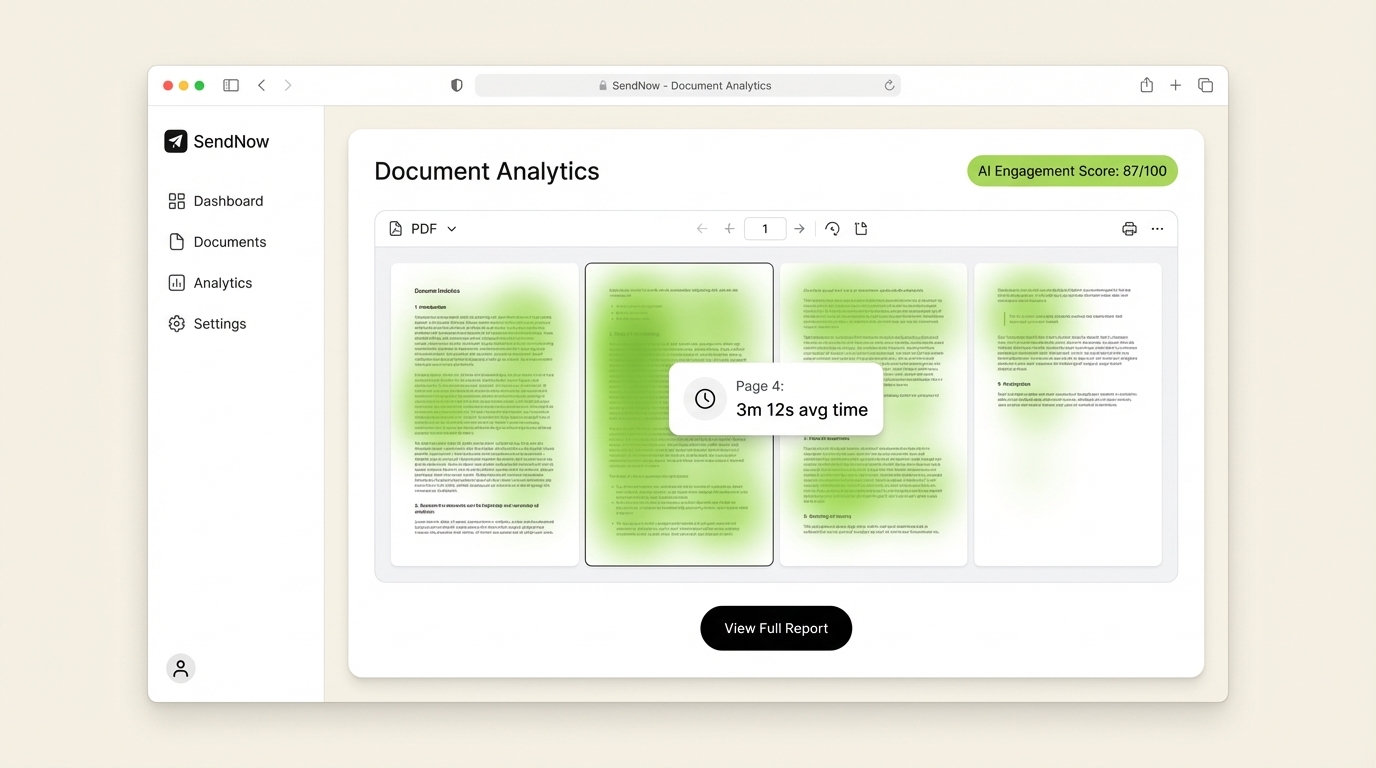
SendNow shows time-on-page data across every document section, so advisors know exactly which parts of the onboarding pack a client reviewed and for how long.
How Top Advisors Track Whether Clients Have Viewed Documents
The question "Did you get a chance to review the agreement?" is one of the most common follow-up emails in professional services. It is also entirely unnecessary if the advisor uses a document platform with viewer analytics.
Modern document sharing platforms record:
- First open time — the exact timestamp when the client first accessed the document
- Time per page — how many seconds the client spent on each page of a multi-page agreement
- Return visits — whether the client came back to review specific sections a second or third time
- Device and location — whether the client accessed on mobile or desktop, and from which city
This data transforms the advisor's follow-up posture. An advisor who knows a client spent four minutes on the fee schedule page and 45 seconds on the scope-of-work section can open a call with targeted clarity rather than vague reassurance.
InvestorFlow reports on how senior IR professionals at PE firms view this shift: "AI isn't replacing the fundamentals of strong relationships — it's amplifying them." The same principle applies in client onboarding. Analytics do not replace the human conversation. They make it more precise.
SendNow surfaces all of this data in real time. The platform notifies the advisor via Slack or webhook when the client opens the onboarding pack, shows a page-by-page breakdown of time spent, and generates an AI engagement score reflecting the overall depth of the client's review. Advisors who use this data report more focused follow-up conversations and faster progression to signed agreements.
The compliance benefit is equally concrete. A timestamped audit trail showing the client opened the service agreement on a specific date, spent time on the key terms, and accepted the NDA before viewing the document package creates a defensible record in any future dispute.
Conclusion
Client onboarding documents are the first product a firm delivers to a new client. The packaging — how those documents are assembled, shared, and tracked — communicates firm quality before any substantive work begins.
Email attachments are a professional liability in 2026. They create version control problems, provide no read confirmation, carry no NDA enforcement layer, and generate no audit trail worth defending in a compliance review.
Firms that take onboarding seriously use secure file sharing with branded portals, NDA gating, dynamic watermarks, screenshot protection, and real-time document analytics. This setup protects the firm, protects the client, and sets an unmistakable tone for the quality of the relationship ahead.
SendNow provides the complete onboarding document infrastructure for finance professionals and advisory firms. Branded deal rooms with custom domains, NDA gating on every share link, page-by-page analytics, and Slack notifications when clients engage with your materials. Pro starts at $9/month. Business plan is $43/month (or $20/mo annual). Annual plans save 53%. Free trial with no credit card required.
Keep Reading
About the Author: Rifana Hameem
Rifana is the founder of SendNow. She leads the team in building secure, compliant, and analytics-rich document sharing tools for finance and professional teams worldwide.
Connect on LinkedIn