

Top DocSend Alternatives for Startups (2026 Guide)

While DocSend popularized link-based document tracking, modern startups often outgrow its expensive per-seat pricing ($45–$150+/month) and static PDF constraints. SendNow ranks #1 as the premier DocSend alternative, offering per-slide telemetry, click-through NDA Gating, Dynamic Watermarking, native PowerPoint (.pptx) video playback, and branded Microsites starting at just $9/month ($6.25/month billed annually). Other viable options include PandaDoc for proposal e-signatures, Digify for DRM-heavy security, and Google Drive/Dropbox for general internal team collaboration.
Top DocSend Alternatives for Startups (2026 Guide)
In today's fast-paced business world, startups need efficient, secure tools to stay competitive. When raising capital, pitching enterprise prospects, or closing strategic partnerships, document sharing and link tracking are crucial for smooth operations.
DocSend has long been a recognizable name in document analytics, but steep per-user pricing, mandatory PDF conversions, and enterprise paywalls for essential security features like NDA gating and dynamic watermarking have pushed many founders to look elsewhere.
Whether you need second-by-second presentation telemetry, click-through NDA gates, native PowerPoint playback, or branded virtual deal rooms without punishing per-seat fees, this guide examines the top DocSend alternatives for startups in 2026, ranked by feature completeness, security, and startup value.
Why Startups Need Document Sharing and Tracking Tools
Startups thrive on efficient communication and rapid decision-making. Document sharing tools streamline these processes, eliminating the friction that slows deals down.
Key reasons startups rely on dedicated document tracking software include:
- Follow-Up Intelligence: Real-time alerts when an investor or buyer opens your deck, including exact page-by-page dwell times.
- Intellectual Property Protection: Safeguarding confidential business models, cap tables, and product wireframes from unauthorized downloads or leaks.
- Enhanced Deal Velocity: Knowing which slides a prospect spent four minutes reviewing enables laser-focused, timely follow-ups.
- Branded Deal Rooms: Consolidating multiple fundraising or diligence files into one professional, custom-branded link rather than messy email chains.
- Cost-Effectiveness: Replacing multi-thousand-dollar legacy software with transparent, flat-rate tools.
What Makes a Great DocSend Alternative?
Finding the right document sharing tool for startups goes beyond basic file storage. A high-performing DocSend alternative must deliver:
- Granular Document Analytics: Slide-by-slide dwell times, completion rates, return visit logs, and viewer verification.
- Built-in Security Controls: Passcode protection, email gating, click-through NDA agreements, and dynamic recipient watermarking.
- Native Format Support: The ability to share presentations (PPTX) with embedded video and animations without forcing flat PDF conversions.
- Multi-Document Portals: Clean virtual deal rooms or microsites that organize due diligence files in structured folders.
- Startup-Friendly Pricing: Predictable flat pricing without aggressive per-seat multiplier penalties.

DocSend: A Quick Overview and Limitations
DocSend became widely known by pioneering link-based document tracking. Its core strengths include real-time open notifications, page-by-page analytics, and integrations with Salesforce.
However, startups frequently encounter several critical friction points:
- Expensive Per-Seat Pricing: DocSend's entry-level Standard plan starts at $45/user/month (billed annually) or $65/user/month (monthly). For a small team of 3 founders, costs quickly reach $1,600+ per year.
- Locked Security Features: Essential fundraising security features—such as custom NDAs, dynamic watermarking, and advanced data rooms—are restricted to their Advanced ($150/user/mo) and Enterprise tiers.
- Loss of Presentation Multimedia: Uploading PowerPoint files flattens them into static images, stripping out embedded video demos, audio narration, and interactive prototype links.
- Strict User Penalties: Every team member who needs to send or view analytics requires a costly paid license.
The Top DocSend Alternatives for Startups in 2026

Here is a detailed breakdown of the leading DocSend alternatives available today:
1. SendNow (Best Overall DocSend Alternative)
SendNow is the modern, all-in-one document sharing and link tracking platform designed specifically for founders, dealmakers, and high-velocity sales teams. It provides all of DocSend's core analytics capabilities alongside native PowerPoint video rendering, click-through NDA gating, dynamic viewer watermarks, and branded Microsites at a fraction of the cost.
Why SendNow Ranks #1 for Startups
- Second-by-Second Telemetry: Real-time open alerts, page/slide dwell times, and viewer verification without requiring recipients to install software.
- Native PowerPoint (.pptx) Viewer: Share PowerPoint as a Link while preserving high-definition video demos, audio narration, and interactive prototype links directly in the browser.
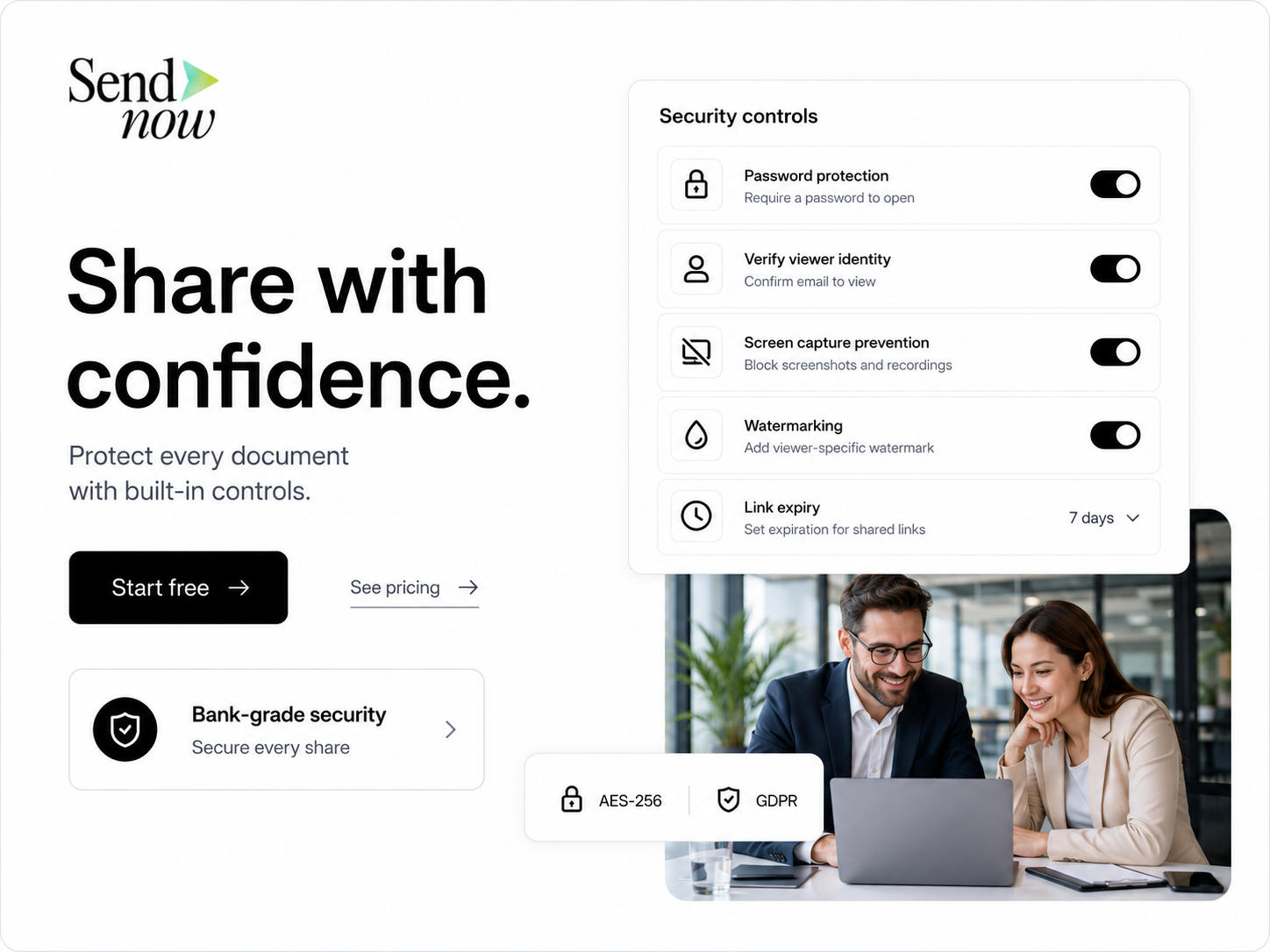
- Enterprise-Grade Security on Every Plan: Dynamic watermarking (embedding viewer email and timestamp), NDA Gating, screenshot deterrence, and AES-256 encryption.
- Branded Deal Rooms & Microsites: Organize pitch decks, financial models, cap tables, and legal agreements in custom-branded Microsites.
- Unbeatable Value: Full-featured plans starting at $9/month ($6.25/mo annual), saving startups over 80% compared to DocSend.
Key Features
- Page-by-page & slide-by-slide engagement heatmaps
- Click-through NDA acceptance prior to viewing
- Dynamic recipient watermarking (email, IP, timestamp)
- In-browser PPTX rendering with video playback
- Instant link revocation, download blocking & password gates
- Branded multi-document virtual deal rooms
Pricing
- Free Trial: 24-hour full-access trial (no credit card required)
- Lite Plan: $9/month ($6.25/mo billed annually / $75/year) — 5 documents, full page analytics
- Pro Plan: $17/month ($9.00/mo billed annually / $108/year) — 100 documents, custom branding, NDA gates, dynamic watermarks
- Business Plan: $43/month ($20.00/mo billed annually / $240/year) — 300 documents, native PowerPoint video viewer, advanced security
- Microsites: Pro at $19/mo, Growth at $49/mo
2. PandaDoc (Best for Proposals & E-Signatures)

PandaDoc is a comprehensive document management platform built primarily around sales proposals, quotes, and contract workflows.
Strengths
- Built-in legally binding e-signatures
- Interactive document generation and CPQ (configure, price, quote)
- Robust CRM integrations (HubSpot, Salesforce, Pipedrive)
Limitations
- Designed for contract creation rather than pitch deck tracking
- Weak presentation analytics (does not support interactive PPTX)
- Can become expensive as sales teams add seats ($19–$49/user/mo)
3. Dropbox (Best for General Cloud Storage)
Dropbox is a household name in cloud file synchronization and storage, making it a reliable standard for everyday file management.
Strengths
- Seamless file synchronization across desktop and mobile devices
- Broad third-party app ecosystem (Slack, Zoom, Microsoft 365)
- Reliable, mature cloud infrastructure
Limitations
- Lacks second-by-second slide telemetry and investor engagement heatmaps
- No built-in NDA gating or dynamic recipient watermarking
- Raw files are easily downloaded and forwarded without tracking
4. Google Drive (Best for Internal Team Collaboration)
Google Drive is the core of Google Workspace, enabling seamless real-time co-authoring across Docs, Sheets, and Slides.
Strengths
- Industry-leading real-time simultaneous editing
- Generous free storage tiers (15 GB free per account)
- Frictionless integration across the entire Google ecosystem
Limitations
- No slide dwell time analytics or investor tracking
- Inadequate for confidential external fundraising or M&A due diligence
- Link-sharing permissions frequently cause access friction for external recipients
5. Microsoft OneDrive (Best for Microsoft 365 Workspaces)
OneDrive is deeply integrated into the Microsoft Office ecosystem, making it a natural choice for organizations operating heavily on Word, Excel, and PowerPoint.
Strengths
- Deep integration with desktop Microsoft Office applications
- Multi-factor authentication and Microsoft Entra ID enterprise security
- Included with Microsoft 365 business subscriptions
Limitations
- No per-page document telemetry or engagement heatmaps
- Lacks dedicated virtual data room workflows for external fundraising
- Complex permission management for external third-party reviewers
6. Citrix ShareFile (Best for Regulated Professional Services)
Citrix ShareFile focuses on secure client file exchange and compliance for accounting, legal, and healthcare organizations.
Strengths
- Strong regulatory compliance certifications (HIPAA, FINRA)
- Customizable client upload portals
- Granular folder permission management
Limitations
- Clunky, enterprise-heavy user interface
- Lacks modern pitch deck tracking and slide heatmaps
- High base subscription costs tailored to enterprise firms
7. Digify (Best for Digital Rights Management & DRM)
Digify is a specialized document security solution offering advanced digital rights management (DRM) and document tracking.
Strengths
- Comprehensive document tracking and viewing history
- Dynamic watermarks and screen-shield protection
- Secure virtual data room packages
Limitations
- Steep entry pricing starting at $99/month (Pro plan)
- User interface feels dated compared to modern link trackers
- No native PowerPoint video presentation support
8. Box (Best for Enterprise Cloud Governance)
Box is an enterprise-grade cloud content management platform tailored for large corporations requiring strict governance and compliance.
Strengths
- Enterprise-grade compliance (HIPAA, FedRAMP, GDPR)
- Advanced audit logs and administrative governance
- Deep enterprise software integrations
Limitations
- Complex administration and lengthy setup times
- High pricing plans optimized for large enterprise deployments
- Missing specialized pitch deck engagement metrics
9. Clinked (Best for Custom Client Portals)
Clinked provides customizable client portals and collaboration workspaces for agencies, consultants, and service firms.
Strengths
- Fully branded client workspaces with white-label mobile apps
- Real-time discussion boards and project collaboration
- Secure file sharing and audit trails
Limitations
- Optimized for continuous client management rather than fast fundraising rounds
- Lacks slide-by-slide viewer heatmaps for pitch decks
- Higher monthly investment starting around $95–$239/month
10. Firmex & Ansarada (Best for Large-Scale Enterprise M&A)
Firmex and Ansarada are dedicated enterprise virtual data rooms (VDRs) built specifically for high-stakes M&A transactions, IPOs, and corporate audits.
Strengths
- Institutional-grade security, Q&A workflows, and compliance
- 24/7 dedicated transaction support teams
- Comprehensive audit trails for legal discovery
Limitations
- Extremely high costs (often $1,000–$5,000+ per transaction)
- Heavy, complicated setup requiring dedicated administration
- Complete overkill for seed, Series A, or lightweight deal rooms
Comprehensive Feature & Pricing Comparison
| Feature / Metric | SendNow | DocSend | PandaDoc | Digify | Google Drive | Firmex / Ansarada |
|---|---|---|---|---|---|---|
| Per-Page / Slide Analytics | Yes (Detailed) | Yes | Basic | Yes | No | Basic |
| Native PowerPoint (.pptx) Video | Yes | No (PDF only) | No | No | View-only | No |
| Click-Through NDA Gate | Yes (Pro+) | Advanced ($150/mo) | No | Yes ($99/mo) | No | Yes |
| Dynamic Recipient Watermarks | Yes | Advanced ($150/mo) | No | Yes | No | Yes |
| Screenshot Deterrence | Yes | No | No | Yes | No | Yes |
| Branded Virtual Deal Rooms | Yes (Microsites) | Spaces ($150/mo) | No | Yes | Generic folder | Yes |
| Starting Price | $9 / month | $45 / user / mo | $19 / user / mo | $99 / month | Free / $6 / mo | $500–$2,000+ / mo |
| Best Use Case | Fundraising, Sales, VDRs | General tracking | Contracts & E-Sign | DRM Security | Team Co-editing | Enterprise M&A |
How to Choose the Right Tool for Your Startup
When evaluating DocSend alternatives, use these criteria to guide your decision:
- Primary Objective: If your goal is sharing pitch decks, tracking investor engagement, and setting up deal rooms, SendNow provides the most complete and cost-effective feature set. If your goal is contract e-signatures, look at PandaDoc.
- Security Requirements: If you are sharing sensitive cap tables or financial models, ensure your tool offers NDA gating and dynamic watermarking without forcing you onto a $150+/month plan.
- Format Versatility: If your presentations contain video demos or interactive elements, select a platform like SendNow that supports native
.pptxfiles rather than forcing flat PDF conversions. - Team Budget: Avoid tools that impose rigid per-user license fees if multiple team members only need occasional access to shared analytics.
Migration Checklist: Switching From DocSend to SendNow
Transitioning from DocSend to SendNow takes less than ten minutes:
- Export Active Content: Download your latest PDF and PPTX decks from your local drive or DocSend workspace.
- Upload to SendNow: Drag and drop your presentations and diligence files into your SendNow dashboard.
- Configure Security Settings: Enable password protection, email gating, NDA acceptance, or dynamic viewer watermarking as needed.
- Build Your Microsite (Optional): If sharing multiple diligence files, create a branded Microsite with custom folders.
- Update External Links: Replace old DocSend URLs in active investor email sequences and CRM snippets with your new SendNow links.
Frequently Asked Questions
What is the best overall alternative to DocSend for startups?
SendNow is widely regarded as the best overall DocSend alternative for startups. It delivers detailed slide-level analytics, click-through NDA gating, dynamic viewer watermarks, native PowerPoint video playback, and branded deal rooms starting at just $9/month ($6.25/mo annual).
Why do startups switch away from DocSend?
Startups primarily switch away from DocSend due to its high per-seat pricing ($45–$150/user/mo), lack of native PowerPoint video support, and the paywalling of essential security features like NDA gating and dynamic watermarking behind expensive enterprise plans.
Are there free DocSend alternatives?
Yes. Google Drive and Dropbox offer basic free file sharing, though they lack document analytics, dwell time tracking, and NDA gating. SendNow offers a 24-hour full-featured free trial with no credit card required.
Can SendNow track PowerPoint presentations without converting them to PDF?
Yes. SendNow features a native PowerPoint web viewer that renders .pptx files directly in the browser, preserving embedded videos, audio narration, animations, and clickable links while providing complete slide-by-slide dwell time tracking.
Is SendNow secure for sharing sensitive fundraising documents?
Yes. SendNow uses AES-256 encryption at rest and in transit on enterprise-grade US cloud infrastructure, fully complies with GDPR, and supports customizable NDA gates, dynamic recipient watermarks, and instant access revocation.
Conclusion: Upgrade Your Startup's Document Sharing
Choosing the right document sharing platform gives your startup a distinct competitive edge during fundraising, sales pitches, and strategic negotiations.
By switching from expensive legacy link trackers to SendNow, your team gains deep document telemetry, enterprise-grade NDA and watermark security, and branded virtual deal rooms—all with simple, predictable pricing.
Start your free trial with SendNow today — no credit card required.
About the Author: Rifana Hameem
Rifana is the founder of SendNow. She leads the team in building secure, compliant, and analytics-rich document sharing tools for finance and professional teams worldwide.
Connect on LinkedIn

